
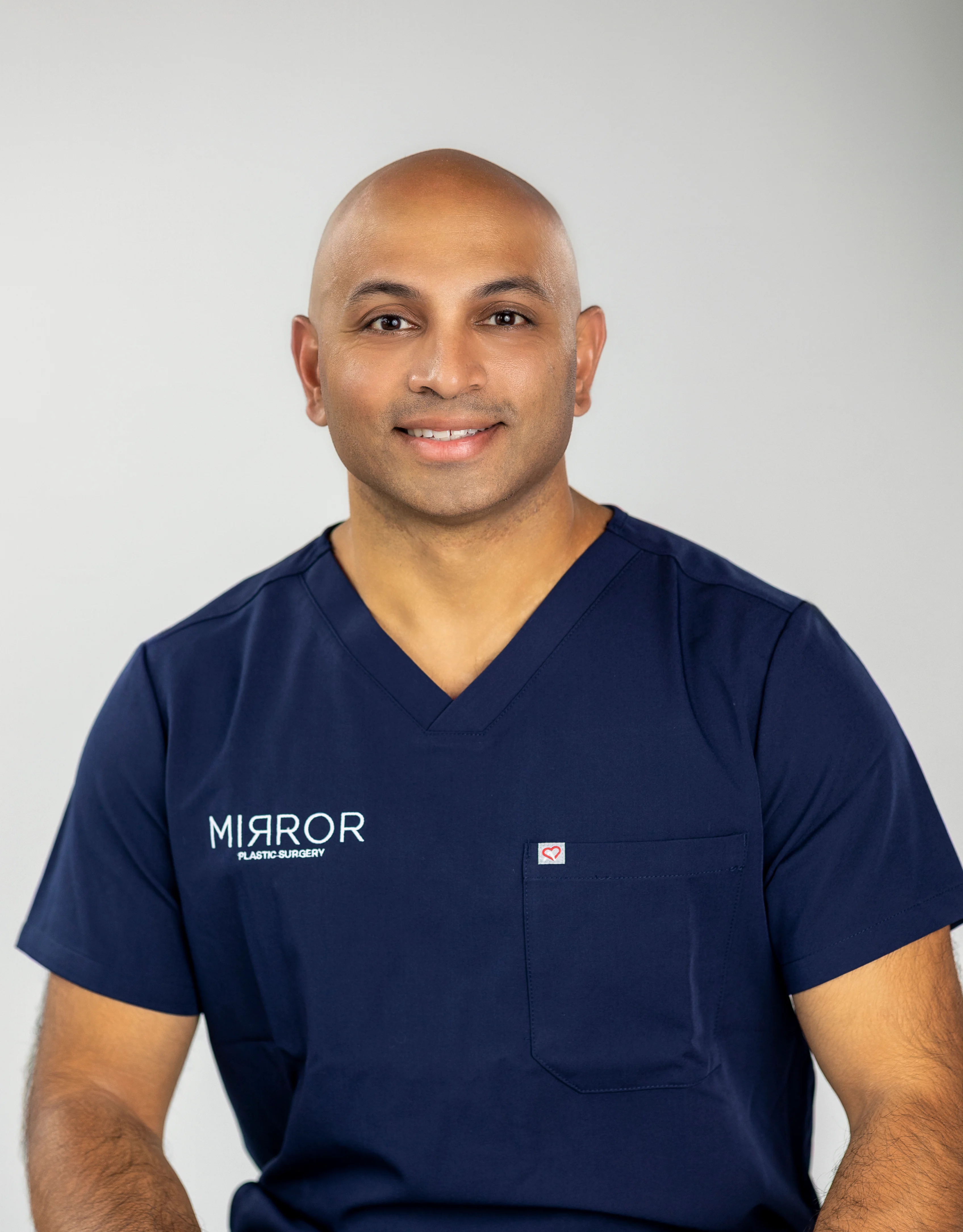
Written by: Dr. Akash Chandawarkar, Board Certified Plastic Surgeon, Mirror Plastic Surgery | Last updated: September 9, 2026
Key Takeaways
- Dermal fillers stay very safe in the hands of a qualified, board-certified professional using FDA-approved products. Serious complications occur in less than 0.3% of cases.1
- Provider expertise is the most critical safety factor. Board-certified plastic surgeons with deep anatomical knowledge greatly reduce risks like vascular occlusion and blindness.
- The “filler fatigue” trend usually comes from over-treatment and poor technique rather than the products. Conservative, holistic planning prevents this.
- Safe provider selection means confirming board certification, emergency protocols, FDA-approved products, and a focus on natural results instead of aggressive volume.
- At Mirror Plastic Surgery, Dr. Akash Chandawarkar personally performs every injection with surgical-level anatomical expertise. Book a consultation to experience this standard of safety and care.
What Current Research Shows About Filler Safety
Serious complications from dermal fillers remain rare. A 2026 systematic review in Aesthetic Plastic Surgery reported intra-arterial injection with necrosis in only 0.1–0.3% of procedures, most often in the lip, forehead, and nasolabial fold. A JAMA Dermatology retrospective cohort study of more than 1.1 million needle syringes found vascular occlusion in about 1 in 6,410 syringe injections. That rate dropped by 77.1% when cannulas replaced needles.1
Filler-induced blindness is catastrophic but extremely rare. A 2026 Journal of Clinical Medicine review estimated the risk at about 1 in 100,000 injections1, with 511 documented cases worldwide through March 2023. These events cluster in high-risk zones such as the glabella, nasal dorsum, and forehead, where vessels connect directly to the ophthalmic circulation. A surgeon’s command of facial vascular anatomy forms the main defense against these outcomes.
Common, non-serious side effects occur more often. Cross-sectional data in the 2026 Aesthetic Plastic Surgery review show:
- Swelling in 60.1% of patients1
- Nodules in 33.7% of patients1
- Pain in 22.6% of patients1
These effects usually resolve within days to weeks and respond well to proper aftercare.1 Complications occur most often in the cheeks (32%), lips (17.9%), and nasolabial folds (14.6%). Technique and product choice matter most in these areas.
As Dr. Akash explains: “As a board-certified plastic surgeon, I understand facial anatomy at a surgical level before ever picking up a syringe. That depth of knowledge is what separates a safe outcome from a preventable complication.”
Why “Filler Fatigue” Is Everywhere
“Filler fatigue” reflects a shift away from overfilled, unnatural results and now shapes how many people think about injectables. The 2026 Aesthetic Plastic Surgery review describes “facial overfilled syndrome” (FOS) as a complication of excessive filler use. It can appear as “flower horn” foreheads, “sunset” eyes, “chipmunk” cheeks, “witch” chins, and “pillow” faces, most often in the lips, nasal dorsum, and malar area.
A 2026 narrative review by Alizadeh et al. in Plastic and Reconstructive Surgery Global Open links facial overfill syndrome to inadequate anatomical knowledge, suboptimal technique, and poor patient selection or counseling. The authors describe “perception drift”, where repeated injections slowly shift a patient’s sense of what looks normal, leading to unnecessary treatment.
The rise in filler dissolving also changed how experts talk about reversal. A 2026 Aesthetic Surgery Journal article by Steven Harris and Steven Weiner argues that hyaluronidase more accurately “modifies” a complex filler–tissue system instead of simply “dissolving” filler. This framing helps patients understand realistic outcomes.
Dr. Akash sees most dissolving cases as the result of over-treatment, poor technique, or poor patient selection. A conservative, balanced plan usually prevents the need for reversal. His first priority is revitalizing a patient’s inherent facial characteristics. He considers volume augmentation only after this foundation looks balanced, which helps maintain smooth transitions and avoids the asymmetry that drives filler fatigue.
How To Choose a Safer Filler Provider
Provider selection has the greatest impact on filler safety. A 2026 systematic review reported that over half of PRP-associated blindness cases involved non-physicians or inadequately trained practitioners, including cosmetologists, aesthetic practitioners, and an unlicensed provider. Credentials protect patients.
Look for these qualifications when you evaluate a provider:
- Board certification in plastic surgery or dermatology from a recognized body such as the American Board of Plastic Surgery
- Extensive, documented experience with injectables across multiple facial zones
- Clear understanding of facial vascular anatomy and high-risk territories
- Emergency protocols with hyaluronidase on site for HA filler complications
- Exclusive use of FDA-approved products
Ask these questions during your consultation:
- “What is your experience managing complications like vascular occlusion?”
- “Do you keep hyaluronidase on site and follow an emergency protocol for suspected occlusion?”
- “Which products do you use, and why are they right for my anatomy?”
- “How do you decide how much filler my face needs?”
At Mirror Plastic Surgery, Dr. Akash personally performs every injection and applies a board-certified plastic surgeon’s understanding of subdermal anatomy to each treatment. He serves on advisory boards for Merz Aesthetics (Radiesse) and Tiger Aesthetics, which keeps him current on injectable advances. Injections are never delegated to less-trained staff.
Book a consultation to have a board-certified plastic surgeon assess your anatomy and goals before any treatment.
Under-Eye Fillers And Safety
Under-eye fillers demand a higher level of technical skill than most other areas. The infraorbital region has very thin skin, a delicate vascular network, and close proximity to the orbital circulation. This combination makes the area unforgiving when technique is imprecise. Lumps, the Tyndall effect (bluish discoloration from superficial filler), and bruising occur more often here with inexperienced injectors.
Restylane Eyelight received FDA approval in 2024 specifically for the tear trough. This approval reflects the unique demands of the under-eye region and the need for purpose-designed products. It also shows that not all HA fillers work interchangeably across the face.
Choosing an injector with focused periorbital expertise is essential for this treatment. Dr. Akash’s surgical background includes detailed orbital anatomy training that most general injectors do not have. Under-eye treatments at Mirror Plastic Surgery rank among the safest options in the St. Petersburg and Tampa Bay area.
Long-Term Effects Of Years Of Fillers
Long-term planning for fillers helps maintain natural results over time. Hyaluronic acid fillers usually show clinical effects for 4–18 months1, depending on product, technique, and patient factors. Lip treatments sit on the shorter end, while cheek and jawline contouring last longer. Biostimulatory fillers like Radiesse stimulate collagen and can last 12–18 months1. Sculptra’s collagen-stimulating effects may persist beyond 2 years1.
Patients who stop treatment gradually absorb HA fillers through normal metabolism. A 2026 MRI study detected HA gel for at least 2 years in some patients, with one case showing findings up to 15 years1. The authors note that long-standing MRI signals likely reflect bound water and new collagen rather than intact gel.
Patients who receive isolated, high-volume injections in single areas face the greatest risk of cumulative over-treatment. Dr. Akash treats the face as a unified system instead of a set of separate problems. Each session builds toward a coherent, natural result and avoids the imbalance that fuels filler fatigue.
How A Surgeon Avoids The Overfilled Look
Preventing an overfilled look starts with a provider who resists pressure to add more product. The 2026 review by Alizadeh et al. describes “perception drift” as a cycle where repeated injections slowly push patients toward exaggerated features. A provider who recognizes this pattern and sets limits protects both safety and aesthetics.
These principles help avoid over-treatment:
- Start conservatively and reassess before adding volume
- Choose a provider who prioritizes facial harmony instead of isolated spot fixes
- Avoid “one-size-fits-all” filler packages
- Remember that natural results come from restraint, not maximal volume
Dr. Akash follows a clear order: safety first, function second, aesthetics third. He begins by restoring inherent facial characteristics, then considers added volume only after the foundation looks balanced. This approach maintains smooth transitions between upper, middle, and lower face and prevents the “overdone” look that comes from isolated, high-volume injections.
Mirror Plastic Surgery also stays supplier-neutral. Dr. Akash selects products based on each patient’s anatomy and goals rather than quotas or commissions. This structure further protects patients from unnecessary treatment.
Frequently Asked Questions
Are Dermal Fillers FDA-Approved?
Dermal fillers fall under FDA regulation as Class III medical devices and gain approval through the Premarket Approval pathway. As of 2026, about 24 marketed FDA-approved filler products exist across 8 brand families, including Juvéderm, Restylane, RHA, Radiesse, Sculptra, Bellafill, Belotero, and Evolysse. Each product must show safety and effectiveness for specific uses. Recent approvals include Restylane Contour for temple hollowing (March 2026), SKINVIVE by Juvéderm for horizontal neck lines (June 2026), and Radiesse for the decolletage (April 2026). The FDA has not approved injectable silicone, needle-free injection devices, or any fillers for general body contouring, so patients should avoid providers offering these options.
Can Dermal Fillers Cause Blindness?
Filler-induced blindness remains extremely rare but represents the most serious potential complication. A 2025 American Academy of Ophthalmology assessment identified 198 patients with vision loss from cosmetic filler emboli, with 83% linked to hyaluronic acid fillers. Risk peaks in the glabella, nasal region, and forehead, where vessels connect directly to the ophthalmic circulation. Final visual acuity was no light perception in about 70% of affected eyes, and no treatment reliably restores vision once occlusion occurs. Choosing an injector with deep anatomical knowledge, ideally a board-certified plastic surgeon, greatly reduces this risk through careful technique, product selection, and avoidance of high-risk injections by unqualified providers.
How Long Do Dermal Fillers Last?
Filler longevity depends on product type and treatment area. Hyaluronic acid fillers usually last 6–18 months1, with lips on the shorter end and cheeks or jawline lasting longer. Biostimulatory fillers like Radiesse last about 12–18 months, while Sculptra’s collagen-stimulating effects may continue beyond 2 years across a series of sessions.1 Bellafill, a permanent filler, lasts 5 years or more and cannot be reversed1. These figures come from clinical experience rather than official FDA durations. Individual results vary based on product, depth, area, and metabolism. A long-term plan with your provider offers the most reliable path to steady, natural results.
Can Fillers Be Dissolved If I Do Not Like Them?
Hyaluronic acid fillers can be dissolved with hyaluronidase, an enzyme that breaks down HA by cleaving glycosidic bonds. Visible changes usually appear within 24–48 hours, with full effect assessed at about 2 weeks1. For vascular occlusion emergencies, high-dose hyaluronidase must be given immediately, often within hours, and may be repeated every 60–90 minutes until blood flow returns. Non-HA fillers such as Radiesse, Sculptra, and Bellafill do not respond to hyaluronidase and have no direct reversal agent. Careful patient selection and conservative dosing matter greatly with these products. Many first-time patients choose a reversible HA filler as the most cautious starting point.
How Do I Choose A Safe Filler Provider?
Safe filler treatment starts with a board-certified plastic surgeon or dermatologist who has extensive injectable experience and clear emergency protocols with hyaluronidase on site. Ask about their experience managing vascular occlusion, their philosophy on natural results, and their commitment to FDA-approved products. A provider who spends real time understanding your anatomy and goals, instead of rushing through a high-volume schedule, signals a safer practice. Be cautious with aggressive package pricing, pressure to use high volumes, or routine delegation of injections to non-physician staff. Investing in a board-certified plastic surgeon who personally performs every injection remains the most reliable way to reduce risk and improve outcomes.
The Bottom Line On Dermal Filler Safety
Dermal fillers remain safe when a qualified provider uses FDA-approved products and evidence-based technique. Serious complications stay rare, and the main drivers of irreversible injury include anatomic injection site, poor technique, and permanent fillers. The “filler fatigue” trend reflects over-treatment and under-qualified injectors rather than an inherent danger in fillers.
Provider expertise shapes both safety and results. A board-certified plastic surgeon who personally performs every injection, maintains emergency protocols, uses only FDA-approved products, and follows a conservative, holistic plan offers one of the highest standards of care in aesthetic medicine.
Dr. Akash Chandawarkar is welcoming new patients at Mirror Plastic Surgery in St. Petersburg, FL. Call or text 727-361-6515, or email hello@mirrorplasticsurgery.com to get started.
Book Your Consultation
Safety and satisfaction guide every decision at Mirror Plastic Surgery. Dr. Akash personally performs every injection and applies a board-certified plastic surgeon’s understanding of facial and subdermal anatomy to your treatment. Consultations last up to an hour so he can understand your anatomy, goals, and concerns without rushing.
You will not encounter upselling, quota-driven product recommendations, or pressure. You receive honest, evidence-based guidance from one of the region’s most credentialed aesthetic physicians.
Book a consultation today and take the first step toward natural, confident results on your terms, at your pace, with your safety always first.
Disclaimer: Results may vary from person to person. Editorial content, before and after images, and patient testimonials do not constitute a guarantee of specific results.
1 Results may vary from person to person. Editorial content, before and after images, and patient testimonials do not constitute a guarantee of specific results.