

Written by: Dr. Akash Chandawarkar, Board Certified Plastic Surgeon, Mirror Plastic Surgery | Last updated: September 9, 2026
Key Takeaways
- Physician supervision by a board-certified plastic surgeon greatly improves injectable safety and lowers complication rates compared to non-physician providers.1
- Always verify the medical director’s credentials, including active state licensure, ABPS board certification, and genuine on-site involvement.
- Confirm exactly who will perform your injection, and choose practices where the most qualified clinician personally administers treatment.
- Ask clear safety questions about emergency protocols, FDA-approved product sourcing, and reversal agent availability before you book.
- Choose physician-led care at schedule your consultation with Mirror Plastic Surgery to experience physician-level safety, expertise, and personalized injectable care.
In this guide, you will walk through the essential steps to choose safe injectable treatments, from verifying credentials to evaluating real emergency preparedness.
Step 1: Why Physician Supervision Matters For Safe Injectables
Botox and dermal fillers are medical treatments, not spa services. The FDA classifies botulinum toxin products as biologics requiring Biologics License Application approval, and dermal fillers as Class III medical devices requiring Premarket Approval, the highest-risk device category. Only licensed practitioners may administer these prescription products.
The anatomical expertise gap between physician and non-physician injectors has real consequences. A board-certified plastic surgeon understands facial layers, blood vessel paths, and muscle structure at a surgical level. That depth of knowledge directly reduces risks such as vascular occlusion, asymmetry, and unnatural results.1 The data supports this. Non-dermatology providers accounted for 51% of reported complications in the CAPER Registry analysis despite performing only 38% of procedures. A separate systematic review found that complication rates increase to 2.1% when non-physician injectors perform procedures, compared to 0.3% under experienced physicians using FDA-approved products, a sevenfold difference.1
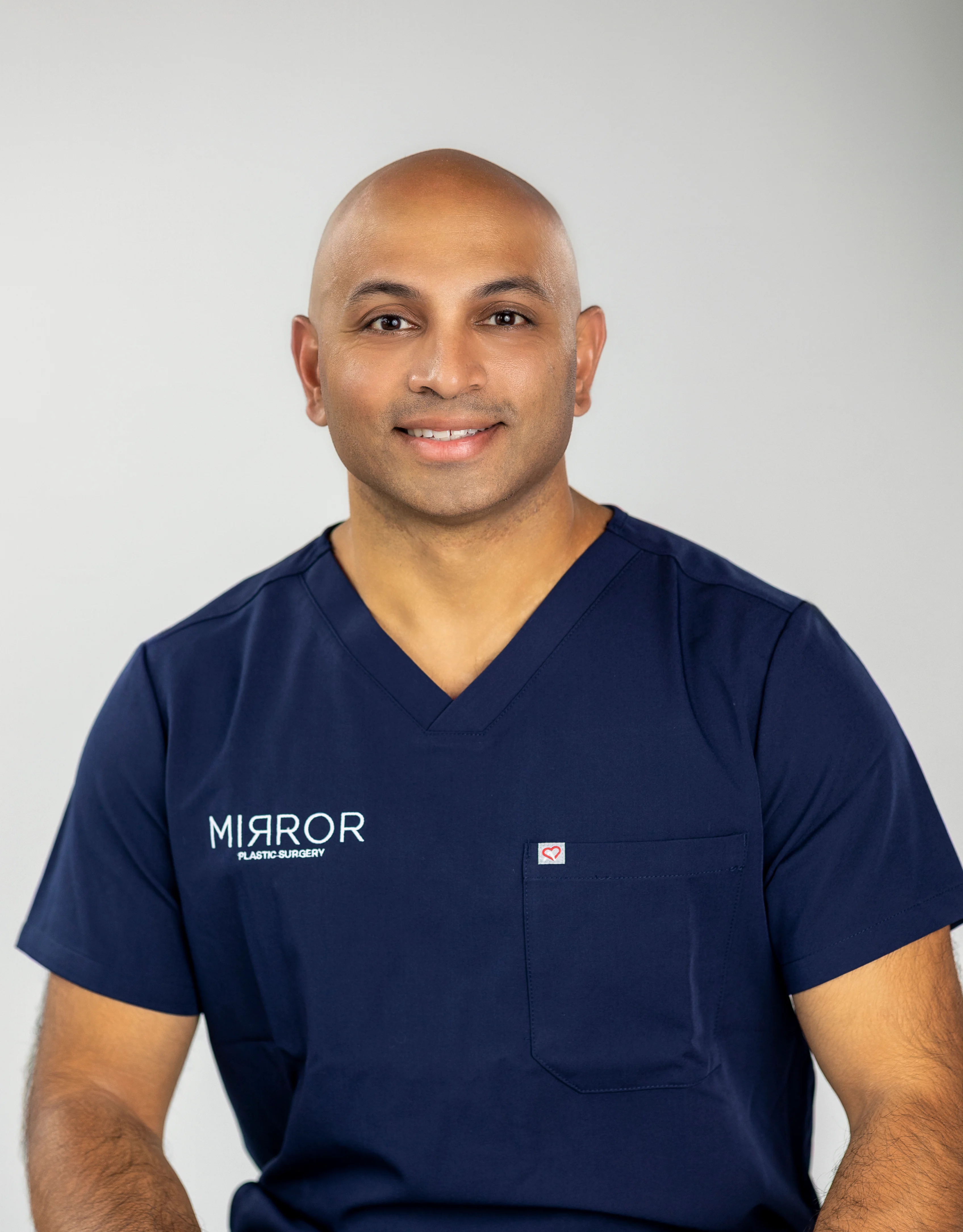
At Mirror Plastic Surgery, board-certified plastic surgeon Dr. Akash personally performs all injections and applies surgical-level anatomical knowledge to every treatment.
Step 2: Verify The Medical Director’s Credentials With A Simple Checklist
Before booking any injectable treatment, verify the supervising physician’s credentials through these concrete steps:
- Check state medical board licenses. Search your state’s medical board website to confirm the physician holds an active, unrestricted license. In Florida, the medical director must be a Florida-licensed MD or DO in good standing with the Florida Board of Medicine.
- Confirm board certification. Look for certification from the American Board of Plastic Surgery and verify it using the ABPS “Verify Certification” tool. The ABPS requires completion of an accredited plastic surgery residency and passing rigorous written and oral examinations.
- Determine actual involvement. Ask whether the physician is on-site during treatments or functions only as a figurehead. In New York, an absentee medical director who lends a signature without visiting or reviewing charts is a “textbook adverse finding” that can trigger disciplinary action. Hold every practice to the same expectation of genuine involvement.
- Understand Florida’s specific requirements. Florida requires all medical treatments to occur under the supervision of a qualified medical director. The state’s high med spa concentration makes careful verification especially important for Tampa Bay area patients.
Mirror Plastic Surgery meets these standards, with an ABPS board-certified plastic surgeon who actively injects and remains directly involved in patient care.
Step 3: Confirm Who Will Actually Perform Your Injection
Physician supervision and the identity of your injector are separate issues. Even in a physician-supervised practice, the person holding the syringe determines your outcome. A plastic surgeon who performs injections daily brings surgical precision to every placement. No level of delegation can fully match that combination of training and experience.
The American Academy of Dermatology Association advises that Botox should only be performed in a medical office by board-certified dermatologists or appropriately trained non-physician clinicians under direct on-site supervision. Safety at a medical spa depends on genuine physician leadership and a highly qualified injector. Surveyed dermatologic surgeons reported that between 61% and 100% of the complications they treated originated at med spas. That statistic highlights why you must know exactly who will treat you.
At Mirror Plastic Surgery, you see the surgeon you researched. Dr. Akash performs every injectable treatment himself rather than delegating injections to less-qualified staff.
Step 4: Ask These 7 Questions Before Booking Any Injectable Treatment
These questions give you a clear framework to evaluate any med spa or injectable provider before you commit to treatment:
- Who will actually perform my injection? Confirm that you will not meet the physician once and then be handed off to an underqualified injector.
- What are your credentials and board certifications? Verify the physician’s training and specialty expertise. For plastic surgeons, look for ABPS certification.
- How do you handle complications? Make sure emergency protocols exist, including reversal agents on-site. Board-certified physicians stock reversal agents like hyaluronidase for filler emergencies, while many med spas do not.
- Are your products FDA-approved and sourced directly from manufacturers? Protect yourself from counterfeit products. Counterfeit hyaluronic acid fillers have shown contamination rates exceeding 40% in documented investigations.
- Can you show me before-and-after photos of your work? Review real results to assess the injector’s aesthetic judgment and experience with goals similar to yours.
- How much experience do you have with this specific treatment? Confirm focused expertise with the exact injectable you are considering, not just general familiarity.
- What is your emergency protocol if something goes wrong? Ensure the practice prepares for rare but serious complications such as vascular occlusion. Vascular occlusion occurs in roughly three of every thousand filler injections, and globally more than 200 cases of filler-related blindness are documented.
At Mirror Plastic Surgery, these questions are encouraged and answered clearly during every consultation, with direct input from the treating surgeon.
Schedule your consultation and bring your questions so Dr. Akash can address each one in detail.
Step 5: Recognize The Red Flags That Signal An Unsafe Med Spa
Certain warning signs appear again and again in practices where patient safety suffers. Treat these patterns as serious caution signals:
- No physician present or available during your appointment
- Inability or unwillingness to verify credentials on request
- Pushy sales tactics or pressure to book immediately
- Discounted “Botox parties” or group injection events without individualized exams
- Suspiciously inexpensive products or no proof of FDA-approved sourcing
- Reluctance to discuss risks, complications, or emergency protocols
- Rushed consultations with no time for a thorough anatomical assessment
Complications from injectables performed by non-physicians rose sharply between 2012 and 2020, and lawsuits involving non-physician procedures more than doubled in the period studied. These red flags are not theoretical. They reflect real patient harm in settings that prioritized volume over vigilance.
In contrast, Mirror Plastic Surgery follows a different model. The practice offers hour-long consultations, concierge-level access, and a safety-first philosophy that limits the schedule to one or two procedures per day so each patient receives undivided attention.
Step 6: What To Expect During A Safe, Physician-Led Consultation
A thorough consultation at a physician-led practice feels very different from a high-volume intake visit. At minimum, it should include a top-to-bottom assessment of your facial anatomy, a review of your medical history and any contraindications, and a clear explanation of treatment options. From there, the physician should create a personalized treatment plan tailored to your anatomy and goals.
The physician should educate you, not upsell you. Dr. Akash’s philosophy places safety first, function second, and aesthetics third. His transparency sometimes means telling a patient that an expensive service is not yet necessary, which builds long-term trust instead of short-term revenue. His initial focus stays on restoring inherent facial characteristics before considering volume augmentation. This approach prevents the “overdone” appearance that often results from isolated, single-area injections.1
Consultations at Mirror Plastic Surgery can last up to an hour. That time allows for genuine understanding, detailed planning, and trust-building that rushed practices cannot match.
Step 7: How Physician-Led Practices Prepare For And Manage Complications
Emergency preparedness creates one of the clearest differences between physician-led and non-physician-led practices. A board-certified plastic surgeon is trained to recognize and manage complications that a less-qualified provider might miss entirely.
The FDA has confirmed that vision loss from filler can be permanent, and recovery requires immediate recognition and rapid treatment. Physician-led practices stock reversal agents and maintain written emergency protocols because their training prepares them to act when seconds matter. Before any treatment, ask directly, “Do you have reversal agents on site?” and “What is your step-by-step emergency protocol?” A practice that cannot answer clearly is not adequately prepared.
Choosing a board-certified plastic surgeon reduces risk and ensures that, if a complication occurs, you have someone with the training, resources, and judgment to respond appropriately.
Conclusion: Your Safety Is In Your Hands, So Choose Deliberately
By following the steps in this guide, you gain a clear framework to evaluate any injectable provider. You now know how to verify physician credentials, confirm who will inject you, ask targeted safety questions, spot red flags, and recognize a truly thorough consultation.
In the St. Petersburg and Tampa Bay area, Mirror Plastic Surgery under Dr. Akash Chandawarkar reflects these standards in daily practice. He combines ABPS board certification, Harvard and Johns Hopkins training, and a concierge approach that keeps safety and honest guidance at the center of every injectable plan.
If you feel ready to experience physician-led injectable care, start your journey with a consultation at Mirror Plastic Surgery. Visit 780 4th Ave S, St. Petersburg, FL 33701, call 727-361-6515, or email hello@mirrorplasticsurgery.com.
Frequently Asked Questions
Here are answers to common questions about injectable safety and choosing a physician-led provider.
What Is The Difference Between A Physician-Led Med Spa And A Standard Med Spa?
A physician-led med spa features a board-certified physician, ideally a plastic surgeon or dermatologist, who actively participates in patient care rather than serving as a name on paper. In a genuinely physician-led practice, the physician performs or directly supervises every injectable treatment. They also conduct thorough pre-treatment assessments, maintain emergency protocols, and remain physically present during procedures.
A standard med spa may employ a medical director who rarely or never visits the clinic and delegates all treatments to nurses, aestheticians, or other non-physician staff with varied training. This distinction matters because injectables are medical procedures that require prescription authorization and detailed anatomical knowledge.
Is It Safe To Get Botox Or Fillers At A Medical Spa?
Safety at a medical spa depends on who performs the injections and what oversight exists. Botox and dermal fillers are FDA-regulated prescription products, with botulinum toxins classified as biologics and fillers as Class III medical devices. Safe administration requires both clinical authorization and deep anatomical understanding.
When a board-certified physician personally performs injections in a properly supervised setting that uses FDA-approved products, maintains emergency protocols, and stocks reversal agents, the risk profile stays low.1 When underqualified providers perform treatments in high-volume settings without strong physician oversight, complication rates rise significantly.1 Use the questions in this guide, especially about your injector and emergency protocols, to assess safety before you book.
What Credentials Should I Look For In An Injectable Provider?
The highest credential for a plastic surgeon performing injectables is board certification from the American Board of Plastic Surgery (ABPS). This certification requires completion of an accredited plastic surgery residency and passing rigorous written and oral examinations. You can verify any surgeon’s certification status using the ABPS public verification tool at abplasticsurgery.org.
Beyond board certification, look for fellowship training in aesthetic surgery, active state licensure in good standing, and a consistent record of personally performing injectable treatments. Additional signs of quality include membership in professional societies, advisory roles with product manufacturers, and a practice philosophy that emphasizes safety and honest communication over volume and aggressive upselling.
What Are The Most Important Red Flags To Avoid When Choosing A Med Spa For Injectables?
Major red flags include the absence of a physician on-site during treatments, an inability to verify the medical director’s credentials or board certification, reluctance to discuss risks or emergency protocols, and pressure to book immediately or purchase packages without a real consultation. Discounted “Botox parties” or group injection events raise concern because they rarely include individualized good-faith examinations.
Suspiciously low pricing can signal counterfeit or improperly stored products, which carry additional safety risks. A rushed consultation that skips a full anatomical assessment and honest discussion of your goals and medical history also suggests that the practice values throughput over patient safety.
How Does Florida Regulate Medical Spas And Injectable Treatments?
Florida has the highest concentration of medical spas in the country and uses a complaint-driven enforcement model through the Board of Medicine. State law requires all medical treatments at a med spa to occur under the supervision of a qualified medical director who must be a Florida-licensed MD or DO in good standing.
Injectable treatments count as medical acts in Florida, so a licensed practitioner within their authorized scope must perform them, such as an ARNP under a written collaborative agreement or a physician directly. Florida does not allow nurse practitioner-owned med spas to operate independently of a physician. Non-physician-owned facilities must obtain a Health Care Clinic License from the Agency for Health Care Administration and appoint a qualified medical director.
For patients in the St. Petersburg and Tampa Bay area, this framework makes verification essential. Always confirm your provider’s credentials and the practice’s compliance with Florida’s medical director requirements before any injectable treatment.
Disclaimer: Results may vary from person to person. Editorial content, before and after images, and patient testimonials do not constitute a guarantee of specific results.
1 Results may vary from person to person. Editorial content, before and after images, and patient testimonials do not constitute a guarantee of specific results.


