
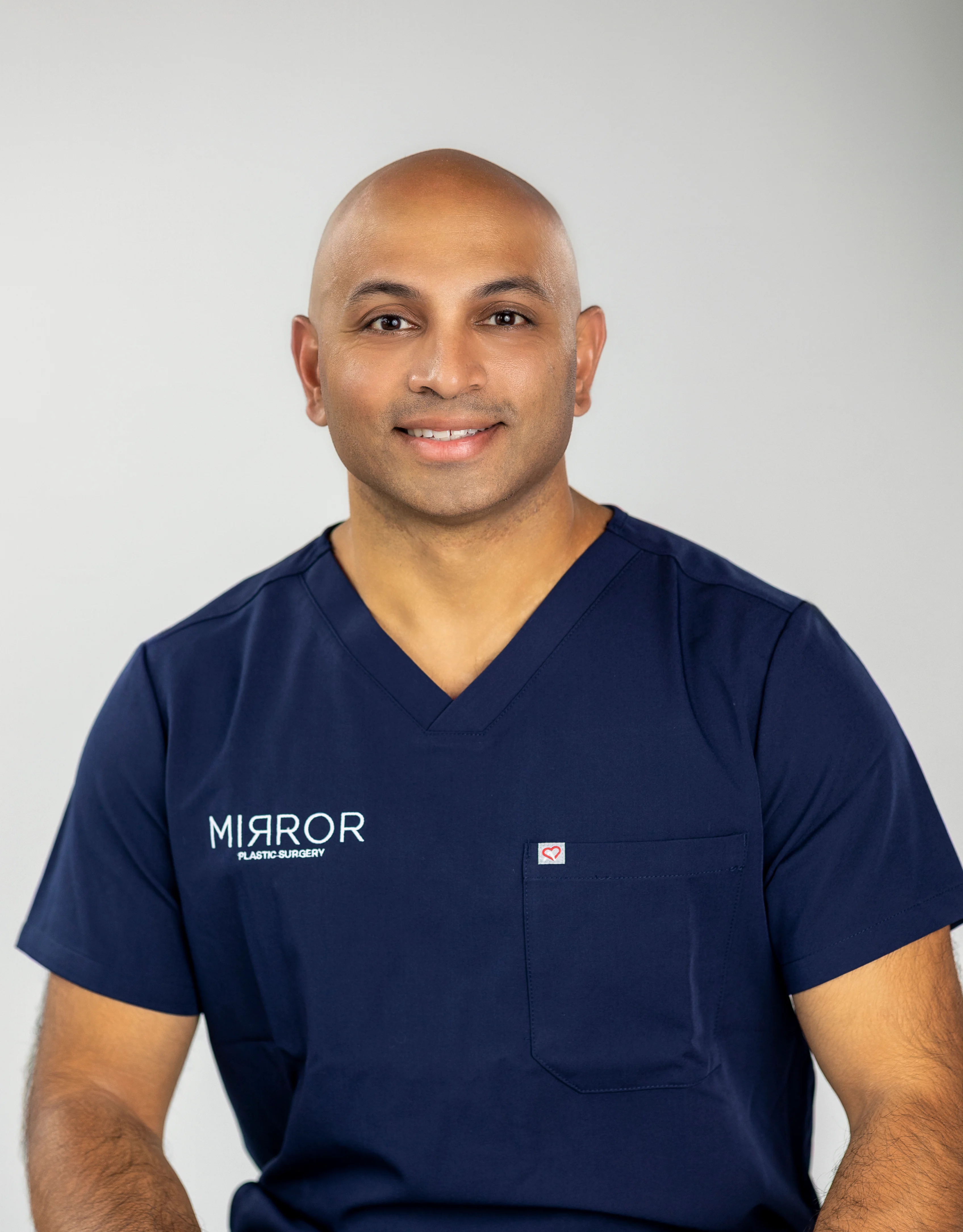
Written by: Dr. Akash Chandawarkar, Board Certified Plastic Surgeon, Mirror Plastic Surgery | Last updated: September 9, 2026
Key Takeaways
- Dermal fillers can improve skin texture over time through hydration, collagen stimulation, and dermal remodeling when performed correctly.1
- Biostimulatory fillers like Radiesse promote collagen production and dermal thickening, while hyaluronic acid (HA) fillers enhance hydration and smoothness.1
- Negative texture changes such as lumps, fibrosis, or an overfilled look usually relate to poor technique, excessive volume, or mismatched product choice.
- HA fillers are temporary and biodegradable, and skin returns to baseline when treatment stops. Conservative volumes and regular assessment help prevent long-term accumulation.
How Fillers Improve Skin Texture Over Time
Hyaluronic Acid Fillers: Hydration And Collagen Support
A 2026 review by Hong et al. in the Journal of Cosmetic Dermatology shows that intradermal cross-linked HA injections improve skin texture, reduce roughness, and increase dermal thickness by about 4%.1 Each HA molecule binds up to 218 water molecules and can expand 500–1,000 times. This expansion elongates fibroblasts and activates TGF-β-related signaling. That signaling increases type I collagen synthesis and reduces collagen breakdown through upregulation of tissue inhibitor of metalloproteinases (TIMP) genes.
A 2026 narrative review by Marchetti et al. in Gels confirms that in vivo human studies of cross-linked HA show fibroblast spreading, increased type I procollagen expression, and more organized collagen in aged and photoaged skin. These findings support a biologic basis for gradual skin-quality improvement that extends beyond simple volume replacement. The review notes that restoring the external scaffold with fillers activates a large pool of quiescent, viable fibroblasts, making the mechanobiologic model clinically meaningful even though it does not fully reverse cellular aging.
Biostimulatory Fillers: Calcium Hydroxylapatite And Collagen Remodeling
Calcium hydroxylapatite (CaHA, Radiesse) improves texture through collagen remodeling rather than pure volume. A 2026 study by de Almeida et al. in the Journal of Cosmetic Dermatology found that hyperdiluted CaHA-CMC increased collagen area by 69.7% and dermal thickness by 36.05% at 45 days.1 CaHA microspheres activate fibroblasts via integrin-mediated mechanotransduction and YAP activation. This process drives synthesis of collagen types I and III, elastin, and new blood vessels.
When CaHA is hyperdiluted, its direct volumizing effect largely disappears. The main benefit becomes dermal extracellular matrix regeneration, which makes it a skin-quality treatment rather than a volumizer. Marchetti et al. report that evidence for CaHA is more heterogeneous than for cross-linked HA but consistently links CaHA to collagen remodeling, angiogenesis pathways, and altered growth-factor signaling.
Clinical Trial Evidence For Texture Improvement
A prospective multicenter trial by Cheng et al. (2026) in Clinical, Cosmetic and Investigational Dermatology followed 448 participants who received full-face intradermal non-cross-linked HA injections across three sessions. By day 84, about 87% of treated patients reached smooth-to-moderate roughness grades on the Allergan Skin Roughness Scale.1 In addition, 90.09% achieved moderate improvement or better on the Global Aesthetic Improvement Scale, compared with 9.57% in the control group.1 Skin hydration increased steadily and remained higher than control at every time point. Elasticity gains appeared with cumulative treatment, suggesting that biostimulatory effects build over time.
A 2026 prospective trial by Pino et al. in the Aesthetic Surgery Journal Open Forum followed 203 volunteers after a single injection of cross-linked HA (BtHCROSS). The study showed statistically significant improvements in skin smoothness, hydration, roughness, and surface irregularities that persisted through nine months.1 Specialists reported global aesthetic improvement in more than 88% of participants at 21 days and 92% at six months.1
Taken together, these studies show that filler type, dilution, and placement influence whether texture improves gradually and naturally. The next sections translate these findings into real-world risks and practical guidance.
Documented Risks Of Negative Texture Changes
Overfilling And Facial Overfilled Syndrome
A 2026 review by Alizadeh et al. in Plastic and Reconstructive Surgery Global Open defines facial overfilled syndrome (FOS), often called “pillow face,” as an undesirable outcome from overuse or inappropriate use of HA gels. Contributors include limited anatomical knowledge, poor injection technique, overfilling, and cumulative effects of prior treatments. The review also describes perception drift, in which repeated injections gradually shift a patient’s sense of their own baseline, encouraging unnecessary additional treatment and often influenced by social media.
Lumps, Nodules, And Fibrosis
A 2026 review by Sukmanskaya, Cotofana, and Alfertshofer in the Journal of Cosmetic Dermatology reports that histologically confirmed foreign-body granulomas from modern fillers are very rare, with an estimated incidence of about 0.02%–0.4% for delayed nodules. Not all delayed nodules represent true granulomas. Some reflect localized filler accumulation, fibrosis, or scar formation related to technique. On high-frequency ultrasound, filler deposits appear as well-defined anechoic pockets. Granulomas and fibrosis create a more heterogeneous, ill-defined signal, which helps with accurate diagnosis.
A 2026 systematic review in Aesthetic Intelligence found that clinically meaningful nodules, biofilm, and persistent inflammatory reactions occur in 0.5%–5% of HA filler treatments. Rates vary by product, injection plane, and operator skill. Late-onset nodules related to biofilm may appear weeks to years after treatment and often follow an infection or dental work.
Long-Term Filler Persistence And Accumulation
A 2026 cross-sectional MRI study by Issa et al. in Plastic and Reconstructive Surgery Global Open evaluated 14 patients and found that detectable HA filler volume averaged 2.8 times the amount initially injected. The mean injected volume was 3.32 mL, while MRI measured a mean of 12.26 mL, with filler visible up to 15 years later. The tear trough showed the greatest proportional increase in filler thickness, likely due to tight fibrovascular tissue and less subcutaneous fat. These findings highlight the value of conservative dosing and regular review to avoid accumulation and contour distortion.
What Happens When Fillers Wear Off
The 2026 review by Alizadeh et al. confirms that HA injectable gels are biodegradable and temporary, with clinical effects usually lasting 4–18 months. In vivo data show progressive resorption over one year and replacement by new functional tissue. Biopsy studies at injection sites demonstrate up to a 12-fold increase in type I procollagen gene expression and dense, well-organized collagen fibrils instead of the fragmented collagen typical of aged skin. This remodeling can maintain visible benefits even after the gel itself has broken down.
Stopping treatment does not speed up aging. Skin returns to its baseline state. The review separates clinical effect duration from apparent persistence on imaging. MRI captures injected HA, bound water, and new procollagen, so a lasting MRI signal does not equal intact product. Repeated extreme overfilling can stretch tissue and cause temporary laxity when the product dissolves. Conservative, anatomy-guided treatment avoids this problem.
Clinical Factors That Shape Texture Outcomes
The research highlights several practical variables that determine whether fillers refine or harm skin texture.
- Filler Type And Formulation: A 2026 clinical strategy paper by Feng et al. in the Journal of Cosmetic Dermatology groups HA fillers into contouring, volumization, smoothening, lifting, and revitalization categories. For skin-quality concerns, it recommends ultra-small particle, non-cross-linked, or diluted gel-type HA fillers for dermal revitalization, while standard fillers address structural volume.
- Placement Depth And Technique: The 2026 review by Margarella and Shin in the Journal of Cosmetic Dermatology stresses that product choice must match injection plane, function, G′, cohesivity, viscosity, swelling tendency, and vascular risk. No facial zone is universally safe. A structurally logical site may still carry vascular risk.
- Provider Expertise: The Aesthetic Intelligence review finds that operator training, regulatory oversight, and clinic protocols drive complication rates more than brand choice. Lower complication rates cluster in regulated, clinician-led practices with written complication protocols and clear escalation pathways.
- Individual Patient Factors: A 2026 review in the Aesthetic Surgery Journal Open Forum notes that postmenopausal reductions in neocollagenesis can affect biostimulatory filler responses. Personalized assessment and dosing remain essential.
Research Conclusions: Balancing Texture Benefits And Risks
The literature supports that carefully selected and precisely placed dermal fillers improve skin texture through hydration, collagen stimulation, and dermal remodeling.1 Alizadeh et al. highlight the biostimulatory properties of HA gels, which promote tissue restructuring through cellular proliferation and collagen deposition. These changes create sustained gains in elasticity and hydration without excessive, disorganized fibrotic tissue. Complications that harm texture, including overfilling, nodules, and fibrosis, stem from injector error, excessive volume, or poor product selection, not from the filler material itself.
A 2026 international consensus paper by Suwanchinda et al. in the Journal of Cosmetic Dermatology introduces the “Natural Outcomes Framework” for evaluating filler results across four domains: see (visual observation), touch (palpation), feel (patient feedback), and express (dynamic expression). The framework underscores that natural results depend on shared goals between patient and provider, ongoing injector training, and biomimetic product design.
Frequently Asked Questions
Do Fillers Make You Look Older Over Time?
Fillers do not accelerate aging when used appropriately. As discussed earlier, HA fillers are temporary, and skin returns to baseline after they metabolize. Biostimulatory fillers like Radiesse may leave behind improved collagen architecture that outlasts the product. Repeated extreme overfilling can stretch tissue and cause temporary laxity when the filler dissolves, and that risk relates directly to injector technique and volume choices.
What Happens To Fillers Years Later?
MRI research shows that HA filler can remain detectable for many years and that measured volume may exceed the amount originally injected. Imaging captures residual filler, bound water, and new collagen. These findings reinforce the need for conservative dosing and regular follow-up so that cumulative volume does not distort contours over time.
Can Fillers Cause Fibrosis Or Lumps?
Fillers can cause lumps or fibrosis, but these outcomes are uncommon and usually manageable. As noted earlier, granulomas are rare, and non-granulomatous nodules occur more often when technique or product choice is suboptimal. HA-related nodules and granulomas respond to hyaluronidase, intralesional corticosteroids, or, in resistant cases, intralesional 5-fluorouracil or surgery. CaHA-related nodules do not dissolve with hyaluronidase, so prevention, supportive care, and selective mechanical or surgical management become more important.
How Do Fillers Improve Skin Texture?
HA fillers hydrate the dermis, support fibroblast activity, and encourage more organized collagen. Biostimulatory fillers such as Radiesse activate fibroblasts through integrin-mediated mechanotransduction and YAP signaling. This activation increases collagen types I and III, elastin, and angiogenesis over time. HA provides immediate, reversible contour refinement, while biostimulators provide slower, collagen-driven remodeling. Many treatment plans combine both approaches.
Are There Long-Term Side Effects Of Dermal Fillers?
Most side effects, such as bruising, swelling, and temporary redness, occur in about 10%–35% of treatments and resolve within days to weeks. Serious complications, including vascular occlusion, occur in fewer than 0.1% of treatments. Late-onset nodules and granulomas appear in roughly 0.02%–5% of cases, depending on product and technique. Facial overfilled syndrome reflects repeated excessive treatment. Choosing a board-certified plastic surgeon with strong anatomical training, a conservative philosophy, and immediate access to hyaluronidase lowers these risks significantly.
Conclusion: Choosing Evidence-Based Care For Skin Texture
Current research shows that dermal fillers can meaningfully improve skin texture through hydration and collagen support when used thoughtfully.1 Outcomes depend on provider expertise, product selection, and a conservative, anatomy-guided plan that prioritizes long-term skin health.
Patients seeking safe, natural results should work with board-certified plastic surgeons or dermatologists who understand facial anatomy in depth and take time for thorough consultations. These clinicians align treatment with your goals while protecting skin quality over the long term.
Mirror Plastic Surgery in St. Petersburg embodies this standard. Dr. Akash Chandawarkar, a Harvard-educated, Johns Hopkins-trained, board-certified plastic surgeon, personally performs all injectable treatments. His guiding principle of safety first, function second, aesthetics third keeps every plan grounded in evidence and tailored to each patient’s anatomy. Dr. Chandawarkar serves on advisory boards for Merz Aesthetics and Tiger Aesthetics, which keeps his practice aligned with current injectable research. Mirror Plastic Surgery limits daily procedure volume so each patient receives focused, concierge-level care.
Schedule your personalized consultation with Ellie to explore how dermal fillers can enhance your skin texture safely and naturally at Mirror Plastic Surgery.
Disclaimer: Results may vary from person to person. Editorial content, before and after images, and patient testimonials do not constitute a guarantee of specific results.
1 Results may vary from person to person. Editorial content, before and after images, and patient testimonials do not constitute a guarantee of specific results.