
Written by: Dr. Akash Chandawarkar, Board Certified Plastic Surgeon, Mirror Plastic Surgery
Key Takeaways For Florida Juvéderm Patients
- Board certification for Juvéderm injectors in Florida carries real weight only when it comes from ABMS-recognized boards such as the American Board of Plastic Surgery (ABPS), American Board of Dermatology (ABD), or American Board of Facial Plastic and Reconstructive Surgery (ABFPRS).
- In Florida, physicians (MD/DO), nurse practitioners (ARNPs), and physician assistants (PAs) may legally inject Juvéderm, while estheticians may not perform any injections.
- Registered nurses may inject only under direct physician supervision with documented delegation, standing orders, and the physician physically present during the procedure.
- Patients can quickly verify an injector by confirming the exact certifying board, checking CertificationMatters.org, reviewing the Florida MQA license, asking about manufacturer training, and confirming that the practice maintains an on-site hyaluronidase protocol.
- Schedule a consultation at Mirror Plastic Surgery to speak directly with a board-certified plastic surgeon who personally performs every Juvéderm treatment and maintains full complication-readiness protocols.
What “Board Certified” Actually Means For A Juvéderm Injector In Florida
Board certification only has meaning when you know the board name. For Juvéderm injector qualifications in Florida, the most relevant certifying boards are the American Board of Plastic Surgery (ABPS), the American Board of Dermatology (ABD), and the American Board of Facial Plastic and Reconstructive Surgery (ABFPRS). Certificates from private “aesthetic medicine” boards do not carry equivalent legal or training weight.
ABPS and ABD are recognized by the American Board of Medical Specialties (ABMS). ABFPRS is a facial plastic surgery certification commonly paired with ABMS-certified otolaryngology training, but the evidence does not establish ABFPRS itself as ABMS-recognized. ABPS certification alone requires graduation from medical school, completion of an accredited six-or-more-year plastic surgery residency covering reconstruction, hand surgery, microsurgery, craniofacial surgery, and aesthetic surgery, plus passing both written and oral examinations.
These boards correspond to core residency pathways: plastic surgery (ABPS), dermatology (ABD), and otolaryngology with a facial plastic surgery fellowship (ABFPRS). “Board eligible” means a physician has completed residency but has not yet passed board examinations, which differs significantly from board certified when you evaluate an injector’s credentials.
Board certification tells you what training an injector has completed. It does not tell you whether they are legally permitted to inject in Florida, which depends on their license type.
Who Can Legally Inject Juvéderm In Florida?
Licensed Medical Professionals Who May Inject Juvéderm
In Florida, injectable neuromodulators and dermal fillers may be administered by physicians (MDs/DOs), nurse practitioners (ARNPs), and physician assistants (PAs). Some sources also describe registered nurses injecting under a physician order and direct supervision, so the exact categories depend on the source and the specific facts. Supervision and protocol requirements vary by provider type and practice setting, so each license category needs separate review.
Why Estheticians Cannot Inject Juvéderm In Florida
Estheticians in Florida are limited to surface skincare that does not pierce the skin, draw blood, or inject, and may never inject dermal fillers or neurotoxins under any circumstances. Their scope of practice covers topical treatments only, such as facials, exfoliation, and surface skincare. No amount of additional coursework changes this rule. A Florida Facial Specialist who wants to inject must first complete nursing school or another eligible clinical license.
RN And Nurse Injector Rules For Juvéderm In Florida
For RN injectors, Florida Board of Nursing guidance has required the physician to be physically present and visually observing the injection, and has not accepted an ARNP as a substitute supervisor. “Nurse injector” is not a protected title in Florida, and Florida registered nurses’ ability to inject filler is disputed across sources. Some state RNs cannot inject filler regardless of training, while others describe RNs injecting under a physician order, direct supervision, and documented delegation. Practices that have an RN “assist” a physician still cannot let the RN hold the syringe or make the injection decision.
The credential hierarchy for Juvéderm injectors in Florida is as follows.
- Physician injectors (MD/DO): May inject independently within their own scope of practice and may serve as medical director for other injectors. They complete the broadest anatomical training, typically six or more years of residency.
- Supervised advanced-practice injectors (APRN, PA-C): May inject under a written collaborative practice agreement with a supervising physician. The supervising physician need not be present during the injection but must be available for consultation.
- RN injectors: May inject only under the direct supervision of a Florida-licensed physician, with signed standing orders, a good-faith exam performed by the delegating physician, and documented delegation.
- Non-injectors (estheticians, medical assistants): Cannot legally inject Juvéderm in Florida under any circumstances.
The table below summarizes how each license type differs on three key variables: legal authority, supervision, and anatomical training.
| Credential Type | Legal Authority To Inject In Florida | Supervision Required | Anatomical Training |
|---|---|---|---|
| Physician (MD/DO) | Unrestricted | None | 6+ years residency |
| APRN/PA-C | Under protocol or collaborative agreement | Physician available | Graduate-level |
| RN | Under delegation only | Direct physician supervision, physically present | Post-licensure courses |
| Esthetician | None | N/A | Topical only |
How To Verify A Juvéderm Injector In Florida
Patients can verify a board certified injector in Florida with a simple five-step checklist before booking. These steps cover every layer of credential verification.
- Ask for the exact name of the certifying board. Ask which board certified the injector. A qualified injector will name ABPS, ABD, or ABFPRS without hesitation. Certification is specialty-specific, so you need the exact specialty rather than a generic phrase.
- Verify the board through the official ABMS database. Check CertificationMatters.org by entering the physician’s first name, last name, and specialty. CertificationMatters.org pulls data directly from ABMS board databases. If a physician claims ABMS certification but does not appear, they are not certified regardless of what their website states.
- Look up the provider’s Florida medical license. Use the Florida MQA License Verification portal. Each Florida MQA license record includes License Status, License Expiration Date, License Original Issue Date, Address of Record, and a Discipline on File field (Yes/No). This information allows patients to screen for past disciplinary history beyond a simple active-license check.
- Ask whether the injector has completed manufacturer training for Juvéderm. For certain Juvéderm products, the FDA has required Allergan Aesthetics to establish a mandatory provider training program, with purchase and administration contingent on successful completion. Ask whether the injector personally performs the injection or supervises another provider.
- Confirm the practice has a complication protocol. Ask whether hyaluronidase is available on-site and whether the injector has completed vascular occlusion training. Maintaining a stocked, current hyaluronidase emergency kit is the standard of care for any practice that injects hyaluronic acid fillers. A practice that cannot answer this question is not emergency-ready.
Review Dr. Akash’s credentials in person and see each of these verification steps applied to your own consultation.
Complication Readiness: The Credential No One Talks About
Hyaluronidase, the enzyme that dissolves hyaluronic acid fillers like Juvéderm, should be available on-site wherever Juvéderm is injected. A ten-year retrospective review of 1.7 million syringe injections estimated that vascular occlusion after hyaluronic acid filler injection occurs in roughly 1 in 5,000 injections. The FDA identifies unintentional injection of filler into a blood vessel as the most serious risk of dermal filler treatment, and other serious risks include infection, nodules, tissue death, blindness, and stroke. Recognizing and managing these events requires anatomical training and a written protocol.
Lower complication rates cluster in regulated, clinician-led settings that maintain written and rehearsed complication protocols, in-date hyaluronidase, defined escalation pathways, and longitudinal training. That pattern shows why complication readiness separates a genuinely qualified injector from a certificate-holder.
Management of hyaluronic acid filler vascular occlusion centers on immediate enzymatic degradation with hyaluronidase using a high-dose, pulsed approach guided by close clinical follow-up. A single vascular occlusion event with re-dosing could consume 20–40 vials, so a practice stocking only two or three is not emergency-ready.
Patients can reasonably ask about hyaluronidase availability and vascular occlusion protocols before booking. A practice that cannot answer clearly is not prepared for a known, foreseeable complication of a procedure it has chosen to offer.
Why Physician-Level Injectors Matter For Full-Face Juvéderm Planning
Juvéderm products are used across multiple facial regions: cheeks, lips, nasolabial folds, temples, and jawline. Each product has its own FDA-approved indication, and use outside approved areas is off-label. Planning placement across the upper, middle, and lower face requires a surgeon’s command of facial and subdermal anatomy.
Comprehensive dermal filler training covers vascular compromise, and vascular occlusion receives significant attention because it can cause tissue necrosis and vision loss. That training is most meaningful when it is built on formal anatomical education rather than a post-licensure course.
Isolated, single-area injections can create asymmetry or an “overdone” appearance. A full-face assessment conducted by a physician with residency-level anatomical training reduces that risk by treating the face as a unified structure rather than a collection of independent zones.
Dr. Akash Chandawarkar, MD, founder of Mirror Plastic Surgery, is board certified by the American Board of Plastic Surgery, Harvard-educated, and Johns Hopkins-trained. He completed aesthetic surgery fellowship training at Manhattan Eye, Ear & Throat Hospital/Lenox Hill Hospital and personally performs the practice’s injectable treatments. He serves on advisory boards for companies developing injectable products, including Merz Aesthetics. Every Juvéderm treatment at Mirror Plastic Surgery is performed by a physician with a surgeon’s command of facial and subdermal anatomy, which supports both safety and precision.
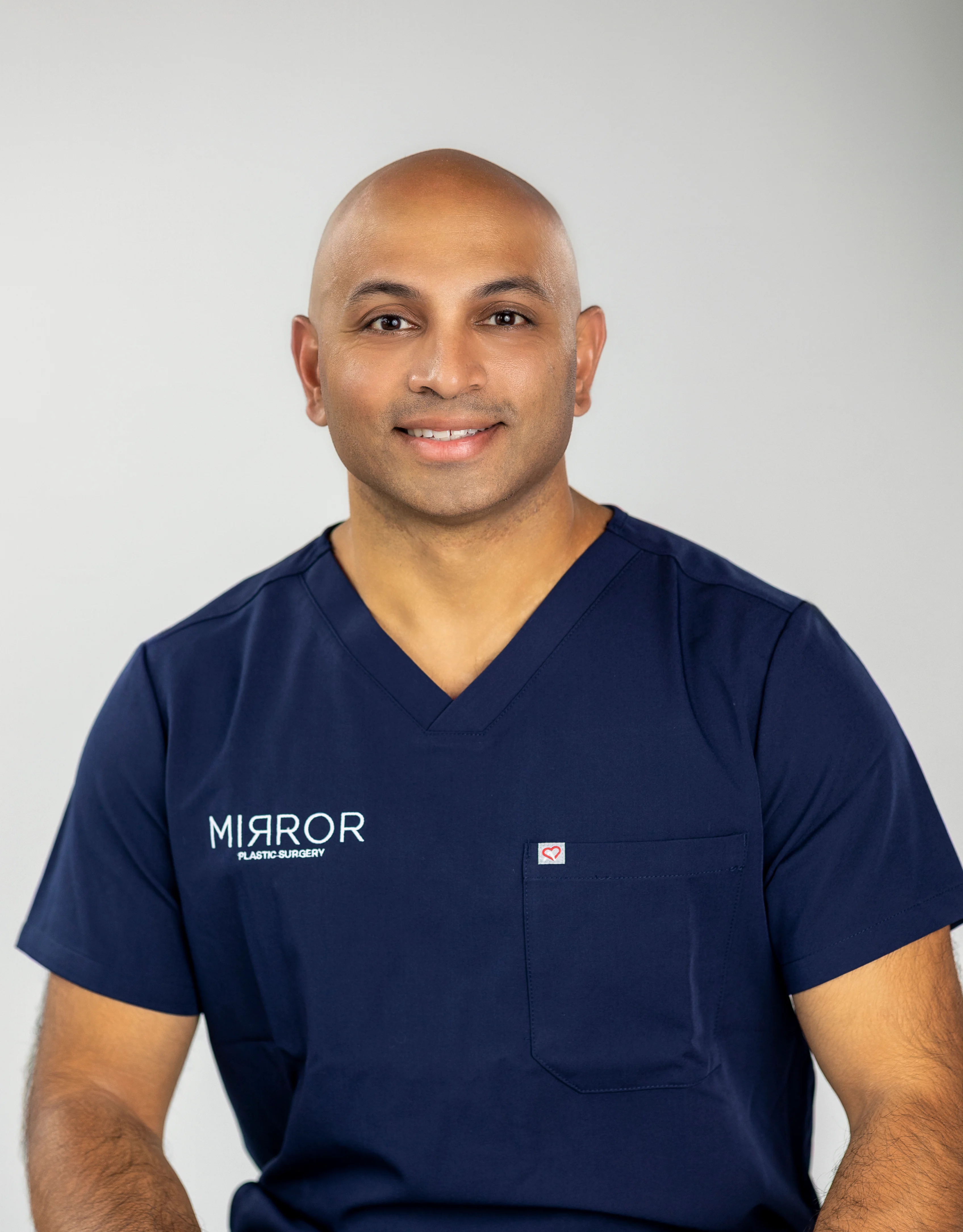
Schedule a full-face Juvéderm assessment with Dr. Akash to align treatment with your anatomy and goals.
What A Fully Credentialed Juvéderm Experience Looks Like At Mirror Plastic Surgery
The same verification checklist applies to any practice, including Mirror Plastic Surgery. A properly credentialed Juvéderm experience at this practice includes the following elements.
- An in-depth consultation that can extend up to an hour, covering the emotional drivers behind treatment and the patient’s long-term goals.
- A top-to-bottom facial assessment that evaluates the upper, middle, and lower face as a unified structure before any product is selected.
- Physician-performed injections, with Dr. Akash personally holding the syringe for every injectable treatment.
- Supplier-neutral product selection based on the patient’s anatomy rather than a quota or commission structure. Mirror Plastic Surgery works with multiple filler brands and selects the most appropriate product for each patient’s specific needs.
- Direct, honest communication about which treatments are appropriate, including the transparency to advise a patient that an expensive service is not yet warranted.
Mirror Plastic Surgery is located at 780 4th Ave S, St. Petersburg, FL 33701, and serves the St. Petersburg and Tampa Bay area. New patients can reach the practice by text or call at 727-361-6515 or by email at hello@mirrorplasticsurgery.com.
Apply this checklist at your own consultation by reviewing Dr. Akash’s ABPS board certification, his Florida medical license, and his on-site complication protocol.
Frequently Asked Questions
What Does Board Certified Mean For A Juvéderm Injector In Florida?
Board certified means the injector has completed residency training in a core specialty and passed examinations administered by an ABMS-recognized board such as the American Board of Plastic Surgery, American Board of Dermatology, or American Board of Facial Plastic and Reconstructive Surgery. Certificates from private aesthetic medicine organizations do not carry equivalent legal or training weight and are not recognized by the American Board of Medical Specialties.
Can A Licensed Esthetician Inject Juvéderm In Florida?
Estheticians in Florida are licensed for topical treatments only and cannot perform injections of any kind, including Juvéderm. Their scope of practice does not include piercing the skin or administering injectable products. This restriction applies regardless of any additional coursework or private certification an esthetician may have completed. An esthetician who injects in Florida is engaging in unlicensed practice of medicine.
Can An RN Inject Juvéderm In Florida?
A registered nurse may inject Juvéderm only under direct physician supervision with documented delegation and standing orders. Florida Board of Nursing guidance has required the supervising physician to be physically present and visually observing the injection. An ARNP cannot serve as a substitute supervisor for an RN performing filler injections. “Nurse injector” is not a protected title in Florida, and the legal ability to inject depends on the specific supervision structure in place rather than a course certificate or a medical director’s name on a protocol.
How Do I Verify A Juvéderm Injector’s Board Certification?
Ask for the exact name of the certifying board, then verify it through CertificationMatters.org, the official ABMS public verification database, by entering the physician’s name and specialty. A search returns whether the physician is board certified, the date of initial certification, and whether the certification is currently active. Also check the provider’s Florida medical license status, license type, expiration date, and disciplinary history through the Florida Department of Health MQA License Verification portal. Both searches use primary-source data that cannot be altered by the provider.
What Should I Ask Before Booking A Juvéderm Appointment?
Ask which board certified the injector and request the specific board name. Ask who will actually perform the injection, whether the consulting physician or a supervised provider. Ask what the complication protocol is and whether hyaluronidase is stocked on-site in adequate quantity. Ask how full-face placement will be planned rather than treating one area in isolation. Ask what the injector’s specific training and experience with Juvéderm products includes, including whether they have completed manufacturer training.
Conclusion: The Credential Is The Combination
The core verification steps are straightforward: name the board, check the Florida license, confirm who actually injects, and ask about complication readiness. Florida supervision rules also matter, because a named medical director without physical presence during injections may fall short of supervision requirements depending on the injector’s license type.
The real credential is the combination of ABMS-recognized board certification, direct product training, a full-face assessment approach, and a safety system that includes on-site hyaluronidase and a written, rehearsed vascular occlusion protocol. That combination is verifiable, and every patient pursuing Juvéderm in Florida has the tools to confirm it before booking.
Start your Juvéderm plan with a credential review at Mirror Plastic Surgery in St. Petersburg and discuss a full-face approach built on board-certified plastic surgery training.
Disclaimer: Results may vary from person to person. Editorial content, before and after images, and patient testimonials do not constitute a guarantee of specific results.