Written by: Dr. Akash Chandawarkar, Board Certified Plastic Surgeon, Mirror Plastic Surgery | Last updated: September 9, 2026
Key Takeaways
- The Brazilian butt lift has the highest mortality rate of any aesthetic surgery when fat enters the gluteal muscle, so strict safety protocols are essential.
- Florida’s 2023 law mandates ultrasound guidance, subcutaneous-only injection, and surgeon-performed liposuction and fat transfer, which dramatically reduce fatal pulmonary fat embolism risk.
- Board certification alone does not guarantee safety; 68% of documented South Florida BBL deaths involved ABPS-certified surgeons who did not follow modern technique.
- Mirror Plastic Surgery limits procedures to 1–2 cases daily, offers hour-long consultations, and ensures Dr. Akash personally performs every step with ultrasound guidance.
- Schedule your personalized consultation today to experience concierge-level care that puts your safety first.
How To Choose A BBL Surgeon: Your Safety Checklist
Florida has the strictest BBL safety regulations in the nation, and the data explain why. South Florida documented 25 fat embolism deaths between 2010 and 2022, with over 90% occurring in high-volume budget clinics. In response, Florida HB 1471 (effective July 1, 2023) became the first law in the United States to codify mandatory BBL safety techniques. These include real-time ultrasound guidance, subcutaneous-only injection, and a requirement that the operating surgeon personally perform both fat extraction and injection. No other U.S. state has enacted equivalent legislation. Outside Florida, compliance with the 2022 multi-society guidelines remains voluntary.
When evaluating BBL surgeons in St. Petersburg, use these questions as your safety checklist:
- Are you board-certified by the American Board of Plastic Surgery (ABPS)? This is the gold standard credential. In Florida, any licensed physician can legally call themselves a “cosmetic surgeon,” and only ABPS certification guarantees completion of an accredited plastic surgery residency and rigorous written and oral examinations.
- Do you use real-time ultrasound guidance during fat injection? Florida law now requires this. Ultrasound lets the surgeon visualize the cannula tip in real time and confirm fat stays in the safe subcutaneous plane above the muscle.
- Do you personally perform both the liposuction and the fat injection? Florida law requires the operating surgeon to perform both steps, without delegating to assistants.
- Is your surgical facility accredited? Look for accreditation from AAAASF, AAAHC, or the Joint Commission. These facilities meet rigorous standards for emergency equipment and sterile protocols.
- How many BBLs do you perform per day? The Multi-Society Gluteal Fat Grafting Task Force recommends a maximum of three BBL cases per surgeon per day. High-volume clinics performing 5–10 daily surgeries have been implicated in most documented fatalities.
- What is your complication rate? A reputable surgeon will discuss their outcomes transparently and clearly.
- Do you meet with patients in person within 24 hours before surgery? Florida law requires this pre-operative examination.
Critical Note On Credentials: Board certification alone does not guarantee adoption of the latest safety protocols. As noted above, a majority of these deaths involved board-certified surgeons, so you must verify technique as well as credentials. Always confirm your surgeon uses subcutaneous-only injection with real-time ultrasound guidance.
Surgical Vs. Non-Surgical BBL: Understanding Your Options
BBL enhancement can be surgical or non-surgical, and each path fits different goals, timelines, and comfort levels.
Surgical BBL (Liposuction + Fat Transfer): This is the traditional BBL. The surgeon harvests fat from donor areas with liposuction, purifies it, and injects it into the buttocks subcutaneously. A surgical BBL can create significant volume enhancement and body contouring in a single procedure. It requires general anesthesia and a recovery period of about 2–3 weeks before returning to desk work. You must follow post-operative protocols closely, including avoiding direct pressure on the buttocks for 2–3 weeks. Published data indicate that 60–80% of transferred fat survives long-term when proper technique is used, with results considered stable at 3–6 months.1
Non-Surgical BBL (Injectable Biostimulatory Fillers): This approach suits patients seeking subtle enhancement, hip dip correction, or improvement in skin texture such as cellulite and stretch marks. Injectable biostimulatory fillers offer a lower-risk option with minimal downtime. Radiesse and AlloClae are described as effective, safe methods for nonsurgical BBL. These fillers stimulate your body’s own collagen production and create gradual, natural-looking results over several weeks. Non-surgical BBL avoids liposuction, general anesthesia, and extended recovery time. Results are temporary, and maintenance treatments may be needed.1
Key Distinction: The key distinction between the two approaches comes down to your goals. If you desire significant volume increase, a surgical BBL is the appropriate choice. For patients who want enhancement without surgery, anesthesia, or extended recovery, a non-surgical BBL serves as a complementary option. During your consultation, Dr. Akash will help you match your goals and anatomy to the right approach.
Why Mirror Plastic Surgery Is The Top Choice For BBL In St. Petersburg
Choosing the best Brazilian butt lift in St. Petersburg, Florida, means weighing both credentials and philosophy. Mirror Plastic Surgery, founded by Dr. Akash Chandawarkar, follows a clear principle: Safety First, Function Second, Aesthetics Third.
Dr. Akash Chandawarkar’s credentials reflect the depth of training that safety-first BBL demands:
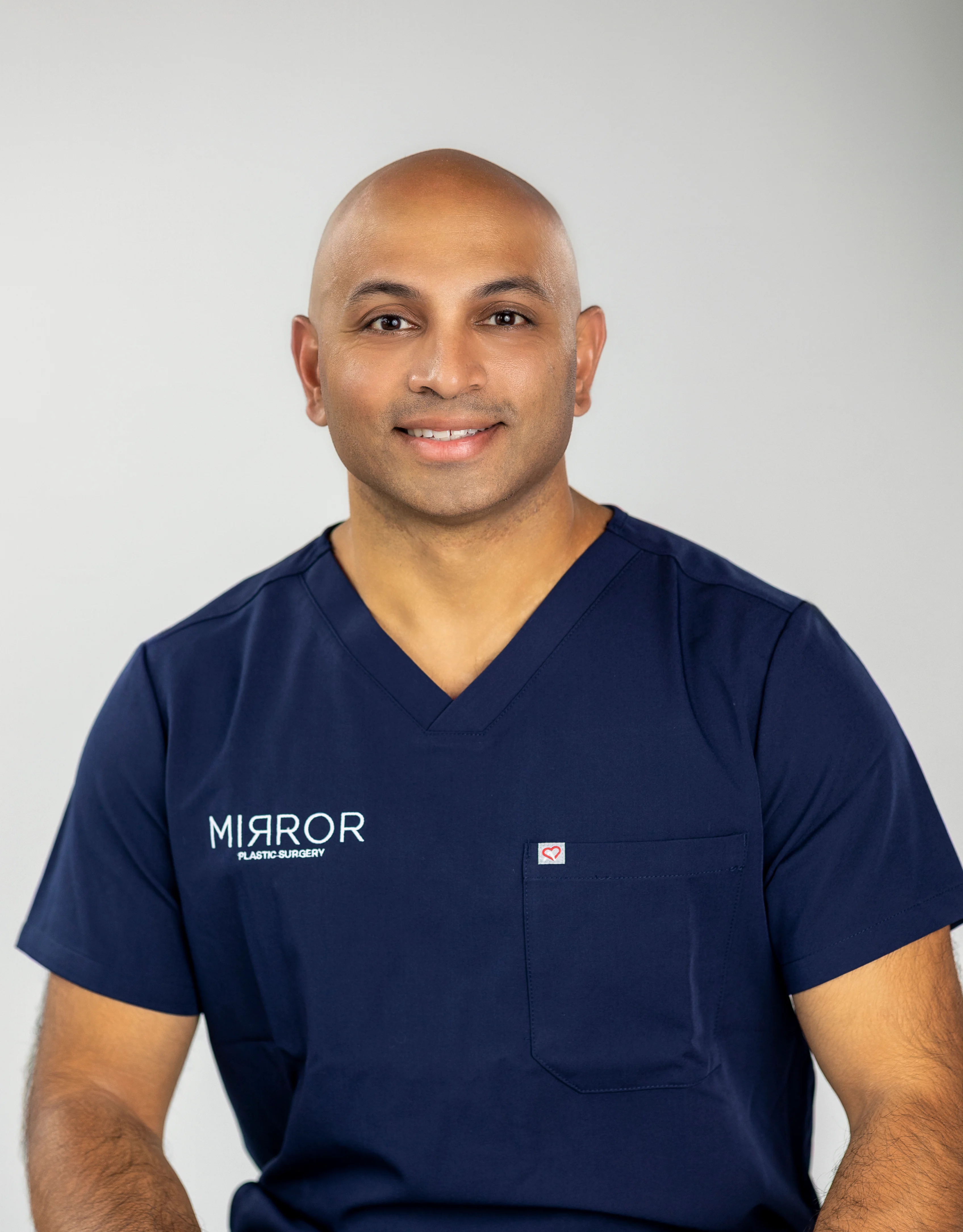
- Harvard-educated physician
- Johns Hopkins-trained plastic surgeon
- Board-certified by the American Board of Plastic Surgery
- Fellowship-trained in aesthetic surgery at MEETH/Lenox Hill Hospital
- Medical innovation training at Stanford University
- Advisory board member for Merz Aesthetics (Radiesse) and Tiger Aesthetics (AlloClae)
The Concierge Difference: Mirror Plastic Surgery practices concierge medicine, a model that prioritizes depth of care over patient volume. High-volume practices may schedule 5–10 surgeries daily. Mirror limits itself to 1–2 surgeries per day so your surgical team can focus fully on you before, during, and after your procedure. Your initial consultation lasts up to one hour, in contrast to the rushed 10–15 minutes common at volume-driven practices. Dr. Akash conducts a comprehensive, top-to-bottom assessment that explores your aesthetic goals and the emotions behind them.
Non-Surgical BBL Expertise: Dr. Akash personally performs all injectable treatments, including non-surgical BBL procedures with Radiesse and AlloClae. His surgeon’s command of subdermal anatomy means every injection is placed with precision to minimize risk and support natural-looking results. He understands the gluteal region’s unique anatomy, including the danger zones that make this procedure historically risky, at a level that exceeds the training of most injectors.
The qualitative contrast between Mirror Plastic Surgery and many high-volume practices is meaningful. Mirror offers ABPS board certification and limits daily surgical volume to 1–2 cases. Consultations last up to one hour, ultrasound guidance is used as Florida law requires, and the surgeon personally performs every step. Patients also get direct post-operative access to Dr. Akash. In contrast, many high-volume practices vary on board certification status. They routinely schedule 5–10 or more surgeries per day, offer only 10–15 minute consultations, and may route post-operative concerns through staff rather than the operating surgeon. As mentioned, the vast majority of these fatalities occurred in high-volume clinics, with some performing as many as 10–12 BBLs in a single day.
Schedule your consultation with Ellie and experience the Mirror difference, where your safety guides every decision.
Recovery And Longevity: What To Expect
Once you have chosen your surgeon and procedure, understanding recovery and how long results last helps you plan with confidence.
Recovery Timeline (Surgical BBL): Here is what to expect during surgical BBL recovery, step by step:
- Weeks 1–2: Rest is required. Do not sit directly on the buttocks. Sleep on your stomach or side. Wear compression garments as directed.
- Weeks 3–4: Gradual return to normal activities. Desk work may resume with a BBL pillow for sitting.
- Months 3–6: Final results become visible as swelling subsides and transferred fat establishes its blood supply.1 Most surgeons consider results stable at 6 months.1
Recovery (Non-Surgical BBL): Downtime is minimal. Most patients return to normal activities immediately. Mild swelling or bruising at injection sites usually resolves within days.
Longevity: Surgical BBL results can last for years, even decades, when you maintain a stable weight.1 As noted earlier, most transferred fat survives long-term with proper technique. Transferred fat behaves like fat elsewhere in your body. Weight gain enlarges the buttocks, and weight loss reduces their size. Non-surgical BBL results with biostimulatory fillers like Radiesse, particularly using the Bella Vida Instant BBL technique with hyperdilute CaHA, typically last 18–24 months.1 With collagen stimulation and maintenance touch-ups, some patients see benefits for two years or more.1
Risks And Common Misconceptions
The primary risk in BBL surgery is pulmonary fat embolism, which occurs when fat enters the bloodstream and travels to the lungs. This complication happens when fat is injected into or below the gluteal muscle, where large blood vessels reside. Florida’s mandatory ultrasound guidance and subcutaneous-only injection protocol have dramatically reduced this risk. Among surgeons following the 2022 multi-society guidelines, mortality fell to approximately 1 in 23,818, which is a major improvement from the historical 1 in 3,000 baseline. A meta-analysis of over 6,235 patients found zero deaths or fat embolisms when ultrasound guidance was used during fat injection.
Other risks include infection, seroma (fluid accumulation), fat necrosis, and asymmetry. Choosing an accredited facility and an experienced, board-certified surgeon who follows modern protocols helps minimize these risks.
Several common misconceptions deserve direct correction:
- “BBL Is A Quick Fix.” Surgical BBL requires 2–3 weeks of modified activity, six weeks before strenuous exercise, and 3–6 months for final results.
- “More Volume Is Better.” Conservative volume is a safety measure. Forcing excessive fat into the subcutaneous space increases pressure and complication risk.
- “Non-Surgical BBL Is Just As Effective As Surgical.” Non-surgical BBL with Radiesse or AlloClae offers subtle enhancement and skin improvement. Significant volume increase requires the surgical approach.
- “Any Board-Certified Surgeon Is Equally Safe.” The 68% statistic mentioned earlier shows credentials alone are not enough. You must verify that your surgeon follows subcutaneous-only injection with ultrasound guidance.
Questions To Ask In Your Consultation
Before committing to any BBL surgeon in St. Petersburg, schedule consultations with two or three candidates and ask:
- Are you certified by the American Board of Plastic Surgery?
- Do you personally perform both the liposuction and fat injection?
- Do you use real-time ultrasound guidance during every BBL?
- How many BBL procedures do you perform monthly?
- What is your complication rate, specifically for fat embolism?
- Is your surgical facility accredited by AAAASF, AAAHC, or the Joint Commission?
- How do you determine if a patient is not a safe candidate?
- Can I see unedited before-and-after photos of your BBL patients?
- What does your recovery protocol look like?
- How do you handle complications if they arise?
Your Safety-First Choice In St. Petersburg
The Brazilian butt lift is one of the most rewarding and potentially dangerous cosmetic procedures available. When a board-certified plastic surgeon follows Florida’s mandatory safety protocols, the modern BBL becomes safer than ever. In St. Petersburg, Mirror Plastic Surgery stands apart. Dr. Akash Chandawarkar’s concierge model, limited to 1–2 surgeries daily with hour-long consultations and direct physician access, ensures you are never treated like a number on an assembly line. His philosophy of “Safety First, Function Second, Aesthetics Third” means your well-being guides every decision from candidacy assessment to surgical technique to post-operative care.
Whether you are considering a surgical BBL or exploring non-surgical enhancement with Radiesse or AlloClae, you deserve a surgeon who combines exceptional credentials with an unwavering commitment to safety.
Start your safety-first consultation at Mirror Plastic Surgery today and take the first step toward safe, natural-looking results.
Call Or Text: 727-361-6515
Visit Us: 780 4th Ave S, St. Petersburg, FL 33701
Email: hello@mirrorplasticsurgery.com
Frequently Asked Questions
How Much Does a BBL Cost in St. Petersburg, Florida?
BBL costs vary based on surgeon expertise, facility accreditation, anesthesia, the number of liposuction donor areas, and whether you choose a surgical or non-surgical approach. At Mirror Plastic Surgery, every patient receives a personalized quote during their consultation. The practice does not publish generic pricing because every patient’s anatomy, goals, and treatment plan are unique. Safety and experience are worth the investment. Revision surgery for a poorly performed BBL can far exceed any savings from choosing a budget clinic. If a quote seems suspiciously low for a Florida facility, treat that as a meaningful red flag and look closely at the surgeon’s credentials and technique.
What Happens 3 Months After a BBL?
At three months post-surgery, most swelling has resolved and you see the early results of your procedure.1 Transferred fat that has successfully established a blood supply is now permanent, and fat that did not survive has been reabsorbed by your body. Most surgeons consider results approximately 80% settled by three months, with final results visible at six months.1 You can typically resume all normal activities, including exercise, by this point once your surgeon clears you. Maintaining a stable weight during this period helps preserve the volume that has successfully integrated.
What Happens 10 Years After a BBL?
Long-term BBL results depend primarily on weight stability.1 Transferred fat behaves like fat elsewhere in your body, so stable weight can support results that last for decades.1 Significant weight gain enlarges the buttocks, and significant weight loss shrinks them. Some patients seek revision procedures after major weight changes or with age-related shifts in skin elasticity. Durable results start with a surgeon who uses proper technique, including conservative volume and precise subcutaneous placement, because this maximizes the percentage of fat that survives long-term.
Is a Non-Surgical BBL Safe?
Non-surgical BBL using biostimulatory fillers like Radiesse or AlloClae carries significantly lower risk than surgical BBL because there is no general anesthesia, no incisions, and no fat injection into deep tissue planes. It remains essential that injections are performed by a qualified physician with deep anatomical knowledge. At Mirror Plastic Surgery, Dr. Akash Chandawarkar, a board-certified plastic surgeon, personally performs all non-surgical BBL injections. His surgeon-level understanding of gluteal anatomy helps ensure that every injection is placed safely and precisely, minimizing risk while supporting natural-looking results. Non-surgical BBL is best suited for patients seeking subtle enhancement, hip dip correction, or skin texture improvement rather than significant volume increase.
1 Results may vary from person to person. Editorial content, before and after images, and patient testimonials do not constitute a guarantee of specific results.