
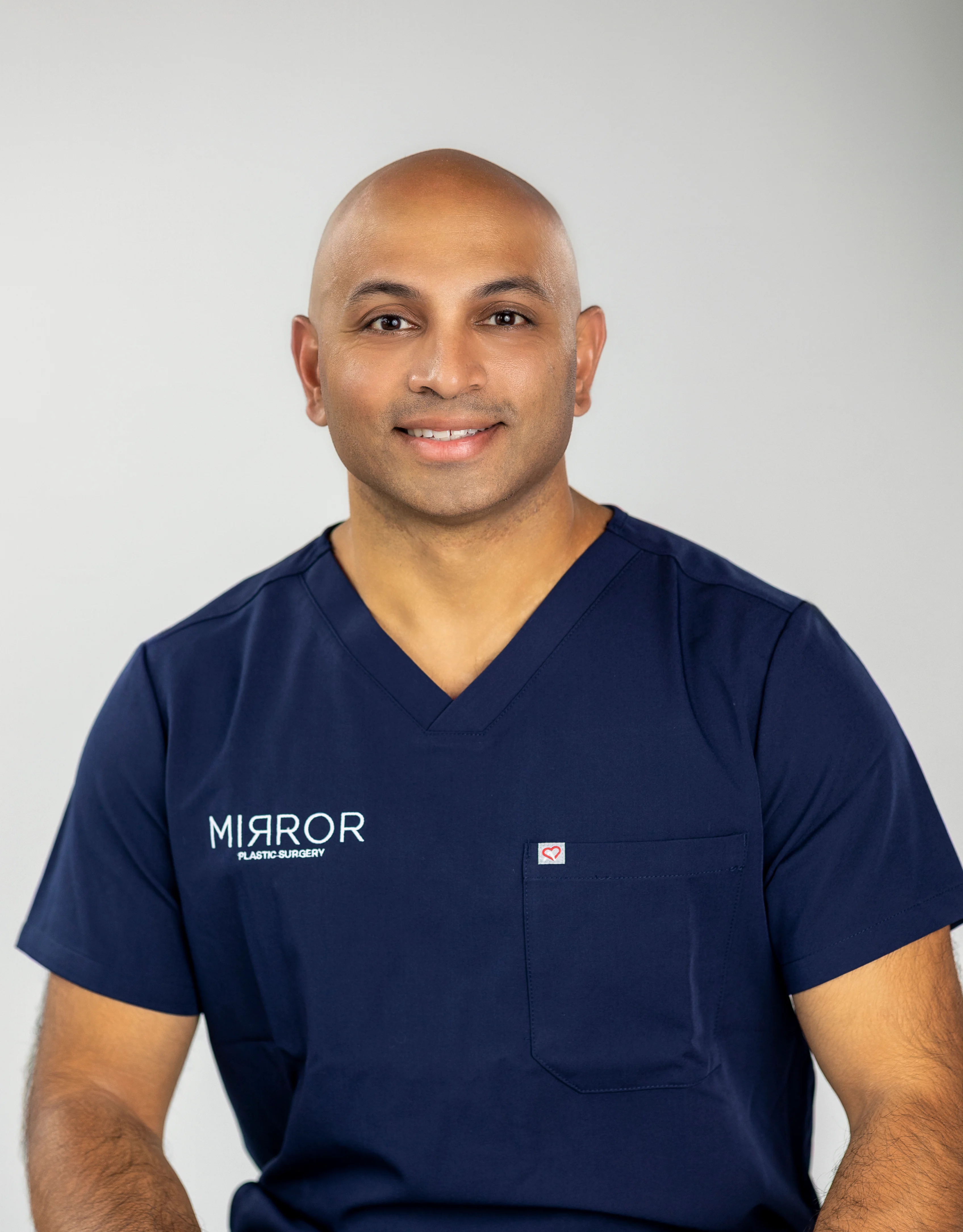
Written by: Dr. Akash Chandawarkar, Board Certified Plastic Surgeon, Mirror Plastic Surgery | Last updated: September 9, 2026
Key Takeaways
- Hip dip surgery is an elective cosmetic procedure that fills the inward curve below the hip bone using fat transfer or silicone implants. Outcomes depend on technique, candidacy, and surgeon expertise.1
- Fat transfer uses your own harvested fat and usually keeps 60–85% of the added volume.1 Implants create predictable structural volume but carry higher complication rates around 10.8%.1
- Most patients return to normal activity in 2–4 weeks after fat transfer.1 Implant recovery usually takes 4–8 weeks and often involves more restrictions and a higher chance of future revision.1
- Good fat transfer candidates have adequate donor fat, a BMI around 22–32, and realistic expectations. Implants suit very lean patients or those with deep, structural dips that fat alone cannot correct.
- A consultation at Mirror Plastic Surgery provides an honest, anatomy-first assessment and a personalized plan for hip dip correction.
Introduction: Hip Dips And Surgical Options
Hip dips, or trochanteric depressions, are the inward curves below the hip bone where the iliac crest meets the soft tissue of the upper thigh over the greater trochanter. They reflect normal anatomy shaped by bone structure, genetics, muscle distribution, and fat placement. Exercise cannot remove them because the spacing between the iliac crest and greater trochanter is genetically fixed.
This report explains whether surgery for hip dips is worth considering for you. It draws on peer-reviewed clinical studies, published complication data, and the protocols of board-certified plastic surgeons, including Dr. Akash Chandawarkar at Mirror Plastic Surgery in St. Petersburg, Florida.
Surgery remains a personal, elective choice. The goal here is clear, evidence-based information so you can decide with confidence.
How This Report Uses Clinical Evidence
The analysis here relies on peer-reviewed studies on fat graft retention, complication data from plastic surgery registries, and clinical protocols from board-certified plastic surgeons. A key source is a 2026 study of 112 women in Medical Research Archives (14:4, DOI 10.18103/mra.v14i4.7467) by Dr. Robert J. Troell, which reports detailed fat retention data for hip dip and gluteal grafting.
Results always vary by patient and surgeon. No single study can promise a specific outcome. Patient selection remains the strongest predictor of satisfaction, and this report favors honest risk discussion over promotional claims.
Fat Transfer For Hip Dips
Fat transfer for hip dips is a two-step procedure. Liposuction first harvests fat from areas such as the abdomen, flanks, or thighs. The surgeon then purifies that fat and injects it into the trochanteric depression in many small passes to support blood vessel growth.
In Dr. Troell’s 2026 series of 112 patients, enriched fat grafting kept 75–85% of volume at seven months, with about 45 cc of enriched fat per hip dip.1 Broader literature shows average fat survival of 60–70%, with 30–40% reabsorbed in three to six months.1 Surgeons usually overfill by about 20–40% to account for this. Fat that survives beyond two to three months usually stays stable for years.1
Fat transfer offers several advantages. It uses your own tissue, feels natural, avoids foreign material, and can contour donor areas at the same time. It also has limits. Fat survival varies, you must have enough donor fat, and you may need a touch-up session. Recovery affects both liposuction and injection sites.
Typical candidacy for fat transfer includes a BMI around 22–32, at least 300–500 cc of harvestable fat per side, stable weight, no smoking, and no uncontrolled medical issues. You also need realistic expectations about how much fat will remain.
Book A Consultation With Ellie to learn whether your anatomy and donor fat make you a good candidate for fat transfer. The team at Mirror Plastic Surgery spends up to an hour reviewing your body from top to bottom before offering a recommendation.
Hip Implants For Structural Hip Dips
Hip implants are solid silicone devices placed through a small incision, often hidden in the bikini line, into a pocket over the hip bone. They add structural volume and do not depend on fat survival.
Published data on buttock and hip implants shows complication rates around 10.8%, compared with about 5% for fat grafting.1 Seroma appears most often. Other implant risks include displacement, capsular contracture, feeling the implant through the skin, infection that may require removal, and the likelihood of future replacement.
Implants suit thin patients without enough donor fat, patients after major weight loss, and those with deep, structurally driven dips that fat alone cannot correct. Recovery usually takes four to eight weeks before normal activity, and revision surgery is more complex than with fat transfer.1
Comparing Fat Transfer And Implants
| Consideration | Fat Transfer | Hip Implants |
|---|---|---|
| Volume Source | Your own fat, harvested with liposuction | Solid silicone prosthesis |
| Retention / Predictability | Typical 60–70% survival, with 30–40% reabsorbed in three to six months1 | Stable structural volume with no resorption |
| Recovery Duration | About 2–4 weeks to normal activity1 | About 4–8 weeks to normal activity1 |
| Key Risks | Fat reabsorption, contour irregularity, fat necrosis, rare fat embolism | Displacement, capsular contracture, infection, revision surgery |
Most candidates with adequate donor fat and soft-tissue-dominant dips start with fat transfer. This approach gives natural results, shapes donor areas, and avoids foreign material. Implants stay reserved for very lean patients, deep structural dips, or those who want fixed volume without relying on fat survival.
Some patients benefit from a composite approach that combines an implant for structure with fat grafting for blending. This option increases complexity and cost. Dr. Akash performs both procedures and tailors the plan to your anatomy and goals.
Who Qualifies For Hip Dip Surgery
Typical fat transfer criteria include a BMI around 22–32, 300–500 cc of donor fat per side, stable weight, no smoking, and no uncontrolled medical conditions. You also need to accept that fat survival varies.
Implant candidacy requires enough soft tissue to cover the implant and comfort with a permanent device and future revision risk.
Some patients do not qualify for either option, including those with:
- Active infection, uncontrolled clotting disorders, or recent DVT or pulmonary embolism
- Active smoking, unless they stop at least four weeks before and after surgery
- BMI below about 20–21 with very limited donor fat
- Poor skin elasticity after major weight loss
- Unrealistic expectations about results
A detailed physical exam separates soft-tissue dips, which usually respond well to fat, from structural dips that may need implants or a combined approach. During a Mirror Plastic Surgery consultation, which can last up to an hour, the team reviews your anatomy, health history, and goals before suggesting a plan.
Book A Consultation With Ellie to receive an anatomy-first assessment and guidance on surgical and non-surgical options.
What Happens On Surgery Day
Fat transfer usually takes place under general anesthesia or awake sedation. The surgeon performs liposuction, purifies the fat with centrifugation and filtration, then injects 2–5 ml aliquots into the hip dip in the subcutaneous layer only to protect blood supply and reduce embolism risk. Total surgery time often ranges from two to four hours.
Implant surgery involves placing the incision, creating the pocket over the hip bone, and inserting and positioning the implant. This step usually takes one to two hours. Both procedures are outpatient for most patients.
Dr. Akash schedules only one to two surgeries per day so he can focus fully on each patient before, during, and after the procedure.
Recovery Timeline After Hip Dip Surgery
Fat transfer recovery usually follows a clear pattern:
- Week 1: Rest at home, wear compression over liposuction sites, manage pain with medication, expect swelling and bruising.
- Weeks 2–3: Return to desk work and light walking. Avoid leaning against chair backs for at least two to five weeks to protect the grafted fat. Many patients start lymphatic massage of liposuction areas.
- Weeks 4–6: Most swelling fades and light exercise resumes. Normal sitting usually returns at six to eight weeks.
- Months 3–6: Final results appear as swelling resolves and surviving fat stabilizes. Fat that lasts beyond two to three months tends to remain long term.
Key Recovery Facts:
- Avoid sitting directly on your hips for at least three weeks.
- Wear compression garments over liposuction areas for about one month.
- Expect 30–40% of transferred fat to reabsorb in three to six months.1
- Plan to see final results between three and six months, not right away.1
- Implant recovery usually takes four to eight weeks before normal activity and often involves stricter movement limits.
Risks And Complications To Consider
Both fat transfer and implants carry risks of infection, bleeding, scarring, asymmetry, anesthesia issues, and possible revision surgery.
Fat transfer risks include fat reabsorption, fat necrosis that can cause firm lumps or oil cysts, contour irregularities, and rare fat embolism. Modern safety steps such as subcutaneous-only injection, blunt cannulas, small aliquots, and awake anesthesia for some patients have lowered embolism risk, though they cannot remove it completely.
Implant risks include displacement, capsular contracture, feeling the implant through the skin, and infection. Infection often requires implant removal, antibiotics, and delayed reconstruction.
Choosing an American Board of Plastic Surgery–certified surgeon with specific hip dip experience likely reduces complication risk, although current data remains more qualitative than numerical for this exact procedure (Hip Dips Surgery: Procedure & Risks). Review 10–15 hip dip before-and-after photos and discuss revision policies before scheduling surgery.
Surgical And Non-Surgical Hip Dip Options
Some patients prefer non-surgical options. Biostimulatory fillers such as Radiesse (calcium hydroxylapatite) and Sculptra (poly-L-lactic acid) stimulate collagen and add volume gradually over two to four months. Sculptra can last up to two years or longer, while Radiesse is also used by Dr. Akash, though current evidence does not specify its exact duration1. Both require maintenance visits.
Non-surgical correction targets the subcutaneous fat plane over the lateral trochanteric depression, which contains only tiny vessels. This area avoids the large gluteal veins linked to fatal BBL fat embolisms. Fillers work well for mild-to-moderate soft-tissue dips. For more dramatic and lasting reshaping, surgery remains the only permanent option.
Over ten years, repeated filler sessions can cost more than a single surgery, so long-term budgeting matters as much as upfront pricing.
Dr. Akash personally performs non-surgical treatments with Radiesse and AlloClae, including hip dip correction, so Mirror Plastic Surgery can offer both pathways. Recommendations focus on your anatomy and goals. Some patients do better with non-surgical care, especially when surgery carries higher risk. Mirror Plastic Surgery follows a clear order of priorities: safety first, function second, aesthetics third.
Book A Consultation With Ellie at Mirror Plastic Surgery in St. Petersburg, Florida, to receive evidence-based, anatomy-driven guidance on whether surgery or fillers fit you best.
Frequently Asked Questions
What Is Hip Dip Surgery And How Does It Work?
Hip dip surgery is a body contouring procedure that fills the inward depression below the hip bone using your own fat or a silicone implant. In fat transfer, the surgeon removes fat from areas such as the abdomen, flanks, or thighs, purifies it, and injects it in small amounts into the hip dip. In implant surgery, a solid silicone device is placed through a small incision into a pocket over the hip bone. Neither option changes your pelvic bones. The correction happens in the soft tissue, and hip dip surgery remains an elective cosmetic choice.
Is Hip Dip Surgery Risky?
All surgery involves risk. With fat transfer, the main concerns include 30–40% fat reabsorption in the first three to six months, contour irregularity, fat necrosis, and rare fat embolism. Modern safety steps such as subcutaneous-only injection, blunt cannulas, and small aliquots have lowered embolism risk. With implants, the main risks include displacement, capsular contracture, feeling the implant, infection that may require removal, and future replacement. Published data places fat grafting complication rates around 5% and implant rates around 10.8%. Choosing a board-certified plastic surgeon with hip dip experience, reviewing photos, and understanding revision policies are key ways you can help lower risk.
Will A BBL Fix Hip Dips?
A traditional Brazilian Butt Lift focuses on buttock projection, yet surgeons often correct hip dips in the same session. Many call this a mini BBL or hip dip fat transfer. The surgeon uses the same donor fat and anesthesia, which makes it efficient to treat both areas together. The choice between a full BBL, a mini BBL, or a focused hip dip fat transfer depends on your anatomy, dip depth, donor fat, and goals. A consultation with a board-certified plastic surgeon remains the most reliable way to choose the right plan.
What Is Recovery Like After Hip Dip Surgery?
Fat transfer recovery affects both liposuction and injection sites. Most patients take one to two weeks off work. You avoid sitting directly on the hips for at least three weeks to protect the grafted fat, although exact timelines vary by surgeon. Compression garments stay on liposuction areas for about a month. Many patients start lymphatic massage within the first week. Strenuous exercise usually waits four to six weeks. Final results appear between three and six months, once swelling settles and fat stabilizes. Implant recovery usually lasts four to eight weeks before normal activity and often includes stricter limits on movement and positioning.
How Do I Choose Between Fat Transfer And Implants?
Your anatomy guides the decision. Fat transfer usually serves as the first surgical choice for patients with enough donor fat and soft-tissue-dominant dips. It gives natural results, shapes donor areas, and avoids foreign material. Implants suit very lean patients without donor fat, those with deep structural dips that fat cannot fully correct, or patients who want fixed volume without depending on fat survival. A hands-on exam by a board-certified plastic surgeon who offers both options remains the best way to decide. At Mirror Plastic Surgery, Dr. Akash Chandawarkar performs both surgical and non-surgical hip dip correction and bases his recommendations on what your anatomy can safely support.
Conclusion: Choosing Your Hip Dip Treatment Path
Hip dip surgery can be effective for the right candidate. Fat transfer usually serves as the first-line surgical option and offers natural results with some variability in fat survival. Implants provide stable structural volume for specific situations, especially in very lean patients or those with deep, bony dips. Your candidacy and anatomy should guide the choice. Non-surgical options using Radiesse and AlloClae offer alternatives for patients who prefer to avoid surgery or do not qualify for it.
The most reliable next step is a consultation with a board-certified plastic surgeon who offers both surgical and non-surgical hip dip correction and provides an honest opinion, even when surgery is not the right answer.
Dr. Akash Chandawarkar, Harvard-educated, Johns Hopkins–trained, and certified by the American Board of Plastic Surgery, brings deep anatomical expertise to every consultation. His concierge model allows up to an hour to understand your goals, examine your anatomy, and recommend a tailored plan. Mirror Plastic Surgery limits itself to one to two surgeries per day so each patient receives focused attention.
Book A Consultation With Ellie at Mirror Plastic Surgery in St. Petersburg, Florida, to receive a clear, expert assessment and move forward with confidence.
Disclaimer: Results may vary from person to person. Editorial content, before and after images, and patient testimonials do not constitute a guarantee of specific results.
1 Results may vary from person to person. Editorial content, before and after images, and patient testimonials do not constitute a guarantee of specific results.