
Written by: Dr. Akash Chandawarkar, Board Certified Plastic Surgeon, Mirror Plastic Surgery | Last updated: September 9, 2026
Key Takeaways
- Hip dips are a normal anatomical feature caused by pelvic shape and soft-tissue distribution, and exercise cannot eliminate them.
- A surgical BBL can permanently correct hip dips by grafting fat into the depression.1 This approach requires adequate donor fat and carries surgical risks that modern ultrasound-guided techniques have significantly reduced.
- Non-surgical biostimulatory fillers such as Radiesse and AlloClae provide a minimally invasive alternative. These options deliver natural-looking results with little downtime for patients who lack donor fat or prefer to avoid surgery.1
- Choosing between surgical and non-surgical options depends on individual anatomy, goals, and tolerance for downtime. Both approaches are effective when performed by a qualified provider.
- Schedule your personalized consultation at Mirror Plastic Surgery to explore the safest, most effective path to smoother hip contours and schedule your consultation with Dr. Akash Chandawarkar.
What Are Hip Dips And Why Do They Occur?
Hip dips, also called violin hips or trochanteric depressions, are natural indentations between the iliac crest and the greater trochanter, present in a large share of the adult population. Their depth and visibility are determined primarily by the width and shape of the pelvis, the distribution of fat and muscle over the lateral hip, and the thickness of connective tissue, all of which are largely governed by genetics and orthopedic structure.
Clinically, hip dips fall into two patterns:
- Soft-Tissue-Dominant Dips: A relative lack of fat over the outer hip. These respond predictably to volume-based correction, whether surgical or injectable.
- Structurally-Dominant Dips: Driven more by underlying bony anatomy. These may improve but not fully resolve with fat or filler alone, and in rare cases a custom implant may be discussed.
Exercise cannot eliminate hip dips. Glute exercises build muscles that sit posteriorly and superiorly and do not fill the lateral hip depression. Understanding this early prevents wasted effort and sets realistic expectations for any treatment. Once you recognize this limitation, procedural options become the next step for meaningful change.
Can A BBL Fix Hip Dips? The Surgical Approach
A surgical Brazilian Butt Lift addresses hip dips by harvesting fat from donor areas, typically the abdomen, flanks, or lower back, through liposuction. The fat is purified and then strategically injected into the subcutaneous layer of the hip dip depression to create a smoother, more continuous contour from waist to thigh. Hip dip fat grafting is not a separate operation from a BBL; it is part of the same contouring session, using fat harvested during the same liposuction that shapes the surrounding frame.
The average fat retention rate after BBL is 60–80%, meaning that only that portion of the transferred fat survives.1 The remainder is reabsorbed by the body during the first three to six months. Fat cells that successfully establish a blood supply are permanent, and significant weight fluctuations will affect them just as they affect native fat.
The Safety Evolution Every Patient Should Know
BBL surgery carries a well-documented history of risk. A 2017 ASERF Task Force study found an annual BBL mortality rate of 1 in 3,448, driven almost entirely by fat injected too deeply into or beneath the gluteal muscle, causing pulmonary fat embolism. That figure made BBL the highest-mortality elective cosmetic procedure at the time.
The field responded decisively. The 2022 ASPS/ASAPS/ISAPS Practice Advisory on Gluteal Fat Grafting formalized subcutaneous-only injection with real-time ultrasound guidance as the standard of care. These guidelines codified ten key principles, including fat placement exclusively in the subcutaneous plane, cannulas of 4 mm or larger, and mandatory ultrasound documentation. By 2019, annual BBL mortality had already dropped to approximately 1 in 14,921, and subsequent projections modeled mortality falling to between 1 in 25,000 and 1 in 35,000 by 2025 with continued technique compliance.
Critically, no confirmed BBL death has involved fat that remained exclusively in the subcutaneous plane. In July 2023, Florida became the first state to legally mandate ultrasound guidance for all BBL procedures. Choosing a board-certified plastic surgeon who adheres to these protocols, in an accredited surgical facility, remains the single most important safety decision a patient can make.
The Non-Surgical BBL: Biostimulatory Fillers For Hip Dips
Non-surgical hip dip correction has matured significantly. For patients who do not want surgery, lack sufficient donor fat, or prefer minimal downtime, biostimulatory fillers offer a clinically sound alternative. At Mirror Plastic Surgery, Dr. Akash uses two primary agents for non-surgical BBL hip dips treatment:
- Radiesse (Calcium Hydroxylapatite): Provides immediate volume and simultaneously stimulates the body’s own collagen production. In the context of non-surgical BBL, Radiesse results are stated to last 1–2 years1, with the calcium hydroxylapatite particles gradually metabolized while stimulated collagen persists.
- AlloClae (Adipose-Derived Filler): Uses regenerative cells derived from adipose tissue to add volume and improve skin quality, integrating regenerative medicine principles into body contouring. Dr. Akash serves on the advisory board for Tiger Aesthetics, the developer of AlloClae, and brings direct product expertise to every treatment.
Biostimulatory fillers vary in how quickly they show results. Radiesse, for example, delivers immediate volume through its gel carrier, while Sculptra produces little visible change at first. Regardless of the product, the collagen stimulation that creates lasting improvement takes time. Most patients see meaningful results between three and six months, with some initial improvement appearing within two to four weeks. Overall longevity often reaches 18 months or more, depending on the product, the volume placed, and individual metabolism.1
These procedures require a physician with a surgeon’s command of subdermal anatomy. Without that depth of anatomical knowledge, injecting large volumes into body areas can cause serious complications, including vascular occlusion and nodule formation. Dr. Akash is a board-certified plastic surgeon who personally performs every injectable treatment at Mirror Plastic Surgery, bringing the same precision to a filler session that he applies in the operating room.
Schedule a hip dip consultation with Ellie to find out whether Radiesse, AlloClae, or a surgical approach is the right fit for your anatomy and goals.
Surgical BBL Vs. Non-Surgical Fillers: A Direct Comparison
The table below highlights the key differences between surgical and non-surgical hip dip treatments. Focus on invasiveness, downtime, longevity, and volume so you can match each option to your priorities.
Non-surgical options do not replace a surgical BBL for patients seeking dramatic volume or projection. They offer an excellent and clinically effective choice for correcting mild to moderate hip dips, refining contour, and improving skin quality, especially for patients who are not surgical candidates or who prefer a lower-risk, lower-downtime approach.
Am I A Good Candidate For Hip Dip Treatment?
Surgical BBL Candidacy
The following criteria generally indicate suitability for a surgical BBL:
- BMI between 22 and 30, balancing donor fat availability and surgical risk
- Sufficient donor fat in at least two areas, such as the abdomen, flanks, lower back, or thighs
- Good overall health, with controlled blood pressure, blood sugar, and nutritional status
- Non-smoker, or willing to cease smoking at least four weeks before surgery
- Stable weight for at least six months
- Realistic expectations, since hip dips can be significantly improved, and complete elimination is not achievable because the depression is anchored to bone
Non-Surgical BBL Candidacy
Biostimulatory fillers are well-suited for patients who:
- Are not ideal surgical candidates due to low BMI or insufficient donor fat
- Prefer minimal downtime and a same-day, in-office procedure
- Have mild to moderate hip dips rather than a need for dramatic volume
- Want to assess results before committing to surgery
- Prefer a less permanent approach with the option to reassess over time
A thorough, in-person consultation is essential to determine which approach, or which combination, fits your unique anatomy. Mirror Plastic Surgery’s consultations run up to an hour, providing the time needed for a genuine top-to-bottom assessment rather than a rushed recommendation.
Plan your hip dip evaluation with Ellie and receive an honest, personalized assessment from Dr. Akash, a board-certified plastic surgeon who performs both surgical and non-surgical treatments himself.
Frequently Asked Questions
Will A BBL Fix Hip Dips Permanently?
A surgical BBL provides long-lasting correction.1 Fat cells that survive the transfer and establish a blood supply behave like native fat. They are permanent, and they will shrink with significant weight loss and expand with weight gain. Maintaining a stable weight is the most important factor in preserving results. Non-surgical biostimulatory fillers are temporary. As mentioned earlier, Radiesse typically lasts 1–2 years, and maintenance sessions are recommended to sustain the contour.
Is Hip Dip Surgery Risky?
Like any surgery, a BBL carries risks. The most serious historical risk, pulmonary fat embolism, has been dramatically reduced by modern safety protocols that mandate subcutaneous-only fat injection with real-time ultrasound guidance. As noted earlier, these protocols have lowered BBL mortality significantly, with projections suggesting continued improvement. Choosing a board-certified plastic surgeon who operates in an accredited facility and follows current ASPS/ASAPS/ISAPS guidelines is the most important step a patient can take to minimize risk.
What Is The Best Non-Surgical Treatment For Hip Dips?
Biostimulatory fillers, specifically Radiesse and AlloClae, are the safest and most effective non-surgical options for hip dip correction. Radiesse provides immediate volume and stimulates collagen production for results that last about one to two years. AlloClae uses adipose-derived regenerative cells to add volume and improve skin quality. Both must be administered by a physician with deep anatomical expertise to support safety and natural-looking results. Hyaluronic acid fillers are not considered safe practice for large-volume body contouring and are not used at Mirror Plastic Surgery for this purpose.
Can Exercises Get Rid Of Hip Dips?
Hip dips are determined primarily by the shape of the pelvis and the distribution of soft tissue over the greater trochanter, both of which are structural and genetic. Targeted glute exercises such as side leg raises, clamshells, and glute bridges can build muscle and improve overall shape. These exercises build muscle posteriorly and superiorly and cannot fill the lateral hip depression created by the underlying bone structure.
How Long Does A Non-Surgical BBL Last?
Results from biostimulatory fillers for hip dip correction develop gradually. Some products like Radiesse provide immediate volume from a gel carrier, while others like Sculptra show little visible change initially. Visible improvement typically emerges over two to four weeks, and meaningful collagen-based results generally develop over three to six months. As mentioned, Radiesse usually lasts 1–2 years.1 Touch-up sessions help maintain the desired contour, and the frequency depends on the product used, the volume placed, and individual metabolism. A personalized maintenance plan is discussed during the consultation at Mirror Plastic Surgery.
How Do I Choose The Right Provider For Hip Dip Treatment?
For surgical BBL, board certification from the American Board of Plastic Surgery, an accredited surgical facility, and documented use of subcutaneous-only injection with real-time ultrasound guidance are essential criteria. For non-surgical treatment, the injector should be a physician, ideally a board-certified plastic surgeon, with a surgeon’s command of subdermal anatomy. Avoid any provider who cannot clearly explain what product is being injected, at what depth, and in what volume. A thorough consultation before any procedure is a baseline expectation.
Choosing The Right Path For Your Hip Dip Correction
Both surgical and non-surgical BBL hip dips treatment options are effective. The best choice depends on your individual anatomy, the depth and pattern of your hip dips, your aesthetic goals, your tolerance for downtime and surgical risk, and your long-term plan for maintenance. The right answer is the one that fits your specific situation.
At Mirror Plastic Surgery, Dr. Akash Chandawarkar is a board-certified plastic surgeon with training from Harvard and Johns Hopkins. He personally performs both surgical BBL procedures and non-surgical injectable treatments. He also serves on the advisory boards of Merz Aesthetics (Radiesse) and Tiger Aesthetics (AlloClae), bringing direct product expertise to every non-surgical BBL consultation. The practice’s concierge philosophy means your consultation will not be rushed. Dr. Akash takes the time to understand your anatomy, your goals, and your motivations before recommending any treatment. Safety first, function second, aesthetics third: that principle guides every decision made at Mirror Plastic Surgery.
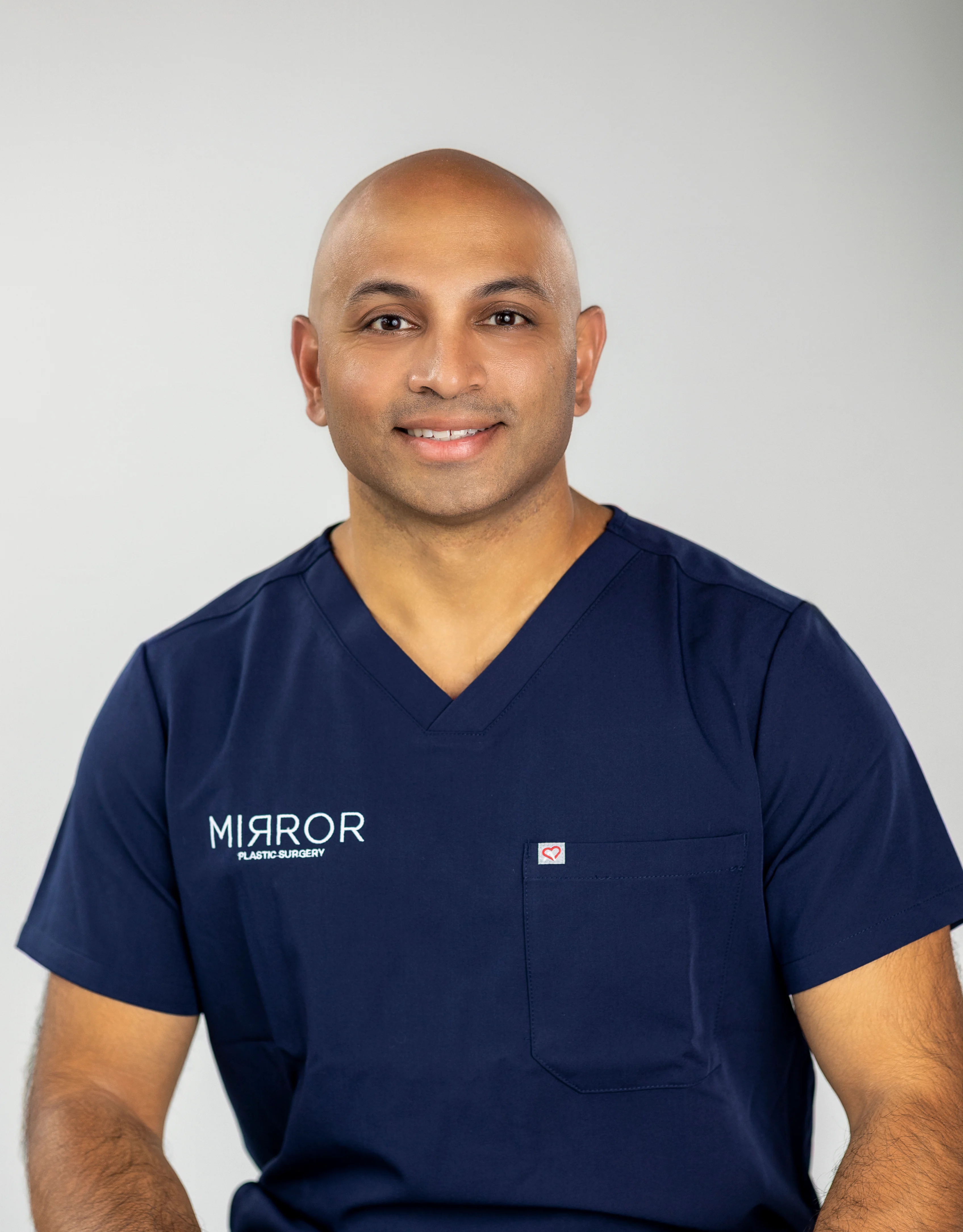
The first step is a conversation. Arrange your hip dip consultation with Ellie at Mirror Plastic Surgery in St. Petersburg, and let Dr. Akash provide an honest, unbiased assessment of the safest and most effective path to the contour you want.
Disclaimer: Results may vary from person to person. Editorial content, before and after images, and patient testimonials do not constitute a guarantee of specific results.
1 Results may vary from person to person. Editorial content, before and after images, and patient testimonials do not constitute a guarantee of specific results.