
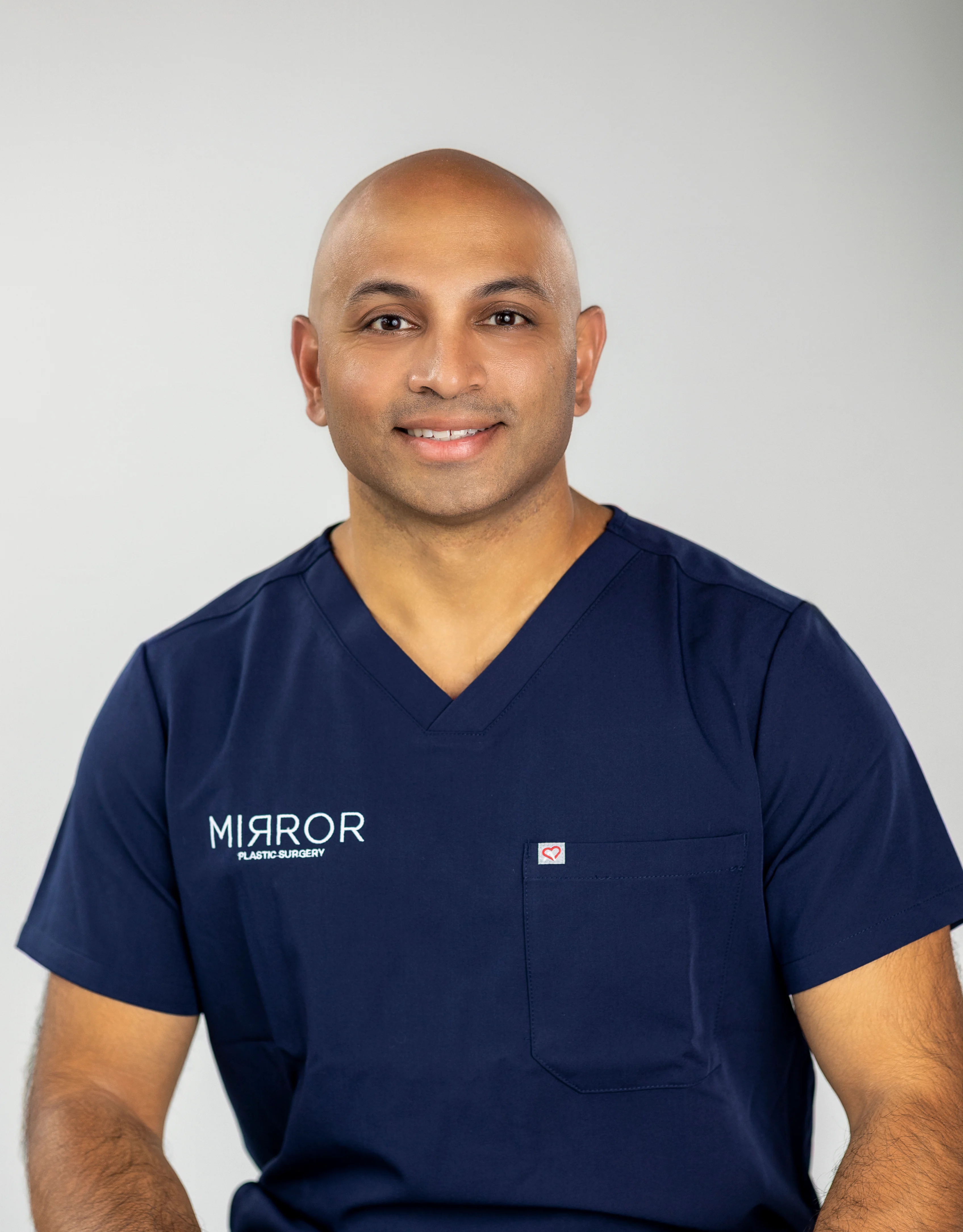
Written by: Dr. Akash Chandawarkar, Board Certified Plastic Surgeon, Mirror Plastic Surgery | Last updated: September 9, 2026
Key Takeaways
- Natural blending techniques treat the face as an interconnected system. Skilled injectors use foundation-first support, multi-plane micro-droplets, cannula gliding, and rheology-matched products to restore structure rather than simply add volume.
- Overfilled or “pillow face” results usually stem from poor technique and placement rather than the filler itself. Choosing an injector with deep anatomical knowledge is essential.
- Experienced injectors prioritize deep structural support before superficial treatment. They use micro-droplet layering across tissue planes and match product firmness to each facial zone for seamless, natural transitions.
- Conservative staging with multiple small sessions, cannula use in high-risk areas, and supplier-neutral product selection help minimize swelling, bruising, and the risk of an overfilled appearance.
- For personalized guidance, book your consultation with a board-certified plastic surgeon who focuses on natural, harmonious results.
Why Natural Blending Techniques Matter: The Real Cause Of “Pillow Face”
Overfilled, puffy, or “done” results appear regularly on social media and in everyday life, and many people now feel wary of fillers. Plastic surgeon Daniel Gould, MD, reported in 2026 that his filler reversal rate has risen from 10–15% to 20–30%, a shift he links to rapid industry growth and the rise of less experienced injectors.
The filler itself is rarely the problem. A 2026 review in the Journal of Cosmetic and Regenerative Medicine concluded that wrong injection site and wrong technique are more important determinants of serious filler complications than volume alone. In practice, unnatural results are almost always technique-driven, not product-driven. When you see what skilled injectors do differently, you can evaluate providers with confidence and clearly ask for subtle, harmonious results that make you look well-rested.
Schedule your consultation to discuss natural blending techniques with a board-certified plastic surgeon.
The Foundation-First Approach: How Structural Support Prevents Overfilling
Skilled injectors restore deep structural support before treating superficial lines or visible volume loss. They focus first on bone and deep fat compartments, which gradually diminish with age. This approach resembles renovating a house: you reinforce the foundation before repainting the walls.
Dr. Akash Chandawarkar, board-certified plastic surgeon and founder of Mirror Plastic Surgery, describes this philosophy as “restore, don’t augment.” His top-to-bottom assessment identifies where volume loss has occurred versus where excess exists. He then prioritizes structural restoration in high-support zones like the cheekbones and temples before considering any surface-level treatment.
A 2026 review in the Journal of Cosmetic Dermatology by Margarella and Shin advises a support-first strategy in the midface and lower face, noting that prioritizing lateral or deep support before medial volumization helps avoid overfilling. The same review links overfilled syndrome, facial heaviness, and unnatural broadening to excessive medial filling and poor analysis of the support system, rather than to filler material itself.
Once deep structural support is restored, the overlying tissues lift more naturally. This often reduces the amount of filler needed in visible areas like the nasolabial folds or lips, because treatment addresses the root cause of the fold or shadow.1
Multi-Plane Micro-Droplets: Layering For Natural Transitions
The micro-droplet technique avoids injecting one large bolus into a single area. Instead, it places tiny amounts, often less than 0.05 mL per point, across multiple tissue planes: deep on the bone, mid within fat compartments, and superficial just beneath the skin.
This multi-plane approach creates smooth transitions between treated and untreated areas. It helps prevent visible edges, lumps, or “sausage” effects that appear when filler concentrates in one location. A 2026 study in the Journal of Cosmetic Dermatology demonstrated this protocol for periorbital rejuvenation, stratifying treatment into supraperiosteal, sub-orbicularis, and pretarsal planes with distinct techniques for each.
A 2026 review in Clinical, Cosmetic and Investigational Dermatology describes the Fibrous Augmentation Lifting Technique (FALT). This method micro-distributes small aliquots of cohesive filler within inter-fibrous spaces to reinforce network stiffness without bulky volume. This mechanism explains why micro-droplet distribution often produces more natural outcomes than single-bolus injection.
Placing filler at the correct depth in each facial region requires intimate knowledge of layered anatomy, including bones, muscles, fat compartments, blood vessels, and ligaments. Dr. Akash’s surgical training provides this level of understanding, which supports seamless harmonization across facial regions using micro-droplet layering.
Cannula Gliding: Minimizing Trauma And Swelling
Skilled injectors choose between sharp needles and blunt-tip cannulas based on the treatment area and goal. Cannula gliding uses a blunt-tipped micro-cannula that moves through tissue planes rather than cutting through them. This technique offers three key clinical advantages:
- Reduced bruising: Split-face randomized controlled trials show cannulas consistently reduce bruising rates by approximately 30–60% compared to needles.
- Lower vascular risk: Large observational studies associate cannulas with lower reported vascular occlusion rates than needles, with estimated odds reductions of 50–80% across analyses.
- Less post-treatment swelling: The blunt tip displaces tissue rather than traumatizing it, which reduces inflammation and the temporary “overfilled” appearance during recovery.
A regional application framework recommends cannulas for high vascular risk zones such as the tear trough, temple, nasolabial fold superficial plane, and midface subcutaneous volumization. Needles remain preferred for structural deep support zones like periosteal augmentation, chin projection, and deep medial cheek support where pinpoint precision matters.
Dr. Akash uses this hybrid approach. He relies on needles for precise structural placement on bone and cannulas for smooth volumization in delicate zones. This safety-focused strategy, where the injector controls depth and plane selection instead of using high-volume superficial placement, reflects consensus recommendations in the Journal of Drugs in Dermatology.
Matching Product Rheology: Choosing The Right Filler Consistency
Dermal fillers behave differently inside the face based on their physical properties. Firmness (G-prime), cohesivity, and water absorption determine whether a filler provides structural lift or soft integration. Product rheology describes these properties, and matching them to each treatment area supports natural results.
High G-prime fillers, around 200–600+ Pa, hold their shape and work well for structural areas like the midface, jawline, and chin. Low G-prime fillers under about 50 Pa flow and conform, which suits delicate zones like the tear trough and periorbital area. Using a firm structural filler in a delicate area, or a very soft filler where bony lift is needed, often produces unnatural results.
A 2026 review in the Journal of Cosmetic Dermatology emphasizes that product selection should consider plane, function, G-prime, cohesivity, viscosity, swelling tendency, and vascular risk. Hydrophilicity deserves special attention in volume-sensitive zones. More hydrophilic fillers attract tissue water after injection, which can cause unintended swelling in areas like the periorbital and tear trough.
Mirror Plastic Surgery follows a supplier-neutral model. Dr. Akash selects products based on your anatomy and goals, not sales quotas or inventory pressure. He carries a full range of FDA-approved fillers including Juvederm, RHA, Restylane, Radiesse, and Evolysse, which allows true product-to-plane matching for every patient. Biostimulatory fillers like Radiesse also stimulate your own collagen production and provide gradual, natural-looking structural support over time.
Conservative Staging: Why Gradual Treatment Protects Your Results
Natural results often come from multiple sessions with small amounts of filler. This pacing lets the injector assess tissue response and adjust the plan as your face settles. Repeated dosing before full integration can gradually create heaviness or distortion, even when each individual session seems modest.
Staging treatment over several visits lets the injector see how your tissue responds to each product, then wait for swelling to fully resolve before adding more. The injector can adjust placement or product selection based on real-world results. This approach also makes it easier to stop once the aesthetic goal has been reached.
Dr. Akash often advises patients that they may not need treatment yet or that a more conservative plan will better match their goals. This level of honesty builds trust and long-term relationships and sets Mirror Plastic Surgery apart from high-volume practices that focus on throughput.
How To Talk To Your Injector: Questions To Ask For Natural Results
These concepts give you clear language to evaluate any injector’s approach. Use these questions during your consultation:
- “How will you ensure my results look natural?” Listen for mention of structural support, conservative dosing, and full-face assessment rather than isolated area treatment.
- “What is your approach to blending fillers across my face?” A skilled injector should describe treating the face holistically and addressing foundation before surface concerns.
- “Can you show me before-and-after photos of patients with similar anatomy?” Look for subtle, refreshed results rather than dramatic transformations.
- “How will you avoid overfilling?” The answer should reference conservative staging, product selection, and anatomical knowledge.
Mirror Plastic Surgery’s hour-long consultations support this level of dialogue. Dr. Akash’s top-to-bottom assessment gives him time to understand your concerns, explain his recommendations, and help you feel confident before any treatment begins. Once you have chosen your injector and completed treatment, thoughtful aftercare helps you achieve the natural results you discussed.
Book your consultation and experience a thorough, unhurried assessment.
Aftercare And Expectations: Managing Swelling And Follow-Up
Most patients see initial results immediately, but swelling can mask the final outcome for up to two weeks.1 Bruising usually resolves within 10–14 days in healthy individuals, though it may last longer for some people.1 For 24–48 hours after treatment, avoid the following:
- Strenuous exercise
- Alcohol consumption
- Excessive heat such as saunas, steam rooms, or hot yoga
- Facial massages or pressure on treated areas
- Makeup on injection sites for at least 6 hours
Schedule a follow-up at the two-week mark to evaluate final results. Initial swelling can make results look more dramatic than they will ultimately appear. Wait the full two weeks before assessing the outcome or requesting adjustments.
Safety, Risks, And Common Misunderstandings
Misunderstanding #1: “Fillers always look fake.” When natural blending techniques such as foundation-first support, micro-droplet layering, and rheology-matched products are used, results should look subtle.1 People should notice that you look refreshed.
Misunderstanding #2: “More filler means better results.” Overfilling leads to facial overfilled syndrome, characterized by anatomical distortion, loss of natural contours, and dynamic impairment. Effective treatment focuses on restoring structure rather than simply adding volume.
Misunderstanding #3: “Any injector can achieve natural results.” Natural results require deep anatomical knowledge, technical precision, and conservative judgment. Dr. Akash Chandawarkar is Harvard-educated, Johns Hopkins-trained, and board-certified by the American Board of Plastic Surgery. His surgeon-level command of facial and subdermal anatomy makes injectable treatment safer and more precise.
Practical Takeaways: Your Checklist For Natural Results
- Natural blending techniques focus on restoration over augmentation, with structural support as the primary goal.
- The foundation-first approach treats deep structural support before superficial concerns to prevent a heavy, overfilled look.
- The micro-droplet technique distributes small amounts of filler across multiple tissue planes for seamless transitions.
- Cannula gliding reduces bruising, swelling, and vascular risk in delicate areas.
- Product rheology matching ensures the right filler consistency for each facial zone.
- Conservative staging builds results gradually, allowing careful assessment and adjustment.
- Ask your injector about their approach to these techniques and choose a board-certified plastic surgeon with deep anatomical knowledge.
- Be patient, because final results often take up to two weeks to settle.
Beyond Fillers: The “Less Is More” Philosophy At Mirror Plastic Surgery
Natural blending techniques reflect a broader shift in aesthetic medicine toward subtle, harmonious rejuvenation. As noted earlier, filler reversal rates have climbed as patients seek to dissolve overfilled results. For patients exploring non-surgical options or full-face rejuvenation, Mirror Plastic Surgery applies a consistent philosophy of safety first, function second, and aesthetics third.
Frequently Asked Questions
What Is Forbidden After Fillers?
For 24–48 hours after dermal filler treatment, avoid strenuous exercise, alcohol, excessive heat such as saunas or hot yoga, facial massages or pressure on treated areas, and makeup on injection sites. These activities can increase swelling, bruising, or the risk of product displacement. Most patients can resume normal daily activities immediately, but following aftercare guidelines supports better results and helps the filler settle correctly.
How Long Does It Take For Dermal Fillers To Settle?
Most filler swelling peaks within 48–72 hours and then gradually resolves over the following days. Final results typically appear after about 1–2 weeks, although areas like the lips and under-eyes may take up to 2–4 weeks to fully settle.1 During this period, the filler integrates with surrounding tissue and early swelling subsides. The two-week mark is the right time to assess the outcome and discuss any adjustments with your injector.
Can Too Much Filler Make You Look Older?
Too much filler can make you look older by distorting natural facial contours, disrupting lymphatic drainage, and creating heaviness that pulls the face downward. Repeated dosing before full integration can also cause cumulative volume buildup, because hyaluronic acid fillers can persist in facial tissues for several years. Natural blending techniques prioritize structural restoration over volume addition so your anatomy stays supported rather than overwhelmed.
How Do I Avoid An Overfilled Look?
Choose an injector who uses natural blending techniques such as foundation-first structural support, micro-droplet layering across multiple tissue planes, cannula gliding in high-risk vascular zones, and rheology-matched product selection. Ask about their approach to conservative staging and request before-and-after photos of patients with similar anatomy. A board-certified plastic surgeon with deep anatomical knowledge and a restoration-focused philosophy offers a safer path to natural, harmonious results.
What Makes Mirror Plastic Surgery Different From A High-Volume Filler Clinic?
Mirror Plastic Surgery operates on a concierge medicine model. Dr. Akash Chandawarkar personally performs all injectable treatments and limits the practice to one to two procedures per day so each patient receives his full attention. Consultations last up to an hour and include a full top-to-bottom anatomical assessment. The practice remains supplier-neutral, so product selection is based entirely on your anatomy and goals. Dr. Akash is also known for advising patients when treatment is not yet necessary, which reflects a commitment to long-term outcomes over quick volume.
Conclusion: Choose An Injector Who Prioritizes Natural Results
Natural blending techniques such as foundation-first structural support, multi-plane micro-droplet layering, cannula gliding, and rheology-matched product selection separate natural-looking filler results from overfilled ones. These methods require an injector with surgical expertise, deep anatomical knowledge, and a conservative philosophy. Dr. Akash Chandawarkar of Mirror Plastic Surgery embodies these principles. He is Harvard-educated, Johns Hopkins-trained, and board-certified by the American Board of Plastic Surgery, and he consistently prioritizes structural restoration over simple volume addition.
Start your journey with a consultation at Mirror Plastic Surgery and experience concierge-level care where safety comes first, function second, and aesthetics third. Your long-term well-being guides every recommendation.
Disclaimer: Results may vary from person to person. Editorial content, before and after images, and patient testimonials do not constitute a guarantee of specific results.
1 Results may vary from person to person. Editorial content, before and after images, and patient testimonials do not constitute a guarantee of specific results.