

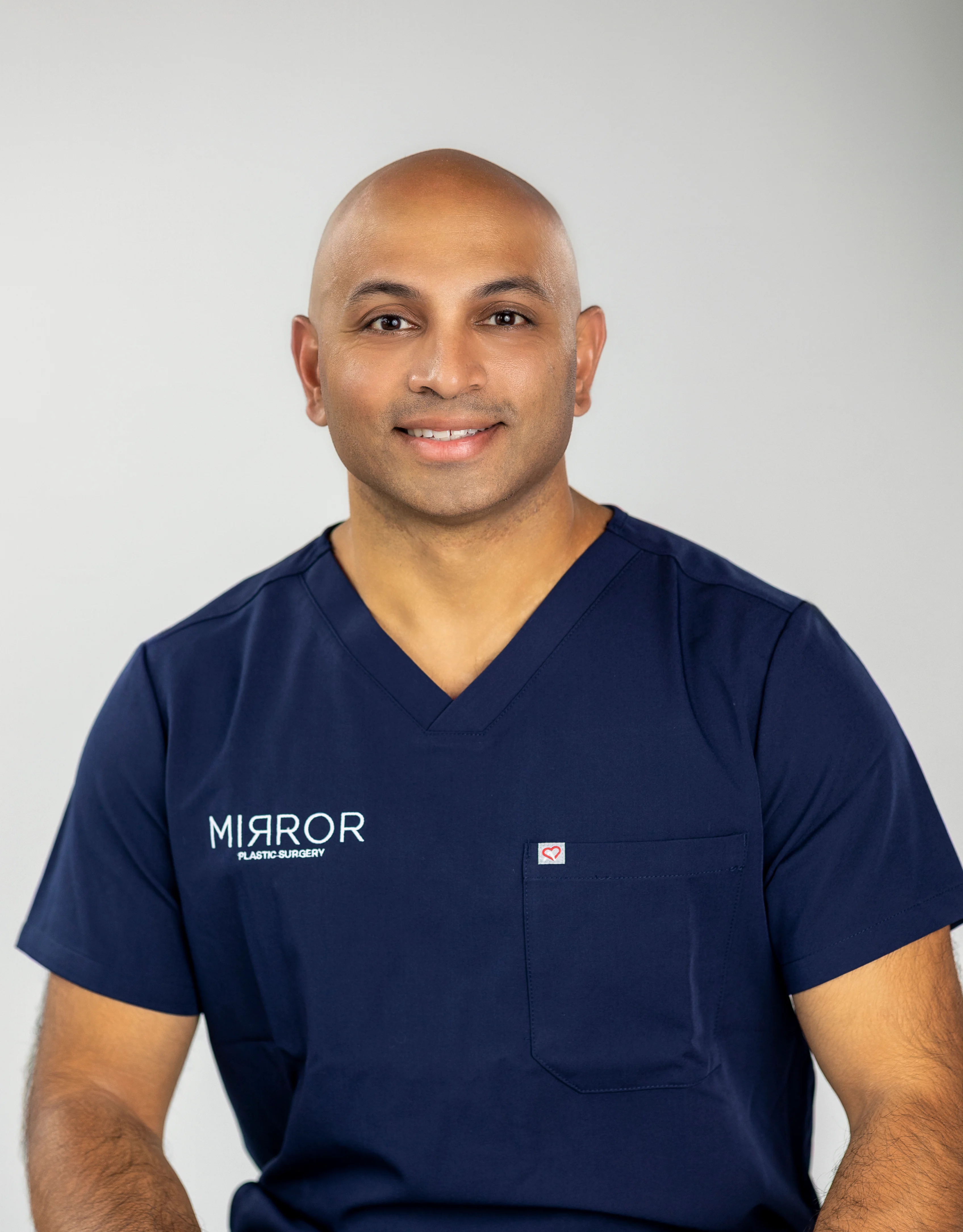
Written by: Dr. Akash Chandawarkar, Board Certified Plastic Surgeon, Mirror Plastic Surgery | Last updated: September 9, 2026
Key Takeaways
- Overfilling happens when fillers sit too close to the surface or in excessive volumes, which distorts natural contours and creates a “pillow face.”
- A clear grasp of facial anatomy, including the five layers and distinct fat compartments, helps prevent an overfilled look.
- Deep structural support, whole-face planning, and avoiding repeated filler in the same spot all lower the risk of distortion.
- High‑risk zones such as tear troughs, lips, and cheeks need conservative dosing and precise technique to avoid puffiness or migration.
- Choosing an injector with strong anatomical training, such as the board-certified plastic surgeons at Mirror Plastic Surgery, supports natural, balanced results with an anatomy‑first, patient‑centered approach.1
What Creates the Overfilled “Pillow Face” Look
The overfilled look, often called “pillow face,” appears when dermal fillers sit too superficially or in excessive volumes. This distorts natural facial contours and creates a puffy, unnatural appearance known as facial overfilled syndrome (FOS).
A 2026 PRISMA-guided systematic review in Aesthetic Plastic Surgery describes FOS as a regional pattern problem with recognizable signs: “flower horn” foreheads, “sunset” eyes, “chipmunk” cheeks, “witch” chins, and “pillow” faces. Large filler volumes can clump and migrate as facial muscles move, while hydrophilic fillers draw in water that exaggerates swelling and distortion.
A subtler driver of FOS is perception drift. Patients slowly adjust to a fuller face and lose their sense of what looks natural. A 2026 critical review in the Journal of Cosmetic and Regenerative Medicine links this to body dysmorphic tendencies and social media filters, which makes honest, anatomy-based communication between patient and provider essential.
Step 1: Learn How Facial Layers and Fat Compartments Work
The face is a layered structure, not a flat surface to fill. It contains five concentric layers: skin; subcutaneous fat in compartments; the SMAS and facial muscles; retaining ligaments and connective tissue; and deep fat, deep fascia, and periosteum over bone. Each layer ages differently and in different directions.
A ten-year study of patients aged 46 to 57 showed an 18.4% loss of deep facial fat and an 11.3% loss of superficial fat. Deep compartments lose volume faster, while superficial fat can expand or descend, forming jowls and folds. The face can look hollow in some areas and heavy in others, which confuses patients and often confuses undertrained injectors.
Prof. Sebastian Cotofana, a leading anatomist, notes that deep fat compartments are the preferred target for volumizing because they remain stable and do not move like superficial fat. Injecting into the wrong layer or across compartment boundaries creates the heavy, bloated look associated with overfilling.
Book A Consultation With Ellie to receive a full anatomical assessment from Dr. Chandawarkar before any filler is placed.
Step 2: Build Deep Support Before Refining the Surface
A 2026 conceptual review in Clinical, Cosmetic and Investigational Dermatology by Kwon, Hong, and Lim recommends separating deep structural support from superficial contour work. This dual-plane strategy reduces surface heaviness and supports more natural outcomes.
High‑elasticity fillers placed on bone or in deep fat compartments rebuild the framework that aging erodes. Softer, more cohesive fillers in superficial layers then fine-tune contours and transitions.
Feng et al. (2026) in the Journal of Cosmetic Dermatology explain that larger-particle fillers with higher elasticity distribute vertically in tissue, which suits deep support and contouring. Gel fillers spread more horizontally and work better for superficial volumization. Improper placement, such as large particles in superficial planes, can create nodules, while small particles in deep planes fail to support the structure.
Because Dr. Chandawarkar is a board-certified plastic surgeon, every filler at Mirror Plastic Surgery reflects a surgeon’s understanding of subdermal anatomy. That expertise makes precise deep-plane work both safe and repeatable.1
Step 3: Plan Treatment for the Whole Face
Isolated injections, such as treating only lips or only nasolabial folds, often create imbalance. Volume loss in the cheeks affects the under-eye area, and a hollow temple changes how the midface rests. The face functions as a connected system, so spot treatments can produce the “done” look many patients want to avoid.
Prof. Cotofana describes the “upper face first” principle. For nasolabial folds, first-line treatment often targets the zygomatic arch, cheeks, or temples. Restoring volume in these areas repositions superficial fat and softens the fold indirectly, often without injecting the fold itself.
Mirror Plastic Surgery structures hour-long consultations to assess the upper, middle, and lower face together. Treatment plans focus on maintaining natural proportions and smooth transitions between regions.
Step 4: Use Conservative Dosing and Avoid Filler Stacking
“Filler stacking” occurs when providers keep adding product to the same area over time without accounting for what remains. An MRI study showed that fillers can persist in fat pads for up to 27 months. Adding new syringes on top of old product creates silent buildup, which often leads to FOS.
Margarella and Shin’s 2026 review in the Journal of Cosmetic Dermatology describes FOS as a frequent result of poor indication, excessive medial filling, poor sequencing, and weak analysis of ligament and fat support. They conclude that the future of filler treatment depends on better-directed filler rather than higher or lower total volumes.
Conservative dosing uses small amounts, low pressure, slow delivery, and frequent reassessment. Fillers settle over several weeks, and adding more later remains possible. Correcting years of accumulated product is far more challenging.
Step 5: Protect High-Risk Areas From Overfilling
Certain regions show overfilling quickly. The tear troughs, lips, and cheeks are especially unforgiving.
Tear Troughs: Superficial HA in this area can cause the Tyndall effect, a bluish tint from light scattering through filler near the surface. Overfilling creates puffiness and persistent malar edema. Typical safe volumes range from 0.2 to 0.5 mL per side, and overfilling is a common and obvious error. Many experienced injectors treat the midface first, since restoring cheek volume often improves tear trough hollowing without direct periorbital injections.
Lips: The orbicularis oris muscle moves constantly and can push soft gel filler. Cumulative lip filler from multiple sessions often creates a visible “shelf” above the upper lip that spreads toward the nose. Excess lip filler can look unnatural and may even disrupt expression and age the face.
Cheeks: The malar area is a frequent site for FOS, especially when filler sits superficially or in large volumes without respect for compartments. Poorly placed filler can extend into the suborbital region and create unwanted lower eyelid fullness.
Step 6: Understand How Overfilling Can Make You Look Older
Excess filler can age the face. FOS can make patients appear older or disproportionate, disrupt harmony, and contribute to psychological stress, anxiety, or depression.
Margarella and Shin emphasize that facial aging involves more than volume loss. Bone remodeling, fat deflation and descent, dermal thinning, and changes in ligament support all play roles. Treating structural problems with volume alone increases fullness without restoring youthful geometry. Effective rejuvenation restores proportions and support rather than simply adding filler.
Book A Consultation With Ellie to explore a personalized, anatomy-first plan with Dr. Chandawarkar.
How to Choose an Injector With True Anatomical Expertise
Selecting an injector with deep anatomical knowledge and a conservative, whole-face philosophy is the strongest protection against overfilling. Most migration and overfilling problems relate to technique more than product choice.
Before treatment, ask a prospective injector:
- How do you assess my facial anatomy before injecting?
- What is your approach to deep versus superficial placement?
- How do you create a natural, balanced result across my whole face?
- What is your philosophy on conservative dosing?
- How do you account for residual filler from previous treatments?
The answers show whether the provider thinks in terms of anatomy and volume distribution or simply follows a pattern. A board-certified plastic surgeon like Dr. Chandawarkar brings advanced anatomical training and a safety-first mindset, always treating the face as a connected unit.
Options If You Already Feel Overfilled
Patients who feel overfilled still have options. Initial FOS treatment may involve an enzyme to dissolve filler or, in some cases, surgical excision with volume reduction. Only an experienced professional should perform enzyme treatment. Dissolving years of filler in one aggressive session can cause hollowing and emotional distress, so a gradual plan is safer.
Biostimulatory fillers such as Radiesse cannot be dissolved enzymatically. In those cases, patients often wait for natural metabolism or seek expert assessment. A 2026 retrospective study of 12 FOS patients used a staged approach with enzyme treatment followed by strategic polycaprolactone filler in the temporal and preauricular regions. All patients were rated “significantly improved” at three and six months, showing that carefully planned correction can restore natural contours.1
Five Practical Principles to Avoid Overfilling
- Choose a provider with deep anatomical expertise. A board-certified plastic surgeon understands facial layers, compartments, and blood vessels in detail.
- Ask for a full-face assessment. Treating one area without viewing the whole face often creates imbalance.
- Rebuild deep support before adding surface volume. A strong foundation creates lift without bulk.
- Start with conservative volumes. Small amounts, slow delivery, and staged sessions reduce the risk of distortion.
- Give fillers time to settle. Account for residual product before adding more and space sessions appropriately.
A Holistic, Anatomy-First Approach at Mirror Plastic Surgery
Volume loss represents only one part of facial aging. Bone changes, fat redistribution, dermal thinning, and skin quality all matter. A provider who thinks beyond syringes of filler can recommend the right mix of treatments.
At Mirror Plastic Surgery, Dr. Chandawarkar combines neuromodulators, energy-based tightening, resurfacing, and biostimulatory fillers with other tools, matching each option to a specific biological issue. His priority is to restore structural support and highlight your natural features before adding volume. This sequencing reflects current evidence that supports the order of lifting, contouring, volumization, and then surface refinement.
Book A Consultation With Ellie to begin a personalized, anatomy-based assessment with Dr. Chandawarkar.
Frequently Asked Questions
How Long Do Dermal Fillers Last?
Longevity depends on filler type, formulation, injection depth, and individual biology. Many fillers provide visible effects for 6 to 18 months, yet MRI studies show that material can persist in fat pads for up to 27 months. Biostimulatory fillers like Radiesse stimulate collagen, so results can extend beyond 18 months as new collagen matures.1 Low-modification fillers for fine lines often resorb more completely within about two years. These timelines highlight why providers must consider residual product before retreatment.
Can the Overfilled Look Be Reversed?
Certain fillers can be dissolved with an enzyme. Only an experienced provider should perform this, because the enzyme also affects some natural components in skin and connective tissue. A staged approach usually works best, especially when large or long-standing volumes are present. Biostimulatory fillers such as Radiesse do not have an enzymatic reversal option. The body gradually metabolizes them over 12 to 24 months, with massage, corticosteroids, or rarely surgery used for severe cases. A surgeon-led practice can design a careful corrective plan to restore natural contours.
Is It Normal to Look Swollen After Fillers?
Mild swelling is common for 24 to 72 hours after injections, especially in the lips and around the eyes. Bruising also occurs frequently in these areas because of their rich blood supply and loose tissue. Puffiness that lasts beyond two weeks, new asymmetry after swelling settles, or fullness appearing away from the injection site deserves prompt follow-up. These changes can signal overfilling, poor plane selection, or early migration, which respond better to early management.
How Do I Know If My Injector Is Qualified?
Board certification in plastic surgery represents the highest credential for injectable treatments. It reflects extensive training in facial anatomy, surgical technique, and complication management. A qualified injector performs a thorough full-face assessment, explains deep versus superficial placement, discusses conservative dosing, and clearly describes how they handle residual filler from past sessions. Skilled providers sometimes advise against treatment when it does not suit a patient’s anatomy or timing, and that restraint signals expertise. Avoid providers who rely on fixed “menus” of injections or pressure patients toward higher volumes.
The Bottom Line: Safe, Natural Results Start With Anatomy
The overfilled look reflects gaps in anatomical understanding and technique, not a flaw in fillers themselves. When a provider respects fat compartments, separates deep support from surface contouring, treats the face as a connected whole, and doses conservatively with staged reassessment, natural results become the norm.1
Mirror Plastic Surgery follows this standard. Dr. Akash Chandawarkar is Harvard-educated, Johns Hopkins-trained, board-certified by the American Board of Plastic Surgery, and fellowship-trained in aesthetic surgery at Manhattan Eye Ear & Throat Hospital. He combines these credentials with a concierge model that allows up to an hour per consultation to understand each patient’s anatomy, motivations, and long-term goals. The practice remains supplier-neutral, evidence-based, and grounded in the belief that safety and function always come first.
Patients in the St. Petersburg and Tampa Bay area who want natural, harmonious results and the confidence of working with a surgeon who truly understands facial anatomy can find that level of care at Mirror Plastic Surgery.
Book a consultation with Ellie to start your journey toward results that look like you, only refreshed.
Disclaimer: Results may vary from person to person. Editorial content, before and after images, and patient testimonials do not constitute a guarantee of specific results.
1 Results may vary from person to person. Editorial content, before and after images, and patient testimonials do not constitute a guarantee of specific results.


