
Written by: Ellie Pranckevicius, FNP-BC, Aesthetic Nurse Practitioner & Aesthetic Injector | Facial Restoration & Regenerative Injectable Specialist, Mirror Plastic Surgery | Last updated: August 1, 2026
Key Takeaways for Avoiding the Overfilled “Pillow Face” Look
- Overfilled “pillow face” usually develops from gradual layering of filler without proper assessment, not from one session.
- Screen practices for red flags such as rushed consultations, daily volume quotas, and supplier contracts before you book.
- Whole-face structural planning and staged treatments across multiple visits help prevent unnatural volume buildup.1
- Wait two weeks after each session for swelling to resolve before you judge results or add more product.
- Book a consultation with Ellie at Mirror Plastic Surgery for a detailed anatomy-based assessment and a personalized, conservative filler plan.
Why the Overfilled “Pillow Face” Look Happens
“Pillow face” describes an overly puffy, swollen, or unnatural facial appearance that occurs when dermal fillers are used excessively, placed incorrectly, or administered without proper facial assessment. It rarely comes from one catastrophic session. Overfilling most often develops gradually through repeated small sessions, driven by layering on undissolved filler, normalizing incremental volume increases, treating facial areas in isolation, and switching providers without a full treatment history.
The scale of the problem is significant. Reversal rates at aesthetic practices have increased in recent years. That shift reflects both the rapid growth of the injectable industry and an increase in treatments performed by less experienced practitioners. Many in Gen Z and younger millennials now rate natural-looking results as a key factor when choosing aesthetic treatments, which signals a clear move toward subtlety.
At Mirror Plastic Surgery in St. Petersburg, Aesthetic Nurse Practitioner Ellie Pranckevicius approaches every filler consultation with a whole-face structural framework that aims to prevent these outcomes before they start.
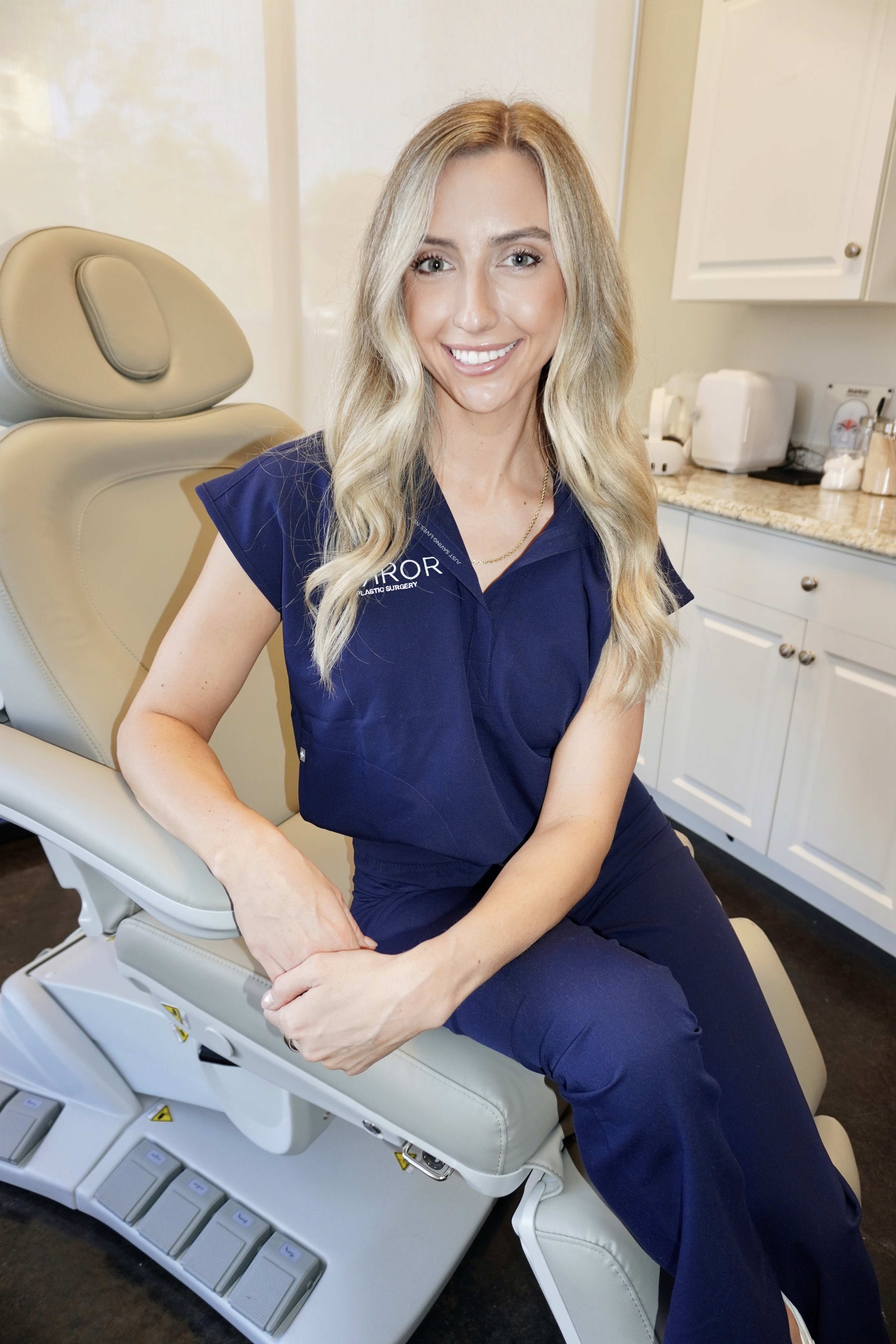
Book a consultation with Ellie to begin with a detailed facial assessment, not a syringe count.
Step 1: Spotting High-Volume “Filler Mill” Clinics
Choosing the right practice is the single most protective step a patient can take. High-volume clinics often prioritize speed over precision, and the warning signs are consistent. These red flags directly relate to rushed assessments, pressure to use more product than needed, and poor tracking of cumulative volume. Before booking anywhere, screen for the following indicators:
- Five or more injectable procedures scheduled per day per injector. Mirror Plastic Surgery limits non-surgical treatments to preserve the focused attention each patient requires, which contrasts with mills that run assembly-line schedules.
- Consultations under 15 minutes. Preventing an overfilled face starts with a detailed consultation that evaluates facial structure, facial movement, prior cosmetic history, whether fillers are truly the best option, and how the face moves at rest versus during expressions. That level of evaluation cannot happen in 15 minutes.
- Pressure to purchase multiple syringes in the same session. A full-face treatment can look natural when appropriate volumes are placed correctly.1 Even one syringe can look excessive in the wrong area or on top of existing filler. Volume recommendations should follow anatomy, not sales targets.
- No review of prior filler history. MRI evidence shows detectable hyaluronic acid filler persisting in all 33 mid-face patients studied, with no complete dissipation observed over a 2-year period post-injection. Any injector who does not ask about previous treatments is stacking volume without a clear picture.
- Supplier-tied product recommendations. A practice contracted to push a single brand cannot make fully unbiased product decisions. Mirror Plastic Surgery is supplier-neutral and selects from Juvederm, RHA, Versa, Restylane, Radiesse, Evolysse, and others based solely on what each patient’s anatomy requires.
Step 2: Key Questions to Ask About Staging and Product Limits
Arriving at a consultation with specific questions shifts you from passive recipient to informed participant. Use this script to guide the conversation:
- “How many syringes are you recommending for this session, and why that number specifically?” A credible injector explains the anatomical rationale, not a package deal.
- “Will we stage this treatment across multiple visits, or do you plan to complete everything today?” A step-by-step, multi-session filler plan begins with foundational support in the first session, followed by fine adjustments in the second session and final touches in the third, which allows progressive evaluation and reduces overfilling risk.
- “Which brands do you carry, and are you contracted to any specific supplier?” Supplier neutrality supports unbiased care.
- “What is your protocol if I feel overfilled after swelling resolves?” A confident injector has a clear dissolving and reassessment plan ready.
- “How will you track my cumulative filler volume over time?” Sticking with one consistent provider who tracks existing filler levels before each session is a primary protective measure against overfilling.
These questions should receive clear, specific answers before you agree to any treatment. Ellie’s hour-long initial assessments at Mirror Plastic Surgery are structured to answer all of these questions proactively before a treatment plan is ever proposed, so you are not left chasing information that should be standard.
Step 3: Using Whole-Face Balance to Avoid the Overfilled Look
Chasing individual lines, such as filling a nasolabial fold directly, is one of the most reliable paths to an unnatural result. Expert injectors avoid pillow face by rejecting treatment of isolated wrinkles in favor of whole-face structural planning that restores midface support, cheek projection, and jawline definition to improve multiple concerns simultaneously.
Natural filler technique prioritizes supporting mid-face volume in the cheeks and temples first to indirectly soften nasolabial folds, rather than directly filling the folds, which can produce an artificial puffy appearance. This structural-first logic is supported by consensus data. The minimal-dose approach, based on the principle of “less but right,” is the gold standard in global aesthetic consensus for achieving natural dermal filler results.
Beyond where filler is placed anatomically, how deeply it is placed determines whether that structural support looks natural or creates visible puffiness. Injection depth matters equally. Filler should sit on stable lateral bone such as the zygoma rather than in dynamic anterior malar fat pads that move with facial expression. Superficial placement in the midface can lead to swelling and puffiness.
Ellie’s dual background in esthetics and advanced nursing gives her a layered understanding of both surface skin physiology and subdermal anatomy. That combination makes whole-face planning practical and precise.
Book a consultation with Ellie to receive a full-face structural assessment before any product is discussed.
Step 4: Swelling and Settling Timelines You Can Expect
Expert guidance for natural-looking dermal filler results includes starting with conservative volume in the first session, waiting two weeks for the filler to fully settle before evaluating outcomes, and only then adding more volume if needed.1 This waiting period is not a formality. It prevents premature stacking because immediate post-treatment volume includes swelling.1
Common causes of an overfilled appearance include returning for touch-ups too soon before previous filler has settled. Treating a swollen baseline as the final result leads directly to accumulation. Mirror Plastic Surgery’s staged follow-up protocol builds the two-week assessment into every treatment plan so what is evaluated is settled tissue, not edema.
Step 5: Deciding When to Dissolve Filler and How to Do It Safely
Dissolving existing filler is a legitimate and increasingly common corrective step for some patients. Many people benefit from careful refinement rather than full reversal, which helps restore natural, harmonious proportions.
The dissolving agent is hyaluronidase, an enzyme with a duration of action of 24–48 hours that begins breaking down hyaluronic acid filler immediately. After swelling subsides, typically two weeks post-dissolve, small precise volumes can be placed deeply on bone using a detailed anatomy-based plan. Dissolving acts as a reset that makes accurate reassessment possible.
Correction of overfilled results requires a staged approach that includes selective dissolving, allowing tissue to settle, reassessment, and only then considering further structural support, because fluid retention and altered lymphatic function may persist after hyaluronidase treatment. Rushing back into volume after dissolving repeats the original error.
Step 6: Building a Long-Term Filler Maintenance Plan
Maintenance is where most overfilling accumulates. Dermal filler treatments in the cheeks, midface, jawline, temples, and under-eye region should be assessed at regular intervals. The decision should rest on whether the correction still achieves the intended aesthetic result, not only on whether filler remains detectable.
Given the persistence findings discussed earlier, frequent re-dosing without assessing residual product creates a slow drift toward distorted proportions. Topping up every four to six months without checking what remains is how faces change over years without any single session appearing excessive.
One consistent provider who maintains a longitudinal record of your treatment history is the most reliable safeguard. Ellie’s concierge follow-up model at Mirror Plastic Surgery is built around this continuity. She tracks cumulative volume, compares clinical photography across visits, and recommends no additional treatment when nothing is needed.
Safety First: FDA-Aligned Guidance and Individual Differences
The American Academy of Dermatology emphasizes the importance of having experienced and qualified providers perform dermal filler injections to reduce the risk of complications.
Every patient’s anatomy, skin quality, bone structure, and prior treatment history creates a unique baseline. No universal syringe count is safe or appropriate across all patients. Professional assessment by a qualified injector, not a social media trend or a package price, is the only reliable guide to what is right for a specific face at a specific point in time.
Mirror Plastic Surgery’s safety-first philosophy places patient well-being, anatomy, and long-term outcomes above any aesthetic objective. That sequence of safety, then function, then aesthetics remains non-negotiable in every treatment Ellie performs.
Quick Takeaway Checklist for Natural-Looking Filler
- Verify your injector’s credentials include formal training in facial anatomy, not just a short certification course.
- Confirm the practice limits daily injectable volume to preserve focused, personalized attention.
- Insist on a consultation of at least 30–60 minutes before any product is selected.
- Ask for a staged treatment plan across multiple sessions rather than maximum volume in one visit.
- Confirm the practice is supplier-neutral and selects products based on your anatomy, not brand contracts.
- Wait a full two weeks after treatment before evaluating results or requesting touch-ups.
- Schedule reassessment at 6–12 months and bring pre-treatment photos for comparison.
- Choose one consistent provider who tracks your cumulative filler history across every visit.
Book a consultation with Ellie at Mirror Plastic Surgery in St. Petersburg and start with a plan built around your anatomy, not a volume target.
Frequently Asked Questions
What does too much filler look like?
The most recognizable signs of excessive filler include a rounder or puffier face than is proportionate to the person’s bone structure, loss of the natural hollows and shadows that define facial contours, inflated or shelf-like cheeks, lips that appear stiff or disproportionately full, and restricted or unnatural facial movement during expressions. In some cases, the face may look different to others without them being able to identify why, which is a common early signal that volume has crossed from restoration into excess. These changes rarely appear overnight. They typically develop over months or years of cumulative product layering, often across multiple providers who each added volume without a full picture of what was already present.
What should you do if you have too much filler?
The first step is a thorough assessment with a qualified injector who can evaluate how much product is present, where it is located, and whether dissolving is indicated. For fillers, hyaluronidase can break down the product within 24–48 hours. After dissolving, the tissue needs time, typically two weeks, to settle before any reassessment or additional treatment is considered. Fluid retention and altered lymphatic function can persist after dissolving, so patience is essential. Rushing back into volume immediately after dissolving repeats the original problem. A staged reassessment, followed by conservative structural support if appropriate, is the correct sequence. Ellie at Mirror Plastic Surgery conducts these reassessments as part of a comprehensive, anatomy-focused approach rather than a quick corrective appointment.
Do fillers make you look older over time?
Fillers themselves do not cause aging, but cumulative misuse can produce results that age poorly. MRI studies have shown that filler can remain detectable in facial tissue for 2 to 15 years after injection. When new product is layered on top of undissolved existing filler, the total volume in finite facial compartments increases progressively. Over time, this can distort natural proportions, compress surrounding structures, and produce the kind of undefined puffiness that reads as unnatural rather than youthful. The risk lies in the absence of a long-term plan that accounts for what is already present. A consistent provider who tracks cumulative volume and reassesses at appropriate intervals is the most reliable way to ensure that filler continues to support a natural, age-appropriate appearance.
How many syringes is too much in one session?
No single answer applies to every patient. The appropriate volume depends on bone structure, skin thickness, the specific areas being treated, and the amount of product already present from prior sessions. As a general framework, 1–2 syringes is typical for a single treatment session, and patients treating multiple areas over a year may use 3–6 syringes total when sessions are properly spaced. Even one syringe can be excessive if placed in the wrong area or on top of existing undissolved product. The more important consideration is not how many syringes are used in one visit, but whether the total accumulated volume across all sessions respects the finite capacity of each facial compartment. At Mirror Plastic Surgery, Ellie’s treatment plans are built around anatomical indication and staged progression, not a predetermined syringe count.
Ready for Natural, Balanced Results?
The difference between filler that looks natural and filler that looks overdone usually comes from the assessment, the plan, the staging, and the ongoing relationship between patient and provider. Ellie Pranckevicius brings a rare combination of esthetician training and advanced nursing expertise to every consultation at Mirror Plastic Surgery, grounded in the same anatomy-focused, safety-before-aesthetics philosophy that defines the entire practice.
Patients in the Tampa Bay area who want a filler plan built around their own facial structure, not a volume target, can take a straightforward next step.
Book a consultation with Ellie at Mirror Plastic Surgery, located at 780 4th Ave S, St. Petersburg, FL 33701. Call or text 727-361-6515, or email hello@mirrorplasticsurgery.com.
Disclaimer: Results may vary from person to person. Editorial content, before and after images, and patient testimonials do not constitute a guarantee of specific results.
1 Results may vary from person to person. Editorial content, before and after images, and patient testimonials do not constitute a guarantee of specific results.