
Written by: Dr. Akash Chandawarkar, Board Certified Plastic Surgeon, Mirror Plastic Surgery | Last updated: July 2, 2026
Key Takeaways
- Lower eyelid blepharoplasty usually leaves minimal, well-concealed scars that mature fully within 6–12 months for most patients.1
- Eyelid retraction is the most significant complication and closely relates to pre-existing lid laxity and anatomical factors identified during thorough pre-operative evaluation.
- Transconjunctival and transcutaneous approaches differ in scar location and retraction risk, and the safest choice depends on individual anatomy rather than a single standard technique.
- Key risk factors such as horizontal lid laxity, positive vector anatomy, smoking, and prior surgery can be reduced with conservative technique and lid-support procedures when needed.
- Patients considering lower eyelid blepharoplasty can schedule a personalized consultation at Mirror Plastic Surgery for an anatomy-specific assessment and a safety-focused surgical plan.
Lower Blepharoplasty Scars and How Visible They Are
Most lower blepharoplasty scars remain subtle when incision placement matches the patient’s anatomy and healing pattern. The lower eyelid has some of the thinnest skin on the body, which usually heals with fine, flat lines that blend into natural creases and shadowed areas.
In the transcutaneous (external) approach, the incision runs just below the lash line, called the subciliary position, and extends into a natural crow’s-foot crease laterally. When placed precisely, this line sits in an area that shadow and lash density naturally conceal. During the first weeks, the scar appears pink and slightly raised. By 3–6 months, it usually flattens and lightens. At 12 months, most patients report that the scar is not visible in normal social interaction or standard photography without close inspection.1
In the transconjunctival approach, the incision sits entirely inside the lower eyelid, so no external scar appears. Surgeons often prefer this route when the main goal is fat removal or repositioning without meaningful skin excision.
Final scar appearance depends on skin tone, sun exposure during healing, the precision of closure, and how closely patients follow post-operative instructions.1 Patients with darker Fitzpatrick skin types carry a modestly higher risk of post-inflammatory hyperpigmentation along the incision line. This risk is manageable but deserves a clear discussion before surgery.
Schedule your skin-type assessment with Dr. Akash to determine which incision approach can minimize visible scarring for your unique anatomy.
Understanding Eyelid Retraction Risk After Surgery
Lower eyelid retraction occurs when the lid margin pulls downward and exposes sclera, the white of the eye, below the iris. Mild retraction creates a rounded, tired look, while severe retraction can cause corneal exposure, dry eye, and functional problems.
Retraction often develops from vertical shortening of the anterior lamella, which includes skin and orbicularis muscle, or from middle-lamellar scarring that tethers the lid downward. Surgeons see it more often after transcutaneous procedures that involve skin removal, especially when too much skin is excised or when the orbicularis muscle is heavily disrupted. Pre-existing horizontal lid laxity, measured with snap-back and distraction tests during examination, is the single most predictive anatomical risk factor. Patients with prominent eyes, known as positive vector anatomy, prior lower lid surgery, or marked lower lid laxity usually need technique adjustments, a concurrent canthopexy or canthoplasty for support, or both.
Mild retraction often improves with conservative care that includes massage, lubricating drops, and time.1 Persistent or severe retraction may require revision surgery with spacer grafts or canthal tightening procedures. A detailed pre-operative anatomical evaluation that identifies laxity and vector before the first incision offers the most reliable way to reduce this risk and forms a core part of Mirror Plastic Surgery’s safety-first approach.
How Lower Blepharoplasty Scars Mature Over Time
Lower eyelid scars follow a predictable healing sequence. The milestones below describe typical progression for a well-executed transcutaneous closure. Patients who undergo a transconjunctival approach do not have an external scar to monitor.
- 3 weeks: The incision line looks pink to red and may feel slightly firm or raised. Sutures have been removed. Bruising has largely resolved, and residual swelling remains, especially in the morning.
- 6 weeks: Redness begins to fade. The scar softens as collagen remodeling increases. Most patients feel comfortable in social settings without camouflage makeup.
- 3 months: Color shifts from pink toward skin tone. Texture continues to smooth. Hyperpigmentation, when present, is usually most noticeable at this stage and often responds to topical treatment.
- 6 months: Most scar maturation has occurred. The line is typically flat, pale, and positioned within the natural lash-line shadow. Many patients consider the scar non-visible at conversational distance.
- 12 months: Final scar appearance has formed. Residual firmness or discoloration is uncommon. Surgeons usually recommend waiting until this point before deciding on any revision.
Comparing Transconjunctival and Transcutaneous Approaches
| Approach | Scarring Location | Retraction Considerations |
|---|---|---|
| Transconjunctival | Internal, on the conjunctival surface, with no external scar | Lower retraction risk, no anterior lamellar shortening, and most lid support structures remain preserved |
| Transcutaneous (subciliary) | External, just below the lash line and extending into a lateral crease | Higher retraction risk when skin excision is excessive or orbicularis disruption is significant. Conservative resection and concurrent canthopexy, when indicated, reduce this risk. |
No single approach works best for every patient. Those with significant skin excess or dermatochalasis of the lower lid often need a transcutaneous component to achieve meaningful skin reduction. Patients whose main concern is fat herniation without clear skin laxity often do well with a transconjunctival route. The most appropriate choice comes from careful anatomical assessment rather than a default protocol.
Key Retraction Risk Factors and Why Assessment Matters
Several patient-specific factors increase the chance of retraction and more visible scarring.
- Horizontal lid laxity: Lids that distract more than 8–10 mm from the globe or fail to snap back quickly after distraction show insufficient support and usually need canthal reinforcement at the time of blepharoplasty.
- Positive vector anatomy: When the cornea projects in front of the inferior orbital rim, the lower lid has less bony support and becomes more vulnerable to downward displacement after surgery.
- Excessive skin excision: Removing more anterior lamellar tissue than the lid can tolerate without tension directly causes mechanical retraction. Conservative, anatomy-guided resection remains the main preventive strategy.
- Smoking: Nicotine reduces microvascular blood flow and slows wound healing, which increases the risk of wound separation, prolonged redness, and less favorable scar quality. Surgeons typically advise stopping smoking for at least four weeks before and after surgery.
- Prior lower lid surgery or trauma: Existing scar tissue decreases tissue flexibility and raises retraction risk, so surgeons must adjust technique planning.
- Thyroid eye disease or dry eye syndrome: These conditions affect lid position and ocular surface health and require ophthalmologic clearance before surgery.
Mirror Plastic Surgery’s hour-long consultation process evaluates each of these factors in a structured way. Dr. Akash, named to Newsweek’s America’s Best Plastic Surgeons list for two consecutive years including 2025, performs a top-to-bottom anatomical assessment before proposing any surgical plan.
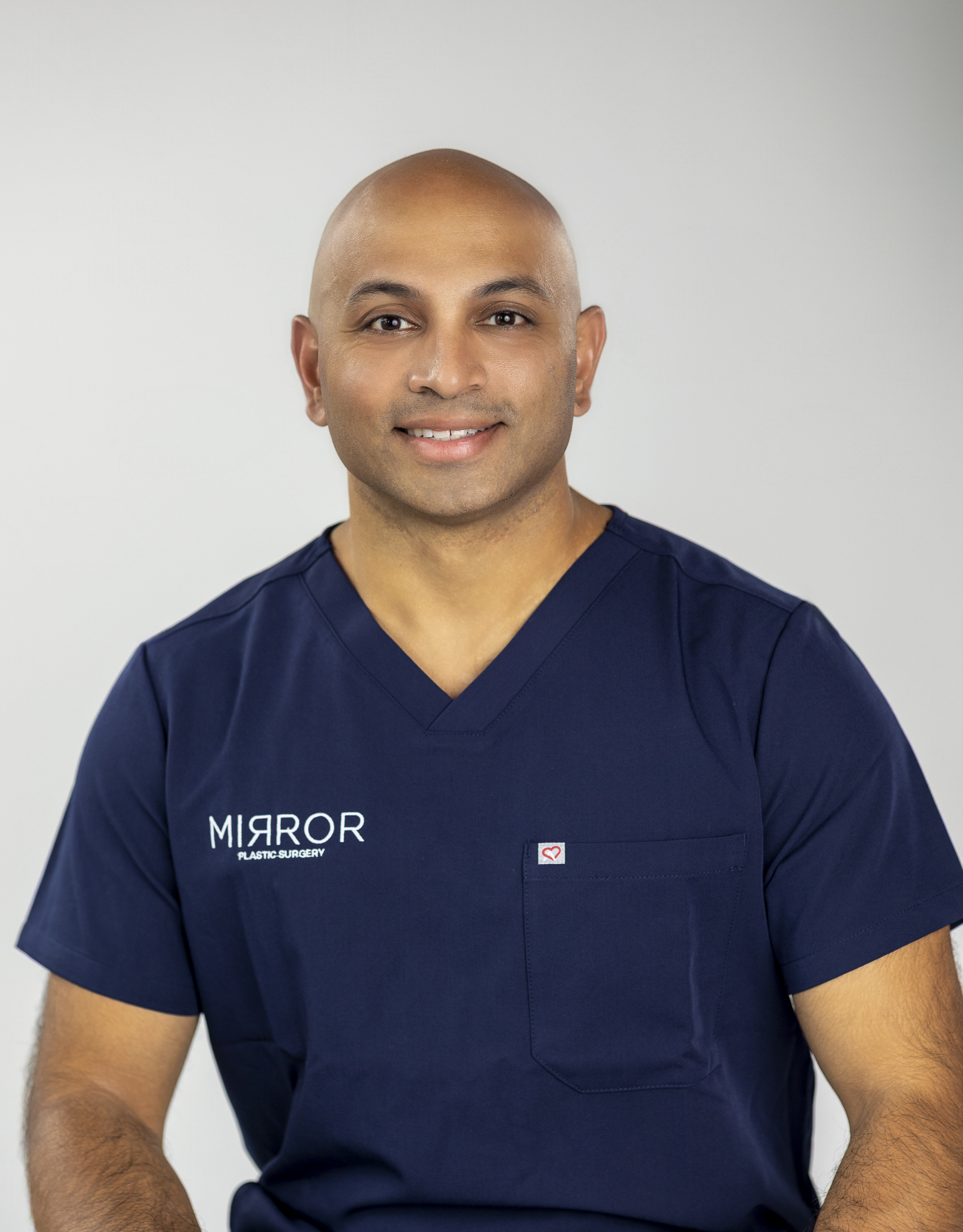
Get your lid laxity and vector anatomy evaluated by Dr. Akash before you commit to a specific surgical approach.
Post-Operative Care Steps That Shape Final Scars
Post-operative care works as a layered plan that supports healing at each stage. Sun protection forms the base of this plan. UV exposure during the first 6–12 months stimulates melanocyte activity along the healing incision and can worsen hyperpigmentation. Daily broad-spectrum SPF 30 or higher, combined with physical shielding using sunglasses, remains essential throughout this period.
Once the incision has fully epithelialized at about 4–6 weeks, patients can begin scar massage. Gentle transverse massage of the healed incision line helps break up superficial collagen cross-links and speeds softening. During this same period, lubrication plays a key role. Preservative-free artificial tears and ophthalmic ointment at night reduce corneal exposure symptoms while swelling temporarily affects lid closure.
Head elevation supports fluid drainage. Sleeping with the head elevated 30–45 degrees for the first two weeks reduces dependent edema and shortens the course of periorbital swelling. After full epithelialization, silicone sheeting or gel applied to the external incision line can further improve scar quality. Silicone products have a well-established role in reducing scar hypertrophy and improving final texture.
Other Common Risks: Dry Eye, Swelling, and Pigment Changes
Dry eye: Temporary lagophthalmos, or incomplete lid closure, and reduced blink efficiency often appear in the first weeks after lower blepharoplasty and can worsen pre-existing dry eye. Management usually includes lubricating drops, moisture chamber goggles at night, and close follow-up. Patients with baseline dry eye syndrome should complete a Schirmer’s test and an ophthalmologic evaluation before surgery.
Prolonged swelling: Periorbital edema can come and go for 3–6 months, especially in the morning. Lymphatic drainage massage, consistent head elevation during sleep, and early cold compresses help control this. Patients should understand that final results cannot be judged until swelling has fully resolved.
Hyperpigmentation: Post-inflammatory hyperpigmentation along the incision line occurs more often in Fitzpatrick skin types III–VI. Topical agents such as azelaic acid or niacinamide, combined with strict sun avoidance, usually form first-line treatment. In persistent cases, low-concentration hydroquinone or laser treatment may be considered after full scar maturation.
Lower Blepharoplasty: Common Patient Questions
How long does it take for lower blepharoplasty scars to fully fade?
External scars from a transcutaneous lower blepharoplasty usually reach their final appearance between 9 and 12 months after surgery.1 The most noticeable fading occurs between week 6 and month 6, as the scar shifts from pink to skin tone and flattens. Patients should avoid judging their final result before the 12-month mark, especially if they experienced post-operative swelling or hyperpigmentation.
When is it safe to consider scar revision or retraction correction if results are unsatisfactory?
Most surgeons recommend waiting 12 months after surgery before deciding on revision, because scar maturation and resolution of swelling or tissue contracture need that full period. Intervening earlier can compound the problem. Mild retraction that persists beyond 6 months without improvement, despite conservative care, deserves a surgical consultation to discuss whether canthopexy, spacer grafting, or skin grafting makes sense.
Are there activity restrictions that affect healing and scar quality?
Strenuous physical activity, heavy lifting, and any effort that significantly raises blood pressure should be avoided for the first two to three weeks, because these activities increase the risk of hematoma and prolonged swelling. Contact sports and activities with a clear risk of facial impact should be avoided for at least six weeks. Sun exposure to the incision area should remain limited for the entire first year to reduce the chance of hyperpigmentation.
Can lower blepharoplasty be combined with other procedures without increasing retraction risk?
Surgeons can often combine lower blepharoplasty with procedures that do not directly affect lower lid tension, such as upper blepharoplasty, brow lift, or facial fat transfer, when patient selection is appropriate. Combining lower blepharoplasty with procedures that change midface support or involve significant tissue manipulation near the lower lid requires more careful planning. Mirror Plastic Surgery limits surgeries to one or two per day so that combined procedures receive the same meticulous attention as standalone operations.
Does the transconjunctival approach completely eliminate scarring concerns?
The transconjunctival approach removes concerns about external visible scarring, because the incision sits inside the eyelid. Internal scarring can still occur and, in rare cases, may contribute to lid stiffness or altered fat distribution. The transconjunctival approach also does not correct excess lower eyelid skin. Patients with skin laxity who choose this route may later need a separate skin-pinch excision or laser resurfacing to treat skin redundancy, and those treatments do leave a small external mark.
Summary: Safe Planning and Realistic Expectations
Lower eyelid blepharoplasty produces minimal, well-concealed scarring for most patients, with final results established at about 12 months.1 Retraction risk remains real but measurable and can be reduced with careful anatomical assessment, conservative tissue handling, and technique selection tailored to each patient.
Dr. Akash approaches every lower blepharoplasty case through Mirror Plastic Surgery’s guiding framework of safety first, function second, and aesthetics third. That sequence reflects the principle that a beautiful lower eyelid result lasts only when the lid functions correctly and the patient’s ocular health stays protected.
Patients who understand realistic timelines, technique trade-offs, and their own anatomical risk profile are better prepared to make decisions that feel right long term. That conversation starts during a detailed consultation.
Schedule your comprehensive evaluation at Mirror Plastic Surgery in St. Petersburg, Florida to determine whether you are a candidate for lower eyelid blepharoplasty based on your individual risk profile.
1 Results may vary from person to person. Editorial content, before and after images, and patient testimonials do not constitute a guarantee of specific results.