
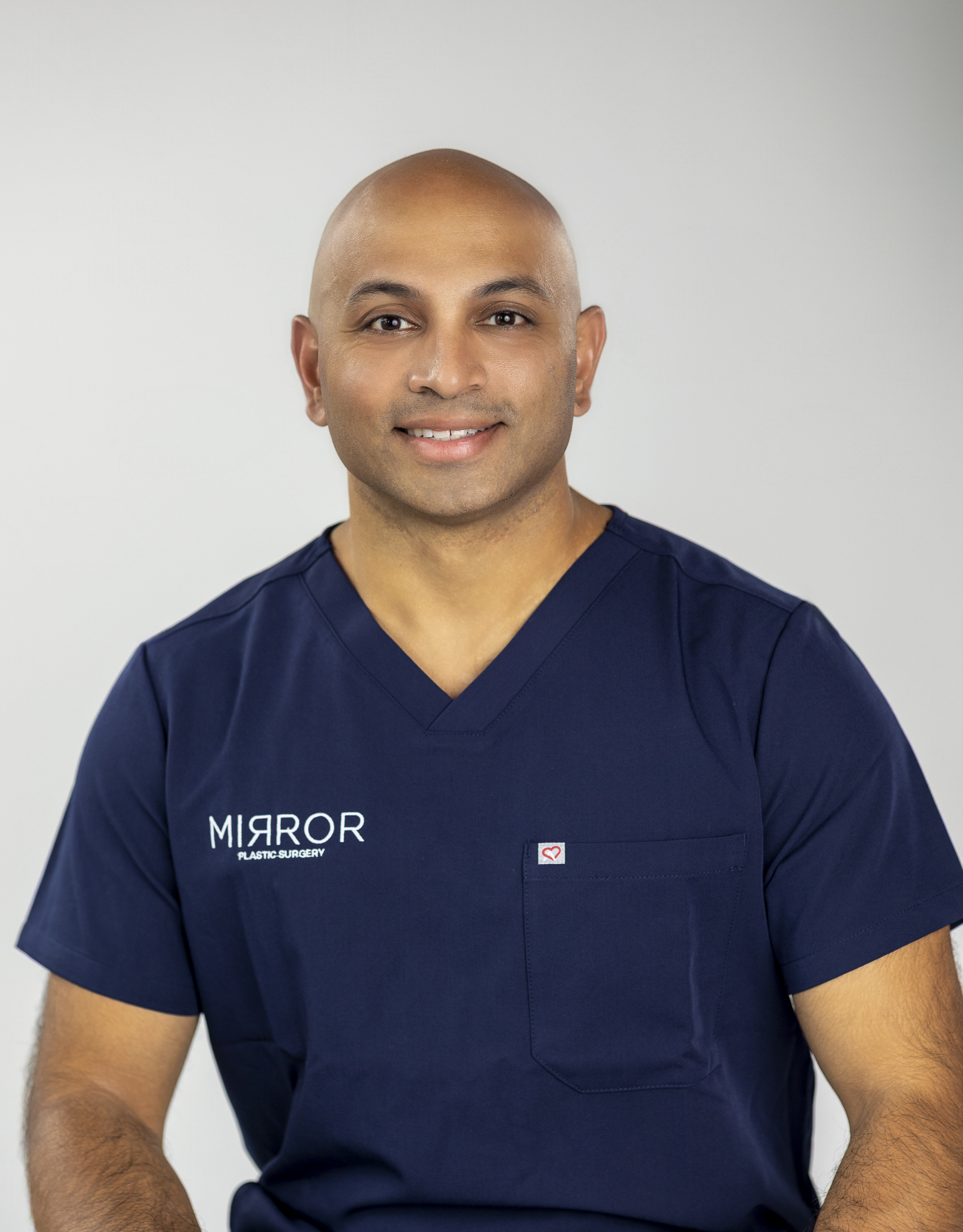
Written by: Dr. Akash Chandawarkar, Board Certified Plastic Surgeon, Mirror Plastic Surgery | Last updated: July 3, 2026
Key Takeaways
- Hip dips come from bone structure, not just muscle or fat, so exercise alone rarely erases them for most patients.
- Dermal fillers add temporary volume with lower immediate risk than surgery, but they need ongoing maintenance and carry injector-dependent safety risks.
- Advanced structural fat grafting by a fellowship-trained surgeon offers the most durable non-implant correction for well-selected candidates.1
- Surgeon experience, detailed planning, and lower daily surgical volume help reduce complication rates in hip dip surgery.
- Schedule your personalized consultation at Mirror Plastic Surgery to design the safest, anatomy-specific plan for your hip dips.
Why Hip Dips Happen and Why Exercise Has Limits
The iliac crest, or upper rim of the pelvis, varies in width from person to person. When the crest sits wide compared with the greater trochanter of the femur, a visible indentation forms at the outer hip. The gluteus medius and minimus muscles fill part of this space, yet their attachment points are fixed by bone and cannot shift outward.
Targeted lateral hip and glute exercises such as clamshells, hip abductions, and side-lying leg raises can build muscle and soften the contour. These movements cannot move the iliac crest or relocate fat into the trochanteric hollow. Patients with moderate to deep hip dips driven mainly by bone structure usually hit a plateau with exercise, no matter how consistent or intense their training.
Questions to raise in any consultation:
- Is my hip dip depth primarily skeletal, muscular, or fat-related?
- What is the realistic ceiling of improvement from exercise given my specific anatomy?
- At what point does a non-surgical or surgical option become the more efficient path?
For patients whose anatomy limits exercise-based improvement, non-surgical volume addition becomes the next step to consider, most often through dermal fillers.
Safety Profile of Hip Dip Fillers
Dermal fillers, usually hyaluronic acid (HA) products or biostimulatory agents such as calcium hydroxylapatite (Radiesse), can be injected into the subcutaneous layer of the lateral hip to add volume. When a qualified, board-certified physician selects the right product and depth, fillers carry lower immediate procedural risk than surgery. This area still presents specific safety considerations.
The lateral hip moves constantly with walking, sitting, and lying down. HA fillers here usually last six to twelve months before the body breaks them down. Biostimulatory fillers may last eighteen to twenty-four months, yet neither option is permanent. Repeated sessions increase total cost and expose the tissue to more interventions over time.
Incorrect injection depth, such as placing product too close to the skin surface or into a blood vessel, can cause nodules, asymmetry, or, in rare cases, vascular occlusion. The FDA has issued guidance noting that soft-tissue fillers carry risks including rare but serious vascular events, and those risks rise when injections occur outside a physician-supervised setting.
Fillers do not create permanent hip dip correction. Patients who choose fillers should plan for maintenance visits and recognize that each additional treatment adds to the cumulative risk profile.
Questions to raise in any consultation:
- Which filler product is most appropriate for the lateral hip, and why?
- What is the provider’s protocol if a vascular complication occurs?
- How many maintenance sessions per year are realistically required?
Schedule your consultation to receive an anatomical assessment and a clear comparison of filler versus structural options for your specific hip shape.
Comparing the Safest Hip Dip Correction Procedures
No single procedure qualifies as universally safest, because the right choice depends on hip dip depth, donor fat availability, skin quality, and overall health. The table below ranks common options from lowest to highest procedural risk. Because current research does not provide peer-reviewed complication-rate data specific to hip dip correction, these risk levels reflect general principles from plastic surgery literature and the Aesthetic Surgery Journal, not procedure-specific statistics.
| Option | Safety Tier | Longevity | Key Risks |
|---|---|---|---|
| Targeted exercise (gluteal/hip strengthening) | Lowest risk | Maintained only with ongoing training; limited by skeletal anatomy | Plateau effect; no structural volume addition |
| Dermal fillers (HA or biostimulatory) | Low-to-moderate risk (operator-dependent) | 6–24 months; requires maintenance cycles | Nodule formation, asymmetry, rare vascular occlusion; higher risk with non-physician injectors |
| Traditional autologous fat transfer (fat grafting) | Moderate risk | Variable; resorption rates are commonly cited in body contouring literature, often requiring volume overcorrection | Uneven resorption, contour irregularity, donor-site complications; highly operator-dependent |
| Advanced structural fat grafting (e.g., AlloClae-assisted adipose transfer) | Moderate risk (reduced with specialist technique) | Improved fat integration compared with traditional grafting; long-term data still emerging1 | Requires specialized training; outcomes vary significantly by surgeon volume and technique |
High-volume practices that perform five to ten body contouring procedures per day add another layer of operator-dependent risk. Shorter assessment time, less individualized planning, and limited post-operative monitoring can all affect outcomes. Mirror Plastic Surgery limits surgical days to one or two procedures so the full team can stay focused on each patient from start to finish.
For patients with enough donor fat and moderate to deep hip dips, advanced structural fat grafting by a fellowship-trained plastic surgeon offers the most durable non-implant option available today. Dr. Akash, named to Newsweek‘s America’s Best Plastic Surgeons list for two consecutive years (2024 and 2025), provides AlloClae-assisted fat transfer for hip dip correction at Mirror Plastic Surgery, using a technique that improves fat integration compared with conventional grafting.1
Real Risks of Hip Dip Surgery
Surgical hip dip correction, whether through fat grafting or implants, involves real risks that patients need to understand before giving consent. General surgical risks include infection, seroma, hematoma, and anesthesia-related events. Fat grafting adds specific risks such as uneven resorption with asymmetry, contour irregularity at the donor site, and possible need for revision. Implant-based lateral hip augmentation introduces additional risks including implant migration, capsular contracture, and a higher revision rate over time.
Operator-dependent risk remains the most underappreciated factor in hip dip surgery. A surgeon’s training depth, experience in this exact anatomical zone, and commitment to individualized pre-operative planning directly influence complication likelihood. The Aesthetic Surgery Journal consistently identifies surgeon experience and anatomical knowledge as primary predictors of body contouring outcomes, which supports this relationship. Practices that shorten consultations or operate at very high daily volume leave less room for the careful mapping that hip contouring requires.
Two common misconceptions deserve clear correction. Fillers do not provide permanent results, so patients expecting lifelong change from one session often feel disappointed and may chase repeated treatments that increase risk. Fat transfer techniques also differ meaningfully, since traditional lipoinjection and advanced structural grafting vary in fat processing, placement depth, and long-term retention.
Questions to raise in any consultation:
- What is your revision rate specifically for hip dip fat grafting?
- How many hip dip correction procedures do you perform per year?
- What is your protocol for managing asymmetry or contour irregularity after surgery?
Book a consultation with Dr. Akash, a Johns Hopkins-trained, Harvard-educated plastic surgeon, to discuss your candidacy and receive a direct, personalized risk assessment.
How Public Figures Usually Smooth Hip Dips
Public figures with fuller outer hips most often choose one of two paths. Many undergo surgical fat grafting, frequently paired with liposuction for donor fat harvest and overall sculpting. Others rely on repeated filler sessions that offer less durable but still noticeable contour changes.
A smaller group achieves improvement through consistent resistance training combined with favorable fat distribution. That outcome depends heavily on anatomy and usually does not apply to patients with wide iliac crests or very little fat over the greater trochanter.
Candidacy for surgical correction requires adequate donor fat, good skin elasticity at the lateral hip, stable body weight, and no medical contraindications to general or tumescent anesthesia. Recovery from fat grafting usually involves two to four weeks of activity restrictions and compression garment use. Final results appear over three to six months as swelling resolves and transferred fat stabilizes.
Patients must also consider functional limits during recovery, including temporary restrictions on side sleeping and high-impact exercise. These factors matter especially for people with physically demanding jobs or intensive training schedules.
Patients who are not surgical candidates, or who prefer to move in stages, can consider dermal fillers as a lower-commitment starting point with temporary results and ongoing maintenance. An honest consultation with a board-certified plastic surgeon remains the most reliable way to match treatment to anatomy, lifestyle, and long-term goals. Mirror Plastic Surgery’s resource on safest hip dips surgery options and results in Florida offers additional detail for those exploring surgery.
Frequently Asked Questions
Will my hip dips ever fill out naturally?
For most adults, bone structure determines hip dip depth and does not change much with age, weight shifts, or exercise. Targeted glute strengthening can create modest improvement when the dip is mainly muscular. Patients with wide iliac crests compared with their greater trochanters usually cannot achieve full correction through natural changes alone.
How long do structural fat grafting results last for hip dips?
Fat retention after grafting varies with technique, surgeon experience, and individual biology. Advanced structural grafting methods, including AlloClae-assisted transfer, aim to improve fat integration and reduce resorption compared with traditional lipoinjection. Patients can expect some volume settling during the first three to six months, followed by stable long-term results in well-selected cases.1 A thorough pre-operative assessment helps set realistic expectations.
Is one filler session enough for hip dips?
One filler session rarely provides lasting correction. The lateral hip needs significant volume for visible change, and filler in this area breaks down with daily movement. Most patients need multiple syringes per session and repeat treatments every six to eighteen months, depending on the product. Patients should weigh total long-term cost and repeated procedural exposure before committing to this path.
How do I choose a safe provider for hip dip correction?
Board certification by the American Board of Plastic Surgery serves as the baseline credential. Helpful additional factors include fellowship training in aesthetic surgery, documented experience with lateral hip contouring, a practice model that allows unhurried consultations, and hospital privileges for rare complications. Avoid providers who cannot explain their revision protocol clearly or who discourage detailed pre-operative questions.
Can hip dip correction be combined with other body contouring procedures?
Combination procedures can be safe for some patients, but they require careful risk review. Each added procedure increases operative time, anesthesia exposure, and overall stress on the body. Mirror Plastic Surgery follows a safety-first approach and often advises against stacking too many procedures at once, because evidence links this pattern to higher complication rates. Dr. Akash reviews each patient’s full health profile before recommending any combined plan.
Conclusion: Choosing a Safe, Realistic Hip Dip Plan
Hip dips reflect normal anatomy for many people, and available options range from exercise to fillers to advanced fat grafting. Each path carries its own balance of risk, longevity, and candidacy requirements. The safest route starts with an honest anatomical evaluation, clear expectations, and a surgeon whose training and practice structure place safety ahead of volume.
Dr. Akash, recognized nationally for surgical excellence, applies that standard to every hip contouring consultation at Mirror Plastic Surgery in St. Petersburg, Florida. Begin your evaluation with a personalized consultation to receive an anatomy-first assessment and a straightforward recommendation for your hip dip correction goals.
1 Results may vary from person to person. Editorial content, before and after images, and patient testimonials do not constitute a guarantee of specific results.