
Written by: Dr. Akash Chandawarkar, Board Certified Plastic Surgeon, Mirror Plastic Surgery | Last updated: July 11, 2026
Key Takeaways
- Ideal hairline design for receding patterns uses conservative, age-appropriate placement guided by the facial rule of thirds so results still look natural decades later.
- Long-term success depends on preserving donor reserves and planning for future procedures instead of maximizing grafts in a single session.
- Surgeon skill and credentials matter more than technology choices, and direct physician involvement in every phase is critical for natural outcomes.
- High-volume clinics carry higher complication and revision risks; Mirror Plastic Surgery limits daily procedures to maintain focused, high-quality care.
- Patients seeking personalized hairline assessment and long-term planning should schedule a comprehensive evaluation with Dr. Akash at Mirror Plastic Surgery.
Designing a Natural, Long-Lasting Hairline for Receding Patterns
An ideal hairline design for a receding pattern stays conservative and age-appropriate and follows the facial rule of thirds rather than the patient’s current hair loss stage. Expert consensus in hair restoration surgery favors conservative placement because it keeps the hairline looking natural at age 60 instead of increasingly artificial as native hair recedes. For most adults, the mid-frontal point of a natural hairline sits approximately 3.0–3.5 inches above the glabella. Pushing it lower can create a youthful look that becomes unsustainable as hair loss progresses.
The technical execution of a conservative design uses a single-hair leading edge, higher central density than lateral density, and deliberate micro-irregularity. The highest compliment for a hairline is that it is invisible as a procedure, achieved through micro-zigzag patterns, staggered single-hair graft placement, and controlled asymmetry instead of ruler-straight symmetry.
What to Expect 10 Years After a Hair Transplant
Transplanted follicles in the frontal and mid-scalp zones can maintain substantial density over the long term.1 Under well-executed conditions, a high percentage of grafts remain active many years after a hair transplant procedure, with some patients benefiting from a modest touch-up session for crown refinement or hairline fine-tuning.1
Preserving the donor reserve carries equal importance. A smart surgeon leaves a reserve of usually 20–25% of the donor bank untouched so patients retain options for future procedures as native hair recession continues. Planning for that reserve from the first session defines a long-term-oriented practice and shapes every design and graft-allocation decision.
Conservative Hairline Design Considerations for Long-Term Balance
The distinction between a mature and a juvenile hairline placement carries significant long-term consequences. Designing a hairline for the patient’s current age instead of their age trajectory is the most frequently violated principle in hair restoration and often leads to the isolated island failure pattern when native hair continues to recede around permanent transplanted grafts.
Conservative design rests on four interconnected principles. First, the hairline itself must be undetectable, achieved through a single-hair leading edge with micro-irregularity and transition zones. Second, density must be calibrated precisely, with approximately 35 follicular units per cm² in the transition zone, increasing to 50–55 FU/cm² just behind it. Third, graft allocation should follow a “less is more” philosophy that conserves donor reserves for potential future procedures instead of maximizing graft volume in a single session. Finally, density must stay balanced across zones, because excessive frontal density can appear unnatural later if surrounding native hair thins.
Common pitfalls of aggressive hairline design include placing the hairline too low, using straight-line designs, over-dense front rows with multi-hair grafts, and ignoring progressive balding patterns. These errors often create isolated islands of hair or force patients into revision surgery.
Donor Hair Preservation Strategies for Your Lifetime “Graft Budget”
The average maximum harvestable donor supply is approximately 6,000 follicular units. That figure represents a finite lifetime budget. Experienced FUE surgeons achieve transection rates below 5%, while inexperienced surgeons have substantially higher rates. Lower transection directly preserves that finite supply and reduces the likelihood of revision surgery.
Overharvesting leading to visible donor depletion is increasingly observed in high-volume FUE sessions exceeding 3,000–4,000 grafts, particularly when performed by inadequately trained teams or in patients with insufficient preoperative donor assessment. To prevent this depletion, the evidence-based approach limits extraction density to 10–20% per session and integrates long-term surgical planning from the outset. The 10–20% per-session limit also helps protect the 20–25% lifetime reserve discussed earlier so patients keep options open across multiple procedures.
ARTAS Versus Manual FUE: Why Surgeon Skill Matters Most
The single biggest variable in hair transplant outcome is surgeon experience and skill rather than technique, with differences between surgeons outweighing differences between techniques such as FUE, DHI, or robotic assistance. Robotic systems like ARTAS can assist with extraction geometry but cannot match the artistic judgment required for hairline design, graft angulation, or long-term progression planning.
Direct surgeon involvement in all critical phases is essential, and turn-key clinic models where unlicensed technicians perform hairline design, recipient site creation, graft extraction, and placement while the surgeon only supervises compromise patient outcomes and increase revision risk. The technology used matters far less than the person executing each step of the procedure.
How to Evaluate Hair Transplant Tampa Surgeon Credentials
Credential verification is the most reliable filter when evaluating a hair transplant Tampa surgeon. The table below shows how Dr. Akash’s training exceeds industry minimums at every stage, from medical school through fellowship, a pattern that separates academically trained surgeons from volume-driven practitioners.
| Credential Category | Industry Benchmark | Dr. Akash at Mirror Plastic Surgery | Verification Source |
|---|---|---|---|
| Medical Education | Accredited M.D. program | Harvard Medical School (cum laude), Harvard-MIT HST joint program; undergraduate neuroscience and nuclear engineering at MIT | Mirror Plastic Surgery company records |
| Surgical Residency | Plastic or facial surgery residency | Seven-year integrated plastic and reconstructive surgery residency, Johns Hopkins University / University of Maryland | Mirror Plastic Surgery company records |
| Aesthetic Fellowship | 9–12 month fellowship, minimum 70 cases | Aesthetic Surgery Fellowship, Manhattan Eye, Ear and Throat Hospital (MEETH) / Lenox Hill Hospital | Mirror Plastic Surgery company records |
| Innovation Training & Recognition | Board certification; documented outcomes | Advanced training with board certification and documented outcomes | Mirror Plastic Surgery company records |
Major academic centers including Johns Hopkins and UCLA Health position hair transplant procedures within their facial plastic surgery divisions, recognizing that combined facial aesthetic expertise and hair restoration specialization produces superior natural outcomes compared to volume-driven or technician-led approaches. Dr. Akash’s Johns Hopkins residency and MEETH fellowship place him squarely within that academic tradition.
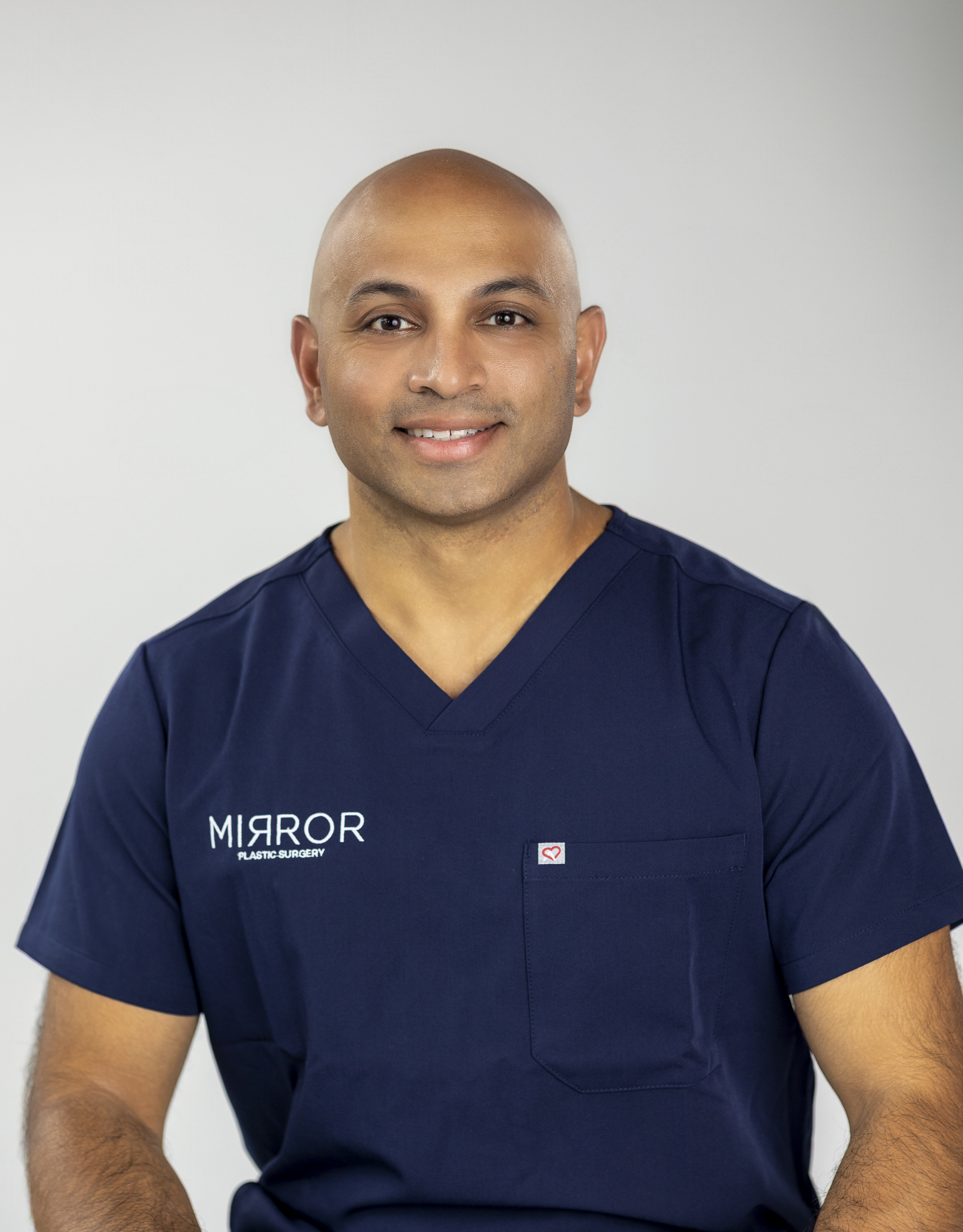
Schedule your personalized assessment with Dr. Akash to review your candidacy, donor supply, and long-term hairline design strategy.
High-Volume Practice Risks and Complication Data
High-volume clinics have been associated with higher complication rates than lower-volume practices. The downstream consequences form a clear pattern of risk.
- Graft survival rates can be lower in high-volume settings compared to those achieved by expert teams.
- Anecdotal reports from corrective surgeons indicate that 30–40% of high-volume clinic patients seek revision procedures, compared to a 5–10% rate in ethical practices.
- Repair procedures climbed to 6.9% of all hair transplant cases in 2024, up from 5.4% in 2021, representing a 28% relative increase in corrective surgeries over three years.
- The tragic nature of donor depletion mentioned earlier stems from its permanence, because once overharvested, no future surgical options remain.
Mirror Plastic Surgery limits itself to one to two surgeries per day, so the entire clinical team’s focus remains on a single patient before, during, and after the procedure. This approach directly contrasts with the assembly-line model reflected in the complication data above and supports safer, more consistent outcomes.
Integrating PRP and Medication for Long-Term Hair Stability
Long-term success depends not only on surgical design but also on protecting the native hair that surrounds transplanted grafts. Surgical restoration addresses existing recession, and adjunct therapies protect the remaining hair and support graft performance. PRP yields optimal results when used as a supportive therapy before and after hair transplantation to enhance graft survival.1 A 2014 study found that autologous activated platelet-rich plasma injections increased hair count by an average of 18.0 hairs in treated areas.1
Medical therapy plays an equally important role in long-term planning. Post-operative medications including finasteride and minoxidil combined with PRP protect native hair and improve graft survival. Adoption of these adjuncts continues to grow, and according to the 2025 ISHRS Practice Census, oral finasteride is prescribed always or often by 72.3% of surgeons and oral minoxidil by about 65%. A ten-year retrospective study found a statistically significant correlation between patient satisfaction at 10 or more years post-transplant and consistent use of hair loss medications.
Frequently Asked Questions
Am I a good candidate for a hair transplant if I am Norwood 2–3?
Norwood 2–3 patients often make strong candidates for hair transplant surgery. At this stage, the donor supply is typically sufficient relative to the coverage area, and the overall hair loss pattern has not yet advanced to a point where donor conservation becomes critically constrained. A thorough consultation evaluates donor density, hair caliber, family history of progression, and whether medical stabilization with finasteride or minoxidil makes sense before surgery. The goal is to design a hairline that remains natural today and across a 20-year trajectory.
How long does recovery take after an FUE hair transplant?
Most patients return to desk work within three to five days.1 Redness and minor scabbing in the recipient area typically resolve within ten to fourteen days.1 Transplanted hairs enter a shedding phase at two to four weeks, which represents a normal part of the follicular cycle. Visible regrowth usually begins at three to four months, with full aesthetic impact typically apparent at nine to twelve months.1 Surgeons generally restrict strenuous exercise and direct sun exposure to the scalp for the first two to four weeks.
What is the risk of an unnatural-looking result, and how is it avoided?
The primary driver of unnatural results is poor hairline design rather than failure of basic surgical technique. Placing the hairline too low, using multi-hair grafts at the leading edge, or failing to account for future recession are the most common design errors. Surgeons avoid these problems through conservative placement using the facial rule of thirds, a single-hair leading edge with micro-irregularity, and a long-term progression plan that anticipates where the patient’s hairline will sit in two decades. Surgeon involvement in every critical phase, including design, extraction, and placement, remains non-negotiable for natural outcomes.
How does Mirror Plastic Surgery’s one-to-two-surgery daily limit affect my procedure?
Limiting the surgical day to one or two procedures keeps the surgeon and the entire clinical team fully focused on a single patient. Graft viability is time-sensitive, and follicular units outside the body begin to deteriorate, so rushed handling in high-volume settings directly reduces survival rates. A focused daily schedule also allows for unhurried hairline design, precise angulation of each graft, and attentive post-operative monitoring. These factors together influence whether the result looks natural at one year and at ten years.
Do I need ongoing treatment after a hair transplant?
Transplanted follicles remain permanent in the recipient zone because of donor dominance, meaning they are genetically resistant to the hormonal signals that cause androgenetic alopecia. Surrounding native hair, however, continues to be susceptible to ongoing loss. Medical therapy with finasteride and minoxidil, along with adjunct treatments such as PRP, helps slow that progression and protect the aesthetic result. Without medical management, continued native hair loss can create a density gradient around the transplanted area that requires additional grafting sooner than planned. Long-term maintenance therefore forms an integral part of a complete hair restoration strategy.
Discuss your hairline goals and long-term restoration strategy with Dr. Akash, a Harvard-MIT and Johns Hopkins-trained plastic surgeon recognized by Newsweek as one of America’s Best Plastic Surgeons.
1 Results may vary from person to person. Editorial content, before and after images, and patient testimonials do not constitute a guarantee of specific results.