
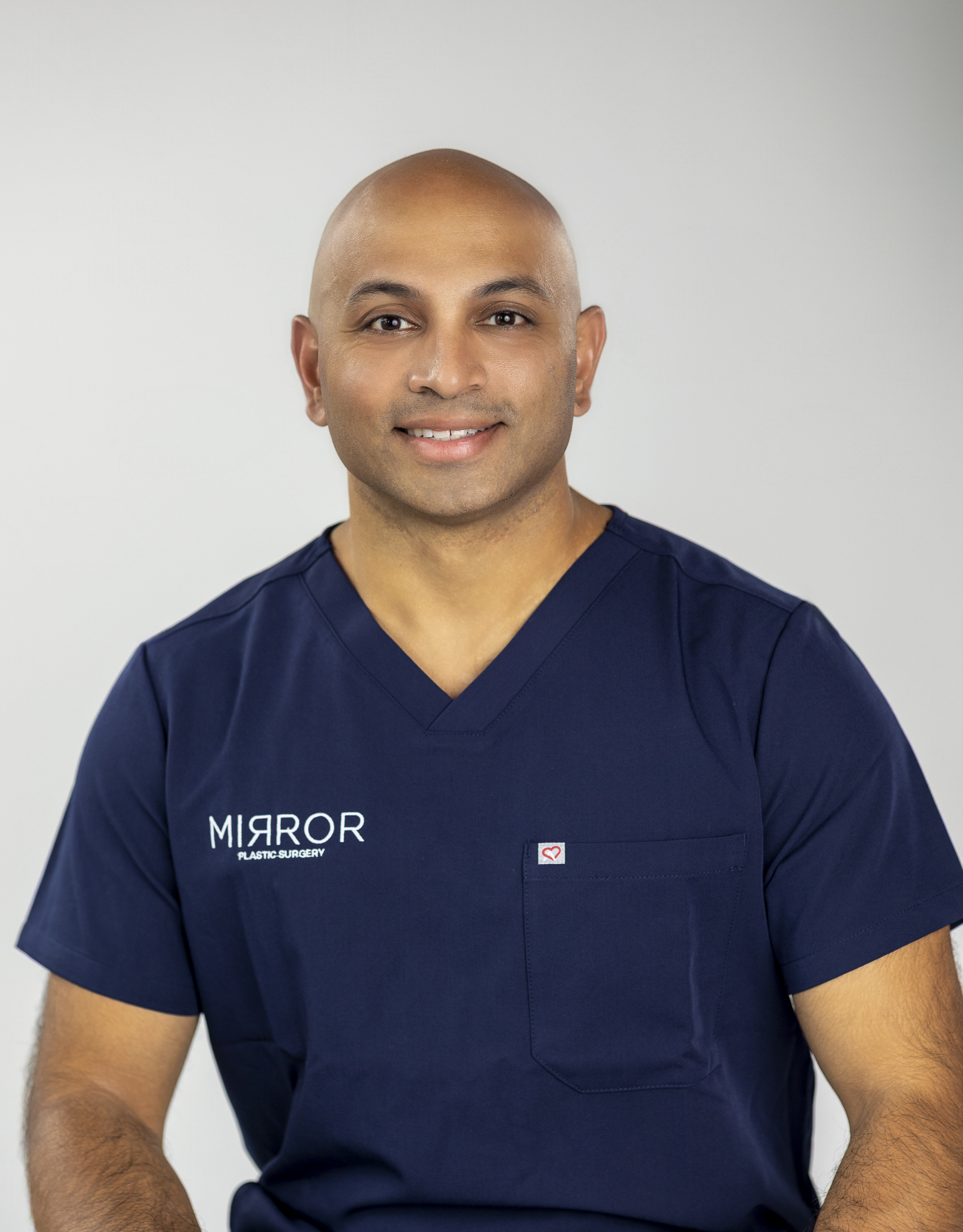
Written by: Dr. Akash Chandawarkar, Board Certified Plastic Surgeon, Mirror Plastic Surgery
What Sets Mirror Plastic Surgery’s Concierge Care Apart
- Mirror Plastic Surgery limits daily procedures to one or two, which allows up to 60-minute consultations and consistent care from the same team.
- The practice follows a safety-function-aesthetics hierarchy supported by ABPS board certification, accredited facilities, and board-certified anesthesiologist oversight.
- Limiting daily case volume and avoiding high-volume procedure stacking reduces complication risks and supports better long-term outcomes.1
- Out-of-town patients receive dedicated coordinator support, virtual pre-op planning, and guidance for at least two weeks of local recovery in St. Petersburg.
- Patients seeking concierge plastic surgery in St. Petersburg can schedule an unhurried consultation with Dr. Akash at Mirror Plastic Surgery to discuss personalized goals.
The Safety-Function-Aesthetics Framework at Mirror Plastic Surgery
Mirror Plastic Surgery follows a clear order of priorities: safety first, function second, aesthetics third. This sequence reflects a clinical framework that guides every treatment decision rather than marketing language.
Safety includes rigorous pre-operative evaluation, operation in accredited surgical facilities, board-certified anesthesiologist oversight, and advanced in-office diagnostic tools such as ultrasound for pre-operative assessment. Board-certified plastic surgeons must maintain hospital privileges and operate only in accredited surgical facilities that meet strict regulatory standards for patient safety and emergency preparedness. Dr. Akash holds American Board of Plastic Surgery (ABPS) certification, the only ABMS-recognized board certifying physicians in plastic surgery in the United States, which also grants privileged hospital access in the rare event of a surgical complication.
Function focuses on the structural role of each procedure. Many operations at Mirror Plastic Surgery restore or improve physical function by relieving musculoskeletal strain, correcting animation deformities, or restoring abdominal muscle integrity after pregnancy or significant weight change. When these functional improvements are achieved, aesthetics follow naturally from this foundation because restored anatomy creates visual harmony without cosmetic excess. By rebuilding underlying structure, the practice produces results that look natural, athletic, and long-lasting rather than artificially imposed.1
Each consultation includes anatomical education that supports safety, function, and aesthetics. During every appointment, patients learn how aging, weight change, or anatomy affects the area being treated, why a specific technique is recommended, and what realistic outcomes look like for their unique structure. This educational approach helps patients evaluate recommendations critically instead of accepting them on faith.
How Limited Daily Case Volume Supports Safer Outcomes
Research across surgical specialties shows a strong relationship between case volume and patient outcomes. Multiple large-scale studies analyzing over 10,000 liposuction cases demonstrate an inverse correlation between annual surgeon case volume and complication rates, with surgeons performing more than 100 liposuction procedures per year showing significantly lower complication rates than those performing fewer than 25 per year.1 A 10-year ACS-NSQIP analysis of 128,545 reconstructive procedures found that operative times and complication rates were generally inversely proportional to case volume across surgical specialties.
These data describe annual experience, yet how that volume is distributed across days also matters. A surgeon who performs one to two carefully selected procedures per day, every operating day, builds substantial annual volume while preserving focused attention for each case. When daily volume is compressed into many long cases, the risk profile changes because longer operative days, fatigued teams, and reduced time for intraoperative decision-making can increase complication potential.
High-volume liposuction, defined as removing more than five liters of fat in a single session, creates greater physiological strain from fluid shifts and blood loss and carries elevated complication risk, including fluid imbalance, shock, extended anesthesia exposure, deep vein thrombosis, and pulmonary embolism. Mirror Plastic Surgery advises against combining too many procedures at once, which aligns with published evidence that procedure stacking can sharply increase complication rates.
Many private practice-affiliated ambulatory surgery centers employ only Certified Nurse Anesthetists to administer anesthesia, while board-certified anesthesiologist involvement is cited as a significant safety indicator for procedures involving general anesthesia. Mirror Plastic Surgery requires board-certified physician anesthesiologists for every operative case, reflecting the practice’s non-negotiable commitment to patient safety. These safety standards apply to both local and traveling patients and contribute to St. Petersburg’s appeal as a destination for concierge-level care.
Out-of-Town Plastic Surgery and Recovery Planning in St. Petersburg
St. Petersburg, Florida has become a frequent destination for patients traveling from across the United States for elective plastic surgery. The city’s accessibility, climate, and concentration of qualified surgeons make it practical for out-of-town patients to plan a complete surgical and recovery itinerary.
Mirror Plastic Surgery supports traveling patients with dedicated coordinator assistance from the first inquiry through post-operative follow-up. Pre-operative consultations can take place virtually to confirm candidacy and outline surgical planning before travel, with an in-person visit scheduled closer to the procedure date. Comprehensive out-of-town patient support, including extended virtual consultations and coordinated pre- and post-operative care planning, is a recognized standard for practices serving patients from across Florida and the United States.
Most patients traveling to St. Petersburg for surgery should plan a minimum two-week local recovery period before returning home. Out-of-town patients must arrange for a trusted adult to drive them home after surgery and remain with them for the first day and night, and discharge alone or via public transport is prohibited. Private recovery accommodations near the practice allow easy access to post-operative appointments and reduce the strain of long-distance travel during early healing.
Florida’s regulatory environment adds another layer of protection for body contouring patients. State law requires real-time ultrasound guidance during fat injection for gluteal fat grafting to help avoid intramuscular injection. Patients who travel to Florida for these procedures benefit from these safeguards when they choose an accredited, ABPS-certified practice.
Connect with our patient coordinator to plan your travel, procedure, and recovery timeline.
Dr. Akash’s Training, Credentials, and Professional Roles
The concierge model at Mirror Plastic Surgery rests on the training and credentials of Dr. Akash, whose education spans several of the most selective academic and surgical institutions in the United States. He has been named to Newsweek’s America’s Best Plastic Surgeons list for two consecutive years, including 2025.
| Institution | Program | Focus |
|---|---|---|
| Massachusetts Institute of Technology (MIT) | Undergraduate | Neuroscience and Nuclear Engineering |
| Harvard-MIT Division of Health Sciences and Technology (HST) | M.D. Program | Physician-scientist training integrating research and clinical medicine; graduated Harvard Medical School cum laude with Honors |
| Johns Hopkins University | Seven-Year Integrated Residency | Plastic and Reconstructive Surgery, including Johns Hopkins Hospital, R Adams Cowley Shock Trauma Center, and Curtis National Hand Center |
| Manhattan Eye, Ear and Throat Hospital (MEETH) / Lenox Hill Hospital | Aesthetic Surgery Fellowship | Advanced facial rejuvenation, breast surgery, and body contouring |
| Stanford University | Biodesign Innovation Fellowship | Medical device innovation and unmet clinical need identification |
Beyond formal training, Dr. Akash serves as Next Generation Editor for the Aesthetic Surgery Journal, has testified before the U.S. Food and Drug Administration on breast implant safety, and sits on advisory boards for companies developing technologies in breast augmentation, cellulite treatment, minimally invasive facial procedures, and biostimulatory fillers. ABPS certification requires graduation from medical school, completion of an accredited 6+ year residency covering reconstruction, hand, microsurgery, craniofacial, and aesthetic surgery, and passing comprehensive written and oral examinations. His seven-year Johns Hopkins integrated residency and MEETH aesthetic fellowship extend well beyond these minimum requirements.
Key Questions for Evaluating Any Concierge Plastic Surgery Practice
Patients comparing concierge plastic surgery practices in St. Petersburg or the broader Tampa Bay area benefit from a focused set of questions that reveal how a practice truly operates.
- How many surgeries does the surgeon perform each day? A genuine concierge model limits daily volume to one or two cases. Practices performing five to ten procedures daily follow a very different attention model regardless of marketing language.
- Who administers anesthesia, and what are their credentials? Board-certified anesthesiologists leading care teams, rather than CRNAs operating independently, represent the highest standard of anesthesia safety for elective cosmetic procedures.
- Will the consultation include anatomical education specific to my case? A surgeon who explains the anatomy of the area being treated, how aging or other factors affect it, and why a specific technique is recommended provides the information patients need for truly informed consent.
- How are long-term results managed? Concierge practices maintain ongoing relationships with patients instead of treating each procedure as a one-time transaction. Ask whether the practice offers structured follow-up and how complications or revision needs are handled.
- Is the surgeon ABPS board-certified, and can that be verified? Patients can verify ABPS certification status directly at certificationmatters.org or abplasticsurgery.org. Any surgeon can legally perform plastic surgery in Florida without specific training in the field, which makes independent verification of ABPS certification essential.
Frequently Asked Questions
Who is a good candidate for concierge plastic surgery at Mirror Plastic Surgery?
Ideal candidates are adults in good general health who have specific, realistic aesthetic goals and understand that outcomes depend on anatomy, healing biology, and long-term maintenance. During a comprehensive consultation of up to 60 minutes, Dr. Akash reviews the full medical history, examines the treatment area, and evaluates the patient’s motivations and expectations. Candidacy is determined individually because no two patients share the same anatomy or goals, and Mirror Plastic Surgery does not use a one-size-fits-all approach. Patients with significant medical comorbidities, active smoking habits, or unrealistic expectations may be advised to address those factors before proceeding.
How should out-of-town patients prepare for surgery and recovery in St. Petersburg?
Out-of-town patients should arrive in St. Petersburg at least one to two days before their procedure to complete final pre-operative appointments and settle in. A trusted adult companion must provide transportation home after surgery and remain available for the first 24 to 48 hours of recovery. Patients should arrange private accommodations close to the practice for a minimum of two weeks for most procedures. Before traveling, patients should stop smoking at least four to six weeks before surgery, discontinue blood-thinning medications and supplements as directed, and prepare their recovery space with supportive pillows, accessible supplies, and completed household tasks to avoid overexertion. Mirror Plastic Surgery’s dedicated coordinator assists out-of-town patients with this logistical planning from the initial inquiry.
What is the difference between a board-certified plastic surgeon and a cosmetic surgeon in Florida?
In Florida, any licensed physician may legally perform cosmetic procedures regardless of surgical training or specialty background. The American Board of Plastic Surgery (ABPS) is the only ABMS-recognized board certifying physicians in plastic surgery in the United States and requires a minimum of six years of post-medical-school surgical training, at least three years dedicated to plastic surgery residency, and passage of comprehensive written and oral examinations. The generic title “board-certified cosmetic surgeon” does not carry the same requirements and may reflect certification from boards not recognized by the American Board of Medical Specialties. Before committing to any procedure, independently verify the surgeon’s ABPS status using the resources mentioned above.
What recovery timeline should patients expect after a facelift or body contouring procedure?
Recovery timelines vary by procedure, patient health, and the extent of surgery. For facelift procedures, most patients need one to two weeks before returning to light daily activity, with more strenuous activity restricted for four to six weeks. Body contouring procedures such as tummy tuck or liposuction usually involve a similar initial recovery window, with compression garment use continuing for several weeks. Swelling and final aesthetic results continue to evolve for three to six months or longer depending on the procedure.1 Dr. Akash provides individualized recovery guidance during consultation and follow-up, and the Mirror Plastic Surgery team remains accessible throughout healing to address questions or concerns.
How does Mirror Plastic Surgery evaluate and manage long-term aesthetic outcomes?
Mirror Plastic Surgery’s concierge model centers on long-term patient relationships rather than single-episode care. Non-surgical treatments are planned with maintenance in mind, and surgical outcomes are monitored through structured follow-up appointments. Dr. Akash uses evidence-based treatment planning, so every recommendation is grounded in anatomical understanding and documented efficacy, not quota-driven upselling. Patients receive direct guidance on what a procedure can and cannot achieve for their specific anatomy, and the practice explains techniques or combinations that carry higher revision or complication risk so patients can make fully informed decisions.
Making an Informed Decision About Concierge Plastic Surgery
Choosing a plastic surgeon in St. Petersburg or the broader Tampa Bay area requires evaluating credentials, care model, facility standards, and the quality of information provided during consultation rather than focusing on price alone. A UC Davis Medical Center study of patients treated for aesthetic surgery complications between 2020 and 2023 reported a median hospital charge exceeding $43,000 per patient, with charges surpassing $125,000 for those requiring additional surgery, which reframes the cost calculus of choosing a lower-priced, less credentialed provider.
The concierge model at Mirror Plastic Surgery, with one to two surgeries per day, up to 60-minute consultations, board-certified anesthesiologist oversight, ABPS certification, and a safety-function-aesthetics hierarchy, addresses structural factors that research links to better outcomes and lower revision risk.1 Board certification by the American Board of Plastic Surgery confirms that a surgeon has completed accredited residency training, passed rigorous examinations, and adheres to ongoing continuing education requirements; for procedures such as facial fat grafting and body contouring, surgeon experience directly correlates with safety and outcomes.
Patients who prioritize safety, functional restoration, and natural aesthetics, and who want a surgeon whose training spans MIT, Harvard Medical School, Johns Hopkins, MEETH, and Stanford, can begin with a thorough, no-pressure consultation.
1 Results may vary from person to person. Editorial content, before and after images, and patient testimonials do not constitute a guarantee of specific results.