
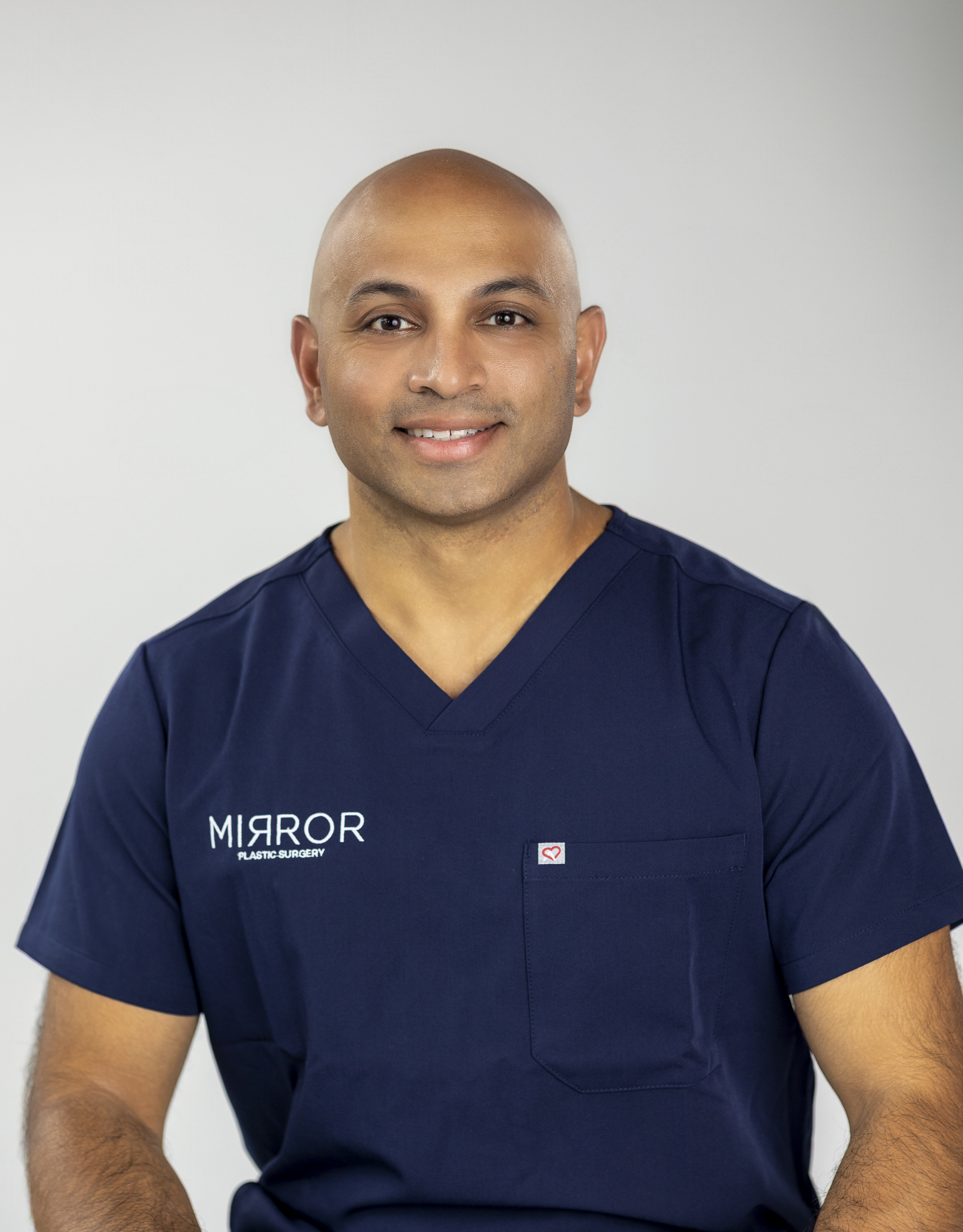
Written by: Dr. Akash Chandawarkar, Board Certified Plastic Surgeon, Mirror Plastic Surgery | Last updated: July 10, 2026
Key Points Before You Choose Cheek Slimming
- Buccal fat pads are a permanent, encapsulated deep structure that does not shrink with weight loss, exercise, or topical treatments.
- Non-surgical options such as masseter Botox, dermal fillers, RF microneedling, and off-label Kybella treat subcutaneous fat, masseter hypertrophy, or skin laxity, not the buccal fat pad itself.
- Accurate anatomical assessment clarifies whether cheek fullness comes from buccal fat, subcutaneous fat, masseter muscle, or bone structure before any treatment choice.
- Surgical buccal fat removal carries long-term aging risks, including premature hollowing, so non-surgical options suit most patients who want reversible contouring.
- Schedule a personalized consultation at Mirror Plastic Surgery for a layered facial evaluation and guidance on the safest, most effective plan for your goals.
Why Buccal Fat Does Not Shrink Without Surgery
Natural weight loss does not reduce or remove buccal fat pads, which are a distinct anatomical structure unrelated to subcutaneous fat associated with obesity. The buccal fat pad sits deep to the superficial musculoaponeurotic system (SMAS) and is encapsulated.
This deep, separate position explains why weight loss changes the face but often leaves lower-cheek fullness. A patient who loses 20 pounds may notice slimmer cheeks, yet that change reflects subcutaneous fat reduction, not buccal pad reduction. If prominent lower-cheek fullness persists after significant weight loss, the buccal fat pad is the more likely contributor, and non-surgical alternatives cannot remove it directly. Facial exercises, face yoga, and topical treatments cannot reduce buccal fat because the buccal fat pad is a deep, encapsulated anatomical structure.
As Dr. Akash explains: “Before recommending any contouring approach, I need to determine whether a patient’s cheek fullness is coming from subcutaneous fat, the buccal pad itself, masseter hypertrophy, or simply their underlying bone structure. Each of those requires a completely different treatment strategy, and getting that assessment wrong leads to results that either do nothing or accelerate aging.”
Natural and Non-Surgical Ways to Slim the Lower Face
True buccal fat reduction without surgery is not achievable. Given the encapsulated nature of buccal fat pads described above, non-surgical strategies instead change how full the lower face appears by targeting nearby tissues.
- Reduce subcutaneous facial fat through sustained caloric deficit and cardiovascular exercise.
- Reduce masseter muscle bulk with neuromodulator injections such as Botox or Dysport.
- Create optical contrast with strategic cheekbone filler placement.
- Improve skin laxity and subdermal tissue quality with RF microneedling or FaceTite.
For patients whose fullness is primarily subcutaneous or masseter-driven, these approaches can create visible and satisfying slimming without surgery.1
How to Tell Buccal Fat from Subcutaneous Fat, Muscle, and Bone
Accurate self-assessment starts with four distinct anatomical contributors to lower-face width. No online guide replaces an in-person evaluation, yet this framework helps you arrive at a consultation with clearer questions.
- Buccal fat pad: Fullness centered in the lower cheek, below the cheekbone, that persists regardless of body weight. It does not change with jaw clenching and has usually been present since adolescence.
- Subcutaneous fat: Fullness that fluctuates with body weight. It spreads more broadly across the cheek and jowl and responds to weight loss.
- Masseter hypertrophy: Squareness or width at the jaw angle that becomes more prominent when you clench your teeth. It often appears with bruxism and responds to neuromodulator injections.
- Bony structure: Wide zygomatic arches or a broad mandibular angle that you can feel on palpation and that does not change with any soft-tissue treatment. Surgical options such as implants or bone contouring are the only modifiers.
Buccal fat removal suits only patients with objectively prominent buccal fat pads that create disproportionate lower-cheek fullness, not general facial roundness from weight or normal variation.
Once you understand which anatomical layer drives your concern, you can compare treatment options that target that specific layer and weigh permanence, risk, and evidence quality.
Ranked Comparison of Buccal Fat Removal Alternatives
The table below scores four non-surgical and minimally invasive alternatives across permanence, invasiveness, evidence level, and long-term aging risk. All ratings reflect published clinical data and expert consensus cited inline.
| Option | Permanence | Invasiveness | Evidence Level | Long-Term Aging Risk |
|---|---|---|---|---|
| Masseter Botox | Temporary (3–6 months per cycle), reversible with no permanent structural change | Minimal, needle injection only | High, well-established neuromodulator use with a defined safety profile | Low, injectables carry very few risks when performed by a board-certified surgeon or dermatologist |
| Dermal Fillers (cheekbone) | Temporary (6–24 months) | Minimal, needle or cannula injection | Moderate to high, hyaluronic acid fillers lift the cheek and create an illusion of definition | Low to moderate, with overfilling over time possibly distorting facial proportions if not managed |
| RF Microneedling / FaceTite | Semi-permanent, collagen remodeling effects are durable but continue to evolve with natural aging | Low to moderate, micro-needle penetration with thermal energy | Moderate, clinical trials show significant submental contour improvement with high patient satisfaction | Low, because collagen stimulation supports tissue quality over time |
| Off-Label Kybella (submental/jowl) | Permanent fat cell destruction, fat cells do not regenerate, so results remain stable if weight stays stable | Moderate, multiple injection sessions with post-treatment swelling | Moderate, FDA-approved for submental fat, with off-label cheek or jowl use requiring careful anatomical judgment | Moderate, because permanent volume reduction in an already-aging face can create long-term hollowing if selection is poor |
Schedule your personalized treatment evaluation to match these options with your anatomy, goals, and long-term facial aging pattern.
Why Weight Stability Comes Before Facial Procedures
Patients who have not yet reached a stable, healthy body weight should focus on lifestyle changes before any facial contouring procedure. Subcutaneous facial fat responds to sustained caloric deficit, and meaningful weight loss can slim the cheeks enough that further intervention becomes unnecessary.
Ideal candidates for any facial contouring procedure, surgical or non-surgical, are at a stable weight, because ongoing weight fluctuation after treatment can distort results. Patients considering buccal fat removal specifically should reach their target weight first. If lower-cheek fullness persists at a stable weight, the buccal pad more likely represents the primary contributor.
How Masseter Botox and Cheek Fillers Shape the Face
Botox or Dysport injected into the masseter muscles defines the jawline by reducing the bulk of the chewing muscle at the jaw angle. Results usually appear within several weeks and last three to six months per treatment cycle, with cumulative muscle atrophy often extending intervals over time.1 This approach works especially well for patients whose lower-face width comes from masseter hypertrophy rather than fat.
Cheekbone dermal fillers work through a different mechanism. Instead of removing volume from the lower face, they add strategic projection to the mid-face and create a shadow effect that makes the lower cheek appear slimmer by contrast. Cheekbone dermal fillers create contrast without volume removal, which makes them a low-risk option for patients concerned about long-term hollowing.
Energy-Based Tightening with Morpheus8, FaceTite, and RF Microneedling
RF microneedling devices deliver controlled heat through fine needles into the deeper layers of the skin to stimulate collagen remodeling while improving surface texture. Devices such as Morpheus8 and FaceTite combine radiofrequency energy with microneedling or subdermal heating to tighten skin and modestly reduce subdermal fat volume in the lower face and jowl.
A 2026 pilot study by Dziabas et al. using a 1210-nm subcutaneous laser lipolifting technique reported cheek volume reductions per session in facial contouring patients, with all participants rating outcomes as “very much improved” on the Global Aesthetic Improvement Scale and no serious adverse events beyond transient swelling and mild bruising.1 The procedure required no patient downtime and was performed under local anesthesia.
Energy-based approaches suit patients with mild to moderate subdermal laxity and subcutaneous fat excess, not those with true buccal pad prominence.
Key Considerations for Off-Label Kybella in the Lower Face
Injectable deoxycholic acid (Kybella) disrupts the membranes of fat cells, leading to permanent destruction, and once eliminated, the cells do not regenerate. While FDA-approved for submental fat, some providers use it off-label in the jowl or lower cheek. The permanence of fat cell destruction means patient selection and injection precision matter greatly, because the same long-term hollowing risk that applies to surgical buccal fat removal appears here if the wrong anatomical layer is targeted or the face is already lean.
Dr. Akash’s position is direct: “Kybella off-label in the cheek is a tool I use selectively and only after a thorough anatomical assessment. Permanent fat destruction in the wrong patient, someone who is lean, young, or whose fullness is bony rather than adipose, can produce results that look fine at 30 and skeletal at 50.”
When Surgical Buccal Fat Removal Makes Sense
Surgical buccal fat removal remains the only intervention that directly and permanently reduces the buccal fat pad. Surgeons perform it through intraoral incisions under local anesthetic with no external scarring.
Appropriate candidates share several characteristics:
- No serious underlying health problems, stable weight, and a rounder face rather than a naturally long, thin face
- Objectively prominent buccal fat pads producing disproportionate lower-cheek fullness confirmed on examination
- Age typically between 25 and 45, since patients under 25 are generally counseled against the procedure while facial structure matures, and patients over 45 are often declined because of existing natural mid-face volume loss
The long-term aging risk is real and well documented. “The procedure gives the face a more gaunt appearance, which many people prefer when they are in their twenties or thirties.1 However, with age, in the forties, fifties, and above, the face naturally loses its fat. People who have had this procedure tend to develop a skeletonized appearance, much more so than people who left their buccal fat pads alone,” according to Joshua Zeichner, MD, director of cosmetic and clinical research at Mount Sinai Hospital. The mid-face naturally loses volume between ages 30 and 60, which compounds the permanent volume reduction from the procedure.
Partial removal is preferred over complete excision in most cases to preserve cushioning tissue and support more age-tolerant long-term results.
Dr. Akash, named to Newsweek’s America’s Best Plastic Surgeons list two years in a row, performs buccal fat removal as part of a comprehensive facial contouring plan. He often combines it with chin augmentation, facial fat transfer, or filler to help results age gracefully rather than prematurely.
Get a comprehensive anatomical assessment to learn whether surgery, a non-surgical alternative, or a combination approach fits your face.
Frequently Asked Questions
How can I tell if my cheek fullness comes from buccal fat?
The most reliable way to determine the source of lower-face fullness is an in-person evaluation with a board-certified plastic surgeon who performs a layered anatomical assessment. General indicators include whether fullness fluctuates with body weight, which suggests subcutaneous fat, whether jaw width increases when you clench your teeth, which suggests masseter hypertrophy, or whether fullness has been present since adolescence regardless of weight, which suggests a buccal fat pad. Bony width is assessed by palpation and does not change with any soft-tissue treatment. No self-assessment tool replaces a clinical examination.
Will my masseter Botox results last forever?
Masseter Botox does not create permanent change. Each treatment cycle lasts about three to six months, after which the muscle gradually regains its bulk. With repeated treatments over one to two years, some patients experience cumulative muscle atrophy that extends the interval between sessions, yet the effect remains reversible. This reversibility counts as one of its main advantages over surgical options, because if facial proportions change with age or weight, the treatment can be adjusted or discontinued without lasting consequence.
What aging risks come with buccal fat removal?
The mid-face naturally loses volume between ages 30 and 60. Buccal fat removal permanently subtracts additional volume from this region, which means patients who undergo the procedure in their twenties or thirties may develop a hollowed or skeletonized appearance in their forties and fifties that appears more pronounced than in patients who retained their buccal fat pads. This risk is highest in patients who already have lean faces, naturally long or narrow facial structure, or complete rather than partial pad excision. Patients who develop premature hollowing after buccal fat removal often need injectable fillers or fat grafting to restore volume.
Can Kybella safely slim the cheeks without surgery?
Kybella, or deoxycholic acid, is FDA-approved for submental fat reduction and is used off-label by some providers in the jowl and lower cheek. Because it permanently destroys fat cells, it carries the same long-term hollowing risk as surgical removal if used in the wrong patient or anatomical location. It does not suit patients whose lower-face fullness comes from the buccal fat pad, masseter muscle, or bony structure. When used precisely in a well-selected patient with true subcutaneous fat excess in the lower face, it can create meaningful and durable contouring without surgery. Multiple treatment sessions are typically required, and post-treatment swelling can be significant.
What should I look for in a facial contouring provider?
Anatomical expertise matters most. A qualified provider should identify which layer of tissue drives your concern, such as subcutaneous fat, buccal fat pad, masseter muscle, or bone, and explain why a specific treatment addresses that layer. Board certification in plastic surgery by the American Board of Plastic Surgery provides a baseline credential. Beyond certification, look for a surgeon with dedicated fellowship training in facial surgery, a track record of conservative and anatomy-driven outcomes, and a consultation process that prioritizes education over upselling. High-volume practices that perform many procedures per day are structurally less able to provide the individualized assessment that facial contouring requires.
Conclusion: Choosing a Safe Path to a Slimmer Lower Face
Most patients who want a slimmer lower face do not need buccal fat removal. Masseter Botox, strategic dermal fillers, RF microneedling, and, in carefully selected cases, off-label Kybella can create meaningful, reversible contouring without the permanent volume loss and long-term aging risk that surgical excision carries. Accurate anatomical diagnosis remains the critical variable, because you need to know which tissue layer causes the concern before choosing any treatment.
At Mirror Plastic Surgery, Dr. Akash, a Harvard-MIT and Johns Hopkins-trained plastic surgeon with fellowship training at MEETH and two consecutive Newsweek America’s Best Plastic Surgeons recognitions, dedicates up to an hour per consultation to this kind of layered assessment. The practice performs one to two procedures per day, which allows every patient to receive the focused, individualized attention that facial contouring decisions require.
Start with a consultation at Mirror Plastic Surgery in St. Petersburg, FL, and receive a comprehensive anatomical evaluation before committing to any facial contouring approach.
1 Results may vary from person to person. Editorial content, before and after images, and patient testimonials do not constitute a guarantee of specific results.