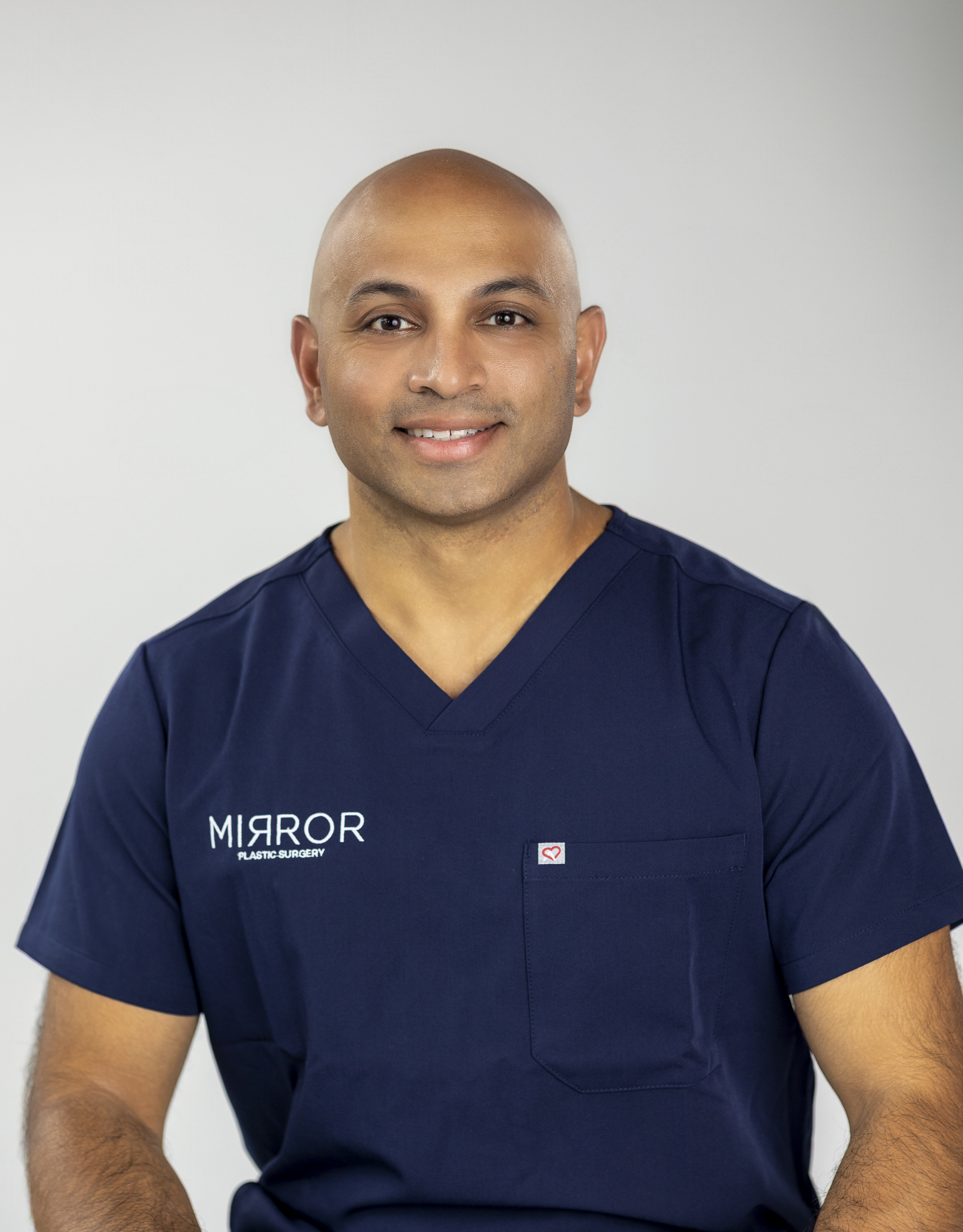
Written by: Dr. Akash Chandawarkar, Board Certified Plastic Surgeon, Mirror Plastic Surgery
Key Functional Takeaways After Brachioplasty
- Brachioplasty delivers measurable gains in shoulder and elbow motion, often restoring comfortable overhead reach by week 6 and full activity between weeks 8–12.1
- Removing excess upper-arm skin relieves chronic intertrigo, chafing, and hygiene problems that persist after massive weight loss despite careful self-care.1
- Postero-medial incision placement and layered tension-reducing closure techniques lower scar tension, which supports scar quality and long-term motion.1
- Ideal candidates maintain stable weight for at least six months, have skin laxity that restricts daily activities, and follow structured recovery plans.
- Patients who want a personalized functional assessment of their upper arms after weight loss can book a consultation at Mirror Plastic Surgery with Dr. Akash.
Quantified Functional Outcomes After Arm Lift Surgery
The table below summarizes functional milestones drawn from published recovery data and scar-management research. These figures reflect patients who followed standard postoperative protocols.1 Individual results vary based on anatomy, surgical technique, and adherence to aftercare.
| Functional Domain | Baseline Limitation | Milestone Achieved | Timeframe |
|---|---|---|---|
| Overhead arm elevation | Restricted to below shoulder height | Comfortable overhead reach restored | Week 6 |
| Light daily tasks (meals, computer work) | Avoided due to incision protection | Tolerated with arms below shoulder height | Week 2 |
| Gentle range-of-motion exercises | Prohibited in first weeks | Initiated under guidance | Week 3 |
| Light upper-body exercise | Fully restricted | Cleared below shoulder height | Week 6 |
| Full unrestricted arm activity | All overhead and heavy lifting prohibited | Unrestricted return to exercise and daily tasks | Weeks 8–12 |
| Intertrigo / chafing relief | Chronic skin-on-skin friction and irritation | Relief once excess skin is removed and healed | Post-healing (weeks 4–6) |
What Is the Success Rate of Brachioplasty?
Functional improvement offers the clearest way to judge brachioplasty success, not photographs alone.1 Brachioplasty improves daily comfort and arm contour, and these results tend to last when patients maintain a stable weight and healthy habits.1 Patients who reach or approach their goal weight before surgery and follow structured aftercare usually report the highest satisfaction.1
Functional success extends beyond mobility gains to relief of chronic skin problems. By removing the excess skin folds that trap moisture and create friction, brachioplasty helps resolve intertrigo and the hygiene difficulties that accompany it.1 When patient selection, technique, and recovery protocols align, the procedure delivers durable, measurable gains across both motion and skin health rather than cosmetic change alone.1
How Brachioplasty Changes Range of Motion
These functional gains stem from a straightforward mechanical principle. Excess upper-arm skin creates a physical barrier to full glenohumeral and elbow range of motion. Redundant tissue bunches at the axilla during abduction and creates drag during extension, which limits both the arc and comfort of arm movement. Surgical excision removes this obstruction so the shoulder and elbow can move through their full anatomical range once healing is complete.
Incision placement then shapes how scar tension interacts with long-term motion. Research published in Aesthetic Plastic Surgery (2025) compared incision placements and found that the postero-medial brachioplasty approach balanced scar concealment with patient comfort during recovery. The postero-medial position places the scar along the posterior-medial arm seam and reduces the tension vector that would otherwise oppose overhead elevation.
Scar tension management during the remodeling phase also plays a central role. Overhead reaching, lifting, and repetitive arm motions can pull on the brachioplasty incision and increase the risk of scar widening because arms move constantly and the inner upper arm skin is thin and prone to tension. The first 6 to 12 weeks after brachioplasty form the key window for tension control and friction reduction, as scar responsiveness is highest and the body lays down new collagen rapidly. Controlled, progressive mobilization during this period preserves motion gains while protecting scar integrity.
Brachioplasty Recovery Timeline for Regaining Arm Function
Days 1–3: Patients avoid raising their arms above shoulder level, pushing up from a chair, or lifting anything heavier than a coffee mug during the first 72 hours after surgery.
Week 1: Showering, short walks, and gentle elbow and wrist motion are allowed. Lifting remains limited to 5–10 pounds, and arms should stay near the torso without overhead reaching.
Weeks 2–3: Light household tasks such as preparing meals and working at a computer are usually tolerated by the end of week two when arms remain below shoulder height. Gentle arm elevation can begin two to three weeks after surgery once early healing is stable.
Weeks 3–6: Patients start gentle range-of-motion exercises around week 3 and may add very light approved stretching by the end of week 4. Many patients receive clearance for full unrestricted activity at about 6 weeks if the tissue looks healthy and strength is returning. Light upper-body work begins below shoulder height first, then progresses.
Weeks 8–12: Most patients resume their usual exercise routines and unrestricted daily arm activities, such as reaching and lifting, at 8 or more weeks after brachioplasty once their surgeon clears them. Many patients notice easier dressing, smoother seat-belt reach, and greater confidence in fitted sleeves as scars mature between months 3 and 12.
Who Benefits Most From Brachioplasty for Function?
Post-massive-weight-loss patients whose excess arm skin interferes with daily activities gain the most functional benefit from brachioplasty. Many patients experience improved comfort and movement because surgery removes heavy or restrictive skin, so the greatest gains occur when arm skin physically blocks motion or causes chafing.
Stable weight forms a non-negotiable prerequisite. Patients should remain at their optimum weight for at least 6 months before brachioplasty to support predictable results and maintain long-term outcomes. Ongoing weight changes make results less reliable and can re-stretch tissues after surgery.
The anatomical extent of laxity also guides technique selection. After major weight loss, upper-arm laxity often extends beyond the mid-arm into the armpit and lateral chest, which can require an extended brachioplasty to achieve complete correction and smooth arm-to-torso transitions. Additional criteria include good overall health, non-smoking status or willingness to quit around the time of surgery, and realistic expectations about the scar trade-off that comes with the procedure.
Schedule your candidacy evaluation with Dr. Akash to determine whether your anatomy and functional goals align with brachioplasty criteria.
What Patients Commonly Report After Surgery
Patient reports after brachioplasty often focus on functional relief such as reduced chafing, easier hygiene, and freer arm movement, along with temporary concern about scars during remodeling. Brachioplasty scars commonly mature over 12 to 18 months, so long-term scar outcomes depend on how well early wound tension is controlled during this period. Scars often look more raised or red at weeks 3–8 before they fade and soften. Patients who understand this pattern usually feel more satisfied because they do not interpret temporary scar prominence as a poor result.
Scar tightness and itching during weeks 3–8 represent normal collagen remodeling rather than functional failure. Structured scar care that includes compression garments, silicone sheeting, and progressive mobilization helps limit these effects. Brachioplasty aims to improve comfort, mobility, and hygiene in patients whose excess skin causes functional problems such as irritation, friction, chafing, hygiene difficulty, or restricted movement during walking or exercise. When functional goals are clearly defined before surgery, patients can better interpret each stage of recovery.
2025–2026 Technique Updates That Affect Function
Recent peer-reviewed studies from 2025 directly inform brachioplasty functional outcomes. One Aesthetic Plastic Surgery study compared incision placements and confirmed that the postero-medial approach balanced scar concealment with patient comfort during recovery. This finding supports its use as a preferred technique for post-massive-weight-loss patients who prioritize both scar position and motion preservation.
Prospective research on tension-reducing sutures in high-tension closures also showed reduced incision tension and improved scar appearance scores. These data provide mechanistic evidence that layered closure technique influences scar maturation and, in turn, the tension environment that shapes postoperative range of motion.
These findings reinforce Mirror Plastic Surgery’s anatomical, evidence-based approach. Dr. Akash’s seven-year integrated plastic and reconstructive surgery residency at Johns Hopkins, combined with his aesthetic surgery fellowship at the Manhattan Eye, Ear and Throat Hospital, provides the technical foundation to apply these advances within a safety-function-aesthetics framework that prioritizes measurable functional restoration before cosmetic refinement.
Frequently Asked Questions
How long does it take to regain full arm function after brachioplasty?
Most patients regain functional use of their arms for light daily tasks such as meal preparation, computer work, and personal hygiene within two to three weeks. Overhead reaching usually returns by week six. Full unrestricted arm activity, including upper-body exercise and heavy lifting, is often cleared between weeks eight and twelve, depending on individual healing and surgeon assessment. Patients with physically demanding jobs may need the full twelve-week window before returning to work.
Does brachioplasty permanently resolve intertrigo and skin chafing?
For post-massive-weight-loss patients, brachioplasty removes the redundant skin folds that create the warm, moist environment where intertrigo develops. Once the excess skin is excised and healing is complete, the mechanical cause of friction and irritation is largely removed. Long-term relief depends on maintaining a stable weight, because significant weight regain can re-create skin redundancy. Patients who sustain their weight loss usually experience lasting relief from chafing and hygiene difficulties.
Will brachioplasty scars restrict my range of motion long-term?
Scar placement and closure technique largely determine whether scarring affects long-term motion. The postero-medial incision approach positions the scar along the posterior-medial arm seam, which minimizes the tension vector that opposes overhead elevation. Layered closure techniques that reduce wound tension during healing further protect scar quality. During the maturation period described earlier, tightness experienced during weeks three through eight generally improves as collagen remodeling progresses. Structured progressive mobilization beginning around week three helps maintain motion gains throughout this period.
Am I a candidate for brachioplasty if I still have some weight to lose?
Brachioplasty does not function as a weight-loss procedure and works best after weight has remained stable for the six-month period discussed earlier. Patients who proceed before reaching a stable weight risk re-stretching the skin envelope with additional weight loss or experiencing less predictable outcomes if weight fluctuates afterward. The ideal candidate has completed their weight-loss journey, maintains a healthy lifestyle, and has arm skin laxity that does not respond to exercise, which reflects permanent changes to skin elasticity rather than residual fat volume.
What distinguishes a function-first brachioplasty approach from a cosmetic-only approach?
A function-first approach starts with a detailed anatomical assessment that identifies specific physical limitations such as restricted reach, chafing, or hygiene difficulties and uses those as primary outcome targets. Technique selection, incision placement, and closure method are chosen to maximize functional restoration while managing scar risk. Cosmetic-only approaches focus on contour and appearance without systematically measuring or tracking functional benchmarks. At Mirror Plastic Surgery, Dr. Akash’s safety-function-aesthetics framework treats functional restoration as a core clinical outcome, and recovery protocols follow measurable weekly milestones rather than vague timelines.
Medical Disclaimer
The information in this article is intended for general education and does not constitute medical advice, diagnosis, or a treatment recommendation. Individual anatomy, medical history, weight-loss history, and surgical goals vary significantly, so the outcomes described here represent general clinical benchmarks and may not reflect any specific patient’s results. Brachioplasty is a surgical procedure that carries risks including scarring, infection, changes in sensation, and anesthesia-related complications. This content does not replace a personalized consultation with a board-certified plastic surgeon. All treatment decisions should be made with a qualified physician after a thorough evaluation of your individual circumstances.
Request your personalized assessment with Dr. Akash at Mirror Plastic Surgery in St. Petersburg, Florida, to receive an evidence-based evaluation of your brachioplasty candidacy and functional goals.
1 Results may vary from person to person. Editorial content, before and after images, and patient testimonials do not constitute a guarantee of specific results.