

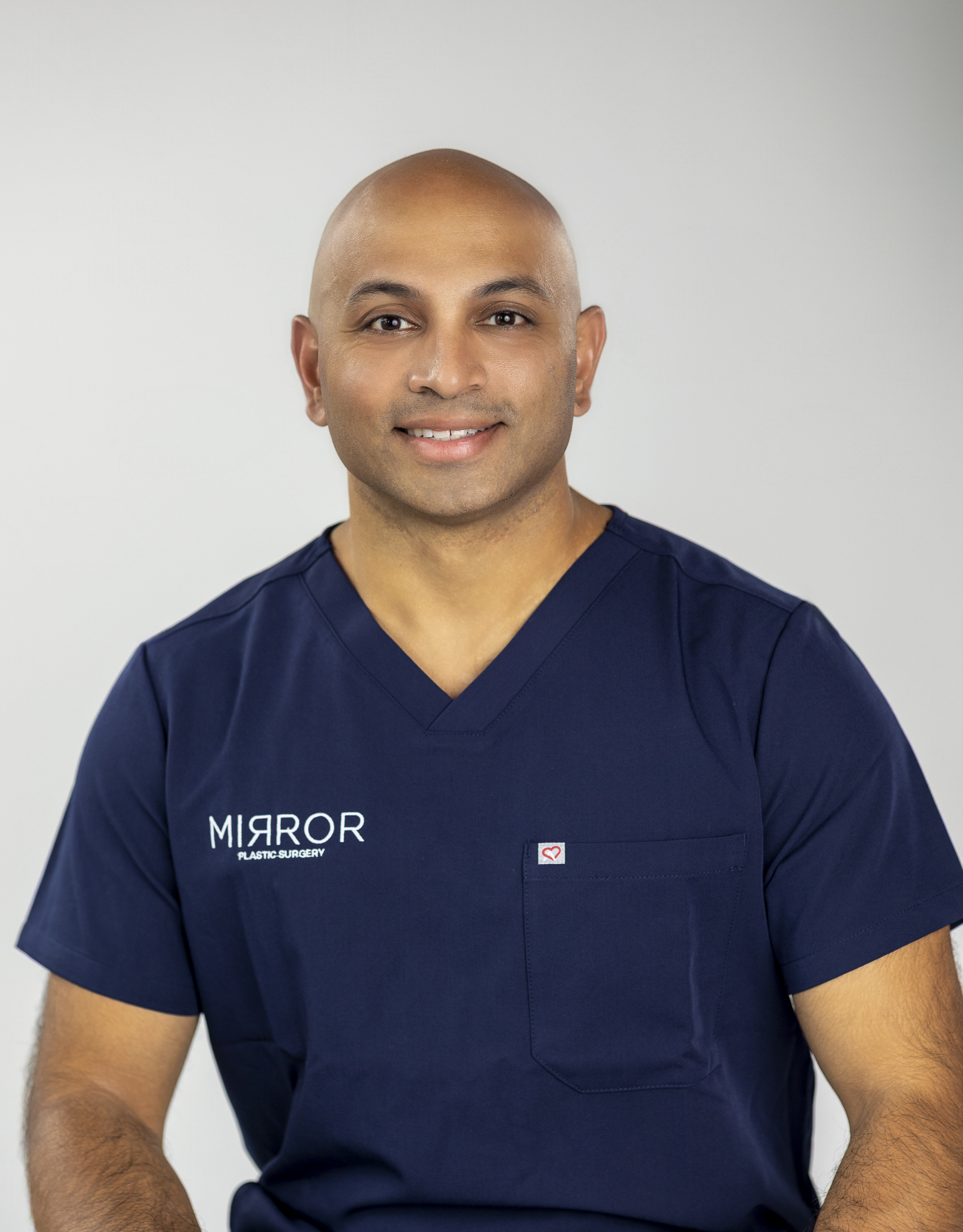
Written by: Dr. Akash Chandawarkar, Board Certified Plastic Surgeon, Mirror Plastic Surgery
Key Takeaways
- Revision plastic surgery requires specialized expertise because scar tissue, altered anatomy, and depleted structural support make secondary procedures more complex than primary ones.
- Patients should confirm ABMS-recognized board certification, revision-specific case volume, facility accreditation, and detailed consultation protocols when choosing a revision surgeon in Tampa Bay.
- Qualification for revision surgery depends on both functional issues such as breathing obstruction or implant complications and aesthetic concerns like asymmetry or malposition that persist after healing.
- Revision procedures, especially rhinoplasty and complex body revisions, usually involve longer recovery times and call for surgeons experienced with compromised tissues and unpredictable healing.
- Schedule your personalized revision consultation at Mirror Plastic Surgery for a comprehensive anatomical assessment and an evidence-based correction plan tailored to your needs.
Why Revision Surgery Requires Different Expertise Than Primary Procedures
Prior operations create scarring, altered anatomy, compromised tissue quality or blood supply, and broader tissue changes that increase technical difficulty beyond what primary surgery involves. Scar tissue disrupts the predictable tissue planes a surgeon relies on for safe dissection. Compromised blood supply affects healing capacity and limits how aggressively tissues can be manipulated. Structural resources, such as nasal cartilage, capsule integrity around a breast implant, and abdominal skin elasticity, may be partially or fully depleted.
Because these limitations cannot be fully reversed, revision planning must work within constraints that primary surgery never faces. Some effects of prior surgery cannot be completely undone, so the plan must account for scar tissue and altered anatomy that restrict achievable outcomes. This narrower margin for correction demands a surgeon who can diagnose deformities systematically before forming an operative plan, adapt in real time when scarred tissues behave unpredictably, and communicate clearly about what level of correction is and is not realistic.
7-Step Checklist to Vet a Revision Plastic Surgeon
- Verify ABMS-recognized board certification. The American Board of Plastic Surgery (ABPS) is the only plastic surgery board recognized by the American Board of Medical Specialties (ABMS) and requires rigorous training through accredited residency programs, comprehensive board exams, and ongoing recertification. Any licensed physician can legally perform cosmetic surgery regardless of specialty training, so ABMS-recognized certification serves as a non-negotiable baseline.
- Confirm revision-specific case volume. Ask directly how many times the surgeon has performed your specific revision procedure, which complications they have encountered, and how they managed those issues. A surgeon who primarily performs primary procedures does not offer the same experience as one who routinely manages altered anatomy.
- Confirm facility accreditation and anesthesia credentials. A surgeon’s complication management capability depends on three connected elements. The facility’s accreditation status determines available emergency protocols. The anesthesia provider’s credentials affect how quickly and safely intraoperative complications can be addressed. The practice’s revision policy clarifies accountability if secondary correction becomes necessary. Board-certified physician anesthesiologists and accredited surgical facilities are the standard for safe revision surgery because they provide the infrastructure and expertise required when complications arise.
- Evaluate consultation depth. A revision consultation requires more detailed pre-operative evaluation than a primary procedure. Pre-revision assessment typically includes implant position, capsule condition, tissue thickness and elasticity, skin envelope quality, nipple position, chest wall anatomy, and existing scar patterns, with equivalent anatomical detail for facial and body revision cases. A rushed 15-minute consultation signals inadequate evaluation and should disqualify a surgeon.
- Review procedure-specific before-and-after cases. Ask to see revision cases specifically, not only primary procedure galleries. Revision results are less predictable, and a surgeon’s portfolio of secondary cases provides the most direct evidence of their ability to correct complex problems.1
- Assess complication management protocols. Confirm that the surgeon holds hospital privileges at an accredited facility. ABPS board certification supports privileged hospital access in the event of rare surgical complications, which offers a safeguard that non-ABMS-certified practitioners may not provide.
- Evaluate surgical volume philosophy. High-volume practices that perform 5–10 surgeries daily divide team attention and increase the risk of rushed pre- and post-operative care. A practice limited to 1–2 surgeries daily keeps the entire surgical team focused on one patient at a time.
How Surgeons Decide If You Qualify for Revision Surgery
Qualification for revision surgery is evaluated across both functional and aesthetic dimensions. Functional indications include breathing obstruction following rhinoplasty, chronic pain or animation deformity from breast implants, abdominal muscle separation that persists after a prior tummy tuck, or nerve and contour complications following body contouring. These functional problems carry independent medical justification for correction.
Aesthetic indications include implant malposition, capsular contracture, visible asymmetry, over-resection of nasal cartilage, contour irregularities after liposuction, and results that do not align with the patient’s anatomy or goals. Revision cases may require staged procedures and often take longer to settle, with final results frequently needing 6–12 months or more for complete scar maturation and tissue settling.1 Timing matters. Most surgeons recommend waiting a minimum of 12 months after a primary rhinoplasty before pursuing revision because final results cannot be fully assessed until at least twelve months after surgery, and often longer in revision cases, as swelling can mask the true outcome for an extended period.1
How Plastic Surgeons Typically Charge for Revision Procedures
Revision surgery performed by a different surgeon than the original operator is almost always a fee-for-service procedure. The new surgeon has no contractual obligation from the prior practice, and the technical complexity of secondary cases, including longer operative times, additional grafting materials, and specialized instrumentation, creates legitimate costs independent of the original fee. Patients should ask any prospective revision surgeon to explain their revision policy in writing before proceeding, including what is covered if a secondary correction is needed after the revision itself. Each patient’s situation is unique, and Mirror Plastic Surgery provides personalized quotes during the consultation based on the specific anatomical complexity involved.
Which Revision Surgeries Are Hardest to Recover From
Revision rhinoplasty is widely regarded as one of the most technically demanding and recovery-intensive procedures in plastic surgery. Revision rhinoplasty requires exceptional surgical judgment, intimate knowledge of complex nasal anatomy, and extensive experience managing compromised tissues because tissues have already been altered and remaining cartilage may be limited. Recovery often lasts longer because scar tissue increases swelling, and final results may not be visible for 18–24 months.1
Complex body revision procedures, including circumferential body lifts, revisional abdominoplasty with muscle repair, and secondary BBL correction, also carry extended recovery timelines and higher complication profiles due to the extent of tissue disruption. Tampa Bay’s warm climate supports post-operative mobility but requires careful management of sun exposure and strict compression garment use during healing.
Breast Revision in Tampa Bay: Key Anatomical Factors
Breast revision surgery is usually more technically complex than primary breast augmentation because it must address existing surgical changes, scar tissue, altered tissue planes, and the body’s variable healing response to the initial procedure. Common indications include capsular contracture, implant malposition such as bottoming out, lateral displacement, symmastia, or high-riding implants, asymmetry, and implant aging.
Modern capsular contracture treatment in revision surgery may involve targeted capsule release, partial or total capsulectomy, pocket relocation, or implant plane change rather than simple scar removal alone. Plane conversion, which moves an implant from subglandular to submuscular placement or the reverse, requires precise understanding of chest wall anatomy and tissue quality that exceeds the demands of primary augmentation. Mirror Plastic Surgery’s breast revision approach includes repositioning implants above the muscle when anatomically appropriate while preserving breast tissue and using advanced diagnostic tools, including in-office ultrasound, for pre-operative assessment.
Facial and Rhinoplasty Revision: Advanced Considerations for Tampa Patients
Revision rhinoplasty operates on a nose already altered by prior surgery, where scar tissue and fibrosis within the soft tissue envelope make dissection more difficult, tissue planes less predictable, and healing less straightforward than in primary procedures. Peer-reviewed data show revision rates after primary rhinoplasty range from 5 percent to 15 percent, with a commonly cited 9–10 percent figure. Studies report that some patients remain dissatisfied even when the surgeon considers the anatomical result successful.
Many revision rhinoplasty cases require substantial cartilage grafting, including spreader grafts to widen a collapsed middle vault, tip grafts to rebuild over-resected tip structures, dorsal grafts to augment an over-reduced bridge, and batten grafts to support collapsed sidewalls. When septal cartilage is depleted, surgeons may harvest from the ear or rib, which adds donor-site management to an already complex procedure. Revision facelift surgery is also considered among the most demanding procedures in facial plastic surgery because scar tissue changes the anatomy significantly, with denser tissues, less defined planes, and a narrower margin for error.
Body Revision in Tampa Bay: Safety, Anatomy, and Regulation
Body revision procedures address contour irregularities, asymmetry, and functional deficits following liposuction, abdominoplasty, or buttock augmentation. Revision abdominoplasty frequently requires complete re-repair of the rectus abdominis from the xiphoid to the pubic symphysis. This scope of correction exceeds what a mini tummy tuck can address and demands comprehensive understanding of abdominal wall anatomy.
Florida’s regulatory environment for gluteal fat grafting ranks among the most stringent in the nation. In 2022, the Florida Board of Medicine adopted an emergency rule limiting gluteal fat grafting procedures to three per day per physician because of high complication and fatality rates from fat embolisms. Patients seeking BBL revision in Tampa Bay should confirm that any prospective surgeon operates in full compliance with these 2022 regulations and the 2024 legislative updates that increased inspection requirements and fines for non-compliant practices.
Comparing Surgeon Credentials and Care Philosophy for Revision Cases
The following comparison shows how training depth, revision focus, and daily surgical volume create very different care models that directly affect safety and outcome quality in revision surgery.
| Attribute | Elite Revision-Focused Surgeon | General Aesthetic Surgeon | High-Volume Generalist |
|---|---|---|---|
| Training & Fellowships | ABMS-recognized board certification (ABPS), dedicated aesthetic surgery fellowship (e.g., MEETH), subspecialty training in facial, breast, and body surgery, research and innovation training | ABMS-recognized board certification (ABPS or ABFPRS), standard residency, may or may not hold a dedicated aesthetic fellowship | May hold non-ABMS board certification (e.g., ABCS) or no plastic surgery board certification, any licensed physician can legally perform cosmetic surgery regardless of specialty training |
| Revision Focus | Routinely performs revision surgery and develops deeper understanding of factors that produce unnatural outcomes and how anatomy changes after prior procedures | Performs revisions as a subset of a broader primary procedure practice | Revision cases are uncommon, and the primary focus is volume-driven primary procedures |
| Daily Surgical Volume | 1–2 surgeries per day, entire team focused on one patient at a time | Typically 2–4 surgeries per day | 5–10 or more surgeries per day, practice model based on high patient volume and minimal patient interaction |
| Care Philosophy | Safety first, function second, aesthetics third, hour-long consultations, evidence-based, anatomy-driven planning, hospital privileges for complication management | Patient-centered but may not prioritize functional outcomes or extended consultation time | Efficiency-driven, limited pre-operative assessment depth, associated with higher complication and fatality rates in Florida data |
Red Flags to Avoid in Tampa Bay Revision Practices
Patients evaluating revision surgeons in Tampa Bay should treat the following as disqualifying indicators that signal practice quality problems. A surgeon who cannot produce revision-specific before-and-after cases, or who presents only primary procedure results, lacks documented experience with the anatomical complexity of secondary surgery. This documentation gap matters because revision rhinoplasty requires deeper experience and higher surgical judgment than primary rhinoplasty. Scar tissue, altered anatomy, and reduced cartilage support make planning more complex and reduce the margin for error, so a surgeon’s revision portfolio becomes the only direct evidence that they can navigate these challenges.
Consultations shorter than 30 minutes for a revision case represent a structural red flag, since the pre-operative evaluation alone for breast revision requires assessment of implant position, capsule condition, tissue thickness, skin envelope quality, and chest wall anatomy. Practices that perform 5–10 surgeries daily cannot allocate the team attention that revision complexity demands. Confirm that any surgeon holds current ABPS board certification, operates in an accredited facility, and employs board-certified physician anesthesiologists, all requirements that remain in force under 2026 Florida standards. Surgeons who hold only non-ABMS-recognized certifications lack the standardized training requirements discussed earlier, a gap that becomes critical when managing revision complexity.
Frequently Asked Questions
How do I know if I need revision surgery or if my results will improve with more healing time?
As noted earlier, most primary procedures require the standard 12-month healing window before final results can be accurately assessed, with revision rhinoplasty often extending to 18–24 months because scar tissue increases swelling. Functional problems such as breathing obstruction, chronic pain, implant animation deformity, or abdominal muscle separation do not resolve with time and warrant earlier evaluation. Aesthetic concerns such as asymmetry, malposition, or over-resection should be assessed by a board-certified plastic surgeon after the standard healing window has passed. A thorough consultation with anatomical imaging and physical examination will determine whether the issue reflects residual swelling or a structural problem that requires correction.
Is revision rhinoplasty more painful than primary rhinoplasty?
Pain levels vary by individual and by the extent of correction required. Revision rhinoplasty that involves cartilage harvest from the ear or rib adds a donor-site component that primary rhinoplasty does not. Swelling is typically more pronounced and longer-lasting in revision cases because scar tissue and disrupted lymphatic drainage slow recovery.1 Many patients report that the recovery feels more prolonged than their primary rhinoplasty, though not always more acutely painful. Your surgeon should provide a detailed recovery protocol tailored to the grafting and structural work planned for your case.
Can capsular contracture come back after breast revision surgery?
Capsular contracture can recur after revision surgery, although the risk varies based on the correction technique used, implant surface, pocket location, and individual healing response.1 Modern revision approaches, including total capsulectomy, pocket relocation, and implant plane conversion, reduce recurrence risk more effectively than simple capsule scoring alone.1 Surgeons who use advanced pocket management techniques, meticulous sterile protocols, and high-quality implant technology with documented low contracture rates provide more durable outcomes. Discussing your surgeon’s specific capsulectomy approach and implant selection rationale during the consultation remains essential.
What questions should I ask a Tampa Bay surgeon before agreeing to revision surgery?
Ask for their ABPS board certification number and verify it independently through the ABMS database. Request to see revision-specific before-and-after cases for your procedure, not only primary cases. Ask how many revision procedures of your specific type they perform annually, which complications they have encountered and how they managed them, and what their policy is if you require further correction after the revision. Confirm the surgical facility’s accreditation status and the anesthesia provider’s credentials. Ask whether they hold hospital privileges at an accredited facility for emergency management. Finally, ask how long your consultation will be and whether they use diagnostic imaging such as ultrasound in their pre-operative assessment.
Does Mirror Plastic Surgery accept patients who had their original procedure performed elsewhere?
Yes. Mirror Plastic Surgery regularly evaluates patients whose prior procedures were performed at other practices in Tampa Bay and nationally. Dr. Akash conducts a comprehensive, hour-long anatomical assessment that reviews prior operative reports when available, evaluates current tissue quality and structural integrity, and develops an evidence-based correction plan tailored to each patient’s specific anatomy and goals. The practice’s safety-first philosophy means that if staged procedures are required for the safest outcome, that recommendation will be made transparently during the consultation regardless of the patient’s timeline preferences.
Conclusion and Next Steps for Tampa Bay Revision Patients
Selecting a revision plastic surgeon in Tampa Bay requires a structured evaluation process that goes beyond reviewing before-and-after photos or choosing based on proximity. The anatomical complexity of secondary procedures, including scar tissue, depleted structural resources, compromised blood supply, and altered tissue planes, calls for a surgeon with ABMS-recognized board certification, documented revision case volume, accredited facility standards, and a care philosophy that prioritizes depth of assessment over throughput.
Dr. Akash brings Harvard-MIT medical training, a seven-year Johns Hopkins integrated plastic surgery residency, and a dedicated aesthetic surgery fellowship at MEETH to every revision consultation at Mirror Plastic Surgery. Recognized by Newsweek as one of America’s Best Plastic Surgeons for two consecutive years through 2025, Dr. Akash limits the practice to 1–2 surgeries per day so that every revision patient receives the full anatomical focus their case demands. The practice’s safety-first, function-second, aesthetics-third philosophy serves as the operational framework that guides every pre-operative evaluation, intraoperative decision, and post-operative follow-up.
1 Results may vary from person to person. Editorial content, before and after images, and patient testimonials do not constitute a guarantee of specific results.
