

Written by: Ellie Pranckevicius, FNP-BC, Aesthetic Nurse Practitioner & Aesthetic Injector | Facial Restoration & Regenerative Injectable Specialist, Mirror Plastic Surgery | Last updated: August 22, 2026
Key Takeaways on PRP Hair Restoration
- PRP uses your own platelets and growth factors to stimulate existing follicles, but it does not cure hair loss.
- 2026 evidence shows PRP and minoxidil create similar hair-density gains, while combination therapy delivers stronger overall improvement.1
- Transitional shedding can appear in the first 2–4 weeks. Other drawbacks include ongoing maintenance, protocol variability, and lack of insurance coverage.
- Ideal candidates have early to moderate hair loss with active follicles. Completely bald areas or untreated medical issues limit results.
- Schedule your personalized assessment with Ellie at Mirror Plastic Surgery to determine whether PRP fits your hair-restoration goals.
How PRP Works for Hair Loss
Platelet-rich plasma comes from a small sample of your own blood. After centrifugation, the plasma fraction, concentrated with platelets and growth factors (PDGF, VEGF, IGF-1, TGF-β), is injected into the scalp at the level of the hair follicle. These growth factors can prolong the anagen (active growth) phase, improve blood supply around follicles, and slow miniaturization in androgenetic alopecia.
Because PRP is autologous, the risk of allergic reaction or foreign-body rejection is virtually zero. PRP does not alter DHT signaling the way finasteride does, and it does not act as a vasodilator the way minoxidil does. Its mechanism is regenerative rather than pharmacologic, so it works best when follicles remain biologically active.
Comparing PRP and Minoxidil for Hair Loss
A 2025 systematic review and meta-analysis by Anitua, Tierno, and Alkhraisat of 43 randomized controlled trials involving 1,877 participants assessed PRP for alopecia. A 2025 systematic review and meta-analysis in Aesthetic Plastic Surgery of nine randomized controlled trials found no significant difference in hair density between PRP and minoxidil, but PRP showed higher patient satisfaction and better results in the negative hair pull test. These findings show that the two treatments have overlapping yet distinct benefit profiles.
The more clinically useful question is whether combination therapy outperforms either treatment alone. Multiple studies, including those by Pakhomova et al. and Singh et al., found that combining PRP with minoxidil produces superior improvements in hair density compared to either treatment alone. A 2026 prospective RCT by Choubey et al. found that PRP injections combined with topical minoxidil improved the terminal-to-vellus hair ratio, which represents a clinically meaningful gain.
The table below summarizes how PRP, minoxidil, and combination therapy compare in hair-density gains, maintenance needs, and strength of evidence.
Increases in hair density at 6 months reported across studies1Thirty to forty percent of users experience moderate to dense regrowth with continuous use up to 5 years1Improvements in terminal-to-vellus hair ratio in Choubey et al. RCT1
| Treatment | Hair Density Gain | Maintenance Requirement | Evidence Depth |
|---|---|---|---|
| PRP alone | Sessions every 3–9 months indefinitely, with regression toward baseline within 12–18 months if stopped | Systematic reviews highlight the need for better protocol reporting and larger standardized trials | |
| Topical minoxidil | Daily application required, with reversal of results within 3–6 months after discontinuation | Level A recommendation from the American Academy of Dermatology for men when combined with finasteride | |
| PRP + minoxidil combination | Ongoing PRP sessions plus daily topical application | Multiple RCTs confirm superior benefit over monotherapy |
Protocol variability remains a major limitation in PRP research. No 2026 Limanda et al. meta-analysis of eight studies exists; the nearest publication is a 2025 systematic review by Lim et al. documenting poor PRP protocol and composition reporting across orthopaedic studies. Provider expertise and preparation system quality therefore matter as much as the treatment itself.
Shedding and Other PRP Drawbacks
A slight temporary increase in hair loss, sometimes called transitional shedding, can occur in the first few weeks after PRP treatment and is generally temporary before regrowth begins. This brief period of increased shedding in the first 2 to 4 weeks occurs as follicles activate and push out weaker resting hairs, and it typically settles without intervention.
Beyond transitional shedding, the documented disadvantages of PRP for hair loss include the following:
- Mild transient side effects: PRP is generally well tolerated, with mostly mild, short-lived events such as injection-site pain, redness, swelling, itching, and bruising, and no consistent signal of serious complications.
- Ongoing maintenance requirement: Hair density can decline toward baseline within 12 to 18 months without maintenance treatments.
- Protocol-dependent efficacy: PRP success rates vary with patient selection and protocol, and some patients do not achieve meaningful improvement with PRP alone.
- Follicle viability ceiling: PRP cannot create new follicles, reverse fully miniaturized ones, or counteract the hormonal and genetic drivers of hair loss.
- Cost without insurance coverage: PRP is classified as a cosmetic procedure and is not covered by health insurance in the United States. Each patient’s investment depends on their protocol, and Mirror Plastic Surgery provides a personalized quote during consultation.
Given these limitations and maintenance needs, choosing the right candidate profile becomes essential for meaningful results.
Who Benefits Most from PRP Hair Restoration
Early to moderate hair loss, Norwood I–III in men or Ludwig I–II in women, with active, viable follicles present is the ideal setting for PRP as a primary treatment, with clinical studies reporting 70–80% success rates and up to 90% in select profiles.1 Good overall health, younger age, adequate nutritional status, and high platelet quality support better outcomes, while heavy smoking impairs platelet function and scalp blood flow.
Individuals who are completely bald in the area of concern are not likely to experience any benefit from PRP, because the treatment requires viable follicles to stimulate. Even when follicles are present, untreated conditions such as iron deficiency or thyroid disease must be addressed first, since these systemic factors can block effective results in otherwise suitable candidates.
At Mirror Plastic Surgery, candidacy is never decided in a brief intake. The one-hour top-to-bottom consultation evaluates follicle viability through physical assessment, reviews medical history for contraindications, examines hormonal and nutritional status, and sets realistic goals before any treatment plan is proposed. This reflects the practice’s safety-first, function-second, aesthetics-third philosophy applied to hair restoration.
The Four-Step PRP Treatment Protocol
The in-office PRP procedure follows a consistent four-step sequence and takes place during a single visit.
- Blood draw: A small volume of blood is collected from the arm using standard venipuncture. Because PRP is autologous, there is no risk of disease transmission or foreign-body rejection.
- Centrifugation: The blood sample is processed in a calibrated centrifuge to separate and concentrate the platelet-rich plasma fraction. Different PRP preparation systems can reach different platelet concentrations.
- Scalp injection: The concentrated PRP is injected at the level of the hair follicle across the treatment area using a standardized injection technique.
- Aftercare and maintenance: Patients should avoid washing hair for 24 hours, vigorous exercise for 48 hours, and hair dyes, chemical treatments, saunas, or swimming for 48–72 hours after treatment. In Florida’s climate, where heat, humidity, and sun exposure are constant, careful post-procedure scalp care is especially important during the initial healing window. After the initial series of 3–4 sessions spaced 4–6 weeks apart, maintenance injections are needed every 3–9 months depending on individual response, consistent with International Society of Hair Restoration Surgery guidance.
Mirror Plastic Surgery’s Concierge Approach to PRP
Mirror Plastic Surgery operates as a low-volume, high-attention practice. The team performs one to two procedures per day so every patient, surgical or non-surgical, receives focused care before, during, and after treatment. This structure contrasts with high-throughput clinics that see five to ten patients daily, where protocol customization and follow-through are often limited.
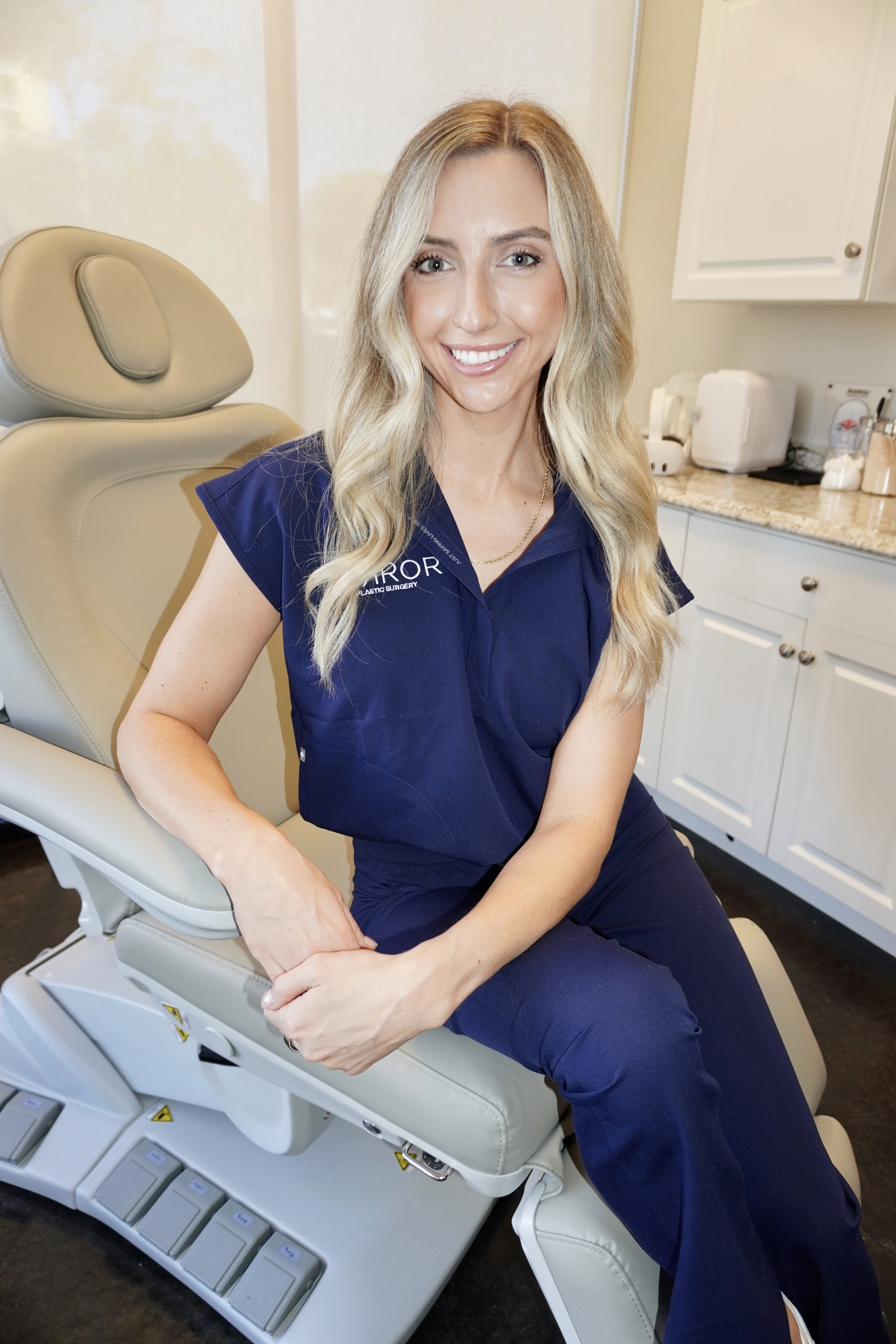
PRP hair restoration at Mirror Plastic Surgery is led by Ellie Pranckevicius, FNP-BC. Her combined background in esthetics and advanced nursing provides a layered understanding of scalp physiology that extends beyond injection technique. Before joining Mirror, Ellie spent four years in the Neuroscience ICU at Tampa General Hospital, which sharpened her clinical judgment and her ability to recognize when a patient needs further medical evaluation before any aesthetic procedure.
The practice was founded by Dr. Akash Chandawarkar, a Harvard-educated physician, Johns Hopkins-trained plastic surgeon, and fellowship-trained aesthetic surgeon at the Manhattan Eye Ear & Throat Hospital (MEETH)/Lenox Hill Hospital. His anatomical expertise and commitment to evidence-based, supplier-neutral planning set the standard of care across every service Mirror offers, including non-surgical hair restoration.
Mirror also offers hair restoration with Acorn Biolabs Secretome as an adjunct or alternative. This reflects the practice’s commitment to reviewing the full landscape of evidence-based options rather than defaulting to a single protocol for every patient.
Frequently Asked Questions
Is PRP better than minoxidil for hair loss?
As discussed in the evidence section above, neither treatment is categorically superior, because they work through different mechanisms and show different strengths. The key clinical finding is that combination therapy outperforms either treatment alone, which is why Mirror Plastic Surgery evaluates your existing regimen before recommending a protocol. The right approach depends on your stage of hair loss, follicle viability, medical history, and long-term goals, all of which are reviewed during the one-hour consultation.
Can PRP cause shedding?
A temporary increase in shedding in the first two to four weeks after PRP treatment is a recognized pattern. Growth factors injected into the scalp can push resting-phase (telogen) hairs out of the follicle, clearing the way for new anagen growth. This transitional shedding does not signal treatment failure and usually resolves on its own. It differs from ongoing pattern hair loss, which continues in the background regardless of PRP. Patients who notice shedding that persists beyond six to eight weeks, or that occurs with scalp irritation or patchy loss, should return for reassessment, since these signs may indicate a separate condition.
What are the disadvantages of PRP for hair loss?
The main disadvantages include the absence of a maintenance-free endpoint, variability in outcomes across protocols, and the inability of PRP to restore follicles that are already permanently lost. Results tend to decline within 12 to 18 months without maintenance sessions. Roughly 10 to 30% of patients do not achieve significant improvement with PRP alone, especially those with advanced hair loss or poor platelet quality. Mild side effects such as pain, redness, swelling, and bruising are common and short-lived. Serious complications remain rare when a credentialed provider uses sterile technique and a validated centrifuge system. PRP is also not covered by health insurance in the United States, so long-term cost matters for anyone planning multi-year maintenance.
How long do PRP results last without maintenance?
Without maintenance sessions, gains from an initial PRP series usually begin to regress within 6 to 12 months, with a statistically significant decline toward baseline by 18 months in published follow-up studies. PRP does not change the underlying hormonal and genetic drivers of androgenetic alopecia, so DHT-mediated miniaturization continues in the background. Maintenance frequency varies by individual response. Faster responders may sustain results with sessions every 9 months, while slower responders may need sessions every 3 to 4 months. Florida’s year-round sun exposure and heat can also affect scalp health between sessions, which is one reason Mirror Plastic Surgery builds a personalized maintenance schedule into every treatment plan instead of using a generic template.
Conclusion: Deciding Whether PRP Fits Your Plan
Meta-analyses show that PRP can increase hair density and hair thickness versus control in patients with androgenetic alopecia when follicles remain viable, confirming that PRP produces measurable, reproducible improvements under the right conditions. PRP is not a cure, and it does not suit every patient. Current evidence supports PRP as an adjunctive therapy rather than a replacement for topical minoxidil or oral finasteride, since neither PRP nor low-level laser therapy has the evidence depth to justify replacing primary medical treatments.
Adults in the St. Petersburg and Tampa Bay area who have already tried over-the-counter treatments and want a data-driven assessment of PRP can expect something different at Mirror Plastic Surgery. The practice offers a full hour with a clinician who will evaluate follicle viability, review medical history, assess the existing regimen, and give an honest opinion about whether PRP is likely to help or whether another approach better fits the patient’s anatomy and goals.
Disclaimer: Results may vary from person to person. Editorial content, before and after images, and patient testimonials do not constitute a guarantee of specific results.
1 Results may vary from person to person. Editorial content, before and after images, and patient testimonials do not constitute a guarantee of specific results.



