
Written by: Ellie Pranckevicius, FNP-BC, Aesthetic Nurse Practitioner & Aesthetic Injector | Facial Restoration & Regenerative Injectable Specialist, Mirror Plastic Surgery | Last updated: July 6, 2026
Key Steps for Choosing a Safe Florida Injector
- A safe Florida injector holds an active license, works under a documented MD or DO medical director, and completes verified hands-on training with live patients.
- Use the state MQA portal to confirm licensure status, medical director credentials, and any disciplinary history before you book.
- Ask for documented training hours, reversal-agent availability, and clear product sourcing to lower complication risks.
- Avoid rushed consultations, vague oversight answers, or pressure tactics. True concierge care includes thorough assessment and transparent risk disclosure.
- Schedule your personalized consultation at Mirror Plastic Surgery to experience credential-transparent injectable care in St. Petersburg, FL.
7-Step Checklist to Verify Any Florida Med-Spa Injector
- Look up the license. Visit the Florida Department of Health MQA license portal, enter the provider’s name, and confirm the license type (RN, APRN, PA, MD, or DO), status (active), and expiration date.
- Confirm the medical director. Ask for the medical director’s full name and Florida license number, then verify it on the same portal. Florida law requires every med spa performing medical procedures to operate under a Florida-licensed MD or DO, not an NP, PA, or out-of-state physician.
- Request documented training hours. Ask how many hands-on hours the injector completed on live patients. AAOPM offers dermal filler certification as a single-day course of 4–8 hours that includes optional hands-on live patient training, which represents a common minimum benchmark.
- Ask about case volume and supervised practice. Industry guidance supports a period of supervised or mentored practice after initial certification before independent proficiency. Ask how many procedures the injector has performed and what supervision structure supported that experience.
- Verify reversal agent availability. Confirm the practice stocks appropriate reversal agents on-site for immediate management of filler complications. Vague answers about complication management, such as “we’ll refer you to your doctor,” signal inadequate emergency protocols.
- Identify the exact product being used. Unclear communication about what is in the syringe violates patients’ right to know the product and technology involved. Confirm the brand name, lot number availability, and that product is sourced through licensed distributors.
- Test the consultation quality. A compliant, patient-centered practice spends meaningful time on assessment, discloses risks, and does not pressure you with same-day discounts. Time-limited pricing pressure functions as a sales tactic, not a clinical practice.
Schedule a credential-transparent consultation with Ellie to experience concierge-standard injectable care in St. Petersburg, FL.
Required Training and Credentials for Florida Med Spa Injectors
Florida requires that injectables such as neuromodulators and fillers be administered by licensed medical professionals, including MDs, DOs, NPs, PAs, or RNs under documented delegation, who have appropriate training and documented competency. Estheticians and non-licensed staff may not administer prescription injectables under any circumstance.
This licensure requirement sets the legal minimum, not the standard for true clinical skill. Professional organizations help define competency by setting training benchmarks that go beyond basic licensure. The AACM Comprehensive Course is a 20-hour program requiring hands-on training with neuromodulators in at least 10 injection areas and advanced filler injections in at least 8 facial areas. Skilled injectors then pursue continuing education to maintain and advance skills as techniques and products evolve.
Ellie Pranckevicius, FNP-BC, at Mirror Plastic Surgery completed a rigorous aesthetics licensure program with 600 hours of hands-on training, which far exceeds common benchmarks. She also holds a BSN and MSN from the University of South Florida and a Bachelor’s in Health Science from Boston University. Her critical care nursing experience adds clinical judgment that most aesthetic-only training programs cannot match.
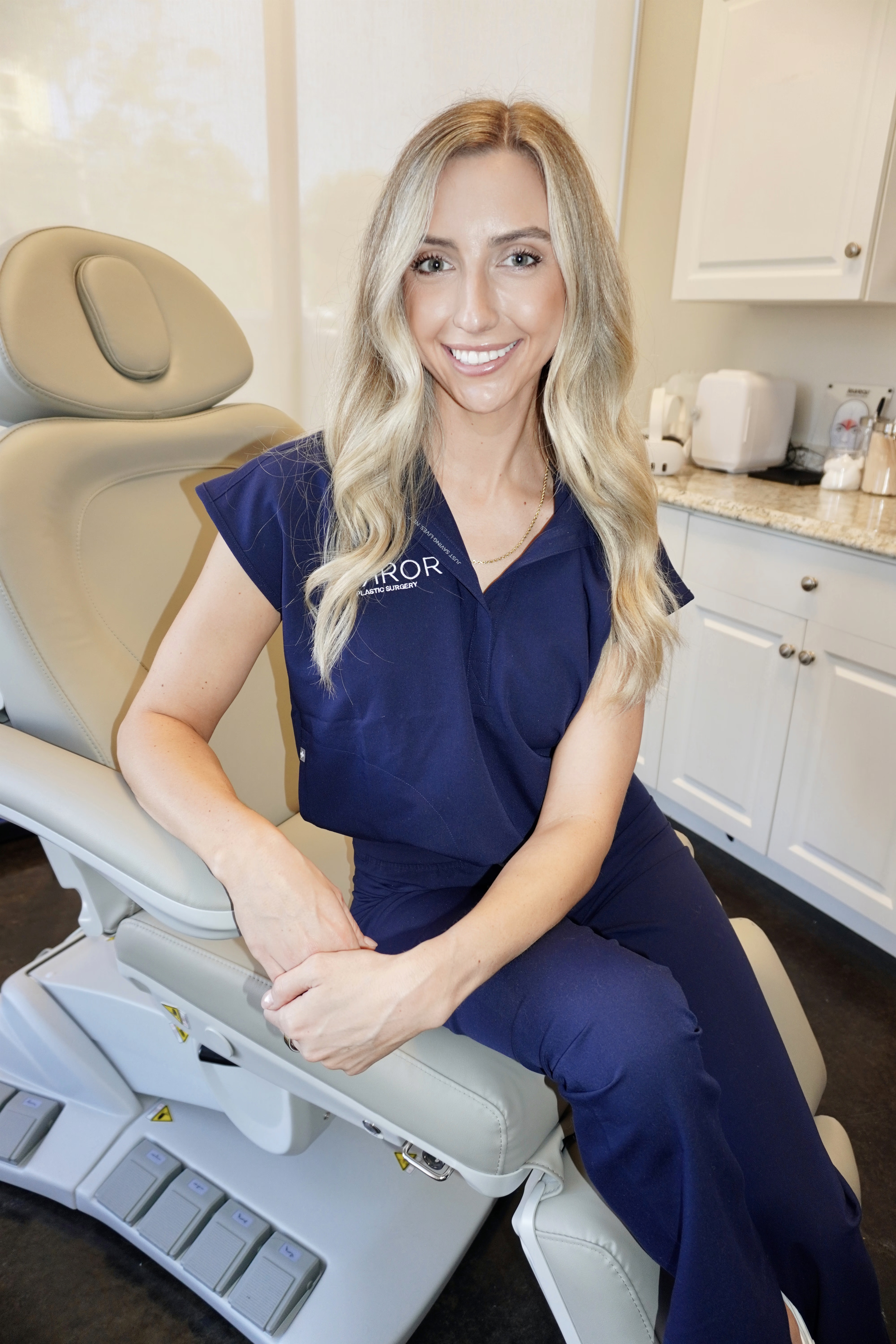
Understanding who can legally own and oversee a med spa in Florida helps you confirm that this level of training operates under proper medical supervision.
RN and NP Ownership and Oversight Rules in Florida
Under Florida law, only MDs or DOs may serve as medical directors of med spas. Nurse practitioners, physician assistants, and chiropractors cannot hold this role. An RN cannot independently prescribe Botox or establish a treatment plan. RNs in Florida may administer injectables under standing orders from a supervising physician, ARNP, or PA after the prescriber has examined the patient and established the plan.
A nurse practitioner with prescriptive authority works with a broader scope but must still comply with all state laws regarding scope of practice, prescriptive authority, and supervision requirements. Any med spa that cannot clearly identify its medical director’s name, specialty, and oversight structure likely operates outside compliant boundaries.
Step-by-Step: How to Check a Florida Nursing or Physician License
Go to the Florida Department of Health Medical Quality Assurance (MQA) online portal. Select “Health Care Providers,” enter the provider’s first and last name, and choose the appropriate license type from the dropdown, such as Advanced Practice Registered Nurse or Registered Nurse. Confirm that the license status reads “Active,” note the expiration date, and check for any disciplinary actions listed under the provider’s record. This process usually takes under two minutes. Inability to verify a provider’s credentials through Florida’s Department of Health online licensing portal functions as a red flag on its own.
For physician medical directors, use the same MQA portal and select “Medical Doctor” or “Osteopathic Physician” as the license type.
What Real Hands-On Injector Training Looks Like
Real hands-on training means injecting live patients under direct instructor supervision, not watching videos, practicing on mannequins, or attending lecture-only seminars. One-day dermal filler programs rarely provide adequate hands-on experience for true competency development. Comprehensive programs keep a low student-to-instructor ratio during live patient sessions.
The Certified Aesthetic Nurse Specialist (CANS) credential requires at least 1,000 practice hours in the last two years and current collaboration with a board-certified physician in plastic surgery, ophthalmology, dermatology, or facial plastic surgery. When you evaluate any injector, ask directly: How many live patients did you treat during training? Who supervised you? What complications did your training cover?
Experience Benchmarks: How Many Procedures Matter?
No single universal number defines competency, so context carries more weight than raw volume. Industry guidance supports a period of supervised or mentored practice after initial certification before an injector considers themselves independently proficient. Volume alone does not guarantee skill. An injector who has performed 500 identical lip treatments has narrower experience than one who has treated diverse facial anatomies across multiple indications under physician mentorship.
Ellie Pranckevicius began her aesthetic career in 2019 at a high-end medical spa in Boston, progressing from esthetician to medical esthetician and then to FNP-BC. Her background spans neuromodulators, biostimulatory fillers, full-face rejuvenation, and non-surgical BBL using Radiesse and other biostimulatory agents. She built this experience across years of supervised and independent practice under physician oversight.
Med-Spa Red Flags and How to Respond
| Red Flag | Why It Matters | Florida Requirement | Action to Take |
|---|---|---|---|
| Unusually low pricing as the primary sales pitch | “Too good to be true” pricing often hides diluted product, weak safety steps, or injector inexperience. | No price floor exists, but licensed distributors and authentic products carry standard costs | Ask for the product brand, lot number, and distributor name |
| Non-medical or unlicensed injector | Estheticians and non-licensed staff are prohibited from administering prescription injectables in Florida. | Injectables must be administered by MD, DO, NP, PA, or RN under documented delegation | Request the injector’s license type and number, then verify on the MQA portal |
| No reversal agent on-site | Absence of a defined escalation pathway and reversal agent signals inadequate emergency protocols. | No explicit statute, but standard of care requires complication readiness | Ask directly: “Do you stock appropriate reversal agents on-site?” |
| Marketing titles without verifiable credentials (“aesthetic specialist,” “beauty technician”) | Describing providers only as “aesthetic specialists” or “technicians” obscures scope of practice and license type. | Florida requires identification of the licensed provider performing each procedure | Ask for the specific license type and verify it independently |
| Absent or “ghost” medical director | Florida regulators consider a medical director who never visits the facility or fails to review charts to be operating under an invalid “paper” arrangement that exposes the practice to license revocation. | Florida requires documented chart reviews, signed delegation agreements, and availability during operating hours. | Ask for the medical director’s name, specialty, and how often they are on-site |
How to Spot a Concierge-Quality Consultation
A rushed consultation usually lasts 10–15 minutes, skips medical history, presents a pre-packaged treatment menu, and applies same-day discount pressure. A concierge consultation can spend up to an hour on a top-to-bottom anatomical assessment, ask about emotional drivers and long-term goals, disclose risks alongside benefits, and sometimes advise that a procedure is not yet necessary for your anatomy. Providers who discuss only the upside of treatments and never mention risks or realistic limitations fail to provide the full picture required for informed consent.
At Mirror Plastic Surgery, Ellie’s initial consultations follow a structured diagnostic framework that evaluates facial and bodily areas systematically. She has a reputation for transparency and often advises patients that an expensive service is not yet warranted. This approach builds long-term trust that high-volume practices rarely achieve.
Product Authenticity and Supplier-Neutral Care at Mirror Plastic Surgery
Authentic neuromodulators and fillers come from licensed U.S. distributors and arrive with verifiable lot numbers. Practices that cannot name the specific brand being injected or that source product through unverified channels create compounding safety risks. Mirror Plastic Surgery operates as a supplier-neutral practice, so product selection follows patient anatomy and clinical evidence, not distributor agreements or volume incentives. Ellie works across a full range of neuromodulators (Botox, Dysport, Xeomin, Daxxify, Jeuveau) and fillers (Juvederm, RHA, Versa, Restylane, Radiesse, Evolysse), then selects the most appropriate option for each patient’s presentation.
Final Walk-Away Decision Tree for Florida Med Spas
Start here: Confirm that you can verify the injector’s active Florida license on the MQA portal.
- No → Do not book. An unverifiable license disqualifies the provider.
- Yes → Confirm whether the medical director is a Florida-licensed MD or DO with documented on-site involvement.
- No → Do not book. Paper-only medical director arrangements are considered fraudulent by the Florida Board of Medicine.
- Yes → Ask whether the injector completed verified hands-on training with live patients and a period of supervised practice.
- No or unknown → Request documentation. If the practice cannot provide it, proceed with caution or seek an alternative provider.
- Yes → Confirm that the practice stocks hyaluronidase, discloses product brands, and provides a clear complication protocol.
- No → Do not book.
- Yes → Evaluate whether the consultation lasted sufficient time, covered risks, and avoided high-pressure sales tactics.
- No → Seek a second opinion.
- Yes → You have likely identified a compliant, patient-centered provider and can proceed with confidence.
Verify this checklist in person by booking your consultation with Ellie at Mirror Plastic Surgery, 780 4th Ave S, St. Petersburg, FL 33701.
Frequently Asked Questions
What is the difference between an RN and an NP injector in Florida?
A registered nurse (RN) in Florida can administer injectable treatments such as Botox and dermal fillers only under direct physician supervision and documented delegation. An RN cannot independently diagnose, prescribe, or develop a treatment plan. A nurse practitioner (NP) with prescriptive authority, such as a Family Nurse Practitioner Board-Certified (FNP-BC), works with a broader scope of practice, including the ability to evaluate patients, develop treatment plans, and prescribe medications within their licensure and practice arrangements. When you evaluate an injector, ask specifically whether they are an RN or an NP, and confirm the level of physician oversight in place. Ellie Pranckevicius holds FNP-BC certification, so she brings advanced clinical training and prescriptive authority to every patient interaction at Mirror Plastic Surgery.
What should I ask a med spa about its medical director before booking?
Ask for the medical director’s full name, Florida license number, and medical specialty. Confirm whether they are on-site during treatments or available remotely, how frequently they review patient charts, and whether they have signed delegation agreements for each procedure type performed at the practice. A compliant medical director meets the MD or DO requirement described earlier and maintains documented oversight through chart reviews, protocol approvals, and availability during operating hours. If a practice cannot answer these questions specifically, or describes oversight only in vague terms, treat that as a meaningful red flag. Under Florida’s 2026 Medical Spa Prescription Drug Oversight Act, documentation of supervision is a legal requirement, not an optional extra.
How do I know if the filler or Botox being used is authentic?
Ask the practice to name the specific brand and confirm that it is sourced through a licensed U.S. distributor. Authentic products arrive with verifiable lot numbers that you can cross-reference with the manufacturer. Practices that cannot name the brand, describe the product only generically, or source through unverified channels present a significant safety risk, because counterfeit or improperly stored injectables have been linked to serious adverse events. At Mirror Plastic Surgery, Ellie works with a defined range of FDA-approved neuromodulators and fillers selected based on clinical evidence and patient anatomy, with no supplier incentives influencing product choice.
Is a 600-hour aesthetics training program standard, or is Ellie’s background unusual?
Ellie’s 600-hour program sits well above standard expectations. Most injectable certification programs range from 8 to 20 hours of hands-on training. A 600-hour aesthetics licensure program functions as a full professional credential, covering skin physiology, treatment protocols, and hands-on technique at a depth that short-course certifications cannot match. Combined with her advanced nursing degrees and critical care experience, her preparation for aesthetic injectable practice exceeds the minimum required by Florida law or professional organizations.
What happens if I have a complication after a filler treatment at Mirror Plastic Surgery?
Mirror Plastic Surgery operates under the direct oversight of Dr. Akash Chandawarkar, a Harvard-educated, Johns Hopkins-trained plastic surgeon with fellowship training in aesthetic surgery. The practice maintains on-site emergency protocols, including access to appropriate reversal agents. Ellie’s critical care nursing background means she can recognize and respond to adverse events with clinical precision. The practice follows up with patients after treatment and maintains open communication via call, text, or email. This level of complication readiness and post-treatment follow-through defines a concierge medical practice compared with a high-volume aesthetic mill.
Conclusion: Put This Florida Injector Checklist to Work
Verifying a Florida med-spa injector usually takes under ten minutes when you follow a structured process. Confirm the active license on the MQA portal, identify a compliant MD or DO medical director, document hands-on training hours, confirm product authenticity and hyaluronidase availability, and assess consultation quality. Every item on this checklist is publicly verifiable. Ellie Pranckevicius, FNP-BC, at Mirror Plastic Surgery meets each standard, including 600 hours of hands-on aesthetics training, FNP-BC licensure, critical care experience, and physician oversight from a Johns Hopkins-trained plastic surgeon. Apply this checklist to every provider you consider, including Ellie.
Bring your completed checklist to your consultation with Ellie at Mirror Plastic Surgery in St. Petersburg, FL.
Disclaimer: Results may vary from person to person. Editorial content, before and after images, and patient testimonials do not constitute a guarantee of specific results.