

Written by: Ellie Pranckevicius, FNP-BC, Aesthetic Nurse Practitioner & Aesthetic Injector | Facial Restoration & Regenerative Injectable Specialist, Mirror Plastic Surgery
Key Takeaways for Long-Term Laser Hair Reduction
- Professional laser hair removal provides long-term hair reduction, not permanent removal, with optimal results typically requiring 6–8 sessions spaced 4–8 weeks apart.1
- Wavelength selection must match your Fitzpatrick skin type, such as Alexandrite for I–III, Diode for II–V, and Nd:YAG for V–VI, to maximize efficacy and reduce risks like post-inflammatory hyperpigmentation.
- Paradoxical hypertrichosis occurs in approximately 3% of patients, and accurate pre-treatment assessment with individualized settings helps lower this risk.
- Provider expertise and a thorough anatomical evaluation are critical, because wavelength choice, fluence, and pulse width should be customized rather than standardized.
- Schedule your personalized consultation at Mirror Plastic Surgery to receive a concierge-level evaluation that matches the right laser protocol to your skin type and long-term goals.
Session Counts and Spacing for Lasting Hair Reduction
Hair follicles respond to laser energy only during the anagen, or active growth, phase. Because only 15–20% of hairs are in anagen at any given time, a single session cannot treat every follicle. Treatment protocols typically require 6–8 sessions spaced 4–8 weeks apart to achieve long-lasting hair reduction, with exact numbers varying by individual response and treatment area.1
Coarser, darker hair in the underarms or bikini line usually responds faster than finer hair on the upper lip or arms.1 Clinical studies confirm that hair reduction rates differ by body area, hair thickness, and baseline density. These differences explain why two people can follow similar protocols yet see slightly different timelines.
After completing an initial course, many clients need occasional maintenance treatments to manage any regrowth. Hair that returns is usually finer and lighter than the original. Long-term success therefore means durable reduction with minimal upkeep, rather than a single endpoint after which no hair ever grows.
Schedule your personalized session plan to determine the protocol and spacing that fit your skin type, treatment area, and hair characteristics.
Long-Term Effects of Professional Laser Hair Removal
The main long-term effect of professional laser hair removal is sustained follicular reduction. Matching wavelength to Fitzpatrick skin type improves results and reduces adverse effects such as post-inflammatory hyperpigmentation or burns. The table below summarizes peer-reviewed reduction data and skin-type suitability for the three principal clinical wavelengths.1
| Wavelength | Fitzpatrick Skin Types | Long-Term Hair Reduction | Key Safety Notes |
|---|---|---|---|
| Alexandrite 755 nm | I–III (optimal); use with caution on IV) | Substantial long-term hair reduction | Recommended for types I–III with coarse dark hair, with higher PIH risk on darker skin |
| Diode 810 nm | II–V (safe I–VI with SHR protocols) | Substantial long-term hair reduction | Most common hair-removal device, safe across I–VI when fluence and pulse width are appropriately adjusted |
| Nd:YAG 1064 nm | V–VI (gold standard); suitable for tanned skin | Substantial long-term hair reduction | Gold standard for Fitzpatrick V–VI due to low melanin absorption and very low PIH risk in dark skin |
While each wavelength offers distinct advantages for specific skin types, combining wavelengths can outperform either alone. Simultaneous emission treatment combining 755 nm Alexandrite and 1064 nm Nd:YAG can achieve substantial hair count reduction at 12 months, and in some research it outperforms either wavelength alone across axillae, bikini, and leg areas.1 The same study documented statistically significant reductions in hair coarseness and color, so remaining hairs were thinner and lighter across all treatment groups and sites.
Beyond hair reduction, side effects from professional laser treatment are usually short-lived. No peer-reviewed evidence supports permanent adverse structural changes to skin when appropriate wavelengths and parameters are used by trained providers.
Use the checklist below to identify your approximate Fitzpatrick skin type before a clinical evaluation:
- Type I: Always burns, never tans; very fair skin, often with red or blonde hair and blue or green eyes
- Type II: Usually burns, tans minimally; fair skin, light hair, light eyes
- Type III: Sometimes burns, tans gradually; medium skin, dark blonde to brown hair
- Type IV: Rarely burns, tans easily; olive or light brown skin, dark hair and eyes
- Type V: Very rarely burns, tans deeply; brown skin, dark hair and eyes
- Type VI: Never burns, deeply pigmented; dark brown to black skin, dark hair and eyes
This self-assessment offers a starting point only. Accurate Fitzpatrick classification requires clinical evaluation, because skin response to UV and laser energy depends on more than visible tone, including recent sun exposure, hormonal status, and medication use.
Paradoxical Hair Growth After Laser Treatment
A small subset of patients experience paradoxical hypertrichosis, which means increased hair density or terminal hair growth in or near a treated area after laser or light-based treatment. A 2021 systematic review and meta-analysis of 22 studies involving 9,733 patients found a pooled prevalence of approximately 3%, with literature-reported rates ranging from 0.34% to 10%.
The mechanism remains unclear, but the risk profile is well described. Key risk factors include medium to darker skin tones, dark hair, hormonal or androgen-driven hair growth areas, and treatment of vellus or fine hair rather than coarse terminal hair. It occurs most commonly in androgen-sensitive areas such as the back and shoulders in men and the face, neck, or upper arms in women.
The condition does not always persist. Some studies report improvement when continued laser treatments are performed with adjusted energy, pulse duration, or technique by an experienced provider. Mitigation centers on accurate pre-treatment assessment. Providers identify vellus hair fields near treatment zones, select the correct wavelength for the patient’s skin type, and calibrate fluence to avoid sub-therapeutic stimulation of dormant follicles. A rushed, high-volume protocol rarely allows this level of anatomical evaluation.
Get your risk assessment to evaluate your paradoxical hypertrichosis risk factors and build a treatment plan designed to avoid them.
Choosing a Provider for Safe, Predictable Laser Results
Laser wavelength selection and session count only work well when the provider executes the protocol correctly. The difference between a 63% and an 84% reduction outcome, or between a complication-free course and a case of paradoxical hypertrichosis, often reflects the depth of the pre-treatment assessment and the provider’s ability to individualize parameters in real time.
Mirror Plastic Surgery’s concierge model centers on an hour-long, top-to-bottom anatomical assessment before any treatment is planned. This approach contrasts with high-volume practices where consultation time is brief and protocols remain standardized instead of individualized. Use the checklist below when evaluating any provider for laser hair removal:
- Does the provider perform and document a formal Fitzpatrick skin type assessment?
- Is the consultation long enough to review your full medical history, hormonal status, and medication list?
- Does the provider explain which wavelength they recommend and why it suits your skin type?
- Are treatment parameters such as fluence, pulse width, spot size, and cooling discussed and individualized, not pulled from a fixed menu?
- Does the provider proactively discuss paradoxical hypertrichosis risk and how they mitigate it for your specific anatomy?
- Is the practice supplier-neutral, or does it have a financial incentive to use a particular device regardless of your skin type?
- Does the provider give a realistic maintenance timeline instead of promising permanent removal?
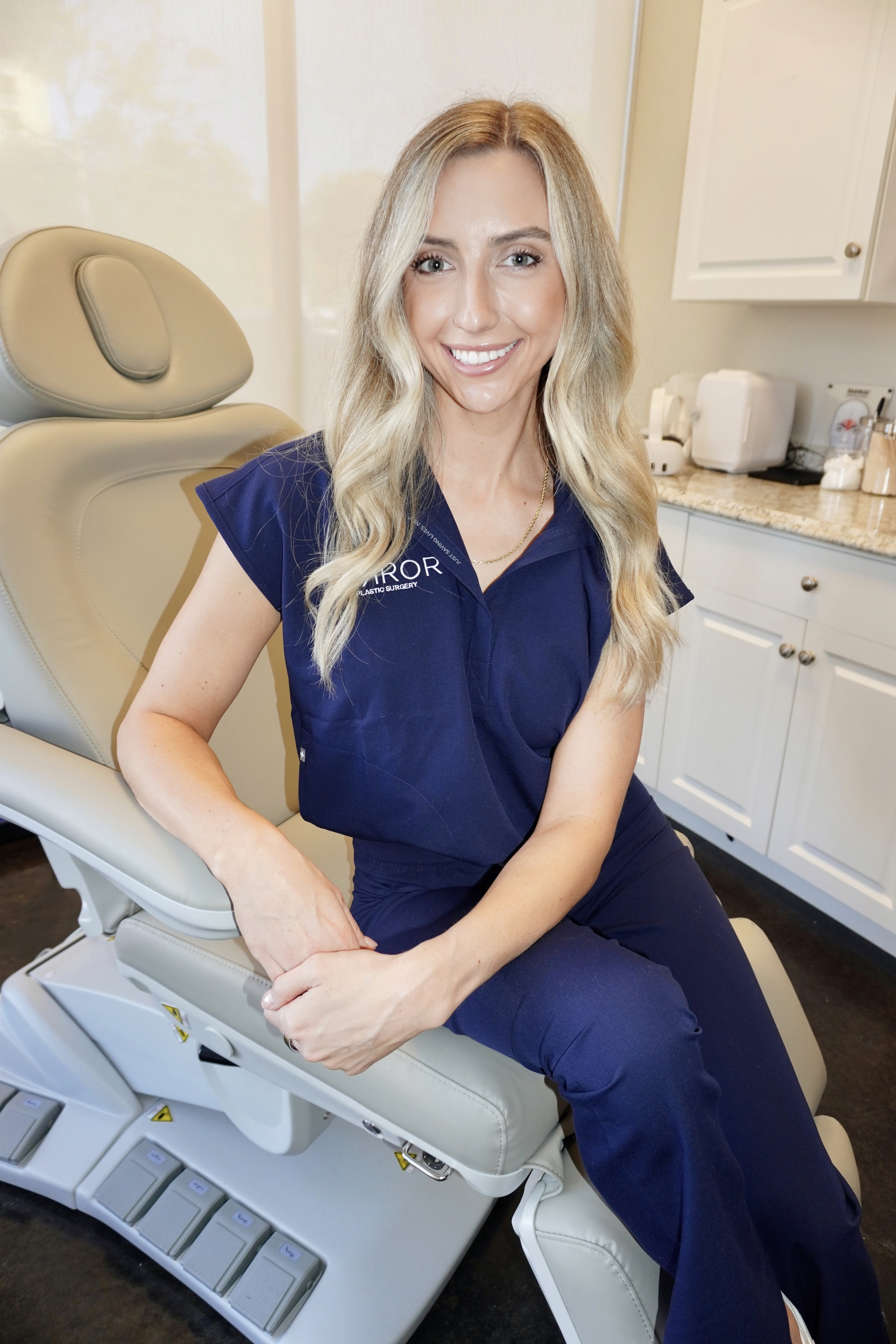
Mirror Plastic Surgery’s non-surgical treatments are led by Ellie Pranckevicius, FNP-BC, an Aesthetic Nurse Practitioner with a dual background in esthetics and advanced nursing, including four years in a Neuroscience ICU. This training supports a level of anatomical and physiological understanding that remains uncommon in aesthetic practice. The practice is supplier-neutral, so device and product recommendations follow evidence and patient anatomy rather than vendor relationships.
Start your concierge-level evaluation at Mirror Plastic Surgery in St. Petersburg, FL, to match the right wavelength protocol to your skin type, hair characteristics, and long-term goals.
Frequently Asked Questions
Is laser hair removal truly permanent, or will hair grow back?
No laser device is FDA-cleared for permanent hair removal. The regulatory standard is permanent hair reduction, which means a long-term, stable decrease in the number of regrowing hairs measured at 6, 9, and 12 months after treatment. In practice, most patients achieve durable reduction that requires only one to two maintenance sessions per year. Some regrowth can occur over years, often driven by hormonal changes, and returning hair is typically finer and lighter than the original. Only electrolysis is classified by the FDA as permanent hair removal, because it destroys each follicle individually regardless of hair color.
Which laser wavelength is safest for darker skin tones?
For Fitzpatrick types V and VI, the long-pulsed 1064 nm Nd:YAG, discussed earlier, offers the safest profile. Its longer wavelength penetrates deeper into the dermis while being absorbed less by epidermal melanin, which reduces the risk of post-inflammatory hyperpigmentation and burns compared to shorter wavelengths. The 810 nm diode laser can also be used safely on darker skin types when fluence and pulse width are appropriately adjusted, particularly with super hair removal protocols and active cooling. Alexandrite at 755 nm carries the highest PIH risk on darker skin and is generally reserved for Fitzpatrick types I–III.
How do professional lasers compare to at-home IPL devices for long-term results?
Professional lasers consistently outperform at-home IPL devices on both efficacy and durability. Systematic reviews show that professional lasers can achieve greater long-term hair reduction compared to IPL. At-home IPL devices operate at lower fluence levels for consumer safety, require twice-weekly use for months, and produce results that plateau around 50–70% for most users, with ongoing maintenance needed indefinitely. Professional systems deliver higher, targeted energy levels that create stronger follicular damage through selective photothermolysis. Repeated use of lower-powered at-home devices can thin hair without fully disabling follicles, which may reduce the effectiveness of later professional laser treatments that rely on melanin contrast.
Can laser hair removal be performed on all skin tones, including very dark skin?
Laser hair removal can be performed safely on all skin tones when the correct wavelength and parameters are used. Fitzpatrick type VI skin requires the 1064 nm Nd:YAG exclusively, because shorter wavelengths carry unacceptable risk of epidermal damage in deeply pigmented skin. A prospective clinical study evaluating an 808 nm diode laser with low-fluence, high-repetition-rate protocols and sapphire cooling in subjects with Fitzpatrick types IV–VI reported mean hair reduction of approximately 57–58% after only three sessions, with only transient erythema and no blistering, scarring, or permanent pigmentary changes.1 Provider expertise in parameter selection remains the key variable, not skin tone itself.
What should I do if I have light, grey, or white hair that I want removed permanently?
Laser and IPL do not work on hair that lacks melanin pigment, including white, grey, most red, and light blonde hair. Electrolysis is the only appropriate option for these hair colors because it uses an electrical current to destroy each follicle directly, independent of pigment. A common clinical approach uses laser first to reduce the bulk of dark hair on large areas, then follows with electrolysis to address any remaining light-colored or resistant follicles. If you have a mix of dark and light hair, a thorough pre-treatment assessment is essential to map which areas can be treated with laser and which require electrolysis.
Disclaimer
Disclaimer: Results may vary from person to person. Editorial content, before and after images, and patient testimonials do not constitute a guarantee of specific results. This article is intended for informational purposes only and does not constitute medical advice. Laser hair removal involves medical judgment and individualized treatment planning. Mirror Plastic Surgery offers individualized consultations to evaluate your specific anatomy, skin type, and goals before any treatment is recommended.
1 Results may vary from person to person. Editorial content, before and after images, and patient testimonials do not constitute a guarantee of specific results.
