
Written by: Ellie Pranckevicius, FNP-BC, Aesthetic Nurse Practitioner & Aesthetic Injector | Facial Restoration & Regenerative Injectable Specialist, Mirror Plastic Surgery | Last updated: August 15, 2026
Key Takeaways
- Concierge aesthetic medicine prioritizes extended, unhurried appointments and individualized treatment plans over high-volume throughput.
- The model follows a strict safety-first, function-second, aesthetics-third hierarchy to minimize complications and revision risk.
- Full-face and full-body assessments evaluate anatomy as an integrated system rather than isolated treatment zones.
- Credentialed providers like Ellie Pranckevicius limit daily patient volume to maintain continuity and deliver honest, evidence-based recommendations.
- Patients seeking this level of personalized care can book a consultation with Mirror Plastic Surgery to experience the difference firsthand.
Concierge-Level Injectables, Full-Face Harmony, and Non-Surgical Body Contouring
The American Society of Plastic Surgeons recorded 9,883,711 neuromodulator injections in the United States in 2024. According to Market Research Future, the facial injectable market is projected to grow from USD 14.11 billion in 2025 to USD 36.58 billion by 2035. Within that expanding market, facial injectables are shifting from event-based beauty spending to maintenance-led medical aesthetics, especially among patients seeking preventative care.
High-volume med-spas respond to that demand by increasing appointment slots. Concierge practices respond by deepening the quality of each appointment. The practical difference is significant:
- High-volume model: Single-area treatments booked in 10–15 minute slots, often with rotating injectors and no continuity between visits.
- Concierge model: Full-face and full-body assessment conducted over up to an hour, with the same provider evaluating, treating, and following up across every session.
Ellie Pranckevicius applies this concierge approach to Mirror Plastic Surgery’s full non-surgical injectable services, including neuromodulators, dermal fillers, lip augmentation, Kybella, energy-based skin tightening, and non-surgical BBL using biostimulatory fillers. Treating one area in isolation without evaluating its relationship to adjacent structures routinely produces the asymmetry and “overdone” appearance that brings patients to revision consultations.
Three Pillars at Mirror: Safety, Function, and Aesthetic Outcome
A peer-reviewed consensus from the Harley Street Institute establishes that patient safety in non-surgical facial aesthetics is a system property of the clinic, driven by regulatory environment, operator training, written protocols, and emergency readiness, rather than a personal attribute of the individual injector. Mirror Plastic Surgery’s three-pillar hierarchy reflects that systems-level commitment and shapes every treatment decision.
Pillar 1: Safety. Every treatment begins with a comprehensive medical history review, contraindication screening, and documented informed consent structured on a per-zone and per-product basis. The Harley Street Institute recommends that informed consent name relevant risks at published rates and reference the local management pathway, rather than relying on generic verbal reassurance. Mirror’s clinical environment meets that standard.
Pillar 2: Function. Treatments are planned to preserve natural facial movement and expression. Relaxing one muscle changes the behavior of every muscle attached to it, which requires injectors to think in vectors rather than isolated zones for balanced, natural results. High-volume practices rarely allocate the time required for that level of planning.
Pillar 3: Aesthetics. Mirror focuses on aesthetic outcome only after safety and function are addressed. This sequencing prevents the over-treatment and volume-driven distortion that occur when aesthetics are prioritized first.
High-volume med-spas often invert this order because of time and revenue pressures. Standard med-spa appointments are built around throughput with short consultations and frequent room turnover, creating a clinical incentive to recommend treatment because the visit must convert. In a concierge model, the first appointment may consist entirely of assessment and conversation, with no treatment performed.
Ellie’s Full-Face Anatomical Customization in Injectable Care
Ellie Pranckevicius holds a Bachelor’s in Health Science from Boston University, completed 600 hours of hands-on aesthetics training, and earned both her Bachelor’s and Master’s in Nursing from the University of South Florida. Before joining Mirror, she spent four years in the Neuroscience ICU at Tampa General Hospital. That environment sharpened her clinical judgment and deepened her understanding of human physiology in ways that directly inform her injectable practice.
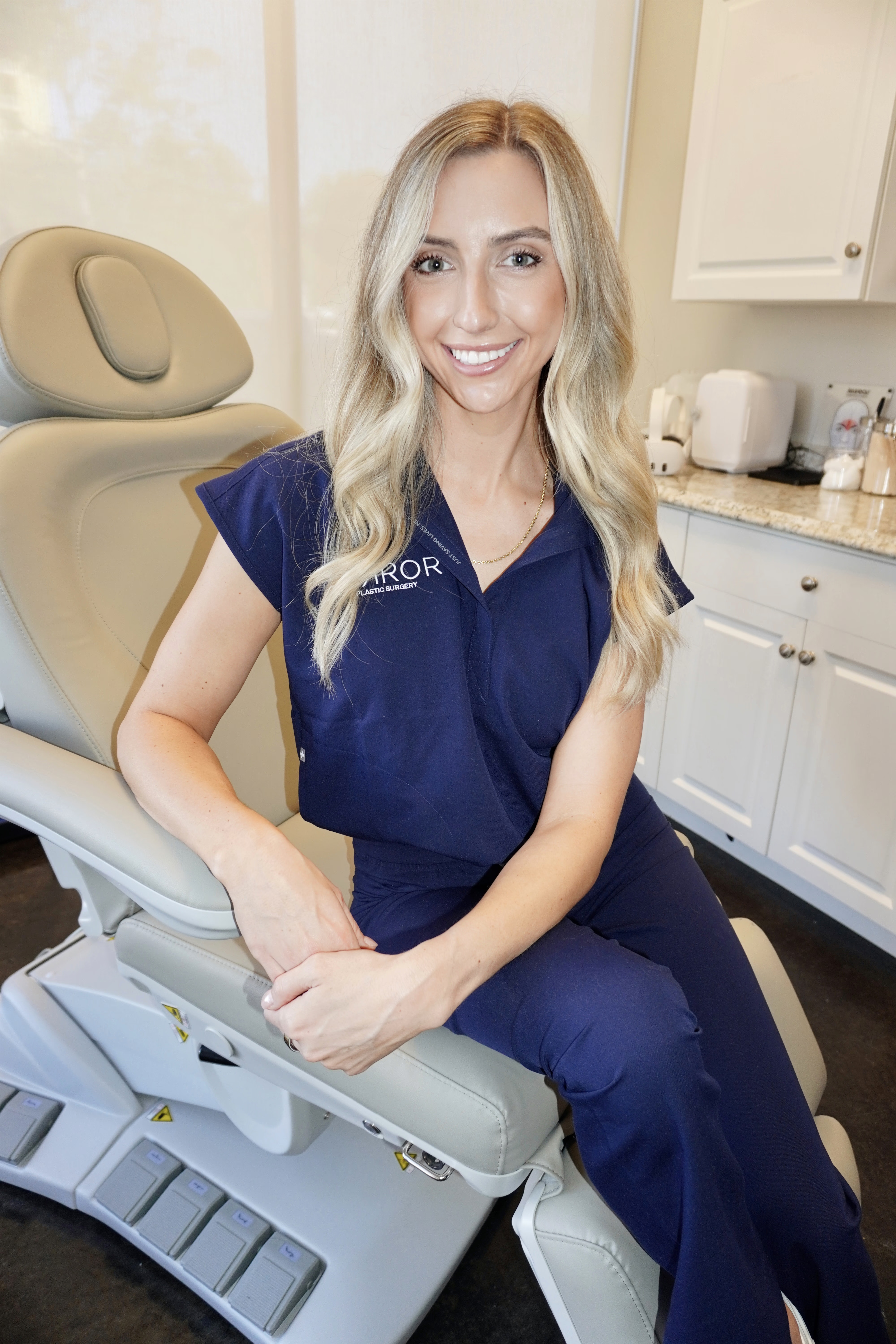
Her full-face assessment framework builds on the vector-based approach described earlier and evaluates the face as a complete structural unit. The face must be analyzed as a structural system involving skin quality, ligaments, fat compartments, muscle activity, connective tissue, facial proportions, and bone support, rather than treating isolated areas that can disturb harmony.
In practice, Ellie’s framework proceeds in a defined sequence:
- Evaluate facial proportions, tissue quality, and volume distribution from multiple angles at rest and in animation.
- Assess dynamic muscle activity to plan neuromodulator placement across the upper, mid, and lower face as an integrated unit.
- Prioritize foundational restoration before considering volume augmentation, ensuring a seamless transition between facial regions.
- Introduce biostimulatory fillers where structural support is needed, using products selected for the individual patient’s anatomy rather than a fixed menu.
- Reserve a follow-up review to assess response and refine results iteratively.
For non-surgical BBL, Ellie uses Radiesse and AlloClae, biostimulatory agents that stimulate the body’s own collagen production, to achieve gluteal contouring, smooth cellulite, reduce the appearance of stretch marks, and correct hip dips.1 This approach integrates regenerative medicine principles and is tailored to whether a patient seeks significant volume, subtle enhancement, or structural correction.
Book a consultation with Ellie to receive a full-face or full-body anatomical assessment built around your specific goals.
Cost, Prevention, and the Value of Concierge Med-Spa Care
The 2025 AAFPRS Annual Survey found an increase in patients under 30 requesting cosmetic procedures, with many opting for subtle, preventative approaches to preserve facial structure and support long-term skin health. That shift toward maintenance-led aesthetics makes the cost-value calculation for concierge care straightforward. Prevention usually costs less than correction.
Mirror Plastic Surgery does not operate on a quota-driven or commission-based model. Ellie often advises patients that an expensive service is not yet necessary for them. That transparency builds trust and reduces the likelihood of over-treatment. Every product recommendation is supplier-neutral and evidence-based, selected for the patient’s anatomy rather than inventory targets.
The long-term value of concierge aesthetic care rests on three measurable factors:
- Reduced revision risk from anatomy-driven planning and conservative, iterative dosing.1
- Longer-lasting results from treatments sequenced to build on each other rather than address isolated concerns episodically.1
- Honest maintenance guidance that helps patients understand what to do between appointments to protect their investment.
Daily Patient Volume in a Concierge Aesthetic Practice
Mirror Plastic Surgery limits surgical volume to one to two procedures per day. The same principle governs non-surgical care. Ellie conducts extended consultations, and the entire clinical team focuses on each patient before, during, and after treatment. High-volume practices performing five to ten procedures daily cannot replicate that level of attention regardless of injector skill.
Concierge aesthetic consultations that run 45 to 90 minutes include detailed history, assessment of facial animation under multiple lighting conditions, goal alignment, and explicit recommendations that may include no treatment. That willingness to recommend doing nothing is structurally impossible in a model where revenue depends on treatment volume.
Patient Journey: From Rushed Med-Spa Visits to Mirror’s Transparent Process
A patient arrives at Mirror Plastic Surgery after years of 15-minute appointments at high-volume practices. Each visit followed the same pattern: a brief intake, a product recommendation, a treatment, and a checkout. Concerns about asymmetry were minimized. Questions about long-term implications went unanswered. The results were technically adequate but never quite right, slightly overdone in one area and unaddressed in another.
At Mirror, the first appointment differs in structure and intent. Ellie spends up to an hour reviewing the patient’s medical history, emotional motivations for seeking treatment, and long-term aesthetic goals. She evaluates the full face under multiple lighting conditions, explains the physiology of what she observes in plain language, and presents a phased treatment plan that prioritizes restoration before augmentation. She also tells the patient what she does not recommend and why.
The patient leaves with a documented plan, a clear understanding of the rationale behind every proposed treatment, and direct access to Ellie for follow-up questions. The outcome extends beyond an aesthetic result. It includes confidence in the process and a provider relationship built on transparency rather than transaction.
Book a consultation with Ellie and begin a patient journey built around your anatomy, your goals, and your long-term well-being.
Questions to Ask Any Aesthetic Provider
Evaluating any aesthetic practice before committing to treatment requires direct, specific questions. Red flags during a med-spa consultation include pressure to book today, vague answers about devices or products, no physician on-site or clearly involved for medical-grade treatments, and brushing off risk questions with statements that the procedure is “super safe.”
Use the following questions to assess any provider:
- What specific product will be used, and why is it appropriate for my anatomy and goals?
- How many of these treatments have you personally performed in the past year?
- What are the risks, and what is your protocol if something does not go as planned?
- Will the same provider assess me, treat me, and follow up with me at every visit?
- Will you ever recommend that I do less than I am requesting, or wait before proceeding?
- How do you approach full-face harmony rather than single-area treatment?
- What does a long-term maintenance plan look like for my specific concerns?
A provider who answers these questions directly, without deflection or sales pressure, operates within a concierge or high-touch model. A provider who pivots to pricing, promotions, or urgency does not.
Frequently Asked Questions
What makes concierge aesthetic medicine different from a regular med-spa?
Concierge aesthetic medicine prioritizes extended consultation time, provider continuity, and anatomy-driven treatment planning over appointment volume. At Mirror Plastic Surgery, consultations run up to an hour, the same provider assesses and treats each patient across every visit, and the practice limits daily patient volume to ensure undivided clinical focus. Standard med-spas typically structure appointments around throughput, with shorter consultations, rotating injectors, and a treatment model that incentivizes conversion at each visit. The concierge model aims to reduce revision risk and build long-term results rather than address isolated concerns episodically.
What non-surgical injectable treatments does Ellie Pranckevicius offer at Mirror Plastic Surgery?
Ellie specializes in neuromodulators, including Botox, Dysport, Xeomin, Daxxify, and Jeuveau, applied to the face, neck, masseters, TMJ, and trapezius muscles. She also performs dermal filler treatments using biostimulatory fillers from brands including Juvederm, RHA, Versa, Restylane, Radiesse, and Evolysse, addressing the face, neck, earlobes, hands, décolleté, and upper knees. Her non-surgical BBL service uses Radiesse and AlloClae to contour the gluteal region, smooth cellulite, reduce the appearance of stretch marks, and correct hip dips. Additional services include lip augmentation, Kybella for submental fat reduction, energy-based skin tightening, and microneedling.
Is a non-surgical BBL with injectables safe?
When a credentialed provider with deep anatomical knowledge and a safety-first protocol performs it, non-surgical BBL using biostimulatory fillers is a well-established body contouring option. At Mirror Plastic Surgery, Ellie uses Radiesse and AlloClae, biostimulatory agents that stimulate the body’s own collagen production, rather than relying on approaches that carry higher risk profiles. Every treatment begins with a comprehensive medical history review, contraindication screening, and individualized treatment planning. Ellie’s background in the Neuroscience ICU at Tampa General Hospital, combined with her advanced nursing credentials and esthetics training, gives her the clinical judgment to identify when a patient is not a candidate for a given treatment and to manage any adverse events that may arise.
How does Mirror Plastic Surgery approach full-face harmony in injectable treatments?
Ellie evaluates the face as a connected structural system rather than a collection of isolated concerns. Her assessment covers facial proportions, tissue quality, volume distribution, dynamic muscle activity, and skin quality from multiple angles at rest and in animation. She sequences treatments to address foundational restoration before volume augmentation, which supports a seamless transition between the upper, middle, and lower facial regions. This approach helps prevent the asymmetry and overdone appearance that commonly results from single-area injections performed without a full-face framework.1 Neuromodulators and biostimulatory fillers are selected and placed based on each patient’s individual anatomy and long-term goals, not a fixed treatment menu.
How do I know if concierge aesthetic care at Mirror Plastic Surgery is right for me?
Mirror Plastic Surgery serves adults in the St. Petersburg and Tampa Bay area who prioritize safety, anatomical expertise, and honest long-term guidance over the lowest price or fastest appointment. Patients who have experienced rushed consultations, upselling pressure, or results that felt unnatural or required correction often find that the concierge model at Mirror addresses each of those concerns directly. Ellie will tell you when a treatment is not yet necessary, recommend a phased approach when appropriate, and build a maintenance plan around your specific anatomy and goals. Patients seeking a provider relationship built on transparency and continuity rather than transaction benefit most from a consultation with Ellie.
Disclaimer: Results may vary from person to person. Editorial content, before and after images, and patient testimonials do not constitute a guarantee of specific results.
1 Results may vary from person to person. Editorial content, before and after images, and patient testimonials do not constitute a guarantee of specific results.