

Written by: Dr. Akash Chandawarkar, Board Certified Plastic Surgeon, Mirror Plastic Surgery | Last updated: September 9, 2026
Key Takeaways
- Temple filler is a high-risk procedure that requires surgical-level anatomical knowledge and strict safety protocols.
- Board-certified plastic surgeons with aesthetic fellowship training, like Dr. Akash Chandawarkar, bring advanced expertise in the temple’s complex vascular anatomy.
- Expert injectors master both hyaluronic acid fillers and collagen-stimulating biostimulators and match each option to a patient’s unique anatomy.
- A thorough consultation, clear safety protocols, and real emergency preparedness separate qualified providers from high-volume med spas.
- Experience the difference surgical expertise makes and schedule your consultation with Ellie at Mirror Plastic Surgery today.
Quality #1: Board-Certified Plastic Surgeon Credentials For Temple Filler
“Certified injector” often means a brief training course with limited anatomical depth. True board certification by the American Board of Plastic Surgery requires years of surgical residency, rigorous written and oral examinations, and proven mastery of human anatomy in the operating room. Weekend courses cannot match that level of training.
This distinction matters most in the temple. The temple contains the superficial temporal artery, deep temporal arteries, middle temporal vein, and branches of the facial nerve. A board-certified plastic surgeon has not only studied these structures but has dissected and operated on them directly.
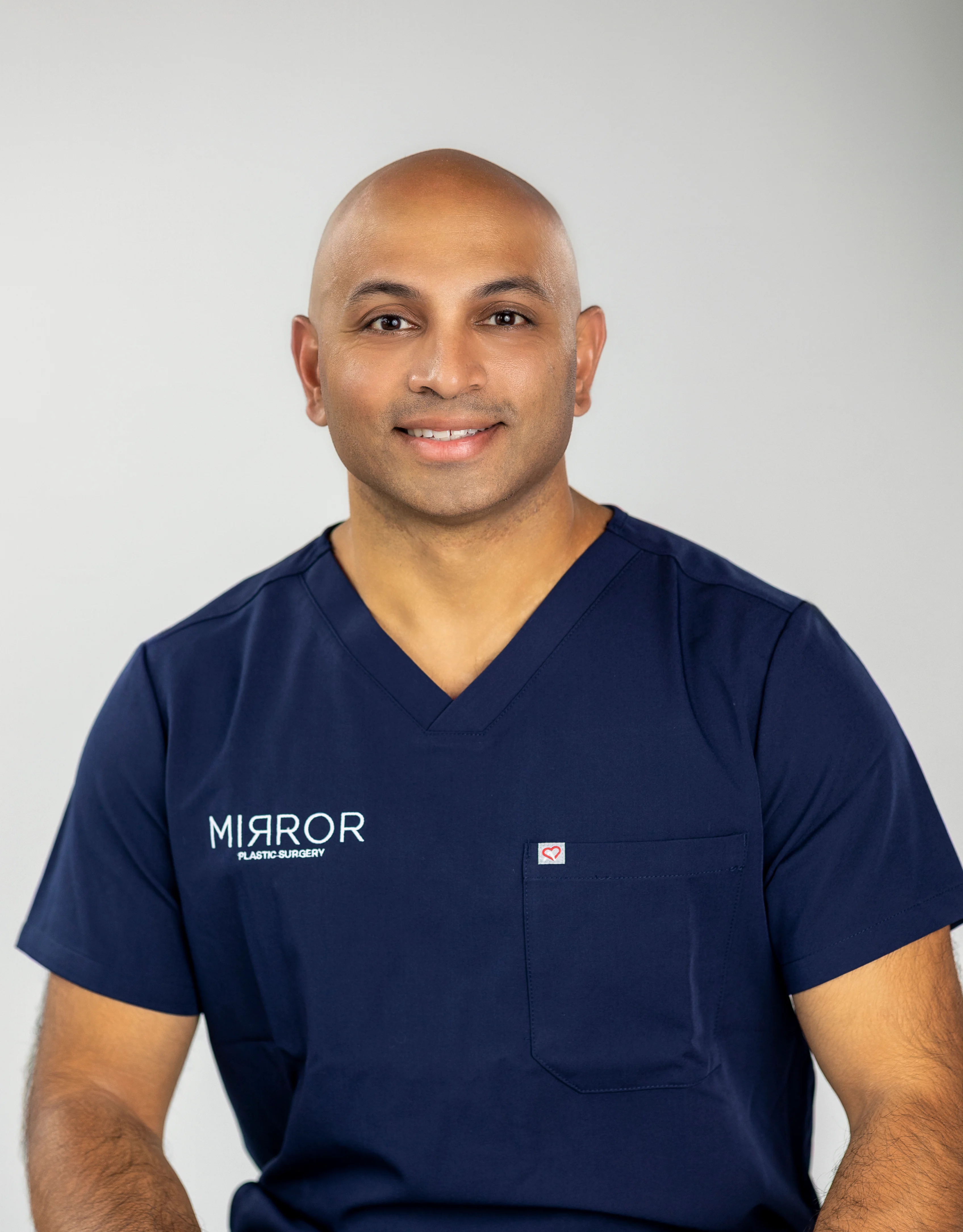
Dr. Akash Chandawarkar is Harvard-educated, Johns Hopkins-trained, and board certified by the American Board of Plastic Surgery. At Mirror Plastic Surgery, he personally performs every injectable treatment. Patients never get passed to a less-qualified provider, which sets the practice apart from many high-volume med spas and generalist clinics in the Tampa Bay area.
Quality #2: Fellowship Training In Aesthetic Surgery For Facial Balancing
Board certification creates a strong surgical foundation. Fellowship training in aesthetic surgery adds advanced artistry and judgment on top of that base. Dr. Akash completed his aesthetic surgery fellowship at the Manhattan Eye Ear & Throat Hospital (MEETH)/Lenox Hill Hospital, one of the most prestigious aesthetic surgery fellowships in the United States. The program emphasizes facial balancing, harmonization, and the nuanced decisions that separate natural results from overdone outcomes.
His commitment to cutting-edge technique extends further through medical innovation training at Stanford University. This background keeps his approach aligned with the latest evidence and technology, not just standard clinical routines. Most injectors in med spas across St. Petersburg and the broader Tampa Bay area, including many nurse practitioners with aesthetic training, do not hold surgical fellowship credentials. In a high-risk procedure like temple filler, this rare level of preparation directly supports patient safety.
Quality #3: Deep Anatomical Knowledge Of The Temple “Danger Zone”
The temple is a high-risk injection zone for specific anatomical reasons. The temple is composed of eight distinct layers. Major vascular structures concentrate in the superficial layers, which makes depth selection the primary determinant of safety. The superficial temporal artery and its branches run just beneath thin skin. The middle temporal vein sits in an intermediate tissue plane and is large and valveless, and venous cannulation during filler injection has been linked to pulmonary embolisation.
Beleznay et al. (2019), in an updated global literature review, confirmed that the temporal and glabellar regions are among the highest-risk injection zones for retrograde embolisation and vision loss. Aspiration is unreliable in the temple due to vessel collapse and negative pressure artefact. Detailed anatomical knowledge, not aspiration, provides the main safeguard.
Expert navigation of this region involves selecting the correct injection plane, such as supraperiosteal or interfascial, using blunt-tip cannulas, and injecting in small boluses of 0.1–0.2 mL with slow, low-pressure technique. Dr. Akash’s surgical background includes operating in this area. His approach to temple filler safety comes from firsthand anatomical experience rather than theoretical familiarity.
Quality #4: Advisory Roles In Aesthetic Product Development
Top injectors contribute to how products are developed and refined. Dr. Akash serves on the advisory boards of Merz Aesthetics, manufacturer of Radiesse (a calcium hydroxyapatite biostimulatory filler), and Tiger Aesthetics, maker of AlloClae adipose fillers. These roles provide insider insight into product science, safety profiles, and ideal injection mechanics that most injectors never access.
Mirror Plastic Surgery also operates as a supplier-neutral practice. Recommendations focus on what best fits a patient’s anatomy and goals, free from commission incentives or inventory pressure. A 2026 systematic review in Aesthetic Plastic Surgery confirmed that permanent complications from dermal fillers are overwhelmingly caused by insufficient understanding of facial anatomy, wrong filler selection, and poor technique. Advisory-level product expertise helps control each of these variables.
Quality #5: A Comprehensive, Concierge Consultation Process
A proper temple filler consultation at Mirror Plastic Surgery can extend up to an hour and covers the entire face. Patients receive a full facial assessment, a detailed review of medical history and goals, and a personalized treatment plan tailored to their anatomy rather than a generic product menu.
Red flags at other practices include rushed visits, immediate upselling, and an inability to explain which injection plane will be used and why. In contrast, Mirror Plastic Surgery follows a concierge medicine philosophy of safety first, function second, and aesthetics third. Dr. Akash will clearly explain when a patient is not ready for treatment or when a different approach better serves long-term results.
This level of transparency builds lasting trust and helps patients feel confident in every decision. The practice also limits daily procedures so each patient receives focused, unhurried attention instead of assembly-line care.
Ready for a consultation that centers your safety and goals? Reserve your appointment with Ellie at Mirror Plastic Surgery.
Quality #6: Mastery Of Both HA Fillers And Collagen Stimulators
An expert injector for hollow temples understands two main categories of volumizers and knows exactly when each one fits a patient’s needs.
Hyaluronic acid (HA) fillers provide immediate volume and offer the key safety advantage of reversibility with hyaluronidase. Two HA fillers now carry FDA approval specifically for temple hollowing:
- Juvéderm Voluma XC received FDA approval in March 2024 as the first hyaluronic acid filler indicated for temple hollowing correction, with results lasting up to 13 months.1
- Restylane Contour received FDA approval in March 2026 for the correction of temple hollowing in patients older than 21, with clinical data showing results lasting up to 18 months and more than 84% patient satisfaction at 18 months.1
Collagen-stimulating biostimulators work differently. They trigger the body’s own collagen production gradually over two to three months, with results that can last two years or more.1 Options include Sculptra for temples (poly-L-lactic acid, or PLLA) and Radiesse (calcium hydroxyapatite, or CaHA). A 2026 clinical study published in the Aesthetic Surgery Journal found that PLLA filler improved temple hollowing with an excellent safety profile and benefits lasting up to 12 months.1 Biostimulators are not reversible, which makes patient selection and technique especially critical.
For patients in St. Petersburg and the Tampa Bay area seeking Sculptra for temples, Dr. Akash’s advisory role with Merz Aesthetics provides particular depth in biostimulatory fillers. He matches product choice to each patient’s anatomy, goals, and timeline and explains the trade-offs clearly instead of defaulting to whatever is most convenient.
Quality #7: A Documented Safety Protocol And Emergency Preparedness
Even the most skilled injector can encounter complications, so preparation matters. Temple filler safety at Mirror Plastic Surgery follows a clear clinical protocol. The safety framework Dr. Akash uses includes:
- Blunt-tip cannula use to reduce the risk of vessel puncture in the temporal zone of caution
- Slow injection in small aliquots with low pressure
- Supraperiosteal or interfascial plane selection based on individual anatomy
- Ultrasound guidance, which is becoming a recommended standard in 2026 for visualizing vessels before injection in high-risk facial zones like the temples
- Hyaluronidase on-site with a rehearsed emergency protocol for vascular events
The latest guidelines from the Complications in Medical Aesthetics Collaborative recommend immediate high-dose, repeated hyaluronidase infiltration into affected areas, warm compresses and massage, administration of aspirin if not contraindicated, and escalation to ophthalmology or emergency care in suspected visual compromise. Dr. Akash’s surgical background allows him to manage complications in-office that might require emergency escalation at other practices.
Frequently Asked Questions About Temple Filler In St. Petersburg
How Long Do Temple Fillers Last?
Longevity depends on the product used and the individual patient. Hyaluronic acid fillers such as Juvéderm Voluma XC and Restylane Contour typically last 12 to 18 months.1 Collagen-stimulating biostimulators like Sculptra can maintain results for up to two years or more, as noted earlier, and they build gradually over two to three months instead of providing instant correction.1 Dr. Akash recommends products based on your anatomy, degree of hollowing, and aesthetic goals rather than a one-size-fits-all timeline.
Is Temple Filler Painful?
Most patients describe temple filler as very tolerable. Many filler products contain lidocaine, a local anesthetic, and the team applies topical numbing agents before injection. Deep supraperiosteal injections placed directly on the bone usually feel like pressure instead of sharp pain. Some patients notice mild tightness or a dull ache when chewing for a few days because the temporalis muscle helps move the jaw. These sensations resolve quickly for most people.
What Are The Risks Of Temple Filler?
Common side effects include bruising, swelling, tenderness, and redness at the injection site, which usually resolve within one to seven days. Serious complications such as vascular occlusion, skin necrosis, and in extremely rare cases vision changes can occur because of the temple’s complex vascular anatomy and its connections to the ophthalmic circulation.1 Treatment by an injector with surgical-level anatomical knowledge, careful technique, and on-site emergency preparedness significantly reduces these risks, though it cannot eliminate them completely.
Warning signs that require immediate medical attention include sudden severe pain, skin blanching or mottled discoloration, and any change in vision.
How Much Does Temple Filler Cost In St. Petersburg?
Cost varies based on the product selected, the volume required to reach your goals, and the overall treatment plan. Mirror Plastic Surgery provides personalized quotes at consultation with clear pricing and no quota-driven upselling. The focus stays on using the right amount of the most appropriate product for your anatomy rather than maximizing revenue per visit.
Your Next Step Toward Safe, Natural-Looking Temple Filler
Each of these seven qualities, from board certification to documented safety protocols, sets a non-negotiable standard for temple filler expertise. Dr. Akash Chandawarkar and Mirror Plastic Surgery meet every one of these benchmarks for patients in St. Petersburg and the greater Tampa Bay area.
Your temples deserve an expert who prioritizes safety, function, and natural results. Book your consultation with Ellie at Mirror Plastic Surgery today and experience the difference surgical expertise makes.
Disclaimer: Results may vary from person to person. Editorial content, before and after images, and patient testimonials do not constitute a guarantee of specific results.
1 Results may vary from person to person. Editorial content, before and after images, and patient testimonials do not constitute a guarantee of specific results.


