
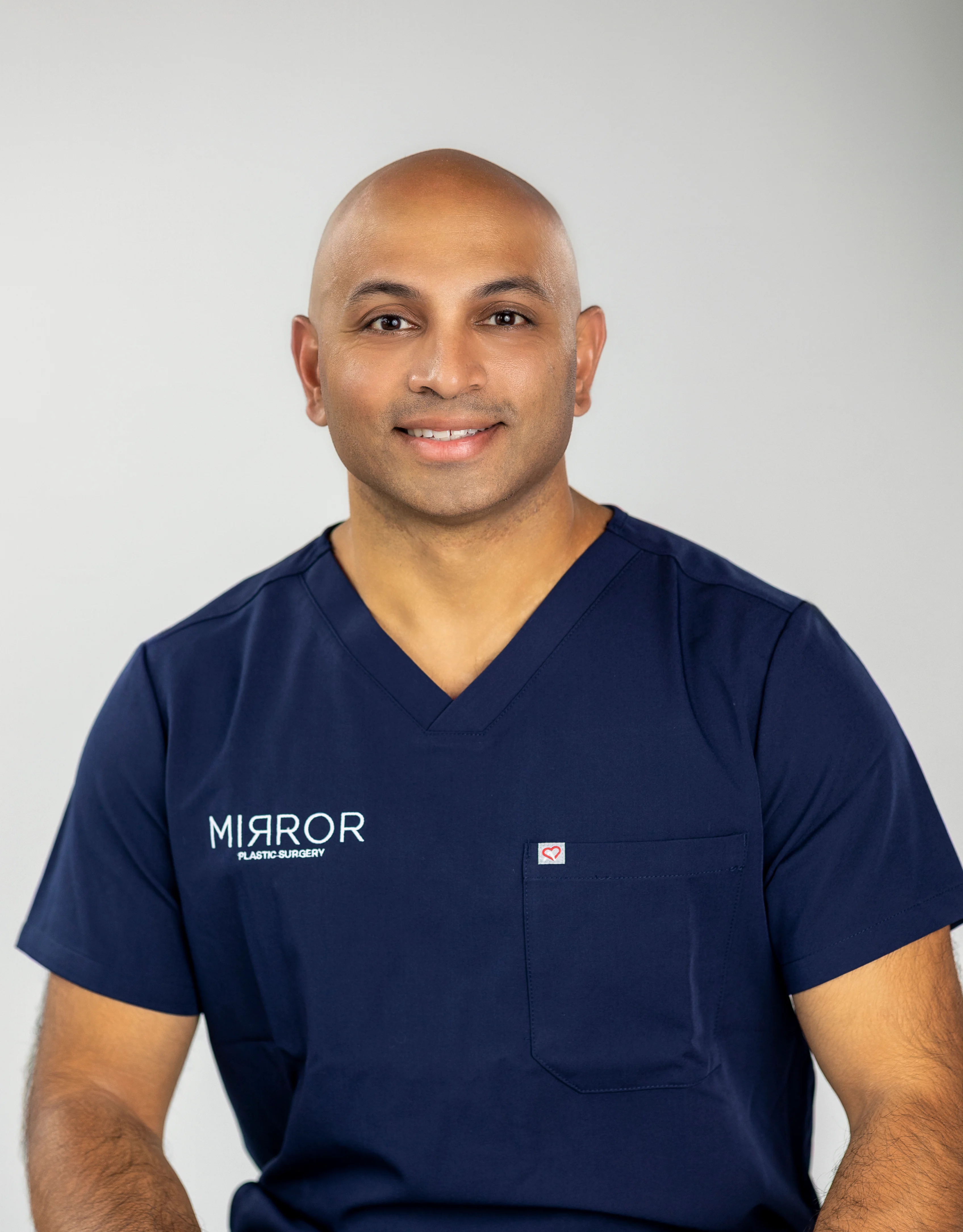
Written by: Dr. Akash Chandawarkar, Board Certified Plastic Surgeon, Mirror Plastic Surgery | Last updated: September 9, 2026
Key Takeaways
- Most patients see full laser hair removal results within 6–12 months, after a series of 6–8 sessions.1
- Each session treats only a portion of follicles in the active growth phase, so results build gradually over time.
- Hair reduction typically progresses from subtle changes after the first visit to major, long-lasting reduction by sessions 6–8.1
- Skin tone, hair color, hormones, and treatment area all shape your final outcome and the number of sessions you need.
- Schedule a consultation with Mirror Plastic Surgery to receive a custom laser hair removal plan for your skin and hair.
How Laser Hair Removal Works With Hair Growth Cycles
Laser hair removal uses selective photothermolysis. The laser emits a specific wavelength of light absorbed by melanin in the hair shaft. This energy converts to heat and damages the follicle’s ability to grow new hair.
The laser only destroys follicles in the active growth phase, called anagen. Catagen is a short transition phase when the hair detaches from its blood supply. Telogen is a resting phase before shedding, and follicles in these phases resist laser energy.
Only a portion of follicles in any area sit in anagen at a given time. Each appointment treats the follicles that are active that day. Later sessions catch new waves of follicles as they cycle into anagen. The American Academy of Dermatology (AAD) notes that most patients need multiple treatments, and clinical practice supports 6–8 sessions for meaningful, lasting reduction.
Laser Hair Removal Results Timeline By Stage
After 1 Session: Early Shedding
Treated hairs usually shed 1–3 weeks after the first session. This shedding reflects dead hair pushing out of the follicle rather than new growth. The AAD reports that many patients see a modest reduction after the first treatment, although the exact percentage varies. Some hair returns as previously untreated follicles enter anagen for the first time.
After 3–4 Sessions: Noticeable Thinning
By sessions 3–4, most patients see clearly thinner, sparser hair.1 Regrowth slows, and returning hair often feels finer and lighter between visits. Patchy areas during this stage show that the laser is selectively disabling active follicles while others await treatment in later cycles.
After 6–8 Sessions: Significant, Long-Lasting Reduction
By sessions 6–8, many patients experience major, long-lasting reduction,1 with remaining hair usually very fine and hard to see. A 2023 literature review found mean hair reduction around 75–85% after standard six-session protocols in Fitzpatrick skin types I–III. Patients with hormonally sensitive areas, especially the face, often need extra sessions beyond this range.
Full Results: 6–12 Months From Your First Session
Full results usually become clear a few months after your final session.1 Residual fine hairs shed, and the treated area looks smoother and less dense. The FDA-cleared term for this outcome is “permanent hair reduction,” defined as a long-term, stable decrease in the number of hairs regrowing after a treatment course. Some hair can return over time as hormones activate dormant follicles, so many patients schedule periodic maintenance.
Laser Hair Removal Timeline At A Glance
Use this quick reference to see how results typically build from session to session.
- After 1 session: modest reduction, shedding begins 1–3 weeks later1
- After 3–4 sessions: clearly thinner hair that grows back more slowly1
- After 6–8 sessions: major, long-lasting reduction for most patients1
- Full results: usually visible 6–12 months after starting treatment1
- Maintenance: many patients schedule 1–2 touch-up sessions per year
Laser Hair Removal Results By Body Area
Different body areas respond differently because follicle depth, density, and growth-cycle length vary. Facial hair cycles faster, so facial sessions are usually spaced about 4 weeks apart, while most body areas are spaced 6–8 weeks apart. The table below outlines typical estimates.
| Body Area | Typical Sessions | Session Interval | Notes |
|---|---|---|---|
| Upper Lip / Chin | 6–10 | 4 weeks | Hormonal influences can push this to 10–12+ sessions with closer maintenance |
| Underarms | 6–8 | 6 weeks | Coarse, dark hair in this area usually responds very well |
| Legs | 6–8 | 6–8 weeks | Lower legs often respond faster than thighs |
| Bikini Line | 6–10 | 6–8 weeks | Full Brazilian treatments may require up to 10 sessions |
| Back / Chest (Men) | 8–10 | 8–10 weeks | Thick, dense hair and longer cycles call for wider spacing |
Factors That Shape Your Laser Hair Removal Results
Skin And Hair Color
Contrast between hair and skin drives how efficiently the laser works. Dark hair on lighter skin often achieves strong reduction, while hormonally driven hair, such as with PCOS, tends to respond less completely. Darker skin tones need longer-wavelength lasers such as Nd:YAG to safely reach the follicle without harming surrounding skin and may require a few extra sessions. Blonde, red, gray, and white hair lack enough melanin for the laser to target effectively, so electrolysis is usually a better choice for those hair types.
Hormonal Influences
Conditions such as PCOS elevate androgen levels, which stimulate dormant follicles and speed growth in androgen-sensitive areas like the chin, upper lip, neck, chest, and abdomen. This ongoing stimulation means patients with hormonal drivers usually need more sessions and more frequent maintenance. Combining laser with physician-guided hormonal treatment often produces better long-term control of PCOS-related facial hair than laser alone.
Consistency And Treatment Intervals
A treatment-interval study found better long-term results with sessions every six weeks than with sessions every two weeks. This finding confirms that spacing follows the biology of the hair growth cycle. Skipping or delaying appointments means missing waves of follicles entering anagen, which stretches the timeline and weakens cumulative results.
Provider Expertise
The AAD warns that laser hair removal can cause burns, permanent color changes, and scarring when performed by inexperienced providers. An experienced physician selects the right wavelength for your Fitzpatrick skin type, adjusts fluence for hair coarseness and body area, and watches closely for any adverse reaction at every visit.
Paradoxical Hypertrichosis: When Hair Appears Thicker After Laser
Paradoxical hypertrichosis (PH) is a rare side effect in which laser treatment appears to stimulate hair growth instead of reducing it. New hair in the area can look thicker, darker, and coarser. A systematic review and meta-analysis of more than 9,700 patients reported a pooled PH prevalence of 3%, with most cases on the face and neck; non-facial cases occurred in only 0.08% of patients.
Researchers believe suboptimal heating plays the main role. When energy is too low to destroy a follicle but high enough to stimulate it, a localized inflammatory response can nudge nearby dormant follicles into anagen. Risk factors include:
- Darker skin tones (Fitzpatrick III–VI), where providers may lower fluence to avoid burns
- Facial and neck areas, which carry the highest PH risk
- Underlying hormonal conditions such as PCOS, nonclassical congenital adrenal hyperplasia, and Cushing syndrome
- Treatment of fine vellus hair, which lacks enough pigment to focus laser energy on the follicle
PH remains uncommon, and a physician-led practice that screens patients carefully, selects the correct wavelength, and calibrates fluence precisely can greatly reduce this risk.
Side Effects And Realistic Limitations
Common, Short-Term Side Effects
The AAD notes that the most common side effects of laser hair removal are mild discomfort, swelling, and redness lasting 1–3 days. Shedding 1–3 weeks after treatment is expected and does not signal failure.
Stopping After Only A Few Sessions
Stopping after 2–3 sessions often leads to underwhelming results because only a portion of follicles have been treated. Hair can return as untreated follicles cycle into anagen. Completing the full recommended series gives the most durable reduction.
Regrowth And Maintenance Over Time
Most patients schedule 1–2 touch-up sessions per year to maintain smoothness. Hormonal shifts, aging, pregnancy, and menopause can recruit new follicles into active growth. Laser reduces the existing terminal hair population but cannot prevent future hormonal changes from activating new follicles.
Common Misconceptions About Laser Hair Removal
Several myths can set unrealistic expectations. These clarifications help you understand what laser can genuinely deliver.
- Laser Hair Removal Offers Permanent Reduction, Not Total Removal. The FDA-cleared definition of permanent hair reduction, discussed earlier, describes a long-term decrease in regrowth rather than complete elimination.
- Results Build Over Multiple Sessions. Each visit treats only the portion of follicles in the active growth phase at that time, so full results require a series.
- Laser Works Best On Pigmented Hair. Blonde, red, gray, and white hairs lack enough melanin for the laser to target effectively, so other methods may be better for those shades.
- Some Discomfort And Temporary Redness Are Normal. The AAD compares the sensation to warm pinpricks or a rubber band snap, with short-lived redness and swelling.
Why Choose A Physician For Laser Hair Removal?
Physician-led care becomes especially important for patients with darker skin tones, hormonal conditions, or complex facial areas. A board-certified plastic surgeon understands anatomy in depth, recognizes and manages complications, and tailors settings more precisely than a high-volume med spa.
At Mirror Plastic Surgery in St. Petersburg, Dr. Akash Chandawarkar, a Harvard-educated, Johns Hopkins-trained, board-certified plastic surgeon, offers laser hair removal within a concierge-style aesthetic practice. The team prioritizes safety first, function second, and aesthetics third. Consultations can last up to an hour to review anatomy, hormonal history, and long-term goals before recommending a treatment plan. This careful approach defines a true medical procedure.
Start your physician-led laser hair removal assessment with Mirror Plastic Surgery today.
Frequently Asked Questions
How Many Laser Hair Removal Sessions Will I Need?
Most patients need 6–8 sessions for body areas, while facial or hormonally influenced areas often require 8–12 sessions.1 Your Fitzpatrick skin type, hair color and thickness, treatment area, and hormonal status all affect this number. A detailed consultation, including a review of your hormonal history, gives the most accurate estimate.
How Long Does Each Laser Hair Removal Session Take?
Session length depends on the area treated. Upper lip sessions take about 5 minutes, underarms 5–10 minutes, bikini or half-leg 15–20 minutes, and full legs, back, or chest 30–45 minutes. Full-body appointments often last 60–90 minutes, depending on how many areas you treat at once.
Can I Shave Between Laser Sessions?
Shaving between sessions is encouraged. Most practices recommend shaving 24–48 hours before each appointment. Avoid waxing, plucking, and threading, because these methods remove the hair root the laser needs to target. Removing the root takes away the chromophore that carries heat to the follicle.
Is Laser Hair Removal Safe For All Skin Tones?
Modern platforms, especially Nd:YAG at 1064 nm, can safely treat darker skin tones by bypassing much of the epidermal melanin and delivering energy to the follicle. However, the AAD stresses that treatment must be performed very carefully in these patients. Incorrect wavelength or excessive fluence can cause burns, hyperpigmentation, or scarring, so provider expertise is crucial.
What Happens If I Stop Laser Hair Removal Early?
Stopping after only a few sessions produces some visible thinning, but hair often returns as untreated follicles cycle into anagen. Laser hair removal works cumulatively, with each session building on the last. Ending treatment early leaves many follicles intact and able to grow terminal hair again, which limits long-term benefit.
Conclusion: Planning Your Path To Smooth, Lasting Results
Most patients reach their full laser hair removal results within 6–12 months and a series of 6–8 sessions because only active follicles respond at each visit.1 Results build gradually from early shedding to major, long-lasting reduction by the end of the series. Treatment area, skin and hair color, hormonal status, and provider skill all influence your personal outcome. Many people schedule 1–2 maintenance sessions per year, especially for hormonally sensitive areas like the face.
Choosing a board-certified plastic surgeon for laser hair removal brings surgical-level attention to anatomy, safety, and customization. This approach replaces one-size-fits-all protocols with a plan built around your body and goals.
To schedule your personalized assessment at Mirror Plastic Surgery, call 727-361-6515, email hello@mirrorplasticsurgery.com, or visit us at 780 4th Ave S, St. Petersburg, FL 33701.
Disclaimer: Results may vary from person to person. Editorial content, before and after images, and patient testimonials do not constitute a guarantee of specific results.
1 Results may vary from person to person. Editorial content, before and after images, and patient testimonials do not constitute a guarantee of specific results.