
Written by: Dr. Akash Chandawarkar, Board Certified Plastic Surgeon, Mirror Plastic Surgery | Last updated: September 9, 2026
Key Takeaways
- Modern safety protocols have reduced BBL mortality by about 80% since 2017, bringing risk closer to procedures like tummy tucks.
- The most serious complication, fat embolism, occurs when fat enters or sits below the gluteal muscle; subcutaneous-only injection almost eliminates this risk.
- Choosing a board-certified plastic surgeon who uses real-time ultrasound guidance and limits daily case volume is the most powerful way to reduce complications.
- Long-term results show that 70–85% of enhanced volume is typically retained at five years, with weight stability as the key patient-controlled factor.1
The 2017 Crisis: How BBL Earned Its Dangerous Reputation
In 2017, the Aesthetic Surgery Education and Research Foundation (ASERF) task force surveyed nearly 200,000 gluteal fat grafting cases and identified 32 confirmed deaths, placing mortality at approximately 1 in 3,000, a rate described as far greater than any other cosmetic surgery. Autopsies consistently revealed fat injected deep within the gluteal muscle, damage to large gluteal veins, and massive fat emboli in the heart and lungs.
The anatomy explains this mechanism clearly. The gluteus maximus muscle contains superior and inferior gluteal veins that are 7 to 13 times larger in diameter than the venules in the subcutaneous space, sitting roughly 6 cm deep from the skin surface. Fat injected into these veins travels to the pulmonary arteries and can cause fatal fat embolism within minutes. Larger fat emboli are almost universally fatal.
The 2018 Safety Revolution: Guidelines That Changed BBL Technique
In August 2018, a multi-society task force representing the American Society of Plastic Surgeons, the American Society for Aesthetic Plastic Surgery, and the International Society of Aesthetic Plastic Surgery issued an urgent warning about BBL risks. The core mandate was clear: inject fat only into the subcutaneous plane above the muscle fascia, never into the muscle. Supporting recommendations included blunt-tip cannulas of 4 mm or larger, injection parallel to the skin, and a cap of three BBL cases per surgeon per day.
The outcome data showed that these guidelines worked. A 2020 survey of Aesthetic Society and ISAPS members found that reported mortality fell from 1 in 3,448 to 1 in 14,952, and pulmonary fat embolism incidence fell from 1 in 1,030 to 1 in 2,492. The share of surgeons still injecting fat deeply dropped from 13.1% to 0.8%.
Current Mortality Data: How Safe BBL Is In 2026
The table below shows how BBL mortality has changed across three key periods.
| Era | Estimated Mortality Rate | Primary Technique |
|---|---|---|
| 2017 (ASERF Task Force) | ~1 in 3,000 | Intramuscular injection prevalent |
| 2019–2020 (Post-Guidelines) | ~1 in 14,952 | Subcutaneous-only adoption rising |
| 2026 (WAGS Data) | ~1 in 23,818 | Subcutaneous-only with ultrasound guidance |
When surgeons strictly follow subcutaneous-only protocols, documented fatal pulmonary fat embolism rates have reached zero in multi-year clinical surveys. The South Florida experience highlights the remaining danger. More than 90% of BBL-related deaths in that region occurred at high-volume budget clinics. Florida responded by mandating subcutaneous-only injection, ultrasound guidance, and a three-case daily cap. The risk in 2026 is concentrated in surgeons who ignore evidence-based protocols, not in the procedure itself.
Discuss your personal risk profile with Ellie to determine if BBL is right for you.
Common Complications And Side Effects Patients Notice
Beyond mortality, BBL carries non-fatal complications that patients should understand before surgery.
- Infection: Bacteria can enter through incisions or liposuction sites. Serious infections after BBL, such as sepsis, are rare but require prompt antibiotics and sometimes surgery.
- Fat necrosis: Some transferred fat may die, forming firm lumps or oil cysts that may need drainage or revision.
- Seroma and hematoma: Fluid or blood pooling beneath the skin is typically managed with needle aspiration and occurred in 5.6% of patients in a 2026 clinical cohort.1
- Asymmetry and contour irregularities: Uneven fat reabsorption can create lumps or mismatched sides, affecting about 7.8% of patients in the same cohort.1
- Scarring: Small incisions at liposuction and injection sites are usually minimal but permanent.
Beyond these complications, patients often search for temporary healing issues such as “BBL smell” or “stomach looks weird after BBL.” These concerns usually reflect normal recovery. Drainage, swelling, and skin retraction at liposuction sites are expected and fade over weeks to months. Swelling occurs in about 90% of patients and temporary numbness in 50%, with both resolving within 3–6 months.1
Long-Term Outcomes: What To Expect 10 Years After A BBL
Approximately 20–40% of transferred fat is reabsorbed in the first 3–6 months, with 60–80% of surviving fat cells becoming permanent after stabilization. Most patients retain 70–85% of enhanced volume at the 5-year mark.1 At 10 years, some projection loss of 10–20% is expected due to skin laxity and gravity, yet the silhouette usually remains more contoured than before surgery.1
Surviving fat behaves like natural fat and responds to weight changes. Yo-yo dieting causes 15–25% volume instability in BBL results, which is why maintaining body weight within ±5–10 lbs of surgery weight is the most important patient-controlled factor.1 Even with stable weight, some patients choose touch-ups, and the revision rate for optional refinements is about 20–30%. Many patients maintain results for 15 or more years without revision when they work with a skilled surgeon and keep a stable weight.1
How To Choose A Safe BBL Surgeon: Evidence-Based Checklist
The criteria below come from multi-society guidelines and peer-reviewed safety data.
- Verify board certification by the American Board of Plastic Surgery (ABPS), the only ABMS-recognized board for plastic surgery. Physicians from non-surgical specialties have performed BBLs with devastating outcomes.
- Confirm subcutaneous-only injection technique by asking whether fat is placed above the muscle fascia. In no confirmed BBL death did fat remain exclusively in the subcutaneous plane.
- Ask about real-time ultrasound guidance. The 2022 multi-society advisory recommends ultrasound to visualize cannula position during injection. A surgeon who relies only on “feel” signals a safety concern.
- Inquire about daily case volume limits. A surgeon performing more than 2–3 major cases per day introduces fatigue-related risk.
- Request before-and-after photos of patients with similar body types to assess consistency and aesthetic judgment.
- Confirm the surgical facility is accredited by AAAASF, AAAHC, or the Joint Commission. These facilities must meet high standards for safety, cleanliness, equipment, and emergency preparedness.
- Watch for red flags such as prices far below the regional average, vague explanations of safety protocols, lack of hospital privileges, and high-volume scheduling. Any licensed physician can legally call themselves a “cosmetic surgeon” regardless of training, so ABPS board certification remains the most reliable credential.
BBL Vs. Implants: Comparing Risk Profiles
BBL uses the patient’s own fat, which eliminates implant-related complications. However, it introduces the fat embolism risk described throughout this report. Buttock implants carry zero fat embolism risk but present a different complication profile. Implants carry long-term complication rates up to 30%, including implant displacement, capsular contracture, seroma formation, and high rates of surgical site infection, which is why many board-certified plastic surgeons have moved away from buttock implants in favor of BBL. For both procedures, safety depends more on the surgeon’s technique and adherence to evidence-based protocols than on the category of procedure.
Why Mirror Plastic Surgery Focuses On Safety-First BBL
The choice of surgeon shapes both safety and results, which is the guiding principle at Mirror Plastic Surgery. Dr. Akash Chandawarkar, founder of Mirror Plastic Surgery, is Harvard-educated, Johns Hopkins-trained, and board-certified by the American Board of Plastic Surgery, with fellowship training in aesthetic surgery at the Manhattan Eye Ear & Throat Hospital (MEETH)/Lenox Hill Hospital. His guiding philosophy, safety first, function second, aesthetics third, is operationalized in every aspect of how the practice runs.
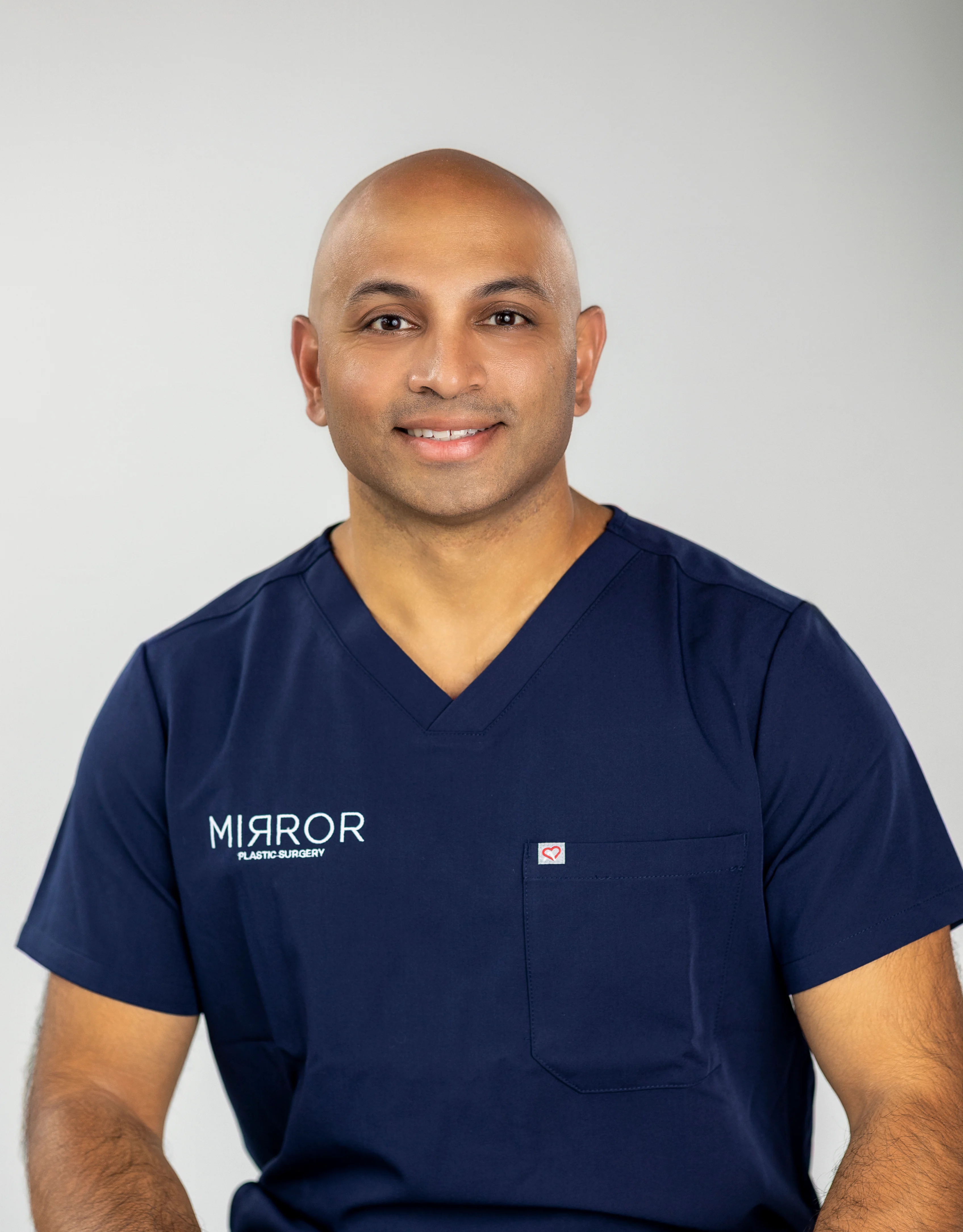
Mirror Plastic Surgery limits surgeries to one to two per day so the entire clinical team can focus on a single patient before, during, and after the procedure. High-volume practices may perform five to ten surgeries daily, which increases fatigue and reduces individualized attention. Consultations at Mirror Plastic Surgery can last up to an hour and cover anatomy, risk, technique, and realistic outcomes rather than sales tactics. Dr. Akash often advises patients to delay or avoid expensive procedures when they are not necessary, which builds trust over time.
For patients who want enhancement without surgery, Dr. Akash offers a non-surgical BBL using biostimulatory fillers such as Radiesse and AlloClae. These fillers enhance shape, smooth cellulite, and address hip dips with zero fat embolism risk. As an advisory board member for Merz Aesthetics (Radiesse) and Tiger Aesthetics (AlloClae), Dr. Akash brings manufacturer-level expertise to these treatments. Results are more subtle than surgical BBL and do not suit patients seeking large volume increases, yet for the right candidate, the non-surgical pathway offers meaningful enhancement with a very different risk profile.
Frequently Asked Questions
Is BBL Worth The Risk?
With a board-certified plastic surgeon who follows subcutaneous-only protocols and real-time ultrasound guidance, mortality risk drops to approximately 1 in 15,000–23,000, a rate comparable to a tummy tuck.1 The decision remains personal and depends on anatomy, health history, and goals. The risk is no longer prohibitive when a qualified surgeon operates in an accredited facility and follows modern standards. High-volume budget clinics that cut corners on technique, volume limits, and facility standards still account for most catastrophic outcomes, so choosing the right surgeon is crucial.
What Is The Mortality Rate For BBL In 2026?
Current data from the World Association of Gluteal Surgeons places BBL mortality at approximately 1 in 23,818, a dramatic improvement from the 2017 rate mentioned earlier. This improvement reflects broad adoption of subcutaneous-only injection, ultrasound guidance, and daily case volume limits. When surgeons follow these protocols consistently, multi-year clinical surveys have reported zero fatal pulmonary fat embolism events.
Can BBL Be Done Without Surgery?
Yes. A non-surgical BBL using biostimulatory fillers such as Radiesse or AlloClae can enhance shape, smooth cellulite, reduce the appearance of stretch marks, and address hip dips without incisions, general anesthesia, or fat embolism risk. Dr. Akash Chandawarkar at Mirror Plastic Surgery performs these treatments himself and draws on his advisory board expertise with both products. Results are more subtle than surgical BBL and do not work for large volume increases, yet for the right candidate, the non-surgical approach offers a meaningful and safer alternative.
What Happens 10 Years After A BBL?
As detailed earlier, most patients retain 70–85% of volume at five years, with some projection loss over a decade due to skin laxity and gravity. Surviving fat responds to weight changes, so weight stability remains the most important long-term maintenance factor. Some patients choose optional touch-ups, while many maintain results for 15 or more years when they work with a skilled surgeon and keep a stable weight.
What Disqualifies You From A BBL?
Contraindications include blood clotting disorders, a history of deep vein thrombosis (DVT) or pulmonary embolism, significant cardiac or pulmonary conditions, active smoking, uncontrolled diabetes, morbid obesity, and insufficient donor fat, often a BMI below about 23. Use of blood-thinning medications that cannot be safely stopped and autoimmune conditions that affect wound healing can also disqualify a patient. A thorough preoperative assessment by a board-certified plastic surgeon remains the best way to evaluate candidacy because individual anatomy and health history shape suitability more precisely than general rules.
Conclusion: Surgeon Choice Drives BBL Safety
BBL mortality has dropped by about 80% since 2017 due to subcutaneous-only technique, ultrasound guidance, and volume restraint. The remaining risk clusters in high-volume budget clinics that ignore these protocols. For patients who choose a board-certified plastic surgeon following modern safety standards, BBL now carries a risk profile similar to other common elective procedures and offers long-term outcomes that feel natural and are well documented in the medical literature.
Mirror Plastic Surgery applies every evidence-based safety standard, including concierge case limits, ultrasound guidance, honest patient education, and a philosophy that places your well-being ahead of procedure volume. Dr. Akash Chandawarkar’s credentials, surgical discipline, and commitment to clear communication make Mirror Plastic Surgery a safety-first choice for women in the St. Petersburg and Tampa Bay area who want enhancement without compromising their health.
Disclaimer: Results may vary from person to person. Editorial content, before and after images, and patient testimonials do not constitute a guarantee of specific results.
1 Results may vary from person to person. Editorial content, before and after images, and patient testimonials do not constitute a guarantee of specific results.