
Written by: Dr. Akash Chandawarkar, Board Certified Plastic Surgeon, Mirror Plastic Surgery | Last updated: September 9, 2026
Key Takeaways For Crow’s Feet Botox
- Botox for crow’s feet is a well-studied, FDA-approved treatment that softens dynamic lateral canthal lines when a qualified injector performs it.
- Most patients need 10–30 units total. National pricing ranges from $10–$25 per unit, and board-certified plastic surgeons generally charge $16–$25 per unit for their expertise and precision.
- Results start in 3–7 days, peak at 10–14 days, and last about 3–4 months. Regular treatments can slow wrinkle progression over time.1
- The eye area is delicate. Choosing a board-certified plastic surgeon with fellowship training in aesthetic surgery helps minimize rare risks such as eyelid ptosis or smile asymmetry.
- At Mirror Plastic Surgery, Dr. Akash Chandawarkar personally performs every treatment. Schedule a consultation to receive a personalized plan and surgeon-level care.
How Botox Works For Crow’s Feet
Crow’s feet form because the orbicularis oculi, the ring-shaped muscle around each eye, contracts thousands of times a day when you smile, squint, or blink. Over years, those repeated contractions etch lines into the overlying skin. Botox is a purified protein that temporarily blocks the nerve signals driving those contractions. When the orbicularis oculi relaxes, the skin above it smooths and dynamic wrinkles soften or disappear.
The FDA-approved protocol uses 24 total units, with 4 units at each of three injection sites per side. Botox treats dynamic wrinkles, which appear during expression. Static lines that remain visible at rest may need additional treatments such as laser resurfacing, medical-grade retinoids, or chemical peels. Injectors generally avoid dermal fillers in the lateral canthal area because superficial filler in thin skin can cause the Tyndall effect, a blue-gray discoloration.
Botox For Crow’s Feet Cost: Units And Pricing Explained
Understanding dosing makes Botox pricing much easier to interpret. Typical dosing for crow’s feet ranges from 5–15 units per side, or 10–30 units total, depending on muscle strength, wrinkle depth, and how much movement you want to keep. The FDA-approved label dose is 24 units total.
Every patient at Mirror Plastic Surgery receives a personalized quote during their consultation. No two patients are alike, and treatment plans reflect those differences. The following ranges provide general market context so you can understand why prices vary.
National per-unit pricing ranges from $10–$25, and the American Society of Plastic Surgeons reports a national average physician fee of $697 for botulinum toxin procedures, which usually reflects multi-area treatments. Board-certified plastic surgeons and dermatologists typically charge $16–$25 per unit, which reflects their advanced training and experience. Prices under $8–$10 per unit often signal diluted product, an unlicensed injector, or non-FDA-approved formulations.
A high-quality injector who doses correctly and delivers consistent results often costs less over a year than a cheaper provider who under-doses and under-assesses. Per-unit pricing is usually more transparent than flat per-area fees. It lets you pay for exactly what is used and reduces incentives to under-treat.
What To Expect During Treatment And Recovery
A typical crow’s feet treatment takes 10–15 minutes, requires no lab tests, and involves virtually no downtime, so most patients return to work right away. The provider marks precise injection points about 1.5–2.0 cm from the outer corner of the eye, then uses a fine-gauge needle for a series of tiny injections. Most people describe each injection as a quick pinch.
You usually see initial softening within 3–7 days, with full effect at 10–14 days, and results that last about 3–4 months. Some consistent patients enjoy up to 5 months of effect1. The orbicularis oculi is one of the busiest muscles in the body, blinking 15–20 times per minute and over 14,000 times per day, which speeds neuromuscular recovery and can make crow’s feet results fade slightly faster than forehead results.
Standard aftercare is simple and helps protect your results:
- Avoid rubbing the treated area for 24 hours.
- Stay upright for at least 4 hours after injections.
- Skip strenuous exercise for the rest of the day.
- Avoid blood-thinning medications such as aspirin, ibuprofen, and fish oil for 7 days before treatment when medically appropriate, to reduce bruising.
Botox For Crow’s Feet Side Effects And Risk Management
The eye area is one of the most delicate regions for injection. The skin is thin, the blood supply is rich, and nearby muscles control eyelid position and smile function. This anatomical complexity makes crow’s feet injections a procedure that benefits from a surgeon’s command of periorbital anatomy.
Rarer complications deserve clear explanation. Eyelid ptosis, or drooping, occurs in under 1% of crow’s feet cases and can happen if toxin migrates to the levator palpebrae superioris, the muscle that lifts the upper eyelid. Treating the lower crow’s feet too low, too deep, or too heavily can weaken the zygomaticus major or minor and create smile asymmetry. Both issues are temporary and resolve as the Botox wears off over 2–6 weeks, yet they are distressing and largely preventable with proper technique.
Specific anatomical safeguards reduce these risks. Injections should be placed with the needle pointing away from the eye, with the first point about 1.5–2.0 cm from the lateral canthus and just temporal to the orbital rim. The injector should stay in the superficial subdermal plane and assess each patient’s animated line pattern, whether upper-dominant, lower-dominant, or full-fan, before marking injection points. Leading anatomical researchers summarize the approach as target the muscle field, not the wrinkle.
If you notice unexpected drooping, asymmetry, or vision changes after treatment, contact your provider right away. Apraclonidine 0.5% eye drops can temporarily lift a drooping eyelid by stimulating Müller’s muscle while the toxin wears off. Most Botox complications reflect technique issues rather than product problems, and an experienced injector who respects anatomy and dosing limits offers the strongest safety margin. That connection makes provider choice the most important safety decision you will make.
To review your risk profile and safety options with a surgeon, request a consultation.
Choosing A Botox Provider For Crow’s Feet
The injector matters more than the product. A board-certified plastic surgeon with fellowship training in aesthetic surgery brings a different level of anatomical knowledge to periorbital injections than a general aesthetician or high-volume med spa injector.
To separate qualified surgeons from high-volume injectors, use this vetting checklist as your starting point:
- Board certification by the American Board of Plastic Surgery or American Board of Dermatology
- Fellowship training in aesthetic surgery
- Extensive experience with periorbital injections specifically
- Willingness to show before-and-after photos of real patients
- A thorough consultation that includes a full facial assessment, not just a quick quote
- Clear communication about risks, benefits, and alternatives
- A defined protocol for managing complications if they occur
Ask direct questions so you understand their approach:
- “What is your experience with Botox for crow’s feet specifically?”
- “How do you customize injection points based on my anatomy and expression pattern?”
- “How do you handle complications if they occur?”
- “How many units do you typically use for crow’s feet, and why?”
- “How far from the corner of my eye will you inject, and how do you stay clear of the orbital rim?”
At Mirror Plastic Surgery, Dr. Akash Chandawarkar personally performs all injectable treatments. His background includes Harvard medical education, Johns Hopkins plastic surgery training, and fellowship training in aesthetic surgery at the Manhattan Eye, Ear & Throat Hospital, one of the most specialized aesthetic surgery training environments in the country. His concierge approach includes consultations that can last up to an hour so every patient receives a comprehensive facial assessment and leaves feeling heard, educated, and confident in their plan.
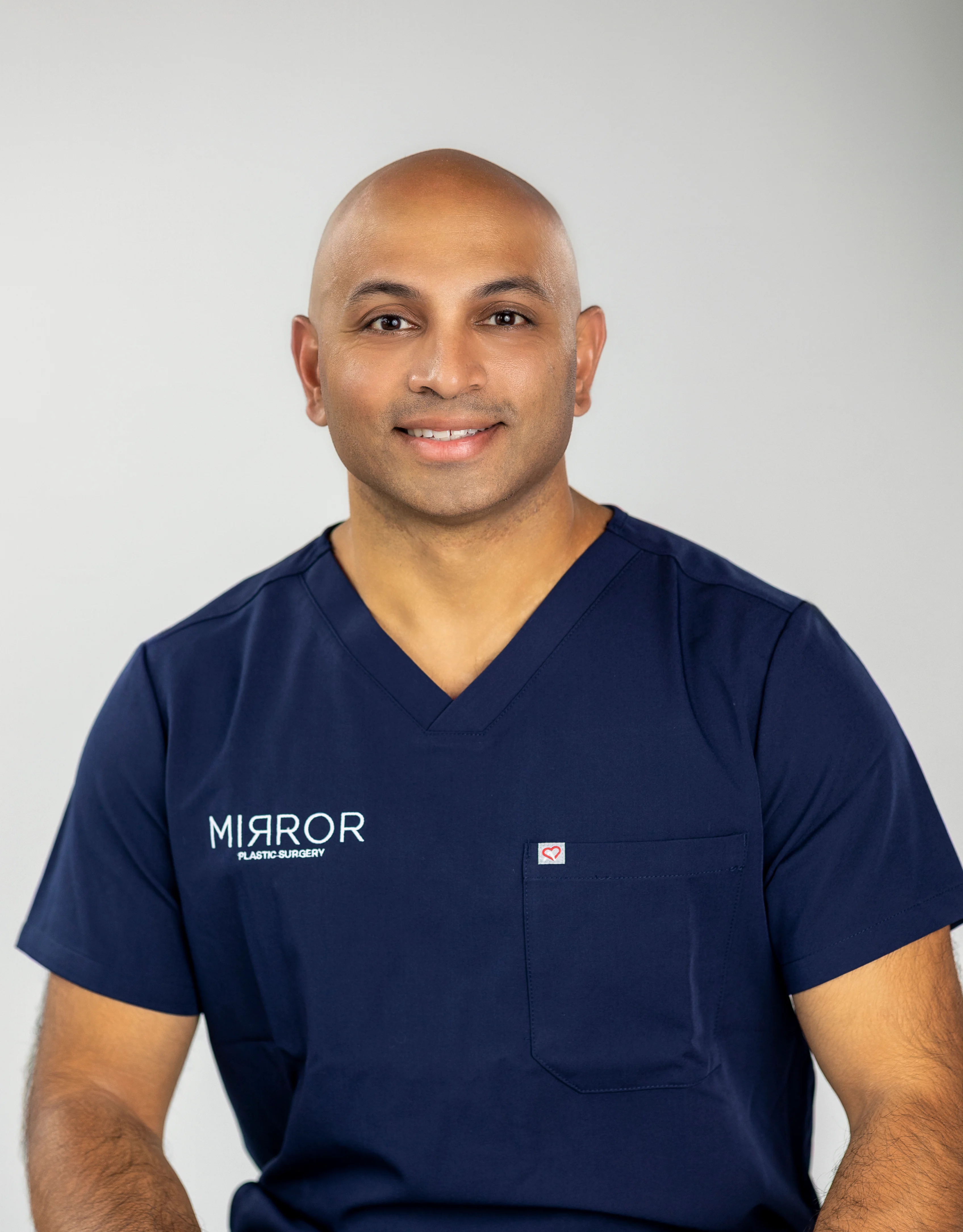
Mirror Plastic Surgery follows a guiding philosophy of safety first, function second, and aesthetics third. This philosophy reflects a deliberate decision to limit daily procedures so each patient receives unhurried, personalized care. The practice focuses on precision rather than volume.
Botox Vs. Dysport And Other Neuromodulators For Crow’s Feet
Botox, Dysport, Xeomin, Jeuveau, and Daxxify are all botulinum toxin type A neuromodulators. They share the same basic mechanism of blocking acetylcholine release at the neuromuscular junction. They differ in formulation, FDA approval status, onset, and diffusion profile. For a deeper comparison, see the dedicated guide on Botox vs. Dysport: What Really Works Better and Lasts Longer.
Botox (onabotulinumtoxinA) is the gold standard with the longest track record and the most clinical trial data. It is one of only two neuromodulators FDA-approved specifically for lateral canthal lines. Its tighter diffusion profile suits precision areas like the periorbital region. Onset is 3–7 days, with full effect at 10–14 days and duration of 3–4 months.
Dysport (abobotulinumtoxinA) has a faster onset, typically 2–3 days to visible relaxation, and a broader diffusion profile. It requires about 2.5–3 units for every 1 unit of Botox. Dysport contains cow’s milk protein and is contraindicated for patients with a cow’s milk protein allergy, which differs from lactose intolerance. Dysport is used off-label for crow’s feet, and its broader spread requires careful placement near the eye.
Xeomin (incobotulinumtoxinA) is a “naked” toxin without accessory proteins. This formulation may reduce the risk of antibody resistance over time and can restore response in patients who have developed tolerance to other neuromodulators. It is FDA-approved for crow’s feet and is dosed about 1:1 with Botox. Onset is slightly slower, usually 5–7 days, with a similar 3–4 month duration.
Daxxify (daxibotulinumtoxinA) offers the longest duration among FDA-approved neuromodulators. Results can last 6–9 months at a higher per-unit cost1. It is not FDA-approved for crow’s feet. For first-time patients, starting with a shorter-acting product is usually wise so any unexpected result resolves in 3–4 months rather than 6–9.
No single product works best for everyone. Dr. Akash offers all brands and selects the best fit for each patient’s anatomy, goals, and treatment history, without manufacturer quotas or commissions. Botox remains the primary and most evidence-supported treatment for crow’s feet.
Long-Term Botox Use And Stopping Treatment
Many patients worry that stopping Botox will cause accelerated aging or a rebound effect. Evidence does not support that concern. When Botox is discontinued, muscle activity returns over 3–6 months and wrinkles return to their natural baseline rather than worsening beyond it1. There is no dependency, withdrawal, or rebound aging.
Consistent long-term treatment can provide meaningful prevention. A landmark identical twin study showed that the twin who received regular Botox for over 12 years had noticeably fewer crow’s feet and forehead lines than her sister, who received only two treatments. Even seven months after her last session, the regularly treated twin still looked younger, a finding cited by the Cleveland Clinic.1
Regular botulinum toxin treatment reduces repetitive muscle activity, which helps prevent dynamic wrinkles from becoming deeply etched static lines, and some evidence suggests repeated treatments may lead to longer-lasting effects through gradual muscle atrophy. Most patients schedule treatments every 3–4 months and sometimes extend intervals as muscles weaken with repeated relaxation.
Common Misconceptions About Crow’s Feet Botox
“Botox will make me look frozen.” Natural results are very achievable with proper dosing and technique. A skilled injector preserves your ability to express emotion while softening lines so you look rested rather than expressionless. A frozen look usually reflects reducing more muscle movement than the patient wants, and treatment can be customized to maintain natural expression.
“Botox is toxic and dangerous.” The FDA approved Botox for cosmetic use in 2002, and the American Society of Plastic Surgeons reported over 9.1 million neuromodulator treatments in 2023. The FDA boxed warning about distant toxin spread applies mainly to therapeutic uses at much higher doses than cosmetic dosing.
“Botox is only for wrinkles.” Botox also treats chronic migraines, TMJ disorders, excessive sweating, and overactive bladder, although cosmetic use remains its most common application. At Mirror Plastic Surgery, Dr. Akash uses neuromodulators across the face, neck, masseters, and trapezius muscles for both functional and aesthetic goals.
“Botox will change my eye shape.” Botox for crow’s feet can create a subtle brow lift because relaxing the orbicularis oculi releases its downward pull, allowing forehead muscles to lift the brow slightly. Unwanted changes to eye shape usually indicate improper injection technique, such as placement too close to the orbital rim or too far medially.
To explore whether Botox can address your specific concerns, schedule a personalized consultation.
FAQ: Botox For Crow’s Feet
How Many Units Of Botox For Crow’s Feet?
Most patients need 6–15 units per side, or 12–30 units total, depending on muscle strength, wrinkle severity, and desired outcome. The FDA-approved label dose is 24 units total, with 4 units at each of three injection sites per side. First-time patients and those with finer lines often start at the lower end of this range. Men frequently require more units than women because of greater muscle mass. Your provider will tailor dosing after assessing your anatomy and expression pattern during consultation.
Does Botox For Crow’s Feet Change Eye Shape?
When injected correctly, Botox relaxes the lateral orbicularis oculi without changing eyelid position or the basic shape of the eye. A subtle brow lift is possible and often welcome as the downward pull on the brow decreases. Unwanted changes, such as a rounded or widened eye, usually mean injections were placed too close to the orbital rim or too far medially, which allows toxin to affect nearby structures.
Is Botox Worth It For Crow’s Feet?
Many patients find Botox worthwhile for crow’s feet. In a clinical study, 67% of patients who received Botox had “none or mild” lines at 30 days compared with 7% in the placebo group, and 60% reported being “satisfied” or “very satisfied” with their results1. Results last about 3–4 months, and consistent treatment can help prevent dynamic lines from becoming static wrinkles. The preventive benefit, supported by long-term twin studies, adds value beyond the immediate cosmetic change.
What Is The Riskiest Place For Botox?
The periorbital region around the eyes ranks among the most delicate areas for Botox injection. The skin is very thin, the blood supply is rich, and nearby muscles control eyelid position, blink function, and smile mechanics. Eyelid ptosis and asymmetrical smile are rare, under 1% in experienced hands, but can occur when toxin diffuses beyond the intended muscle. Both complications are temporary and resolve over 2–6 weeks as the Botox wears off. Choosing a board-certified plastic surgeon with deep knowledge of periorbital anatomy is the most effective way to reduce these risks.
How Long Does Botox For Crow’s Feet Last?
Results usually last 3–4 months, and some patients enjoy up to 5 months of effect. As mentioned earlier, the orbicularis oculi is one of the busiest muscles in the body, which accelerates metabolism of the toxin compared with less active muscles such as the forehead. First-time patients may metabolize Botox slightly faster, around 2–3 months, while consistent long-term patients often notice that results extend as targeted muscles gradually weaken.
Can I Wear Makeup After Botox?
You can wear makeup after Botox, but wait at least 4 hours so injection sites can close. Avoid rubbing or pressing on the treated area for 24 hours. Gentle application is fine; the concern is firm pressure that could move the toxin before it fully binds to the target muscle.
What Is The Difference Between Botox And Dysport For Crow’s Feet?
Botox has a tighter diffusion profile, which makes it a preferred choice for precision areas like the periorbital region. It is one of only two neuromodulators FDA-approved specifically for crow’s feet. Dysport spreads more broadly from each injection point and has a faster onset, usually 2–3 days compared with 3–7 days for Botox, but requires about 2.5–3 times more units for a similar effect and is used off-label for crow’s feet. Dysport also contains cow’s milk protein, so it is contraindicated for patients with a cow’s milk protein allergy. Both products can work well, and the right choice depends on your anatomy, goals, and treatment history, which your injector will review with you.
Next Steps For Crow’s Feet Treatment
Botox for crow’s feet is a safe, effective, and well-studied treatment when a qualified provider performs it. Clear information about costs, units, timelines, and risks helps you make a confident decision. The injector’s anatomical expertise remains the key factor in achieving natural results and avoiding complications.
If you are considering Botox for crow’s feet in the St. Petersburg or Tampa Bay area, Mirror Plastic Surgery offers a more personalized experience than high-volume med spas. Dr. Akash Chandawarkar will complete a comprehensive facial assessment, discuss your goals honestly, and design a treatment plan tailored to your anatomy. Consultations are pressure-free and unhurried. To learn more about risks and what to watch for after any injectable treatment, review the detailed guide on Botox Side Effects: A Surgeon’s Guide To Risks And Reactions.
Call or text 727-361-6515, or visit the practice at 780 4th Ave S, St. Petersburg, FL 33701. Ellie, the patient coordinator, can help you schedule and answer logistical questions.
Arrange Your Consultation With Mirror Plastic Surgery
Disclaimer: Results may vary from person to person. Editorial content, before and after images, and patient testimonials do not constitute a guarantee of specific results.
1 Results may vary from person to person. Editorial content, before and after images, and patient testimonials do not constitute a guarantee of specific results.