
Written by: Dr. Akash Chandawarkar, Board Certified Plastic Surgeon, Mirror Plastic Surgery | Last updated: September 9, 2026
Key Takeaways
- Laser hair removal is a medical procedure that works best with physician oversight and technology matched to your Fitzpatrick skin type.
- Provider credentials directly affect safety and results, and board-certified plastic surgeons offer anatomical expertise and complication management beyond technician-led med spas.
- Alexandrite, Diode, and Nd:YAG lasers each suit different skin tones and hair types, so effective treatment relies on careful laser selection rather than a single device for everyone.
- Most patients complete a series of sessions over several months, so choosing a qualified provider matters more than short-term promotional pricing.
- Physician-led practices that follow Florida medical regulations provide the highest standard of safety for laser hair removal in St. Petersburg.
How Laser Hair Removal Works: The Science Behind the Treatment
Laser hair removal targets the pigment in hair follicles with focused light energy. The laser’s wavelength is absorbed by melanin in the follicle, which converts light to heat and damages the follicle’s ability to grow hair. This process is called selective photothermolysis.
Hair grows in repeating cycles of anagen, catagen, and telogen. Lasers only affect follicles in the active anagen growth phase, so a single session cannot treat every follicle at once. Most patients need a series of sessions spaced several weeks apart to see meaningful reduction.
Provider expertise drives these results. The person treating you must select the right wavelength, fluence, and pulse duration for your skin tone and hair type. This requires clinical training and judgment. Many patients reach 80–90% long-term hair reduction and then schedule occasional maintenance sessions as needed. The FDA defines this outcome as permanent hair reduction, a long-term, stable reduction in the number of hairs regrowing at 6, 9, and 12 months after treatment.
Choosing the Right Laser for Your Skin Tone
The Fitzpatrick skin typing system (types I–VI) guides safe laser selection. A qualified provider evaluates your skin type and hair color first, then chooses the technology that fits your profile. The three main laser categories used in physician-led practices include:
- Alexandrite (755 nm): Often ideal for Fitzpatrick types I–III with lighter skin. High melanin absorption makes it efficient on dark hair and requires advanced cooling on darker skin.
- Diode (810 nm): A versatile option for Fitzpatrick types I–V. It penetrates deeper than Alexandrite and has less impact on the surface, which suits a wide range of skin tones.
- Nd:YAG (1064 nm): Typically the safest choice for Fitzpatrick types IV–VI. Its longer wavelength bypasses much of the surface pigment and targets the follicle, which lowers burn and pigmentation risk.
A 2026 prospective multi-center study in Lasers in Surgery and Medicine evaluated simultaneous Alexandrite and Nd:YAG emission across Fitzpatrick types I–VI. The study reported a mean hair count reduction of 84.6% at 12 months, which exceeded results from either wavelength alone.1 This supports a broader move toward multi-wavelength platforms that match each patient’s skin profile more precisely.
The table below summarizes how each device category fits different skin tones and treatment needs.
| Laser Type | Wavelength | Suitable Fitzpatrick Types | Key Considerations |
|---|---|---|---|
| Alexandrite | 755 nm | I–III | Fast and efficient, requires advanced cooling on darker skin |
| Diode | 810 nm | I–V | Deep follicular targeting with less epidermal absorption, broad clinical utility |
| Nd:YAG | 1064 nm | IV–VI | Safest for darker skin, may require more sessions for fine hair |
| IPL (not a laser) | 500–1200 nm (broad spectrum) | I–II only | Has limitations for long-term reduction and often needs 10+ sessions |
Get your Fitzpatrick skin type assessed by a board-certified plastic surgeon and receive a laser plan tailored to your skin and hair.
What to Look for in a Laser Hair Removal Provider
Provider selection shapes both safety and results. The criteria below distinguish physician-led practices from high-volume studios. The American Academy of Dermatology notes that burns, permanent color changes, and scarring occur more often when inexperienced operators perform laser hair removal, so choosing the right team becomes the most important decision you make.
- Medical oversight: Confirm whether a physician directs treatment planning and supervision or whether technicians operate with minimal medical involvement.
- Provider qualifications: Ask who will perform your treatment and verify their training, licensure, and experience with your skin type.
- Safety protocols: Look for patch testing, integrated cooling, and session-by-session setting adjustments as hair becomes finer.
- Personalized treatment plans: Expect a plan tailored to your skin tone, hair type, and medical history rather than a generic package.
- Technology transparency: Request the laser device name, its FDA clearance, and a clear pricing structure.
These questions help you evaluate any provider. A board-certified plastic surgeon’s anatomical knowledge supports safer treatment and thoughtful complication management, which technician-led operations cannot match. Florida law classifies laser hair removal as a medical procedure that requires physician oversight, although enforcement varies between provider types.
Key Questions for Your Laser Hair Removal Consultation
- Who will perform my treatment, and what are their credentials?
- Is a physician involved in my treatment plan and supervision?
- Which laser device will be used, and is it FDA-cleared for my skin type?
- Will a patch test be performed before my first session?
- How many sessions will I likely need, and how are they spaced?
- What safety protocols protect against burns and pigmentation changes?
- How do you handle complications if they arise?
How Much Does Laser Hair Removal Cost In St. Petersburg?
Costs for laser hair removal in St. Petersburg depend on treatment area size, number of sessions, technology, and provider expertise. The American Society of Plastic Surgeons lists a national average of about $389 per session, although this blends many provider types and body areas. Most patients complete a series of sessions, so the total investment adds up over time. That reality makes provider quality more important than the lowest advertised price.
Budget operations often cut corners in ways that compromise safety. They may rely on IPL devices, employ minimally trained staff, or skip safety steps like patch testing. IPL has well-known limitations for long-term reduction, yet many businesses market it as equivalent to true laser treatment. Reputable practices explain pricing clearly during consultation, and package options often save 15–30% compared with paying per session. At Mirror Plastic Surgery, each patient receives a personalized quote based on an individual treatment plan rather than a one-size-fits-all price.
Comparing Provider Types In St. Petersburg: Med Spas Vs. Physician-Led Practices
The cost differences described above often reflect the type of provider you choose. To understand why prices vary, it helps to compare high-volume med spas with physician-led practices in St. Petersburg.
| Criterion | High-Volume Med Spa | Physician-Led Practice |
|---|---|---|
| Medical Oversight | Frequently technician-led, physician may be off-site or minimally involved | Board-certified plastic surgeon personally oversees treatment planning |
| Technology | May use IPL or single-wavelength devices that are not matched carefully to skin type | Multiple FDA-cleared laser platforms selected after Fitzpatrick assessment |
| Consultation Depth | Often brief, about 10–15 minutes, with emphasis on package sales | Comprehensive, up to 1 hour, with full medical and anatomical assessment |
| Complication Management | Limited protocols and variable physician access | Physician on-site with expertise to diagnose and treat complications |
Schedule a physician-led laser hair removal consultation and experience this higher level of care from your first visit.
Safety and Side Effects: A Surgeon’s Perspective
Most patients experience mild, temporary side effects such as redness, slight swelling, and perifollicular edema. A 2026 clinical study in the Journal of Cosmetic Dermatology followed patients through eight treatment sessions and reported no unexpected or long-term adverse effects. Transient erythema and perifollicular edema resolved on their own in all participants.
Serious complications such as burns, blistering, hyperpigmentation, hypopigmentation, and scarring are rare. These events occur most often when inexperienced operators use incorrect settings. Proper technique lowers risk through accurate Fitzpatrick typing, conservative energy settings for darker skin, integrated cooling, and patch testing before the first full session.
Proper preparation and aftercare are just as important as the treatment itself. Follow these guidelines to support safety and results:
- Stop waxing, plucking, or threading 4–6 weeks before treatment.
- Shave the treatment area 24 hours before each session.
- Avoid sun exposure and tanning beds for at least 2 weeks before treatment.
- Arrive with clean, product-free skin.
- Avoid heat sources such as hot baths, saunas, and strenuous exercise for 24–48 hours after treatment.
- Apply broad-spectrum SPF 30+ sunscreen daily to treated areas between sessions.
A board-certified plastic surgeon can recognize early warning signs, adjust treatment, and manage complications if they occur. This level of oversight provides a safety net that technician-led operations cannot match.
Why Provider Credentials Matter: The Mirror Plastic Surgery Difference
Florida law classifies laser hair removal as a medical procedure that only licensed physicians, PAs, APRNs, or licensed electrologists under direct physician supervision may perform. Performing laser hair removal without a license is a third-degree felony in Florida. Enforcement remains uneven, so patients must choose providers carefully.
Dr. Akash Chandawarkar, founder of Mirror Plastic Surgery, is a Harvard-educated, Johns Hopkins-trained, board-certified plastic surgeon with fellowship training in aesthetic surgery at Manhattan Eye Ear & Throat Hospital (MEETH)/Lenox Hill Hospital. His deep understanding of anatomy, combined with laser physics expertise, supports safer and more effective treatments. His philosophy places safety first, function second, and aesthetics third.
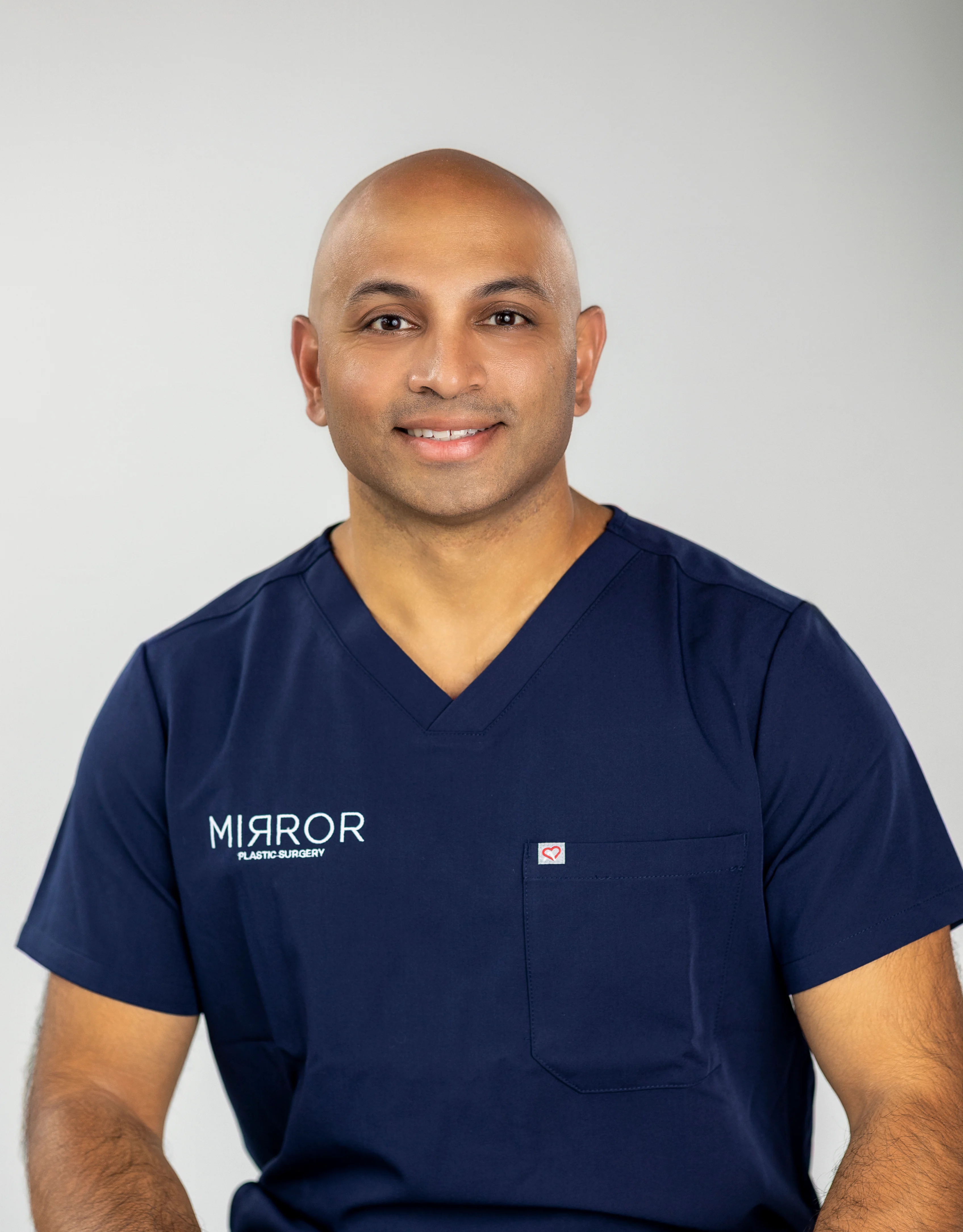
Mirror Plastic Surgery follows a concierge model and reserves up to an hour for each consultation. During that time, Dr. Chandawarkar and his team review skin type, hair characteristics, medical history, and personal goals. This thorough approach supports Mirror Plastic Surgery’s position as a leading choice for physician-led laser hair removal in St. Petersburg.
Common Misconceptions About Laser Hair Removal
- Myth: “Laser hair removal is permanent after one session.” Most patients need a series of sessions. Lasers only affect follicles in the active anagen growth phase, which represents roughly 20–30% of hair at any given time.1
- Myth: “It works on all hair colors.” Lasers target melanin, so blonde, red, gray, or white hair responds poorly. An honest provider will explain this during consultation.
- Myth: “It’s unsafe for darker skin.” Modern Nd:YAG lasers are safe for Fitzpatrick types IV–VI when trained providers use appropriate settings and integrated cooling.
- Myth: “IPL is the same as laser.” IPL uses broad-spectrum light and often requires 10 or more sessions. It has limitations for long-term hair reduction, while true medical-grade lasers remain the clinical standard.
Frequently Asked Questions
Is Laser Hair Removal Safe for All Skin Tones?
Laser hair removal can be safe for all skin tones when qualified providers use the right technology. Fitzpatrick skin typing guides wavelength selection, with Alexandrite often used for lighter skin and Nd:YAG for darker skin. A board-certified plastic surgeon will assess your skin type and adjust settings to reduce risks such as burns or pigmentation changes. Patients with Fitzpatrick types IV–VI benefit from conservative energy settings, integrated cooling, and patch testing before a full session, which physician-led practices treat as essential steps.
How Many Sessions Will I Need?
Most patients complete a series of about 6–8 sessions spaced several weeks apart, as described earlier.1 The exact number depends on skin tone, hair color and thickness, treatment area, and hormonal influences. Areas affected by hormones, such as the face, may need additional sessions or periodic maintenance. A qualified provider will offer a realistic estimate during consultation instead of promising a fixed low number of sessions.
Does Laser Hair Removal Work on PCOS-Related Hair?
Laser hair removal can help with PCOS-related hair growth, although hormonal drivers often require more sessions and ongoing maintenance. Many patients need 10–15 sessions in these areas.1 PCOS stimulates follicles continuously, so a physician-led plan that accounts for hormonal factors provides more realistic expectations and better long-term control. A board-certified plastic surgeon will review your medical history and hormonal profile before finalizing your treatment plan.
What Should I Do to Prepare for Treatment?
Stop waxing, plucking, or threading 4–6 weeks before treatment because these methods remove the follicle that the laser targets. Shave the area 24 hours before each session. Avoid sun exposure and tanning beds for at least 2 weeks before treatment, since tanned skin raises burn risk and forces more conservative settings. Pause retinoids and strong exfoliants at least 48 hours before your appointment. Arrive with clean, product-free skin. Your provider should also review your medical history and medications to confirm that you are a safe candidate.
How Do I Choose Between a Med Spa and a Physician’s Office?
Start by asking who performs the treatment, whether a physician supervises, which laser device is used, whether it is FDA-cleared for your skin type, and how complications are handled. Florida law requires physician oversight for laser hair removal, yet enforcement varies. A physician-led practice offers structural advantages such as personalized treatment planning, multiple laser platforms matched to your Fitzpatrick type, and a board-certified surgeon available for any adverse event. Promotional pricing at a technician-led studio cannot replace these safeguards.
Conclusion: Choose Safety, Expertise, And Results
Laser hair removal works as a medical procedure rather than a simple spa service. The strongest providers in St. Petersburg focus on safety and individualized care instead of volume and discounts. That approach includes physician oversight, FDA-cleared technology matched to your skin type, thorough consultation, and the expertise to manage complications when needed.
Mirror Plastic Surgery, led by Dr. Akash Chandawarkar, delivers this level of care through board-certified plastic surgeon leadership, concierge-style consultations of up to one hour, and a commitment to evidence-based treatment. Schedule your personalized laser hair removal consultation at Mirror Plastic Surgery and take the first step toward safe, physician-led treatment in St. Petersburg.
Practice Contact Information
Mirror Plastic Surgery welcomes new patients seeking physician-led laser hair removal in St. Petersburg, FL. Use the details below to plan your visit or ask questions before scheduling.
- Address: 780 4th Ave S, St. Petersburg, FL 33701
- Phone: 727-361-6515
- Email: hello@mirrorplasticsurgery.com
Experience a physician-led consultation with Ellie and the Mirror Plastic Surgery team and learn whether laser hair removal is right for you.
Disclaimer
Disclaimer: Results may vary from person to person. Editorial content, before and after images, and patient testimonials do not constitute a guarantee of specific results.
1 Results may vary from person to person. Editorial content, before and after images, and patient testimonials do not constitute a guarantee of specific results.