
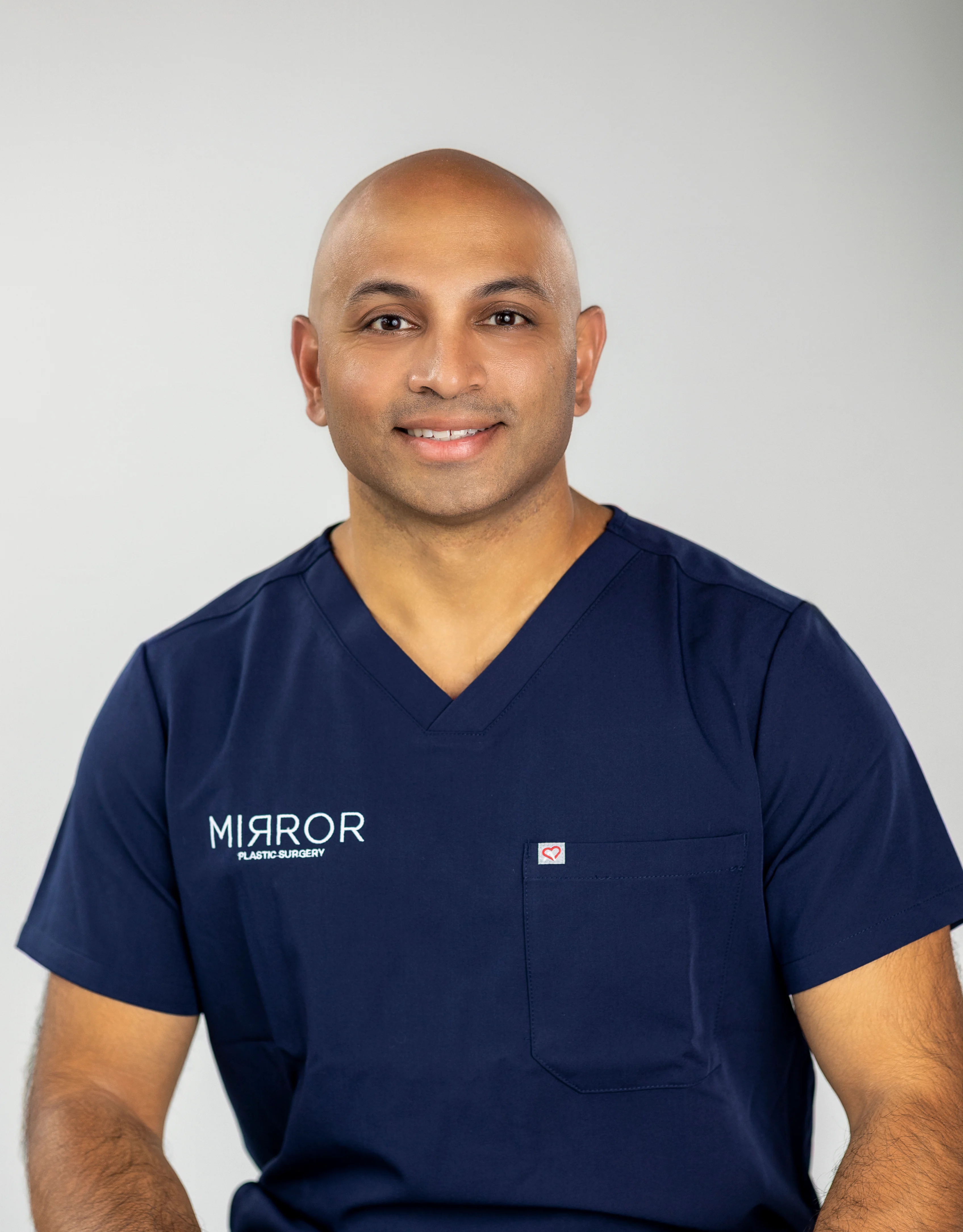
Written by: Dr. Akash Chandawarkar, Board Certified Plastic Surgeon, Mirror Plastic Surgery | Last updated: September 9, 2026
Key Takeaways
- Patient satisfaction with hip dip fillers ranges from 62–90% at 12 months, and results vary by filler type and candidacy.1
- Most dissatisfaction stems from poor candidacy assessment, unrealistic expectations, or inexperienced providers, rather than the treatment category.
- Biostimulatory fillers such as Sculptra and Radiesse tend to provide more natural-feeling contours and longer-lasting results than temporary options.1
- Ideal candidates have mild-to-moderate hip dips, good skin elasticity, adequate subcutaneous fat, and realistic expectations about contour softening.
- At Mirror Plastic Surgery, board-certified plastic surgeon Dr. Akash Chandawarkar provides thorough candidacy assessments and personalized treatment plans, so you can find out if you are a candidate.
Executive Summary: Evidence Behind Hip Dip Filler Satisfaction
Most patients want to know whether hip dip filler delivers results that feel worth the commitment. Current evidence supports a yes, with conditions. Clinical studies show measurable, sustained satisfaction, while patient reviews reveal a wide range of experiences.1 That variance is explained by three modifiable factors: filler selection, candidacy, and provider expertise.
This report combines peer-reviewed data from 2025–2026 with themes from RealSelf and Reddit reviews to give a grounded, evidence-based answer. At Mirror Plastic Surgery, board-certified plastic surgeon Dr. Akash Chandawarkar applies these principles to every hip dip filler treatment, prioritizing safety first, function second, and aesthetics third.
Schedule a consultation to see whether hip dip fillers match your anatomy, lifestyle, and goals.
What Real Patients Say About Hip Dip Fillers
Reviews on RealSelf and Reddit show clear patterns among both highly satisfied and disappointed patients.
Positive themes focus on smoother contour, better clothing fit, and increased confidence. One RealSelf reviewer described being “over the moon” with hip dip filler results and noted that the procedure felt painless with no visible scarring. Reddit users who chose biostimulatory fillers often describe subtle, natural-looking curves that soften the silhouette without looking overdone.
Negative themes cluster around three common complaints:
- High cost relative to minimal visible change
- Lumpiness or texture irregularities under the skin
- Results that faded faster than expected
Reddit threads in r/cosmeticsurgery frequently mention patients who spent significant sums and felt results were barely noticeable. Several users report product migration or palpable filler under thin skin, especially when gel-based fillers were placed too close to the surface.
Reviews are anecdotal and self-selected, so extreme experiences appear more often. Clinical data provides the context needed to interpret these stories accurately.
Satisfaction By Filler Type: Sculptra Vs. Radiesse
Different fillers behave very differently in the hip dip area. The two primary safe options in the United States are Sculptra (poly-L-lactic acid) and Radiesse (calcium hydroxylapatite). Large-particle hyaluronic acid “body fillers” such as HYAcorp and Macrolane are not FDA-approved in the United States, and HA fillers are not considered safe practice for hip dip augmentation domestically.
The comparison below highlights the key trade-off: Sculptra offers longer-lasting, gradual results, while Radiesse provides immediate volume with more frequent maintenance.
| Attribute | Sculptra (PLLA) | Radiesse (CaHA) |
|---|---|---|
| Mechanism | Stimulates Type I collagen via macrophage response to PLLA microparticles | Immediate volume from CMC gel carrier plus CaHA microsphere collagen stimulation |
| Onset Of Results | Gradual over 3–6 months, with no immediate volume | Immediate volume on day one, with collagen building over subsequent months |
| Longevity | Extended duration, often measured in years | Lasts longer than temporary gel fillers, but typically requires earlier maintenance than Sculptra |
| Satisfaction Pattern | Sustained high scores across all time points through Month 12 | High initial satisfaction that softens as the gel carrier resorbs, then stabilizes as collagen matures |
Sculptra has become the most common choice for hip dips because its collagen-stimulation mechanism produces a result that feels completely natural, composed of the patient’s own collagen. This extended longevity also reduces how often most patients need maintenance sessions. The trade-off is patience, because the collagen-building phase takes 3–6 months before full correction appears.
Radiesse suits patients who want visible change on day one. Its dual mechanism, immediate volume plus collagen stimulation, delivers results that last longer than many temporary fillers. Patient reviews indicate high satisfaction with biostimulatory fillers, and longevity is a key factor in the value equation for many patients.
The Science Of Satisfaction: What Clinical Studies Show
Three main groups of clinical studies help explain satisfaction patterns for hip dip filler patients.
A 2026 retrospective study by Hur et al. evaluated 26 female patients (mean age 34.6) receiving gluteal augmentation with cross-linked hyaluronic acid filler. The study reported high patient satisfaction at baseline, 1 month, and 6 months post-treatment, with no major complications. Minor adverse events occurred in 19.2% of patients, all self-limited swelling, ecchymosis, or transient firmness that resolved within 1–3 weeks.
A 2026 study of a hybrid PLLA-b-PEG/HA filler, published in Plastic and Reconstructive Surgery Global Open, tracked satisfaction over time. Satisfaction was 100% at 1 month, 100% at 3 months, 92.3% at 6 months, and 84.6% at 12 months.1 While this study focused on nasolabial folds, the hybrid biostimulatory mechanism offers useful benchmarks for counseling hip dip patients about gradual satisfaction decline as results fade.
A 12-month study of poly-L-lactic acid (PLLA, the Sculptra molecule) reported sustained high satisfaction scores across all time points from Month 1 through Month 12. These findings show that collagen-stimulating fillers maintain satisfaction longer than temporary options by continuing to deliver visible results after the product itself has metabolized.
Across these studies, satisfaction starts high and decreases as temporary fillers resorb, while biostimulatory fillers maintain satisfaction through ongoing collagen deposition.
Why Some Patients Are Disappointed
Most dissatisfaction with hip dip fillers traces back to a few modifiable factors within the treatment process.
Undercorrection is the single most common complaint. A skeletal hip dip typically requires staged treatment across multiple sessions. Patients who expect complete correction after one visit often feel disappointed.
A related issue is cost-to-result mismatch, which occurs when patients do not understand the multi-session commitment before starting treatment. Hip dip filler is a large-volume, multi-session treatment, and patients who receive only a partial plan frequently feel the investment did not match the change they see.
Lumpiness and texture problems are preventable complications. For Sculptra, proper dilution and patient compliance with the “5-5-5” massage protocol support smooth results. Skipping massage increases the risk of nodule formation. Placing any filler too superficially can cause visible irregularities, regardless of product type, so depth control matters.
Migration risk is higher in the hip area than in the face because there is less natural soft tissue to buffer the product. Migration risk increases with gel-based fillers in the hip area for this anatomical reason.
The root cause of most negative reviews is poor candidacy assessment, unrealistic expectations, or inexperienced providers. Careful planning and expert technique significantly reduce these issues.
How To Maximize Your Satisfaction: Candidacy And Provider Selection
Ideal candidates for hip dip filler share several key traits:
- Mild-to-moderate hip dips rather than severe structural hollowing
- Good skin elasticity, typically ages 20–40
- Adequate subcutaneous fat to cushion and conceal the filler
- Realistic expectations that focus on contour softening rather than bone restructuring
Poor candidates include those with severe skin laxity, a BMI under 18.5, or expectations of BBL-like projection. These patients often do better with surgical options.
Provider selection is the single most consequential decision a patient makes. A skilled injector using a solid, evidence-based product will consistently outperform a less experienced injector using a premium product. Patients should look for board-certified plastic surgeons or dermatologists with specific hip dip portfolios, clear treatment plans, and a defined follow-up policy.
At Mirror Plastic Surgery, Dr. Akash Chandawarkar, a Harvard-educated, Johns Hopkins-trained, board-certified plastic surgeon, personally performs every injection. His hour-long consultations include a full anatomical assessment and honest discussion of candidacy. He sometimes advises that fillers are not the right solution for a particular anatomy, which helps prevent the disappointment seen in many negative reviews. As an advisory board member for Merz Aesthetics, Dr. Chandawarkar maintains direct expertise in biostimulatory fillers including Radiesse.
Schedule your candidacy assessment and receive an evidence-based opinion on whether hip dip fillers fit your goals.
Cost And Value: How Mirror Plastic Surgery Approaches Pricing
Hip dip filler treatment plans vary widely, because every patient has different anatomy, goals, and filler needs. The number of vials, number of sessions, and specific product choice all influence the overall investment.
Per-vial pricing often creates confusion, since it does not reflect the full course of treatment. Patients benefit most when they review a complete plan that includes all recommended sessions, follow-up visits, and any associated fees.
Biostimulatory fillers offer extended longevity, which can reduce how often maintenance sessions are needed. At Mirror Plastic Surgery, each patient receives a personalized quote during consultation that reflects their anatomy, chosen filler, and staged treatment plan.
Alternatives To Hip Dip Fillers
Fillers represent one approach to hip dip correction, but some patients do better with alternative treatments. Patients with sufficient donor fat may qualify for surgical fat transfer, which uses their own fat to create more permanent volume in the hip dip area.
Mirror Plastic Surgery also offers AlloClae, an adipose (fat-derived) filler that provides natural volume for hip dips, and Avéli, a minimally invasive treatment for cellulite in the surrounding area. Both options are reviewed in detail during consultation to determine whether they align with your anatomy and goals.
Frequently Asked Questions
Are Hip Dip Fillers Worth It?
Clinical research shows strong satisfaction overall, and biostimulatory fillers provide the most durable results. Satisfaction is highest when patients are good candidates, choose appropriate fillers such as Sculptra or Radiesse, and work with a board-certified provider who performs a thorough assessment. Patients who understand that fillers soften contours rather than create dramatic structural change consistently report better experiences.
How Long Do Hip Dip Fillers Last?
Sculptra stimulates the body’s own collagen, which remains stable long after the product itself has metabolized. Radiesse combines immediate gel volume with CaHA-stimulated collagen for extended results. This longer duration is a major driver of long-term satisfaction, which is why biostimulatory fillers consistently outperform shorter-acting alternatives in patient review analysis.
How Much Does Hip Dip Filler Cost?
The total investment varies based on hip dip severity, filler type, geographic location, and provider credentials. Some patients need only modest correction, while others require more extensive staging. Per-vial pricing is the least helpful number to focus on, so it is best to request a written estimate for the full recommended plan before committing.
Mirror Plastic Surgery provides individualized cost estimates during consultation, tailored to each patient’s anatomy and agreed treatment approach.
What Is The Difference Between Sculptra And Radiesse For Hip Dips?
Sculptra builds collagen gradually over 3–6 months with no immediate visible result, and it delivers a very natural feel with extended longevity. It is currently the most popular choice for hip dips. Radiesse provides immediate volume from its gel carrier on day one while also stimulating collagen, which makes it appealing for patients who want visible change without waiting through a long collagen-building phase. Neither product can be dissolved once injected, so careful candidacy assessment with an experienced provider is essential.
What Are The Risks Of Hip Dip Fillers?
Common minor side effects include swelling, bruising, and tenderness for 1–3 days. Most patients return to normal activity within 24 hours. Rare but serious risks include nodule formation, which is preventable with proper Sculptra dilution and the 5-5-5 massage protocol, and vascular occlusion, estimated at fewer than 1 in 1,000 cases. Unlike HA fillers, Sculptra and Radiesse cannot be dissolved if a complication occurs, so prevention through expert technique and provider selection is the main safeguard. Board-certified plastic surgeons with surgeon-level anatomical knowledge minimize these risks through precise placement in the subcutaneous fat plane above the muscle fascia.
Conclusion: Making An Informed Decision About Hip Dip Fillers
Clinical data shows that biostimulatory fillers deliver the highest and most durable satisfaction.1 Patient reviews highlight that disappointment concentrates among those who received poor candidacy screening, incomplete treatment plans, or care from providers without deep anatomical expertise.
The main drivers of satisfaction are within your control. Choosing a board-certified expert, selecting the right filler for your anatomy and timeline, and entering treatment with accurate expectations all increase the likelihood of a positive outcome.
Mirror Plastic Surgery, led by Dr. Akash Chandawarkar’s surgeon-level expertise and concierge care philosophy, offers a comprehensive approach to hip dip filler treatment in the St. Petersburg and Tampa Bay area. Every patient receives an hour-long consultation, evidence-based planning, and honest guidance about whether fillers will deliver their desired results, including clear recommendations when another approach may serve them better.
Request your personalized consultation to learn whether hip dip fillers align with your goals and to receive a tailored treatment plan from a board-certified plastic surgeon.
Disclaimer: Results may vary from person to person. Editorial content, before and after images, and patient testimonials do not constitute a guarantee of specific results.
1 Results may vary from person to person. Editorial content, before and after images, and patient testimonials do not constitute a guarantee of specific results.