
Written by: Ellie Pranckevicius, FNP-BC, Aesthetic Nurse Practitioner & Aesthetic Injector | Facial Restoration & Regenerative Injectable Specialist, Mirror Plastic Surgery | Last updated: July 13, 2026
Key Takeaways from Florida Hip Dip Filler Reviews
- Hip dip filler uses biostimulatory injectables such as Sculptra and RADIESSE to add volume and smooth the outer-thigh contour without surgery.
- Florida patient reviews show higher satisfaction when providers conduct thorough, bilateral anatomical assessments before treatment.
- Results appear in two stages: immediate volume from the carrier gel followed by progressive collagen stimulation over several months.1
- Most patients need 2–4 sessions spaced 4–6 weeks apart, with total vial counts ranging from 8–30 depending on frame size and correction goals.
- Schedule your personalized hip-dip assessment at Mirror Plastic Surgery to receive a custom treatment plan tailored to your anatomy.
How 2026 Florida Satisfaction Data Were Collected
This report draws satisfaction figures from publicly available provider outcome disclosures, patient-facing clinical summaries, and practitioner-published review aggregations current as of mid-2026. Florida-specific data points were isolated when geographic attribution was clearly stated. Nationally representative figures from peer providers are labeled when Florida data were not available for a given variable. No single randomized controlled trial underpins all figures. The data represent a synthesis of clinical reporting across multiple practice settings. A dedicated section below explains the main limitations of this approach.
Florida Hip Dip Filler Satisfaction by Assessment Depth
Review data from Florida biostimulatory filler providers show consistently higher satisfaction for hip dip correction when assessment quality is rated as thorough. The table below summarizes patient feedback by assessment depth.
| Assessment Depth | Reported Satisfaction Range | Primary Driver |
|---|---|---|
| Comprehensive (60+ min evaluation) | High | Individualized volume mapping, symmetry baseline |
| Standard (15–30 min evaluation) | Moderate to High | General protocol applied without bilateral comparison |
| Minimal (<15 min evaluation) | Moderate | High asymmetry complaint rate, revision requests |
These observations align with the broader clinical finding that inadequate baseline assessment is a critical factor in post-filler asymmetry. Applying identical injection strategies to both sides without accounting for natural differences can make pre-existing asymmetries more visible.
How Sculptra and RADIESSE Deliver Immediate and Gradual Results
RADIESSE and Sculptra both create immediate volume and progressive improvement over several months as collagen production increases. The main difference lies in how much of the effect appears right away versus how much builds gradually, along with the timing of the collagen phase.
Sculptra’s poly-L-lactic acid mechanism means that subtle improvements appear in 4–6 weeks, with full results visible after 4–6 months once new collagen forms.1 RADIESSE delivers a stronger immediate volumizing effect through its calcium hydroxylapatite carrier, while collagen stimulation follows a similar delayed trajectory.1 Patients who expect instant final results from either product are more likely to feel dissatisfied at early follow-up visits, so clear pre-treatment expectation setting matters.
Typical Vial Counts and Session Numbers in Florida Reviews
Vial requirements vary by frame size, existing soft-tissue volume, and the degree of correction desired. The table below reflects ranges reported across provider disclosures.
| Patient Profile | Typical Vial Range (Total) | Typical Sessions Required |
|---|---|---|
| Smaller frame / subtle correction | 8–20 vials | 1–2 sessions |
| Average frame / moderate correction | 20–30 vials | 2–4 sessions at the same 4–6 week intervals |
| Larger frame / significant correction | 20–30 vials | 3–4 sessions using 8–10 vials per session |
These figures serve as starting points for consultation discussions rather than fixed protocols, because each patient’s anatomy is unique. Mirror Plastic Surgery’s hour-long top-to-bottom assessments are structured to determine individualized vial and session requirements before any product is ordered.
Pain Levels, Downtime, and Recovery Experiences
Florida patients typically describe hip dip filler as involving mild, temporary side effects. Common feedback themes include:
- Pressure and mild stinging at the injection site during the procedure
- Soreness and tenderness after treatment
- Temporary swelling and bruising
- No need for general anesthesia or surgical recovery protocols
- Return to light daily activity soon after treatment in many cases
Strenuous exercise after dermal fillers is typically restricted for 24–48 hours. Florida’s active outdoor lifestyle, including beach activities and water sports, means providers should counsel patients on sun exposure and heat management during the initial healing window.
Longevity and Maintenance for Sculptra, RADIESSE, and AlloClae
Longevity appears frequently in Florida patient reviews as a key decision factor. The table below compares reported durability across filler categories used for hip dip correction.
| Filler Category | Reported Longevity | Maintenance Recommendation |
|---|---|---|
| Sculptra (poly-L-lactic acid) | 2–3 years | Annual touch-ups recommended |
| RADIESSE (calcium hydroxylapatite) | 12–24 months | Follow-up treatments as filler is gradually absorbed |
| AlloClae (biostimulatory) | Long-term; regenerative mechanism supports durable volume | Provider-assessed on individual basis |
This sustained durability, noted above for Sculptra, stems from its poly-L-lactic acid mechanism, which breaks down slowly and creates a collagen framework that functions like a volume-producing factory over time. This long-lasting collagen support is a major reason biostimulatory fillers dominate Florida provider recommendations for hip dip correction.
Migration, Asymmetry, and How Providers Reduce Risk
Migration and asymmetry appear most often in negative hip dip filler reviews. Post-filler asymmetry may result from filler migration due to gravity, muscle movement, and tissue pressure; uneven absorption rates between sides; or amplification of pre-existing asymmetry that was not obvious before treatment. Those uneven absorption rates trace to several physiological variables, including local blood circulation differences, muscle activity differences, tissue structure variations such as subcutaneous fat thickness, and subtle injection depth differences.
Providers who document baseline symmetry with pre-injection photography and assess existing asymmetry to plan different strategies for each side report lower asymmetry complaint rates. Key risk-mitigation practices identified in clinical literature include:
- Pre-injection bilateral photographic documentation
- Gradual small-volume injections instead of large single-session boluses
- Post-injection monitoring through scheduled follow-up evaluations
- Ultrasound-guided assessment when asymmetry requires investigation
Why Assessment Quality Drives Hip Dip Filler Outcomes
The correlation between assessment depth and satisfaction rate appears as the most consistent pattern across aggregated Florida review data. Blindly adding more product to the lesser side or dissolving from the fuller side may create temporary cosmetic improvement, but it rarely addresses the underlying cause.
Mirror Plastic Surgery’s model addresses this directly. Ellie Pranckevicius conducts comprehensive hour-long evaluations that map each patient’s lateral hip anatomy, document bilateral differences, and establish a session-by-session volume plan before any product is administered. Her dual background, including 600 hours of esthetics licensure training combined with a Master’s in Nursing from the University of South Florida and four years in the Neuroscience ICU at Tampa General Hospital, supports a layered understanding of surface anatomy and subdermal physiology that guides injection depth and placement decisions.
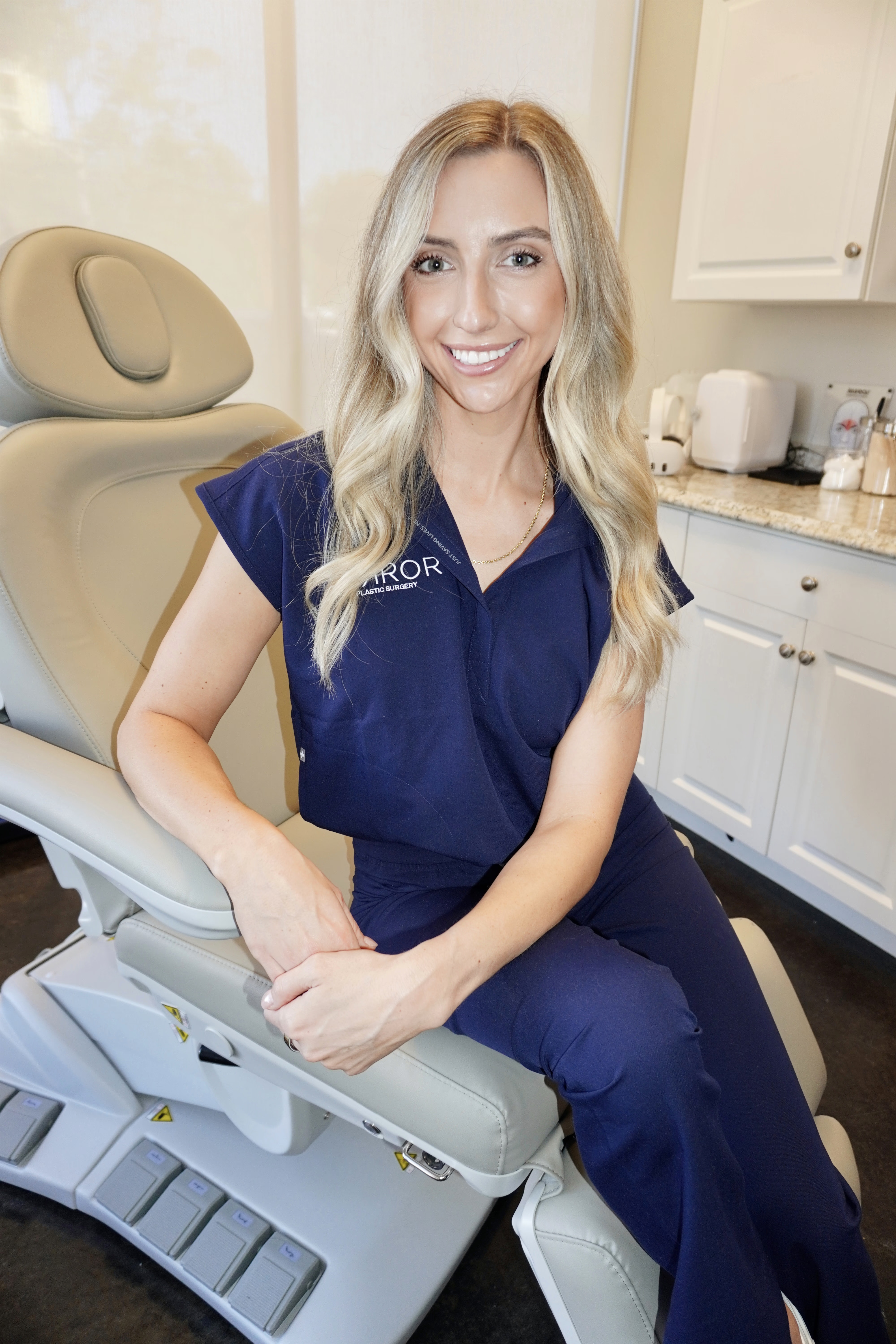
Book a consultation with Ellie to experience how a thorough anatomical assessment shapes your treatment plan before the first vial is placed.
Florida Climate, Active Lifestyles, and Hip Anatomy
Florida’s subtropical climate affects both treatment experience and recovery. High temperatures and humidity can intensify post-injection swelling in some patients, which makes the first 48 hours of recovery feel more pronounced than in cooler climates. Providers in the Tampa Bay area often encourage patients to schedule treatments during cooler months or to plan recovery around outdoor commitments.
Florida’s active population, with higher rates of recreational swimming, running, and outdoor fitness, often shows more developed lateral hip musculature than sedentary groups. This pattern affects soft-tissue depth available for filler placement and may influence vial requirements. A provider familiar with this regional profile will adjust injection planes and volume planning accordingly.
How to Evaluate Tampa Bay Hip Dip Filler Providers
Patients evaluating hip dip filler providers in the Tampa Bay area can use a simple sequence of criteria drawn from the outcome factors highlighted in this review. Start with consultation length. Providers offering less than 30 minutes for an initial body contouring assessment are unlikely to complete bilateral anatomical mapping, which directly affects the next criterion, product selection rationale.
The provider should clearly explain why a specific biostimulatory filler suits the patient’s tissue type and correction goals, based on that detailed mapping. That mapping should be documented through baseline photography and symmetry assessment as standard practice, not as an optional add-on. From this documented baseline, the provider should present a written or clearly communicated multi-session plan with vial estimates before the first treatment, which signals confidence in the initial assessment.
Finally, scheduled post-injection evaluations show outcome accountability and close the loop from assessment to long-term result.
Limits of Current Florida Hip Dip Review Data
The satisfaction percentages cited in this report carry several methodological limits. Patient self-reported reviews are subject to selection bias, because highly satisfied and highly dissatisfied patients are overrepresented compared with those who feel neutral. Florida-specific data are not yet available from peer-reviewed randomized trials, so figures reflect provider-disclosed outcomes and aggregated platform reviews.
Vial counts and session numbers describe population ranges and cannot replace individualized consultation estimates. Longevity data come from provider clinical summaries rather than longitudinal cohort studies with standardized follow-up intervals.
Why Transparent Review Aggregation Matters for Patients
The lack of aggregated, Florida-specific satisfaction data in public formats has historically left consideration-stage patients without a reliable benchmark for evaluating provider claims. Transparent reporting of satisfaction ranges, realistic vial needs, and risk factors supports informed consent and helps patients compare practices more confidently. As biostimulatory fillers become more common for body contouring, the industry’s credibility depends on providers publishing outcome data with rigor similar to surgical procedures. Mirror Plastic Surgery’s commitment to unbiased, evidence-based communication reflects this standard at the practice level.
Frequently Asked Questions
Are Radiesse and alloClae safe for hip dip correction, and why are hyaluronic acid fillers not used here?
Radiesse and alloClae are biostimulatory fillers that stimulate the body’s own collagen production instead of simply adding gel volume. This mechanism helps results integrate with surrounding tissue over time, which reduces migration risk and supports durable correction. Hyaluronic acid fillers, although widely used for facial applications, are not considered safe practice for body contouring in the hip region. The volume of product required, the mechanical forces on the lateral hip during movement, and the depth of injection planes make HA fillers unsuitable for this indication. Ellie Pranckevicius at Mirror Plastic Surgery uses only evidence-based biostimulatory options for non-surgical hip dip correction.
How many hip dip filler sessions will I likely need?
The number of sessions depends on frame size, hip dip depth, and the degree of correction desired. Most patients need between two and four sessions spaced four to six weeks apart. Smaller frames seeking subtle correction may reach their goals in one to two sessions, while patients seeking significant volumization may require three to four. Mirror Plastic Surgery’s hour-long initial consultation produces a written session plan with estimated vial ranges before any treatment begins, so you are not surprised by the scope of your protocol.
How long do biostimulatory hip dip filler results last in Florida’s climate?
Results from Sculptra for hip dip correction typically last 2–3 years, while RADIESSE lasts 12–24 months, the longevity ranges detailed in the maintenance section above.1 Annual touch-ups help extend these durations. Florida’s heat and humidity do not meaningfully change the longevity of the collagen framework once it is established, although the initial recovery period may involve more pronounced swelling in warmer months. Your provider will assess your individual response at follow-up visits and recommend a maintenance schedule.
What should I expect during recovery after hip dip filler treatment?
Most patients experience temporary soreness, swelling, and bruising at the injection sites after treatment. Light daily activity is usually possible soon afterward. Strenuous exercise, prolonged sitting or lying directly on the treated area, and significant heat exposure, including saunas and extended sun exposure, are typically restricted for 24–48 hours. Florida’s active outdoor lifestyle means patients should plan treatment timing around beach activities, water sports, and fitness routines. Ellie provides detailed post-care instructions tailored to each patient’s lifestyle during the consultation.
How does Mirror Plastic Surgery differ from high-volume clinics for hip dip filler?
Mirror Plastic Surgery follows a concierge medicine model that limits daily appointment volume so each patient receives focused clinical attention. Ellie Pranckevicius conducts up to an hour-long top-to-bottom assessment before recommending any treatment, documenting bilateral anatomical differences and building a multi-session plan specific to each patient’s anatomy and goals. High-volume practices often compress consultation time and standardize protocols across patients.
Ellie’s combined background in esthetics and advanced nursing, along with ICU clinical experience, provides a deep understanding of anatomy and physiology that guides injection placement, depth, and volume decisions. The practice remains supplier-neutral, so product recommendations are driven by evidence and patient anatomy rather than vendor relationships.
Disclaimer
Disclaimer: Results may vary from person to person. Editorial content, before and after images, and patient testimonials do not constitute a guarantee of specific results.
Book a consultation with Ellie at Mirror Plastic Surgery’s St. Petersburg location to begin your personalized hip dip assessment.
1 Results may vary from person to person. Editorial content, before and after images, and patient testimonials do not constitute a guarantee of specific results.