
Written by: Dr. Akash Chandawarkar, Board Certified Plastic Surgeon, Mirror Plastic Surgery | Last updated: September 9, 2026
Last Updated: September 2026
Key Takeaways
Here are the most important points from this report:
- Hip dip fat grafting costs $8,000–$20,000 nationally, with $12,000–$15,000 representing the typical all-in range.
- Surgeons who specialize in structural fat grafting achieve the 60–80% fat survival rates mentioned later in this report.1
- Geographic location, surgeon experience, and extent of liposuction are the three main factors driving the $12,000 price spread across the United States.
- Over a five-year horizon, the permanent results of fat grafting usually make it more cost-effective than repeat biostimulatory filler treatments for appropriate candidates.1
- Patients seeking hip dip fat grafting in the Tampa Bay area can schedule a consultation with Ellie at Mirror Plastic Surgery to receive a personalized quote tailored to their anatomy and goals.
National Hip Dip Fat Grafting Cost Benchmarks For 2026
Hip dip fat grafting in the United States typically costs $12,000–$15,000 all-in, with a range of $8,000–$20,000 depending on surgeon, location, and procedure scope. The ASPS reports a national average surgeon fee of $7,264 for buttock augmentation with fat grafting, a figure that excludes anesthesia, facility, and ancillary costs. The complete out-of-pocket investment is meaningfully higher.
| Cost Component | Low Range | Typical Range | High Range |
|---|---|---|---|
| Surgeon’s Fee | $5,000 | $7,000–$9,000 | $12,000 |
| Anesthesia Fee | $1,500 | $2,000–$2,500 | $3,000 |
| Facility (OR) Fee | $1,500 | $2,000–$3,000 | $5,000 |
| Compression Garments & Supplies | $200 | $300–$400 | $500 |
| Post-Op Medications | $50 | $100–$150 | $200 |
| Total All-In | $8,000 | $12,000–$15,000 | $20,000 |
The ASPS average surgeon fee of $7,264 for buttock augmentation with fat grafting excludes anesthesia, facility, and other expenses. Patients should treat it as a starting point when budgeting.
What Factors Drive The $12,000 Price Spread?
Three variables account for most of the cost variation in hip dip fat grafting across the United States.
Geographic Location is the most visible driver. Urban coastal practices in New York, Los Angeles, and Miami run 30–50% above Midwest or Southeast practices, reflecting higher overhead and cost of living. Practices in Manhattan, Beverly Hills, and Miami charge $15,000–$20,000, while suburban and smaller-city practices charge $8,000–$14,000.
Surgeon Experience And Board Certification drive the most consequential cost difference. The premium for an experienced surgeon is usually worth it because hip dip fat transfer is technically demanding. Asymmetry from poor injection technique is difficult to revise. Surgeons who specialize in structural fat grafting charge premium rates and generally deliver the higher survival rates described in the fat survival section below.
Extent Of Liposuction (Donor Sites) directly affects OR time and complexity. Harvesting fat from one area, such as the abdomen only, costs less than harvesting from two or three areas such as the abdomen, flanks, and thighs.
This cost logic extends to combination procedures, which offer a meaningful advantage by sharing anesthesia and facility fees. Bundling hip dip fat grafting with a BBL costs $10,000–$22,000 combined versus $14,000–$35,000 separately; adding Lipo 360 costs $12,000–$25,000 combined versus $16,000–$40,000 separately, because anesthesia and facility fees are shared across the procedures.
Hip Dip Fat Grafting Vs. Fillers: A 5-Year Cost Comparison
Biostimulatory fillers such as Radiesse are the main non-surgical option for hip dip correction. The table below shows that while fat grafting has a higher upfront cost, it usually becomes more cost-effective over five years because fillers require repeat treatments.
| Factor | Hip Dip Fat Grafting | Biostimulatory Fillers (e.g., Radiesse) |
|---|---|---|
| Upfront Cost | $8,000–$20,000 (typical $12,000–$15,000) | $5,600–$14,400 (4–6 vials per side at $700–$1,200/vial) |
| Longevity | Permanent (surviving fat persists indefinitely) | 18–24 months |
| Sessions Required | 1 (occasional touch-up at 6–12 months) | 2–3 sessions initially, then maintenance every 18–24 months |
| 5-Year Cost Estimate | $12,000–$15,000 (plus possible $1,500–$3,500 touch-up) | $16,800–$43,200+ (repeat treatments every 2 years) |
| Downtime | 1–2 weeks off work | None to minimal |
Fat grafting carries a higher upfront cost, and the long-term math often favors surgery for appropriate candidates. A 2026 systematic review published in JPRAS Open found pooled fat retention of 63.7% at 12 months and 56.2% at 24 months, meaning the fat that survives is permanent. Fillers require repeat treatments every 18–24 months, which usually makes them more expensive over a five-year horizon for patients seeking sustained correction. The right choice depends on individual anatomy, goals, and candidacy, a determination best made in consultation with a board-certified plastic surgeon.
Schedule a consultation with Ellie to explore your options and get a personalized recommendation.
Fat Survival Rates: The Science Behind The Cost
Fat grafting involves biological uncertainty because a portion of transferred fat resorbs as the body establishes a new blood supply. The 2026 JPRAS Open systematic review reported pooled retention of 63.7% at 12 months and 56.2% at 24 months, with volume stabilizing after the initial resorption phase.
The range across providers is wide. Experienced, specialized surgeons achieve higher survival rates, while less experienced providers see lower retention. Patient factors also matter: non-smokers at a healthy weight who follow recovery protocols carefully can achieve 80–90% retention, while patients with poor skin quality, a smoking history, or early return to activity may see 50% or less.
To account for resorption, surgeons typically overfill the hip dip area by 20–30%, with final results visible at 3–6 months once swelling resolves and surviving fat stabilizes. This variability makes revision policy a critical question before booking. To protect yourself, ask your surgeon specific questions: Is one revision included in the quoted price? What does it cover, surgeon fee only or also anesthesia and facility? What is the revision window, typically 6–12 months? Is there a minimum fat retention threshold that triggers a free revision?
The 2026 JPRAS Open review also found a meaningful safety advantage for fat grafting over permanent fillers. Revision surgery rates were 4.3% for autologous fat grafting versus 22.7% for fillers, and surgeon-rated good or excellent outcomes were 82.3% for fat grafting versus 67.4% for fillers.
Recovery And Downtime: Budgeting Beyond The Surgical Fee
Recovery time and related expenses add to the overall cost of hip dip fat grafting. Most patients return to office work within 1–2 weeks and resume exercise gradually at 4–6 weeks, with the liposuction donor site typically more painful than the injection site. Compression garments are worn for 2–4 weeks. Patients should budget 30–40% on top of the surgical fee for total out-of-pocket costs, including recovery supplies, medications, and time off work.
Financing And Insurance: Making The Investment Work
Hip dip fat grafting is a cosmetic procedure and is not covered by insurance, so most patients turn to financing. Medical credit programs like CareCredit and Alphaeon Credit are common options. Financing $12,000 over 3 years at 12% APR yields monthly payments of approximately $400 and a total cost of roughly $14,400 with interest. A 24-month 0% APR CareCredit promotional rate yields $500 per month with no interest if paid in full within 24 months. Ask about payment plan options during your consultation to find the best fit for your budget.
Why Mirror Plastic Surgery Is A Strong Choice For Hip Dip Fat Grafting
Surgeon expertise plays a central role in achieving high fat survival rates and long-lasting results, so choosing the right provider is critical. Mirror Plastic Surgery in St. Petersburg, serving the greater Tampa Bay area, follows a concierge medicine philosophy that prioritizes patient outcomes over volume. The practice limits itself to one to two surgeries per day, which keeps the entire clinical team focused on each patient before, during, and after the procedure.
Dr. Akash Chandawarkar brings an exceptional depth of training to every case. He is a Harvard-educated physician and Johns Hopkins-trained plastic surgeon. He completed fellowship training in aesthetic surgery at the Manhattan Eye Ear & Throat Hospital (MEETH)/Lenox Hill Hospital and holds medical innovation training from Stanford University. He is board-certified by the American Board of Plastic Surgery and serves on advisory boards for Merz Aesthetics (Radiesse) and Tiger Aesthetics, giving him direct access to the latest developments in biostimulatory and fat-based body contouring.
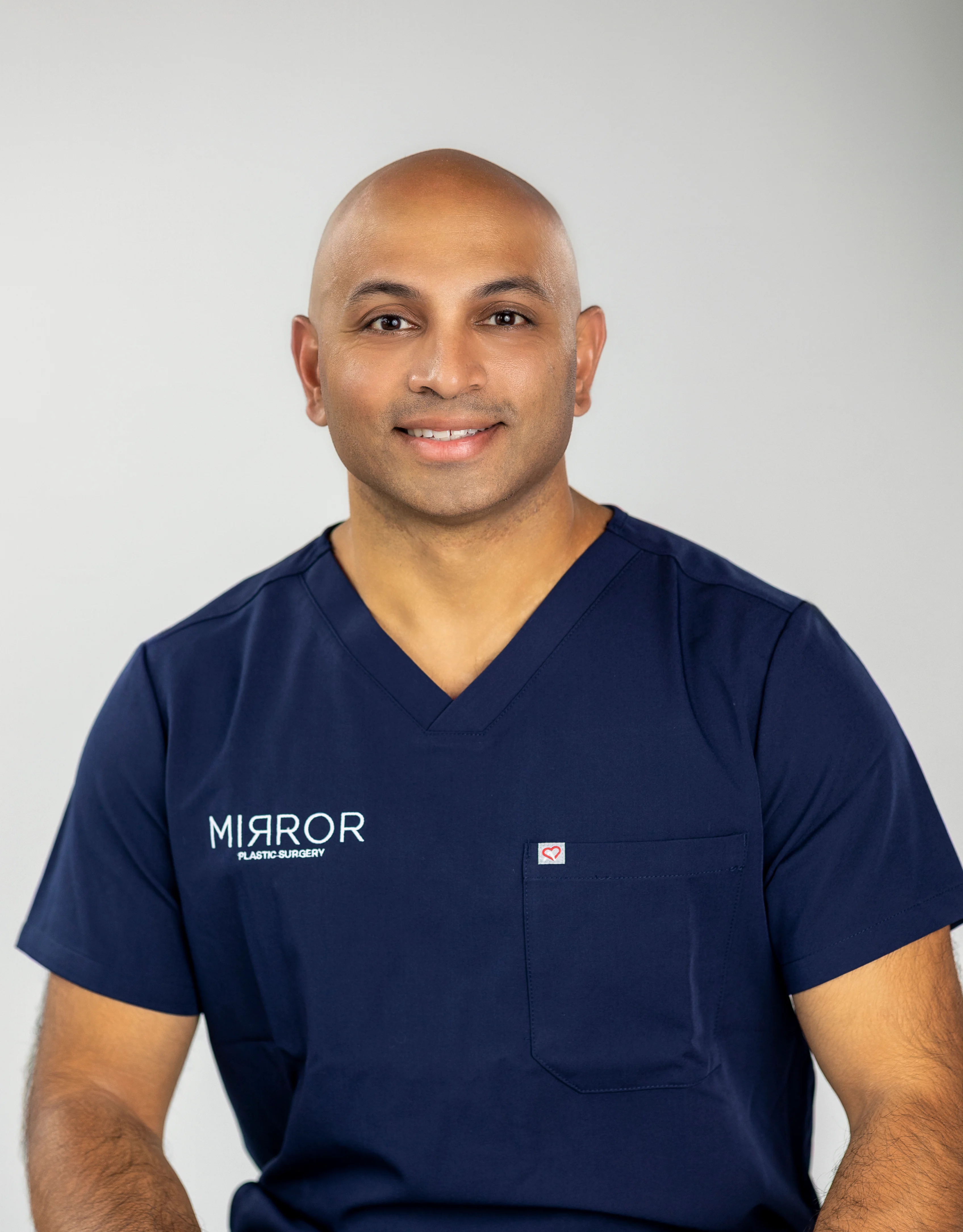
Dr. Akash conducts consultations that run up to an hour. These visits include a top-to-bottom assessment that covers anatomy, goals, and the full range of surgical and non-surgical options. His approach is grounded in transparency. He often advises patients when a procedure is not yet necessary and frequently recommends conservative pathways, including exercise and non-surgical options, before surgery. The practice follows a guiding principle of safety first, function second, aesthetics third.
Patients in the Tampa Bay area who want a board-certified plastic surgeon with the credentials, philosophy, and technical expertise to deliver lasting hip dip correction often view Mirror Plastic Surgery as the local standard of care.
Frequently Asked Questions
How Long Does Hip Dip Fat Grafting Last?
The fat that successfully establishes a blood supply after transfer is permanent.1 Published data from a 2026 systematic review in JPRAS Open found pooled retention of 63.7% at 12 months and 56.2% at 24 months, with volume stabilizing after the initial resorption phase. Final results are typically visible at 3–6 months post-procedure. In ideal patients, such as non-smokers at a healthy weight who follow recovery protocols, retention can reach 80–90%.1 The surviving fat behaves like native tissue rather than fading the way fillers do.
Is Hip Dip Fat Grafting Safe?
When a board-certified plastic surgeon follows current safety protocols, the risk profile is favorable. The Multi-Society Gluteal Fat Grafting Task Force, comprising the ASPS, ISAPS, ASAPS, and other international bodies, mandates subcutaneous-only injection using large blunt-tipped cannulas, with real-time intraoperative ultrasound guidance to prevent pulmonary fat embolism. Florida law independently requires ultrasound guidance for all gluteal fat grafting procedures performed in the state. Hip dip fat transfer carries lower risk than larger-volume BBL procedures because the volumes transferred are smaller. Choosing a board-certified plastic surgeon who adheres to these protocols is the most important safety decision a patient makes.
Will I Need Multiple Sessions?
Most patients achieve their goals in a single procedure.1 Approximately 15% require a minor touch-up at 6–12 months to refine symmetry or address localized resorption.1 Before booking, ask your surgeon whether one revision is included in the quoted price, what the revision covers, and what the revision window is. Reputable surgeons include at least one revision in their quoted price and are transparent about the terms before the initial procedure.
How Much Fat Survives After Hip Dip Fat Grafting?
Published retention rates range from 30% to 80%, with the spread driven primarily by surgeon technique and patient factors. Experienced, board-certified surgeons who specialize in structural fat grafting tend to cluster toward the higher end of that range. Patient behaviors that reduce survival include smoking, poor skin quality, and returning to strenuous activity too early. To account for expected resorption, surgeons typically overfill the treatment area by 20–30% at the time of surgery, so the final stabilized result reflects the surviving fraction of a deliberately larger initial volume.
Can I Combine Hip Dip Fat Grafting With Other Procedures?
Combination surgery often improves value for patients who are good candidates. Combining hip dip fat grafting with a BBL or Lipo 360 reduces the effective per-procedure cost because anesthesia and facility fees are shared. A BBL combined with hip dip fat transfer typically costs $10,000–$22,000, compared to $14,000–$35,000 if performed as separate procedures. Lipo 360 combined with hip dip fat transfer runs $12,000–$25,000 combined versus $16,000–$40,000 separately. Whether combination surgery is appropriate depends on individual anatomy, health status, and goals, which your surgeon evaluates during a thorough consultation.
Conclusion: Prioritizing Expertise For Lasting Value
Hip dip fat grafting costs $8,000–$20,000 nationally, with $12,000–$15,000 representing the typical all-in investment. The price spread of more than $12,000 across the market is real, and surgeon expertise matters more than geography or negotiation. Fat survival rates improve significantly with experienced, board-certified surgeons, and the procedure’s permanent results usually outperform biostimulatory fillers on a multi-year cost basis for appropriate surgical candidates. The cheapest quote rarely delivers the strongest long-term value.
Dr. Akash Chandawarkar’s Harvard and Johns Hopkins training, fellowship in aesthetic surgery, concierge medicine philosophy, and commitment to safety-first, evidence-based care make Mirror Plastic Surgery a leading choice for hip dip correction in the Tampa Bay area. With up to an hour dedicated to each consultation, transparent communication, and a practice that limits itself to one to two surgeries per day, Mirror delivers the focused, personalized care this technically demanding procedure requires.
Ready to get an accurate quote for your hip dip fat grafting? Schedule your consultation with Ellie at Mirror Plastic Surgery today.
Disclaimer: Results may vary from person to person. Editorial content, before and after images, and patient testimonials do not constitute a guarantee of specific results.
1 Results may vary from person to person. Editorial content, before and after images, and patient testimonials do not constitute a guarantee of specific results.