
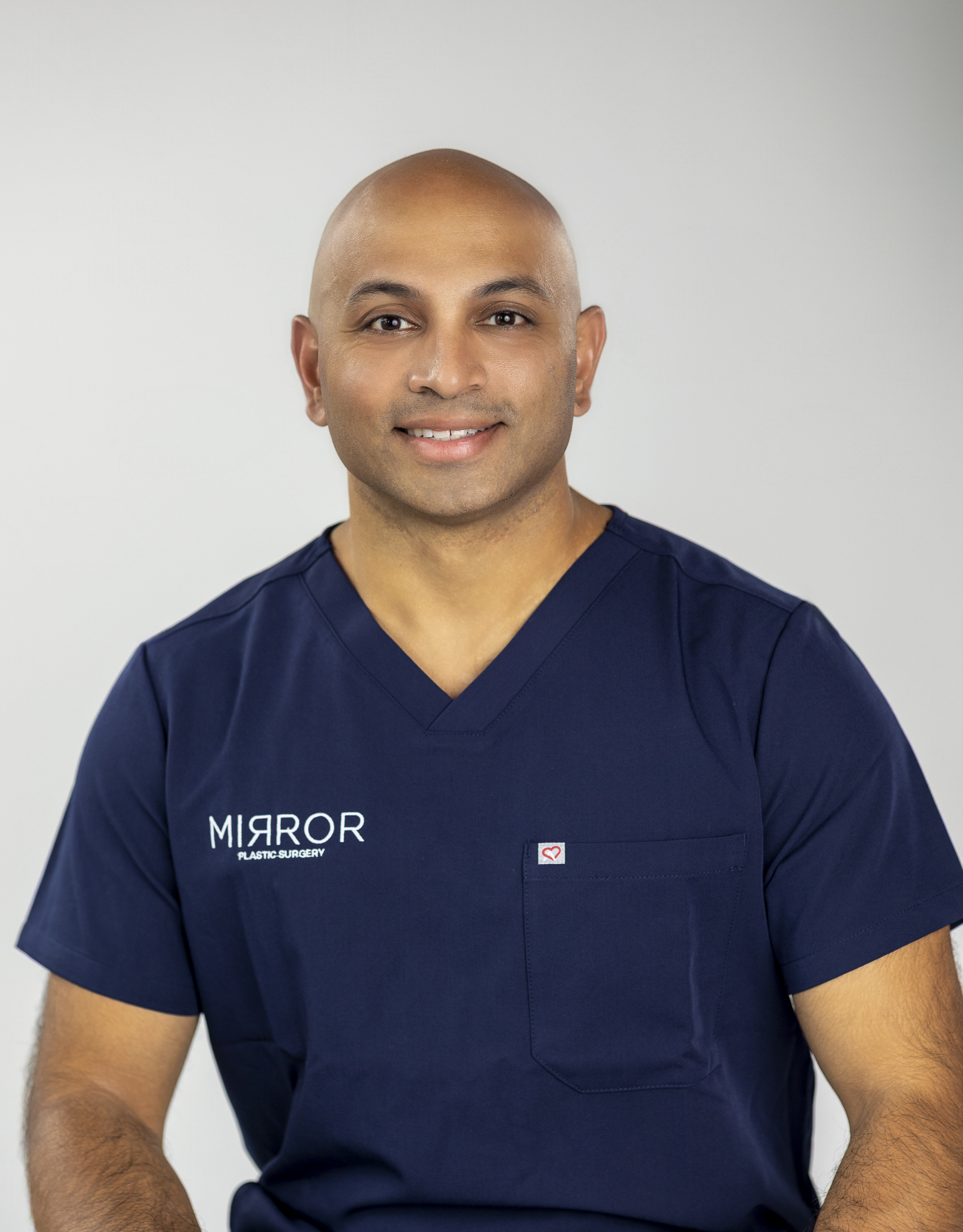
Written by: Dr. Akash Chandawarkar, Board Certified Plastic Surgeon, Mirror Plastic Surgery | Last updated: June 15, 2026
Key Takeaways
- Many Tampa hair restoration clinics advertise surgeon-led procedures but hand off key steps like hairline design and graft placement to unlicensed technicians, which raises the risk of poor results.
- Thorough verification means confirming the surgeon’s credentials, such as active Florida licensure, ABHRS Diplomate status, and primary board certification, and confirming who performs each surgical phase.
- High-volume clinics that schedule several patients per day per surgeon rarely provide consistent surgeon presence, which correlates with higher complication and repair rates.
- Dr. Akash’s training at Harvard-MIT, Johns Hopkins, and MEETH, combined with board certification, illustrates the rigorous standard patients can use as a benchmark.
- Patients ready to verify credentials with a board-certified plastic surgeon can book a consultation with Dr. Akash at Mirror Plastic Surgery for personalized, surgeon-led care.
The 7-Step Tampa Verification Checklist
- Confirm an active Florida medical license via the Florida DOH MQA lookup. Search the surgeon’s name or license number at Florida DOH Medical Quality Assurance License Verification. The result shows license status, expiration date, and any disciplinary indicators. An active, clear license with no flags is the minimum requirement before you consider anything else.
- Check for disciplinary history using the Florida DOH Enforcement Actions search. Run the surgeon’s name through Florida DOH Enforcement Actions, which displays a “Yes” or “No” under “Discipline on File.” For disciplinary actions taken after June 2006, the Florida Department of Health directs users to search final orders and emergency actions through the MQA portal for a complete review.
- Verify ABHRS Diplomate status. The American Board of Hair Restoration Surgery (ABHRS) is a certifying board for hair restoration surgeons, alongside at least one other such as the American Society of Aesthetic and Hair Restoration Surgeons (ASAHRS). Certification requires documentation of a minimum of 150 cases over three years, submission of 50 detailed operative reports, and passing written and oral examinations. Confirm Diplomate status directly through the ABHRS official directory.
- Verify ISHRS membership or FISHRS designation. The Fellow of the International Society of Hair Restoration Surgery (FISHRS) designation, established in 2012, is awarded via a points-based scorecard that evaluates leadership, ABHRS or equivalent board certification, scientific publications, and teaching contributions. Confirm membership or fellowship status in the ISHRS member directory. Basic membership signals professional engagement, while FISHRS designation signals peer-recognized expertise.
- Confirm primary board certification in plastic surgery, dermatology, or facial plastic surgery. Board certification in plastic surgery, dermatology, or facial plastic surgery provides the core surgical training for hair-transplant work and usually follows several years of residency after medical school. Verify plastic surgery certification through the American Board of Plastic Surgery public verification tool.
- Ask clear questions about who performs each critical surgical phase. Critical phases that must be performed personally by the operating surgeon include hairline design, recipient-site creation, and graft placement. Request written confirmation of the full name and license number of the surgeon who will be present for the entire procedure. Patients should ask clinics to provide written confirmation specifying the full name and license number of the surgeon who will perform the procedure and whether that surgeon will be present for the entire operation.
- Confirm hospital privileges and accredited-facility status. A surgeon with active hospital privileges at an accredited facility has already passed an independent credentialing review. Operating in an accredited surgical center also means the facility meets external safety standards. U.S. hair transplant clinics operating under OSHA standards, state medical board oversight, and independent accreditation create accountability through inspections, malpractice liability, and licensing rules. Unaccredited settings lack that level of oversight.
Who Actually Performs the Surgery in Tampa Clinics
The most consequential variable in hair restoration outcomes is not technique or technology, it is who holds the instruments. Published analyses identify delegation of critical steps to inexperienced surgeons or technicians, particularly in high-volume clinic settings, as the single most common factor in poor hair transplant outcomes.
Clinics that rely on less skilled technicians often see higher transection and graft trauma rates, which lowers overall graft survival. This matters because the damage is permanent. Most patients have only 4,000–8,000 grafts that can be safely harvested from the scalp over a lifetime. Overharvesting in a technician-run setting permanently depletes a finite donor supply that cannot be replaced.
High-volume practices that process five to ten patients per day per surgeon cannot realistically provide consistent surgeon presence throughout each case. Leading hair transplant clinics often limit procedures to one patient per day to allow meticulous execution and quality control under close physician oversight. Mirror Plastic Surgery schedules at a low daily volume so that Dr. Akash remains directly involved before, during, and after each procedure, rather than appearing briefly at the start.
Tampa-Specific Red Flags to Watch For
Warning signs that warrant immediate scrutiny:
- Same-day booking pressure or consultations that last fewer than 30 minutes
- Vague or evasive answers when you ask which specific steps the surgeon personally performs
- Inability or refusal to answer how many surgeries the doctor will personally supervise that day
- A large graft count quoted before any scalp examination or donor-area assessment
- Pressure to combine multiple procedures in a single session without a documented safety rationale
- Generic aftercare instructions that are identical for all patients rather than guidance tailored to your case
- No written disclosure of who will administer anesthesia, perform extraction, create recipient sites, and place grafts
These red flags often show up in high-volume FUE sessions and in procedures run by inadequately trained teams. In those environments, preventable iatrogenic complications, including opportunistic infections from nontuberculous Mycobacterium spp. or Mucor spp., have been linked to poorly regulated settings.
Common Misconceptions About Hair-Transplant Credentials
“Any cosmetic surgeon is qualified.” Any physician holding an MD can legally perform hair transplants in the United States regardless of specialized training or experience in hair restoration. Legal permission to perform a procedure differs from demonstrated competency. The absence of a specialty-specific credential such as ABHRS certification is a meaningful data point, not a minor detail.
“Board certification in another specialty suffices.” Primary board certification in plastic surgery or dermatology provides a rigorous surgical foundation. However, hair transplant surgery is not recognized as a distinct specialty or subspecialty by the American Board of Medical Specialties (ABMS). No general board examination tests hair-restoration-specific knowledge. ABHRS certification and ISHRS fellowship training fill that gap.
“Price is a reliable proxy for expertise.” Lower-cost options may reduce fees by shortening procedure times, performing multiple surgeries simultaneously, or relying heavily on technicians, which can compromise precision and long-term results. Price reflects a clinic’s business model, not the surgeon’s credential profile or level of personal involvement.
Reader Checklist for Tampa Hair Transplant Consultations
Before booking any hair restoration procedure in Tampa, confirm:
- ☐ Active Florida medical license with no disciplinary flags (Florida DOH MQA)
- ☐ Enforcement Actions search returns “No” under Discipline on File
- ☐ ABHRS Diplomate status confirmed via ABHRS directory
- ☐ ISHRS membership or FISHRS designation confirmed via ISHRS directory
- ☐ Primary board certification in plastic surgery, dermatology, or facial plastic surgery verified
- ☐ Written confirmation of the surgeon’s name, license number, and presence throughout the procedure
- ☐ Facility holds accreditation and the surgeon holds active hospital privileges
Three consultation questions that expose red flags:
- “Will you personally design my hairline, create every recipient site, and be present for graft placement, or will any of these steps be delegated to a technician or assistant?”
- “How many other surgical cases will you be performing on the day of my procedure?”
- “Can you provide written documentation of your license number and confirmation that you will be the operating surgeon for the entire procedure?”
Book a consultation with Dr. Akash to walk through these questions with a surgeon who answers them directly and specifically.
Safety, Function, and Aesthetics at Mirror Plastic Surgery
The verification framework above mirrors Mirror Plastic Surgery’s operating philosophy: safety first, function second, aesthetics third. Confirming licensure and disciplinary history protects safety. Confirming surgeon presence throughout critical phases protects function. A qualified surgeon understands facial symmetry, hair angles, and future hair loss patterns, which supports hairline design that suits the patient’s age and face shape for natural, long-term results.1 Strong aesthetic outcomes follow when those earlier steps are handled correctly.1
Dr. Akash’s Harvard-MIT and Johns Hopkins training and MEETH fellowship create a credential profile designed for this standard. Those credentials matter most when the surgeon can apply them personally to each case, which is why Mirror Plastic Surgery maintains a low daily case volume that supports direct surgeon involvement from start to finish.
Frequently Asked Questions
Does a Florida hair transplant surgeon need a separate state license for hair restoration specifically?
No separate Florida license exists for hair restoration surgery. Any physician performing hair transplants in Florida must hold an active Florida medical license issued by the Board of Medicine, verifiable through the Florida DOH MQA portal. Hair restoration is not recognized as a distinct licensed specialty at the state level. Voluntary credentials such as ABHRS certification and ISHRS fellowship therefore carry significant weight because they represent the field’s own effort to establish a competency standard that state licensing does not define.
What is the practical difference between ABHRS Diplomate certification and basic ISHRS membership?
ABHRS Diplomate certification requires a surgeon to document at least 150 cases over three years, submit 50 detailed operative reports, and pass written and oral examinations. It functions as an earned credential with objective performance thresholds. Basic ISHRS membership signals professional engagement with the field’s primary society but does not require examination or a minimum case log. The FISHRS designation sits above basic membership and is awarded by peer review based on years of practice, procedural volume, publications, and contributions to the field. When you evaluate a surgeon, ABHRS Diplomate status and FISHRS designation together represent a higher bar than membership alone.
What should a patient do if a Florida DOH search returns a disciplinary flag?
A “Yes” under Discipline on File does not automatically disqualify a surgeon, but it calls for follow-up. The Florida DOH directs patients to search final orders and emergency actions through the MQA portal for actions taken after June 2006. For a complete picture, patients can submit a public records request to the Florida Department of Health; no written request, name, or stated purpose is required. Emergency suspension orders are not final agency actions and may reflect resolved matters. Final orders carry more weight. Any unresolved or recent disciplinary action related to standard of care warrants serious caution before proceeding.
How should a patient prepare for an in-depth hair restoration consultation?
Arrive with documentation of any previous hair restoration procedures, including the name and license number of the performing surgeon. Bring photographs showing your hairline at different ages if available, since these help the surgeon assess the trajectory of hair loss. Prepare to discuss your family history of hair loss, current medications, and any scalp conditions. Bring the three consultation questions from the reader checklist and expect direct, specific answers. A surgeon who cannot or will not answer those questions clearly is already telling you how the procedure will be managed.
Conclusion: Turning a Checklist into a Safer Outcome
Verifying a hair transplant surgeon in Tampa works best as a structured sequence. Confirm active Florida licensure, a clean disciplinary history, ABHRS Diplomate status, ISHRS membership or FISHRS designation, primary board certification, written confirmation of direct surgeon involvement, and accredited-facility status. Each step closes a specific gap that marketing language cannot fill.
Differences between hair transplant techniques matter less than differences between individual surgeons, and a skilled surgeon using standard techniques will outperform an inexperienced operator using advanced tools.1 Verified credentials create the foundation. Continuous surgeon involvement throughout every critical phase shapes the final result.1
Mirror Plastic Surgery’s hour-long consultations and low daily case volume support Dr. Akash’s direct hands-on involvement with each patient. His board certification by the American Board of Plastic Surgery and elite academic training provide the credential foundation. The concierge-style model then ensures that those credentials are applied personally to every case.
Book a consultation with Dr. Akash at Mirror Plastic Surgery in St. Petersburg and receive the in-depth, surgeon-direct evaluation this checklist is designed to help you secure.
1 Results may vary from person to person. Editorial content, before and after images, and patient testimonials do not constitute a guarantee of specific results.