

Written by: Dr. Akash Chandawarkar, Board Certified Plastic Surgeon, Mirror Plastic Surgery | Last updated: July 9, 2026
Key Steps Before You Book a Rhinoplasty Consultation
- Verify a surgeon’s ABPS board certification through the official ABMS tool and confirm active hospital privileges before scheduling any rhinoplasty consultation.
- Confirm that the surgical facility holds AAAASF or equivalent accreditation and that a named, credentialed anesthesiologist will be assigned to your case.
- Choose a consultation that lasts at least 60 minutes and follows a safety-function-aesthetics sequence covering medical history, breathing assessment, and digital imaging.
- Request an itemized quote, written surgical plan, and clear revision policy to avoid hidden fees and pressure tactics common in high-volume practices.
- Schedule a personalized rhinoplasty consultation with Mirror Plastic Surgery to experience a verification-first, concierge approach designed around your safety and goals.
Verifying a Board-Certified Rhinoplasty Surgeon in 2026
The American Board of Medical Specialties (ABMS) is the authoritative body for verifying board certification, and the American Board of Plastic Surgery (ABPS) is the only plastic surgery board it recognizes. Verification should begin at the ABMS online tool before any other step.
The numbered verification process:
- Search the surgeon’s name on the ABMS Certification Matters tool to confirm active ABPS certification.
- Cross-reference membership on the American Society of Plastic Surgeons (ASPS) Find a Surgeon directory.
- Confirm the surgeon holds active hospital privileges, which represent an independent credentialing review of training, licensure, and professional standing beyond a practice website.
- Check for specialty-society membership such as The Rhinoplasty Society, which requires board certification, at least two years in active practice, good standing in a major society such as ASPS, and an average of 30 rhinoplasties performed per year.
- Ask directly whether the surgeon is licensed in your state and whether the operating facility is accredited.
ABPS certification requires graduation from a recognized medical school plus completion of an ACGME- or AOA-approved residency of three to five years, depending on the specialty. High-volume practices performing five to ten surgeries daily may employ credentialed surgeons, but the structural difference lies in time allocation per patient. Concierge practices limit daily surgical volume to one or two cases, which keeps the entire clinical team focused on each patient before, during, and after the procedure.
Rhinoplasty Consultation Costs and Insurance Basics
Once you have verified a surgeon’s credentials, the next practical consideration is cost. Consultation fee structures vary by practice model, and several financial realities matter before you book.
- Many board-certified plastic surgeons charge a consultation fee ranging from $100 to $300, sometimes credited toward the procedure cost if the patient proceeds.
- Cosmetic rhinoplasty is typically not covered by health insurance, and coverage may apply only when the procedure is deemed medically necessary for breathing obstruction, injury repair, or congenital defects.
- Functional components such as septoplasty or turbinate reduction may qualify for partial insurance reimbursement when documented breathing impairment is present.
- An itemized quote covering surgeon fees, anesthesia, facility costs, all follow-up visits, and administrative fees with no hidden costs is a standard expectation at reputable practices.
- Practices that present only a single bundled number without line-item detail make it difficult to compare costs or understand what is and is not included.
- Financing options through third-party healthcare lenders are widely available and are typically discussed during or after the consultation.
Every patient’s anatomy, goals, and procedural complexity differ, which is why Mirror Plastic Surgery provides personalized quotes during the consultation based on each individual’s specific situation rather than a published price list.
Typical Length of a Rhinoplasty Consultation
Consultation duration directly reflects the depth of assessment a patient will receive. A comprehensive rhinoplasty consultation at a concierge practice runs approximately 60 minutes. That time covers a full medical history review, internal and external nasal examination, facial balance analysis, skin-type evaluation, breathing function assessment, digital imaging, surgical planning discussion, and a review of risks, recovery, and next steps.
High-volume practices often schedule shorter consultations. At that pace, a surgeon cannot complete a thorough evaluation of nasal bones, cartilage, tip projection, bridge height, septal alignment, nasal valve competence, and facial thirds while also addressing patient questions and reviewing imaging. A rushed consultation focused on sales rather than anatomy is one of the clearest red flags in rhinoplasty practice selection.
At Mirror Plastic Surgery, the initial consultation is structured to last up to one hour. This visit functions as the foundation of the surgical plan rather than a formality before scheduling.
Step-by-Step Breakdown of a Rhinoplasty Consultation
A structured rhinoplasty consultation follows a logical sequence that prioritizes safety and function before aesthetics. The numbered breakdown:
- Medical history review. The surgeon collects information on chronic conditions, prior nasal or facial surgeries, current medications and supplements, allergies, smoking status, and any history of breathing problems or nasal trauma.
- External nasal examination. The surgeon evaluates nasal bones, cartilage, tip projection, bridge height, columella, alae, and skin thickness. Thick skin conceals fine detail while thin skin exposes irregularities, directly affecting realistic surgical outcomes.
- Internal nasal examination. Assessment of the septum, nasal valves, and turbinates identifies any functional issues, such as a deviated septum, collapsed valves, or hypertrophic turbinates, that affect airflow and must be addressed alongside cosmetic goals.
- Facial balance analysis. The surgeon evaluates chin projection, forehead, and overall facial thirds to ensure the proposed nasal changes harmonize with the patient’s face rather than conform to a generic standard.
- Digital imaging. Standardized clinical photographs are taken and morphing or 3D simulation software is used to visualize potential changes. Digital imaging provides simulations rather than guarantees. Because skin thickness affects how much refinement will be visible, imaging cannot predict individual healing variables with precision.
- Surgical plan discussion. The surgeon explains the planned changes, the rationale for each, the technique to be used (open or closed rhinoplasty), and what the procedure can and cannot achieve based on the patient’s specific anatomy.
- Risk, recovery, and logistics review. Potential complications, week-by-week recovery expectations, anesthesia type, facility accreditation, and scheduling considerations are addressed before the consultation concludes.
Mirror Plastic Surgery’s safety-function-aesthetics hierarchy governs every step of this process. Structural integrity and breathing function are evaluated before any aesthetic refinement is planned.
Essential Questions to Ask Your Rhinoplasty Surgeon
Arriving at a consultation with prepared questions helps you leave with clarity instead of uncertainty. Use the following questions as a starting point:
- Are you board certified by the American Board of Plastic Surgery, and can I verify that certification?
- How many rhinoplasties do you perform each year, and do you perform both open and closed techniques?
- What is your personal revision rate for primary rhinoplasty?
- Who is the anesthesiologist, and what are their credentials?
- Is the surgical facility AAAASF-accredited or equivalently certified?
- Do you hold hospital privileges in case of a rare complication?
- What does week-by-week recovery look like, and when will final results be visible?
- Have you treated patients with my specific anatomy, skin type, or ethnic background?
- Can you show me before-and-after photos of patients with similar anatomy, undated and unfiltered?
- Under what circumstances would you advise a patient against rhinoplasty?
Rhinoplasty Consultation Red Flags to Watch For
Certain consultation behaviors reliably predict poor surgical environments. The following checklist identifies practices that warrant caution or disqualification:
- Rushed appointments under 30 minutes that skip thorough multi-angle assessment and realistic outcome discussion.
- Pressure tactics including limited-time pricing offers, urgency language, or “book today or lose your slot” messaging.
- Unnamed anesthesiologist or vague “the team handles it” responses when asked about anesthesia credentials.
- Heavily filtered or undated before-and-after photos that do not reflect real, unedited patient outcomes.
- Guarantees of perfection or promises that rhinoplasty will resolve concerns without conditions or anatomical caveats.
- No breathing evaluation during the visit, which means the consultation omits assessment of the septum, nasal valves, and turbinates and overlooks critical functional risks even in purely cosmetic cases.
- Absence of a documented revision policy or itemized quote covering anesthesia, follow-ups, and contingencies.
- Willingness to perform any requested procedure regardless of whether it fits the patient’s nasal anatomy, skin type, or facial proportions.
- No examples of cases where surgery was declined, even though ethical surgeons advise against procedures when anatomy or psychological readiness does not support a safe outcome.
A 2026 systematic review found that patients with preexisting psychological conditions including body dysmorphic disorder, anxiety, and depression consistently report lower postoperative satisfaction after aesthetic rhinoplasty despite technically successful results1. A thorough consultation screens for psychological readiness alongside physical candidacy, a step high-volume practices routinely omit.
How to Book a Rhinoplasty Consultation Near You in 2026
The step-by-step national booking process:
- Search and shortlist. Use the ASPS Find a Surgeon tool to identify ABPS-certified plastic surgeons in your area. Filter for facial surgery specialization and rhinoplasty-specific experience.
- Verify credentials. Confirm ABPS certification via the ABMS tool, check hospital privileges, and review specialty-society memberships before contacting any practice.
- Evaluate the practice model. Determine whether the practice operates on a concierge or high-volume model by asking directly how many surgeries are performed daily and how long consultations are scheduled to last.
- Prepare your consultation materials. Gather a list of current medications and supplements, any prior nasal imaging or medical records, and reference photos that communicate your aesthetic preferences. Note any breathing concerns separately from cosmetic goals.
- Book and confirm logistics. Confirm the consultation fee structure, whether it is credited toward the procedure, and what the appointment will cover before arrival.
Tampa and St. Petersburg area patients can contact Mirror Plastic Surgery directly:
- Address: 780 4th Ave S, St. Petersburg, FL 33701
- Phone/Text: 727-361-6515
- Online: mirrorplasticsurgery.com/consultation
Text-to-book is available for patients who prefer asynchronous scheduling. National patients are welcome to begin the process remotely.
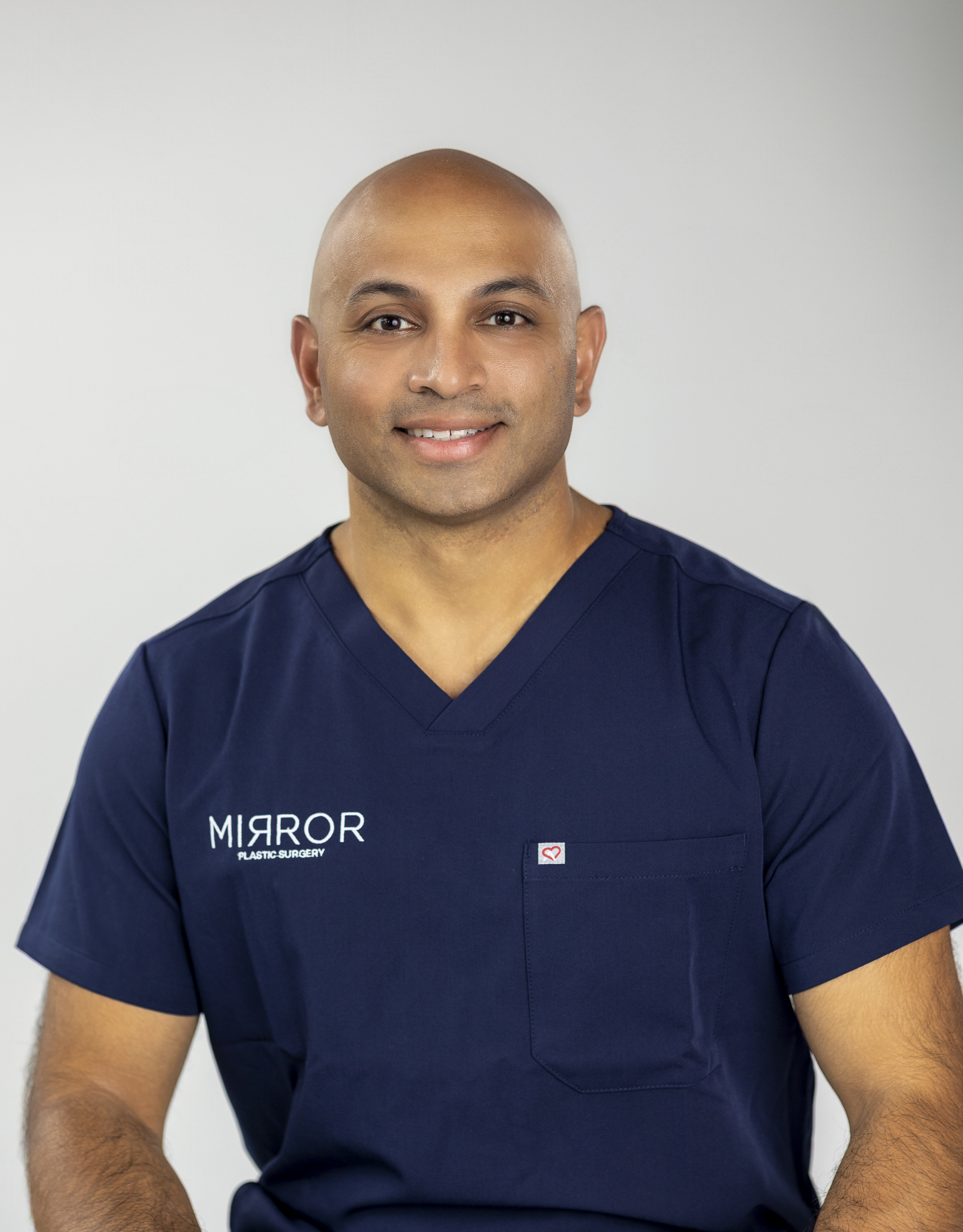
Expert Context: Dr. Akash’s Training and Rhinoplasty Focus
Mirror Plastic Surgery’s rhinoplasty program is led by Dr. Akash, whose academic and clinical training represents one of the most rigorous pathways in American plastic surgery. Dr. Akash completed his undergraduate studies in neuroscience and nuclear engineering at MIT before earning his medical degree through the Harvard-MIT Division of Health Sciences and Technology, a program designed to train physician-scientists by integrating rigorous scientific research with clinical medicine, and he graduated from Harvard Medical School with Honors.
His surgical training was completed during a seven-year integrated plastic and reconstructive surgery residency at Johns Hopkins University, which included rotations at the R Adams Cowley Shock Trauma Center and the Curtis National Hand Center for microsurgical specialization. He subsequently completed an aesthetic surgery fellowship at the Manhattan Eye, Ear and Throat Hospital (MEETH), one of the most competitive programs in the country for advanced facial rejuvenation and body contouring.
Uniquely, Dr. Akash also completed the Stanford University Biodesign Innovation Fellowship, training in medical technology development alongside his surgical career. He is board certified by the American Board of Plastic Surgery, serves as Next Generation Editor for the Aesthetic Surgery Journal, has testified before the FDA on breast implant safety, and has been named in America’s Best Plastic Surgeons 2025 by Newsweek for two consecutive years. His research on artificial intelligence applications in rhinoplasty outcome analysis has been presented at The Rhinoplasty Society Annual Meeting.
Rhinoplasty Readiness Checklist for Patients
Use this checklist when evaluating any rhinoplasty surgeon and practice:
- ABPS board certification confirmed via ABMS tool
- Active state licensure verified
- Hospital privileges confirmed
- ASPS or equivalent specialty-society membership
- Surgical facility holds AAAASF or equivalent accreditation
- Named, credentialed anesthesiologist identified
- Consultation scheduled for at least 45–60 minutes
- Breathing function evaluated alongside cosmetic goals
- Digital imaging presented as a planning tool, not a guarantee
- Itemized quote provided covering all fees and follow-up visits
- Written surgical plan and consent forms provided before scheduling
- Revision policy documented and explained
- No pressure tactics, urgency language, or limited-time offers encountered
- Surgeon provided examples of cases where surgery was not recommended
Frequently Asked Questions
Will health insurance cover any part of my rhinoplasty?
Cosmetic rhinoplasty is not covered by health insurance. Coverage may apply to functional components, such as septoplasty to correct a deviated septum or turbinate reduction to improve airflow, when a physician documents that the structural issue causes a medically significant breathing impairment. Patients pursuing combined cosmetic and functional rhinoplasty should ask their surgeon to separate the functional and aesthetic components in the surgical plan and billing documentation.
Even with documented functional need, insurance approval is not guaranteed and usually requires pre-authorization. The cosmetic portion remains an out-of-pocket expense regardless of any functional coverage that is approved.
Is digital imaging during a rhinoplasty consultation a reliable preview of my results?
Digital imaging is a communication and planning tool, not a surgical guarantee. Morphing software and 3D simulation allow the surgeon and patient to discuss directional changes, such as reducing a dorsal hump, refining tip projection, or adjusting nostril width, in visual terms that are easier to understand than verbal description alone.
The simulation cannot account for individual healing variables including skin thickness, scar tissue formation, cartilage behavior over time, or swelling patterns. Surgeons who present imaging simulations as a contractual preview of results are misrepresenting the technology. At Mirror Plastic Surgery, imaging is used to align expectations with anatomically realistic outcomes, not to promise a specific appearance.
When will I see my final rhinoplasty results?
Final rhinoplasty results typically emerge over a 12-to-18-month healing period.1 The first two weeks involve the most visible swelling and bruising. Most patients return to normal activities within 10 to 14 days and feel comfortable in social settings within three to four weeks.
Subtle swelling, particularly at the nasal tip, continues to resolve gradually over the following months. Structural changes to cartilage and the overlying skin envelope stabilize at approximately 12 months for most patients, though individuals with thicker skin may require the full 18-month window before fine details become visible.1 Recovery timelines are discussed in detail during the Mirror Plastic Surgery consultation so patients have accurate, week-by-week expectations before committing to surgery.
What should I know about revision rhinoplasty before my first consultation?
Revision rhinoplasty is among the most technically demanding procedures in facial plastic surgery. It requires working with tissues already altered by a prior surgery, often with limited remaining cartilage and a compromised blood supply. Most surgeons recommend waiting at least 12 months after a primary rhinoplasty before pursuing revision to allow complete healing, full resolution of swelling, scar tissue maturation, and accurate assessment of what requires correction.
Severe breathing difficulties or significant structural deformities may justify earlier evaluation. Revision rates for primary rhinoplasty are estimated to range from 5% to 15%, which underscores the importance of selecting a highly trained surgeon for the initial procedure.1 Patients considering revision should bring all prior surgical records, operative notes, and any imaging to their consultation.
Conclusion: Making a Confident Rhinoplasty Decision
Scheduling a rhinoplasty consultation is the first clinical decision in a process where every subsequent step depends on the quality of that initial assessment. Verification of board certification, facility accreditation, and anesthesiologist credentials establishes the safety foundation. A consultation that evaluates breathing function alongside cosmetic goals, and takes the time to do both thoroughly, reflects the safety-function-aesthetics hierarchy that produces durable, natural results.
Pressure tactics, unnamed providers, and rushed appointments are reliable indicators of environments where patient safety is subordinated to volume. The AAFPRS 2025 Annual Survey confirms that patients’ primary concern is no longer cost or recovery time but looking unnatural, a shift that places a premium on precision, restraint, and expertise. That standard is met through structured, unhurried consultations with surgeons whose training and practice model are built around it.
Begin with a consultation designed to protect your safety, preserve your function, and achieve results that are genuinely your own by contacting Dr. Akash at Mirror Plastic Surgery, 780 4th Ave S, St. Petersburg, FL 33701, call or text 727-361-6515.
1 Results may vary from person to person. Editorial content, before and after images, and patient testimonials do not constitute a guarantee of specific results.



