
Written by: Dr. Akash Chandawarkar, Board Certified Plastic Surgeon, Mirror Plastic Surgery | Last updated: June 25, 2026
Key Takeaways for 2026 Buttock Enhancement Safety
-
Patients in 2026 now weigh complication rates, recovery time, and long-term upkeep alongside aesthetic goals.
-
New safety data and refined techniques support a broader range of proven surgical and non-surgical options for shaping the buttocks.
-
Risk-averse adults can choose among several approaches that balance volume goals with safety and recovery needs.
-
Modern protocols and updated mortality statistics make today’s decisions more nuanced than in past years.
-
Schedule a personalized consultation at Mirror Plastic Surgery to identify the safest approach for your anatomy and goals.
Safety-Ranking Table: Comparing Buttock Enhancement Options
The table below compares five buttock enhancement categories across four safety and durability measures. All figures are cited inline, and no uncited values appear.
|
Method |
Fat Embolism Risk |
Overall Complication Rate |
Approximate Longevity |
|---|---|---|---|
|
Biostimulatory Fillers (e.g., Sculptra) |
None reported |
Low (nodule formation, asymmetry) |
2–3 years, maintenance required |
|
Liposuction-Only Contouring |
Negligible |
Low–moderate (contour irregularity) |
Long-term with stable weight |
|
Buttock Implants |
Negligible |
Higher rates, revision common |
Long-term, revision common |
|
Modern BBL (Fat Transfer) |
Significantly reduced with modern subcutaneous technique |
9.9% overall |
60–80% fat retention after healing1 |
|
Advanced Adipose Grafting (AlloClae) |
Minimized via subcutaneous placement |
Emerging data, lower than implants |
Structured integration, long-term |
Schedule a personalized consultation to review which category fits your anatomy, goals, and risk tolerance.
The Mirror Plastic Surgery Care Model: How Safety Guides Every Step
Mirror Plastic Surgery follows a clear hierarchy: safety first, function second, aesthetics third. This hierarchy shapes every operational decision in the practice. Each evaluation starts with a comprehensive anatomical assessment that can last up to one hour before any treatment is discussed. This time allows safety concerns to be identified and addressed before aesthetic planning begins.
The practice performs only one to two surgeries per day, which contrasts with high-volume clinics that may complete five to ten procedures daily. This lower volume protects pre-operative planning, intraoperative focus, and post-operative monitoring from time pressure. Ultrasound imaging is available in-office for precise pre-operative assessment, and all surgeries take place in accredited facilities with board-certified physician anesthesiologists.
Patients also receive counseling about the risks of combining multiple procedures in a single session. Evidence shows that stacking procedures can raise complication rates in a steep, non-linear way, so the practice often stages treatments to keep risk as low as reasonably possible.
Expert Perspective: Dr. Akash’s Training and Roles
The clinical protocols at Mirror Plastic Surgery reflect the training and experience of Dr. Akash. He completed his medical degree through the Harvard-MIT Division of Health Sciences and Technology and graduated from Harvard Medical School with Honors. His surgical residency was a seven-year integrated plastic and reconstructive surgery program at Johns Hopkins University.
He then completed an aesthetic surgery fellowship at the Manhattan Eye, Ear and Throat Hospital (MEETH). He also trained in physician-led medical technology development through the Stanford University Biodesign Innovation Fellowship. Newsweek has named him to America’s Best Plastic Surgeons list for two consecutive years, including 2025.
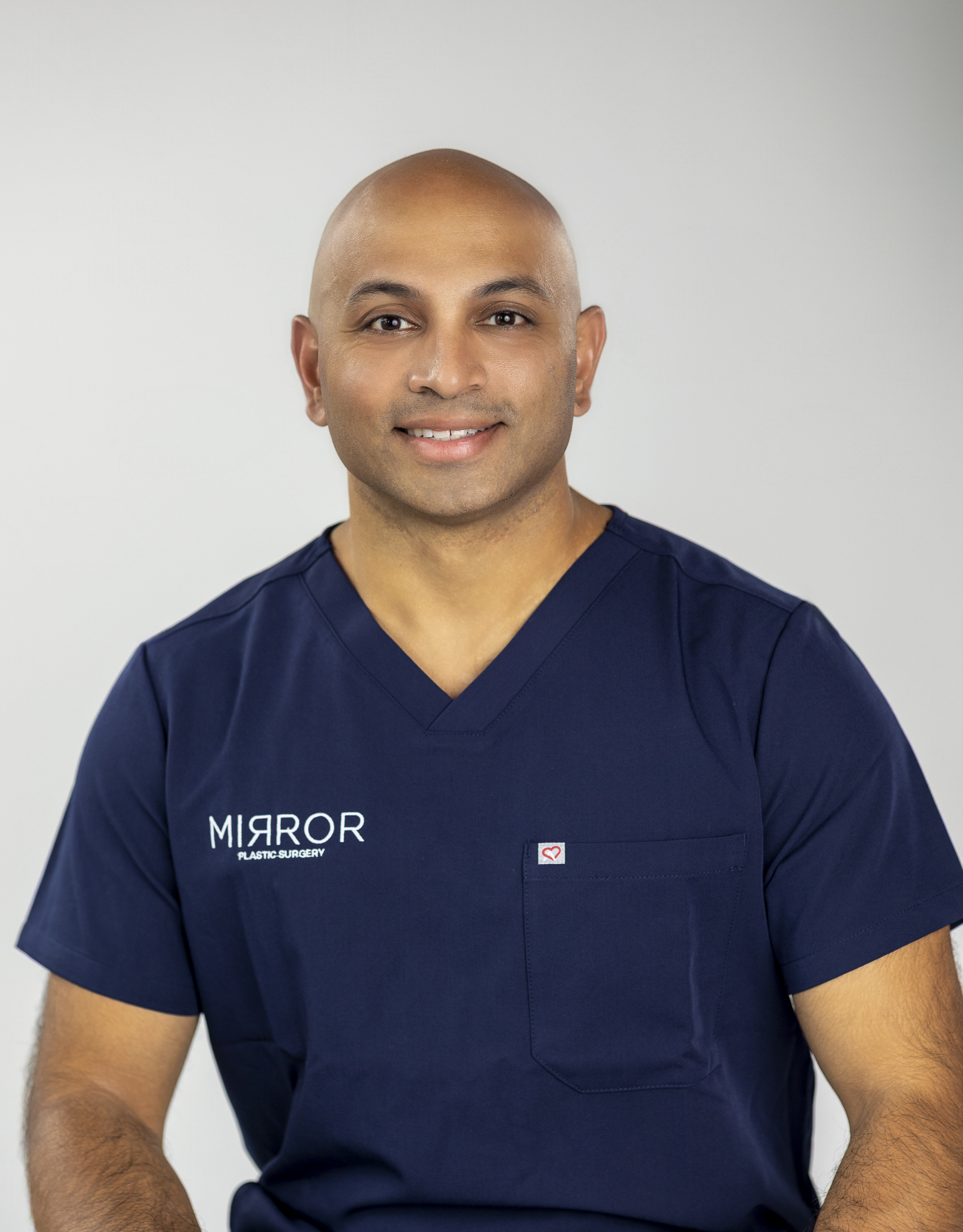
He serves on the advisory boards of Motiva, Tiger Aesthetics, Cypris Medical, and Merz Aesthetics, and has testified before the FDA on breast implant safety. Before comparing specific buttock enhancement options, patients benefit from understanding the key technical terms that appear in safety discussions and clinical research.
Key Terminology for Buttock Enhancement Safety
Fat embolism: A condition in which fat particles enter the bloodstream and can obstruct blood flow in the lungs. In BBL surgery, this risk is linked to intramuscular fat injection and represents the main cause of procedure-related mortality.
Biostimulatory fillers: Injectable products such as Sculptra (poly-L-lactic acid) or Radiesse (calcium hydroxylapatite) that trigger the body’s own collagen production instead of adding permanent volume directly.
Autologous fat transfer: A procedure that uses the patient’s own harvested fat, which removes the risk of rejection or allergic reaction associated with synthetic materials.
Implant-based augmentation: Placement of solid silicone implants within or beneath the gluteal muscle to create structural volume and projection.
AlloClae adipose grafting: An advanced fat integration platform that supplies a structural scaffold for transferred fat. This scaffold supports longer-term retention and integration compared with traditional fat transfer or biostimulatory fillers alone.
Sculptra Compared With BBL: Safety and Tradeoffs
Sculptra and similar biostimulatory fillers carry no documented fat embolism risk because no fat is harvested or injected. The procedure takes place in the office, does not require general anesthesia, and involves minimal recovery time. Results are temporary and usually last two to three years, so maintenance sessions are needed.1
Volume gains from Sculptra are modest and depend on the body’s collagen response.1 Factors such as age, skin quality, and injection technique influence that response. The most common adverse events include nodule formation and asymmetry.
Modern BBL, in contrast, involves general anesthesia, liposuction recovery at donor sites, and a restricted sitting protocol during healing. Updated technique protocols have reduced BBL mortality compared with historical data. Surgeons achieve this reduction by keeping fat placement in subcutaneous planes and avoiding intramuscular injection.
Patients with adequate donor fat and realistic volume goals can achieve durable results with modern BBL, with a meaningful portion of transferred fat surviving long term.1 Patients with limited donor fat or low tolerance for surgical risk often start with biostimulatory fillers, accepting that results are temporary and volume is limited.
Safest Buttock Enhancement Options by Risk Level
Non-surgical biostimulatory fillers carry the lowest procedural risk profile. They involve no anesthesia, no incisions, and no fat embolism risk. These treatments suit patients who want modest, temporary volume enhancement and are comfortable with maintenance visits.
Liposuction-only contouring reshapes areas such as the flanks, lower back, and lateral thighs to highlight the buttocks. This approach creates the visual effect of lift and projection without adding volume directly. Risk remains low, and results can last long term when body weight stays stable.
Buttock implants provide predictable volume even in patients with low body fat. They also carry the highest documented complication and revision burden among the main surgical options. Because of this profile, implants are rarely the first-line surgical choice for most patients.
Modern BBL remains the most common buttock augmentation procedure and accounts for roughly 96% of buttock augmentation cases nationally. When surgeons use micro-aliquot reinjection in subcutaneous planes and select patients carefully, including non-smokers with stable BMI, its complication rate is substantially lower than that of implants.
Advanced adipose grafting with AlloClae represents the current frontier in fat-based augmentation. The platform supports structural fat integration and aims for longer-term retention than traditional fat transfer or biostimulatory fillers alone. Dr. Akash serves on the Tiger Aesthetics advisory board for AlloClae and incorporates this technology within Mirror Plastic Surgery’s evidence-based framework.
BBL Alternatives in 2026: How to Weigh Your Options
Body fat availability: BBL and AlloClae grafting both require sufficient donor fat. Patients with low body fat may not qualify for fat-transfer approaches and may need to consider implants, fillers, or contouring alone.
Desired volume: Biostimulatory fillers and liposuction contouring create modest changes. Implants and fat transfer can deliver more dramatic volume shifts when anatomy allows.
Maintenance requirements: Non-surgical fillers usually require repeat sessions every two to three years. Surgical options are often single events, although implants have a meaningful revision rate over time.
Recovery timeline: Non-surgical options involve little to no downtime. Liposuction contouring typically requires one to two weeks of recovery. BBL and implant surgery usually require four to six weeks of restricted activity, and BBL patients must avoid direct sitting during early healing.
Anatomical suitability: Skin elasticity, existing gluteal muscle mass, fat distribution, and overall body proportions all influence which method will look natural and balanced.
Common Misconceptions About BBL Safety and Alternatives
Sculptra results are permanent. They are not permanent. Biostimulatory fillers stimulate temporary collagen production, and results usually fade within two to three years without maintenance.
Buttock implants are a low-risk fallback. Current data does not support that belief. Notable revision and complication rates place implants among the higher-risk body contouring procedures.
BBL is as dangerous as it was five years ago. Technique evolution has changed the risk profile in a meaningful way. Mortality has decreased from historical levels with modern subcutaneous injection protocols. Surgeon technique, patient selection, and facility standards still drive most safety outcomes.
More fat injected equals better results. Micro-aliquot placement of 0.1–0.5 mL per pass in well-vascularized subcutaneous tissue supports higher graft survival than large bolus injections. Chasing maximum volume at the expense of precise technique increases complication risk and fat necrosis.
Get an evidence-based assessment of which approach fits your anatomy and goals by scheduling your consultation today.
Frequently Asked Questions About BBL Alternatives
Is a non-surgical BBL with Sculptra a safe long-term solution?
Biostimulatory fillers like Sculptra rank among the lowest-risk buttock enhancement options because they require no anesthesia, no incisions, and no fat harvesting. They work well for patients seeking modest, temporary volume improvement. They do not provide a permanent solution, and results usually last two to three years before maintenance injections are needed. Patients with larger volume goals or those seeking durable structural change are often better served by surgical options evaluated case by case.
Who is a good candidate for a modern BBL versus an alternative?
Modern BBL candidates usually have sufficient donor fat in areas such as the abdomen, flanks, or thighs, a stable body weight, non-smoking status, and realistic expectations about fat retention. Patients with low body fat, a history of poor wound healing, or low tolerance for surgical recovery may be better suited to non-surgical fillers or liposuction-only contouring. Anatomical suitability, including skin elasticity and existing gluteal structure, is reviewed during a comprehensive pre-operative evaluation.
What makes buttock implants riskier than a BBL?
Buttock implants carry higher overall complication and revision rates compared with modern BBL. Implant-specific complications include implant displacement, infection, seroma, and the need for reoperation. BBL uses the patient’s own tissue, which removes rejection risk. When surgeons follow current subcutaneous injection technique and apply strict patient selection, modern BBL often has a more favorable complication profile than implants for appropriate candidates.
How does Mirror Plastic Surgery’s approach differ from a high-volume clinic?
Mirror Plastic Surgery performs one to two surgeries per day, while some high-volume practices may perform five to ten. Each patient receives a consultation of up to one hour that includes anatomical education, evidence-based treatment planning, and an honest discussion of realistic outcomes. Dr. Akash is board-certified by the American Board of Plastic Surgery and holds hospital privileges for rare complication management. The practice remains supplier-neutral, so recommendations follow patient anatomy and goals rather than product quotas.
What is AlloClae and how does it differ from traditional fat transfer?
AlloClae is an advanced adipose grafting platform that provides a structural scaffold to support fat integration at the recipient site. Traditional fat transfer depends entirely on transferred fat cells surviving and forming a new blood supply, which can lead to variable retention. AlloClae is designed to improve the structural environment for that integration and support more consistent long-term outcomes. It differs from biostimulatory fillers, which stimulate collagen rather than adding structural fat volume. Dr. Akash serves on the Tiger Aesthetics advisory board for AlloClae and offers it as part of Mirror Plastic Surgery’s body contouring options.
Conclusion: Choosing the Safest Buttock Enhancement for You
No single buttock enhancement method is universally safest or most effective. The right choice depends on body fat availability, desired volume, recovery tolerance, maintenance preferences, and individual anatomy. Biostimulatory fillers offer the lowest procedural risk with modest, temporary results.1 Liposuction contouring reshapes surrounding areas without adding volume to the buttocks themselves.1
Modern BBL, when performed with current subcutaneous technique and rigorous patient selection, carries a lower complication rate than implants. Advanced adipose grafting with AlloClae offers an emerging option with structural integration advantages. Buttock implants remain a solution for patients without sufficient donor fat but carry the highest documented complication and revision burden among the main surgical choices.
Thoughtful evaluation of these options requires a detailed anatomical assessment, clear discussion of realistic outcomes, and a provider who places safety ahead of aesthetics. That framework guides every consultation at Mirror Plastic Surgery.
Book a consultation with Dr. Akash at Mirror Plastic Surgery in St. Petersburg, Florida, and receive a comprehensive, evidence-based assessment of your buttock enhancement options.
1 Results may vary from person to person. Editorial content, before and after images, and patient testimonials do not constitute a guarantee of specific results.