
Written by: Dr. Akash Chandawarkar, Board Certified Plastic Surgeon, Mirror Plastic Surgery | Last updated: July 8, 2026
Key Safety Checkpoints Before You Choose a Surgeon
- Breast augmentation results depend on surgeon credentials, facility standards, and careful planning more than marketing or social media.1
- A 7-step verification process, including ABPS certification, facility accreditation, case volume review, portfolio assessment, and risk communication, helps you find truly qualified surgeons.
- High daily surgical volume and pressure tactics during consultation often signal practices that may compromise individualized safety and care.
- Long-term factors such as implant lifespan, ongoing monitoring, and continuity of care should influence surgeon selection beyond the first procedure.
- Patients seeking high safety standards and personalized care can schedule a consultation at Mirror Plastic Surgery to experience a concierge model that meets every verification criterion.
Why Safety Verification Matters More Than Marketing Claims
High-volume practices that schedule five to ten surgeries per day distribute their team’s attention across many patients simultaneously, prioritizing throughput over individualized attention. In contrast, a concierge model that limits daily surgical volume to one or two cases ensures the surgeon, anesthesiologist, and nursing staff focus entirely on a single patient at each stage of care. This structure supports safer pre-operative assessment, precise intraoperative execution, and attentive post-operative monitoring.1
Board certification by the American Board of Plastic Surgery (ABPS) confirms that a surgeon has completed an accredited residency in plastic surgery, passed rigorous written and oral examinations, and maintains ongoing continuing education, standards that other cosmetic surgery certifications do not require. Facility accreditation by organizations such as the American Association for Accreditation of Ambulatory Surgery Facilities (AAAASF) or The Joint Commission adds independent inspection of equipment, staffing, and emergency protocols. Together, these credentials form the verifiable foundation of surgical safety. The following seven-step process turns these principles into clear actions you can take before scheduling any consultation.
7-Step Safety Checklist to Verify Any Breast Augmentation Surgeon
- Confirm ABPS Certification. Visit the ABPS Diplomate Directory and search the surgeon’s name. Active certification must appear. “Board-certified cosmetic surgeon” designations from other organizations do not carry equivalent training requirements and do not substitute for ABPS certification.
- Verify Facility Accreditation. Ask the practice which accrediting body has certified their surgical facility, then confirm the listing independently through the AAAASF facility locator or The Joint Commission’s public database. Accredited facilities undergo unannounced inspections and must maintain emergency transfer agreements with local hospitals.
- Assess Annual Case Volume and Revision Rates. Ask the surgeon how many breast augmentations they perform annually and what their personal revision rate is. A surgeon who performs the procedure regularly and tracks outcomes shows accountability. Treat vague or deflected answers as a warning sign.
- Review Before-and-After Photographs Critically. Request a portfolio of at least 20–30 cases with body types similar to yours. Look for consistent results, natural proportionality, and symmetry.1 A thin portfolio or images that appear heavily filtered signal potential problems.
- Evaluate Consultation Thoroughness. A safety-focused consultation usually lasts at least 45–60 minutes and includes a full anatomical assessment, discussion of implant options, and review of the FDA breast implant patient decision checklist. The visit should also include a direct conversation about risks, including Breast Implant Illness (BII). Since 2021, the FDA has required breast implant manufacturers to include a boxed warning and patient decision checklist, restricting sales to providers who review the checklist during informed consent. A surgeon who skips this review fails current regulatory standards.
- Confirm Hospital Privileges. Ask whether the surgeon holds active admitting privileges at a local accredited hospital. Privileges require independent credentialing review by a hospital’s medical staff committee, which adds another layer of vetting. In the rare event of a post-operative complication, hospital privileges support direct continuity of care.
- Assess Risk-Communication Transparency. A qualified surgeon proactively discusses capsular contracture, implant rupture, animation deformity, BII symptoms, and long-term maintenance requirements. BII symptoms, including joint and muscle pain, chronic fatigue, memory and concentration problems, breathing issues, sleep disturbance, rashes, anxiety, depression, headaches, hair loss, and gastrointestinal problems, can occur with any implant type whether ruptured or intact and may appear immediately or years after surgery. A surgeon who dismisses these concerns or fails to raise them independently does not meet the current standard of informed consent.
Warning Signs of a High-Risk Plastic Surgeon
Certain observable patterns consistently correlate with higher complication and dissatisfaction rates.
- Scheduling five or more surgeries per day, which limits the time available for individualized pre-operative planning and intraoperative precision.
- Pressure tactics during consultation, including urgency-based discounts, same-day booking incentives, or discouragement of a second opinion.
- Vague or dismissive answers to direct questions about complication rates, revision history, or BII.
- Inability to produce a robust, consistent before-and-after portfolio.
- Recommending multiple major procedures in a single session without a clear evidence-based rationale, since combining procedures can significantly increase complication risk.
- Failure to discuss BII or omission of the FDA-mandated checklist described in step 5 above during informed consent.
- No verifiable hospital privileges at a local accredited facility.
Essential Questions to Ask During Consultation
Bring this list of questions to any breast augmentation consultation to keep the conversation focused on safety and qualifications.
- Are you certified by the American Board of Plastic Surgery, and can I verify that independently?
- How many breast augmentations do you perform each year, and what is your personal revision rate?
- What is your surgical facility’s accreditation status, and which body issued it?
- Do you hold active hospital admitting privileges, and at which facility?
- Can you walk me through the FDA breast implant patient decision checklist, including the risks of BII?
- What is your protocol if I develop symptoms consistent with BII after surgery?
- How many surgeries do you perform on the day of my procedure?
Common Misconceptions About Credentials and Breast Augmentation Safety
“Board-certified” always means ABPS-certified. It does not. Multiple organizations issue “board certification” in cosmetic surgery with significantly lower training thresholds than the ABPS. Only ABPS certification requires completion of an accredited plastic surgery residency and passage of both written and oral specialty examinations.
Combining multiple procedures is always safe if the surgeon is experienced. Procedure stacking increases anesthesia time and physiological stress, which raises complication risk. Mirror Plastic Surgery’s clinical philosophy advises against combining too many procedures at once, because published evidence shows that longer operations with multiple major procedures can increase complications.1
Implant volume alone determines outcome quality. Implant selection is one variable among many. Surgeon technique, anatomical assessment, pocket placement, and post-operative management work together to determine the result. A popular implant brand used by an undertrained surgeon does not create a safe or natural outcome.
Quick-Reference Breast Augmentation Safety Checklist
- ABPS certification confirmed via the official Diplomate Directory
- Surgical facility independently accredited by AAAASF, The Joint Commission, or an equivalent body
- Annual breast augmentation case volume and personal revision rate clearly disclosed
- Before-and-after portfolio reviewed with body types comparable to yours
- Consultation lasted 45–60 minutes with a full anatomical assessment
- FDA breast implant patient decision checklist reviewed during informed consent
- Active hospital admitting privileges confirmed
- Proactive, detailed risk communication provided, including discussion of BII
Beyond the Checklist: Planning for Long-Term Implant Care
Breast augmentation does not function as a permanent, maintenance-free procedure. Implants have a finite lifespan, and patients should plan for the possibility of future exchange or removal. Because complications such as capsular contracture, implant displacement, and changes in breast tissue can develop years after surgery, ongoing monitoring becomes essential.1 This long-term reality makes selecting a surgeon who will be your partner throughout your implant lifespan, not simply the provider of a one-time procedure, a meaningful safety decision.
Mirror Plastic Surgery’s concierge model supports this kind of continuity. Dr. Akash’s commitment to open, honest communication extends beyond the operating room to every follow-up appointment. Patients have a consistent, knowledgeable point of contact throughout their surgical journey and in the years that follow.
Frequently Asked Questions About Safety and Surgeon Selection
What annual case volume should I look for in a breast augmentation surgeon?
No universally mandated minimum exists, but surgeons who perform breast augmentation regularly and can cite their own revision rate show both experience and accountability. The surgeon’s ability to discuss outcomes transparently matters more than raw volume. A low-volume, high-attention model like Mirror Plastic Surgery’s one-to-two surgeries per day prioritizes individualized care over throughput, which creates a meaningful safety distinction.
What conditions or factors can disqualify someone from getting breast implants?
Active autoimmune conditions, connective tissue disorders, uncontrolled thyroid disease, and certain chronic inflammatory conditions may increase the risk of adverse reactions to implants, including symptoms associated with Breast Implant Illness. Patients undergoing hormonal therapy or chemotherapy for breast cancer also require careful evaluation. Active infection anywhere in the body, unrealistic expectations, and insufficient breast tissue for safe implant coverage are additional factors a qualified surgeon will assess during pre-operative evaluation. A thorough consultation with an ABPS-certified surgeon provides the right setting to evaluate individual eligibility.
What is the difference between an ABPS-certified plastic surgeon and a “board-certified cosmetic surgeon”?
The American Board of Plastic Surgery requires candidates to complete a full accredited residency in plastic and reconstructive surgery, typically five to seven years, and pass both written and oral specialty examinations. Other organizations that issue “board certification” in cosmetic surgery have lower or different training requirements and are not recognized by the American Board of Medical Specialties in the same category. When researching surgeons, verify certification directly through the ABPS Diplomate Directory rather than relying on marketing language.
How do I know if a surgical facility is truly accredited?
Ask the practice for the name of the accrediting body and the facility’s accreditation number, then verify independently through that organization’s public database. The AAAASF, Accreditation Association for Ambulatory Health Care (AAAHC), and The Joint Commission all maintain searchable online directories. Accredited facilities must pass unannounced inspections that review equipment, staffing ratios, emergency protocols, and transfer agreements with local hospitals.
What is Breast Implant Illness, and should it affect my surgeon choice?
Breast Implant Illness (BII) refers to the cluster of systemic symptoms described in step 7 above. These symptoms can occur with any implant type, whether silicone or saline, smooth or textured, and whether the implant is intact or ruptured. The FDA now requires that the patient decision checklist addressing these risks be reviewed during informed consent. A surgeon who proactively discusses BII, takes reported symptoms seriously, and does not dismiss patient concerns demonstrates the standard of care. This behavior should directly influence your surgeon selection.
Conclusion: Choose a Surgeon Who Meets Every Safety Standard
Marketing, social media presence, and price do not serve as reliable proxies for surgical safety. The seven verification steps in this guide, including ABPS certification, facility accreditation, case volume transparency, portfolio review, consultation thoroughness, hospital privileges, and risk-communication standards, provide concrete criteria that distinguish a qualified surgeon from a well-marketed one.
Dr. Akash holds ABPS board certification, completed a seven-year integrated plastic surgery residency at Johns Hopkins, and completed an additional aesthetic surgery fellowship at the Manhattan Eye, Ear and Throat Hospital. Mirror Plastic Surgery operates in an accredited surgical facility, employs board-certified physician anesthesiologists, limits daily surgical volume to one or two cases, and conducts thorough consultations that include anatomical assessment and informed consent. Dr. Akash also holds active hospital admitting privileges, which creates a direct safeguard for patients in the rare event of a post-operative complication.
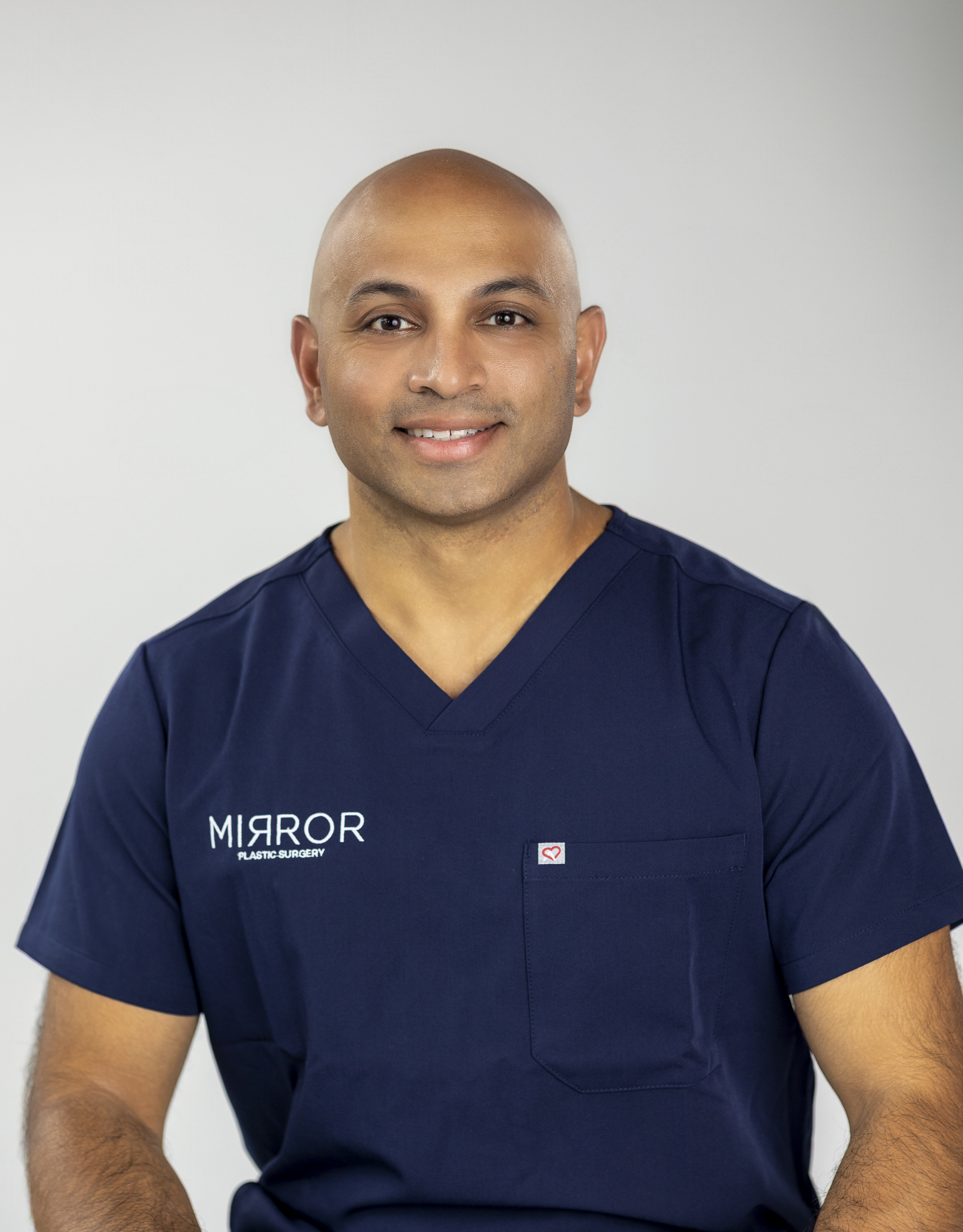
Every criterion on this checklist is met before a single incision is made.
1 Results may vary from person to person. Editorial content, before and after images, and patient testimonials do not constitute a guarantee of specific results.