
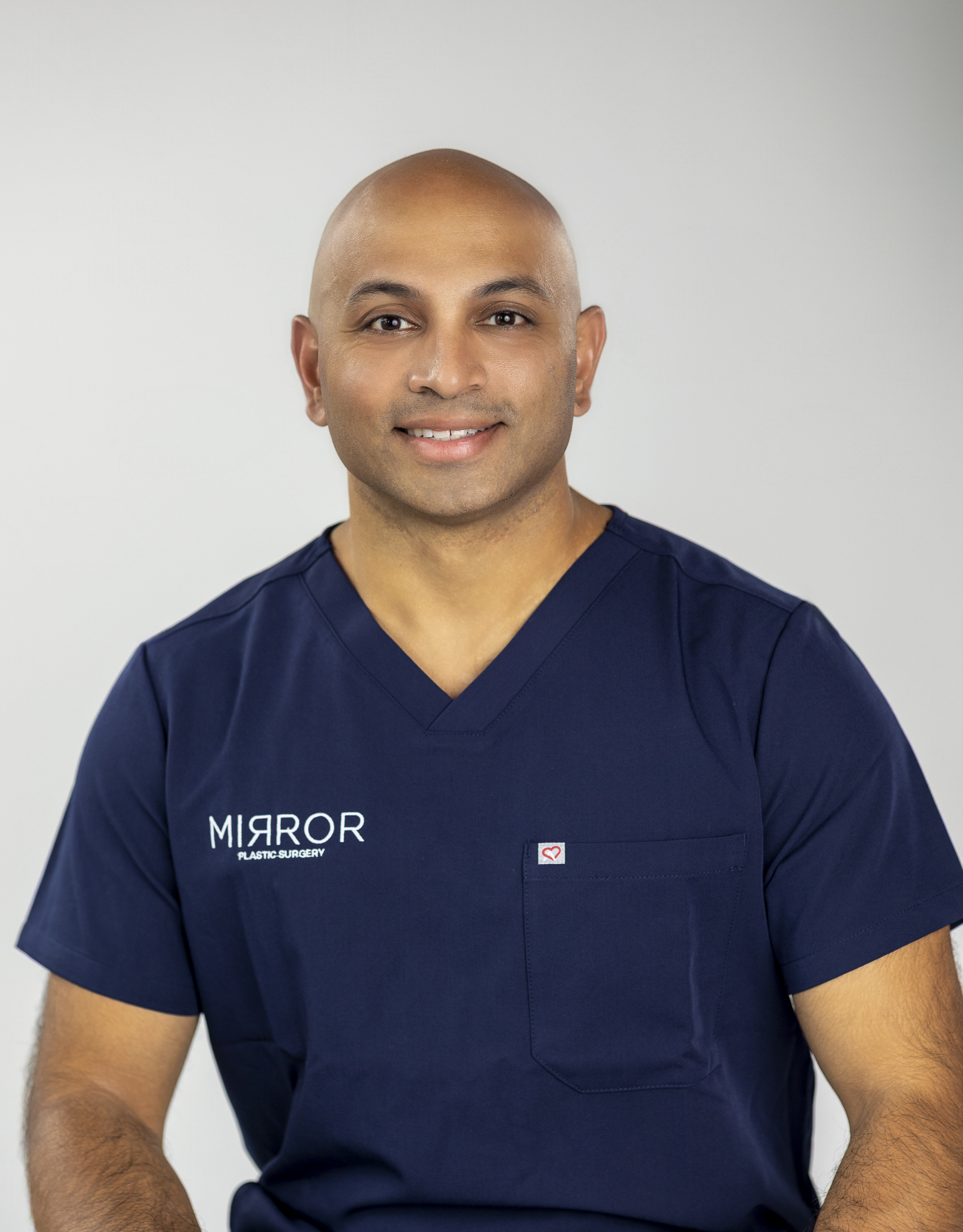
Written by: Dr. Akash Chandawarkar, Board Certified Plastic Surgeon, Mirror Plastic Surgery | Last updated: July 2, 2026
Key Takeaways
- Natural-result blepharoplasty removes only the tissue needed to restore a rested, youthful look while preserving the eye’s original shape and orbital volume.1
- Minimally invasive techniques, such as hidden-crease upper-lid incisions and transconjunctival lower-lid access, shorten downtime and lower the risk of visible scarring or lid retraction.1
- Fat repositioning over fat removal helps prevent hollowing and maintains a youthful under-eye contour by relocating orbital fat instead of discarding it.1
- Conservative skin-pinch excision and meaningful revision-blepharoplasty experience signal that a surgeon prioritizes long-term lid position and function.
- Schedule your personalized consultation at Mirror Plastic Surgery to learn which minimally invasive blepharoplasty approach fits your anatomy and goals.
How Minimally Invasive Blepharoplasty Works
The term “minimally invasive” applies differently to upper and lower blepharoplasty. Upper eyelid surgery typically uses a small incision hidden within the natural lid crease, which makes it one of the least disruptive facial procedures. Lower eyelid surgery can avoid an external incision when the transconjunctival approach is used, placing access on the inner surface of the lid. Both routes, when paired with conservative tissue management, qualify as minimally invasive compared with older techniques that removed large amounts of skin and fat.
The degree of invasiveness also depends on what the surgeon does after gaining access. Aggressive fat removal, excessive skin excision, or disruption of the orbital septum can turn a small incision into a procedure with major structural impact. Technique selection and tissue conservation matter as much as incision size, especially for long-term lid position and eye shape.
Recovery from minimally invasive blepharoplasty usually involves bruising and swelling for one to two weeks. Most patients return to social activities within ten to fourteen days. Final results continue to refine over three to six months as residual swelling resolves and tissues settle into their new position.1 Among the minimally invasive options, the transconjunctival technique offers one of the most conservative choices for lower eyelid rejuvenation.
Transconjunctival Access for Scarless Lower Eyelid Rejuvenation
Transconjunctival blepharoplasty reaches the lower eyelid fat compartments through an incision on the inner conjunctival surface of the lid, so no external scar appears. This approach suits patients whose main concern is under-eye puffiness or fat prolapse without significant extra skin. It focuses on contour correction while keeping the outer lid structures intact.
Because the incision does not cross the outer skin surface, the orbicularis oculi muscle and the supporting ligaments of the lower lid remain largely undisturbed. This preservation matters because these structures help control lid position and support. When they stay intact, the risk of lower lid retraction drops significantly.1 Lid retraction occurs when the lid margin pulls downward and rounds the eye’s appearance, which explains why surgeons who prioritize long-term lid stability consistently favor this access route for appropriate candidates.
The transconjunctival approach also lets the surgeon treat fat through repositioning rather than removal, which the next section explains in detail. When skin laxity is mild, conservative laser resurfacing or a chemical peel can pair with transconjunctival access to improve surface texture without adding an external incision.
Fat Repositioning to Preserve Youthful Volume
Traditional lower blepharoplasty often removed prolapsed orbital fat to flatten the under-eye area. Long-term follow-up of patients treated this way showed a predictable hollowing effect. The tear trough deepened, the mid-face looked skeletonized, and many patients appeared older a decade after surgery than they likely would have without it.
Fat repositioning changes this pattern. The surgeon releases the herniated fat from its compartment and anchors it over the orbital rim into the tear trough depression instead of discarding it. This shift fills the shadow that creates the look of under-eye bags while preserving the volume that supports a youthful contour.1 The technique requires precise knowledge of the arcus marginalis at the orbital rim and the sub-orbicularis oculi fat layer beneath it.
Surgeons who perform fat repositioning must understand the blood supply to the repositioned fat to keep it viable and avoid contour irregularities. The method is more technically demanding than simple excision. For that reason, it is more consistently offered by surgeons with dedicated facial fellowship training rather than general aesthetic experience alone.
Skin-Pinch Excision for Targeted Skin Tightening
When lower eyelid skin laxity appears along with fat prolapse, a skin-pinch excision can complement a transconjunctival procedure. The technique removes only the redundant skin that forms a small fold when the patient looks upward. The underlying orbicularis muscle and the lid’s structural support remain untouched.
The skin-pinch method contrasts with the subciliary incision technique, which cuts below the lash line and elevates a skin-muscle flap. Flap elevation increases the risk of lower lid retraction and scleral show because it disrupts anterior lamella support. Skin-pinch excision limits dissection to the skin layer, which preserves the muscle’s contribution to lid tone and position.
Conservative skin management runs through every natural-result blepharoplasty plan. Removing too much skin creates a tight, pulled look and can impair lid closure, which threatens corneal health. The guiding principle is simple. The surgeon removes the smallest amount of tissue that still achieves the desired improvement. Understanding these principles prepares you to judge whether a surgeon’s results reflect a conservative, natural philosophy when you review their portfolio.
5-Point Checklist for Reading Before-and-After Photos
Before-and-after photographs give the clearest window into a surgeon’s aesthetic judgment. Use these five criteria when you review them:
- Eye shape preservation: The almond shape of the eye should remain. The lateral canthus should not drop or round after surgery.
- Orbital volume: The under-eye area should look smooth and supported, not hollow or skeletonized. A visible tear trough depression in the after photo suggests over-resection of fat.
- Lid margin position: The lower lid margin should rest at or just below the inferior limbus of the iris. Any downward shift indicates retraction.
- Scleral show: White sclera visible below the iris in the after photo signals lower lid retraction and conflicts with natural-result goals.
- Symmetry and skin texture: Both sides should look balanced, and the skin surface should appear smooth without visible scarring, puckering, or color mismatch at incision sites.
Why Revision-Blepharoplasty Experience Matters
Revision blepharoplasty corrects complications from prior surgery, including lid retraction, hollowing, asymmetry, and incomplete correction. It is more technically demanding than primary surgery because scar tissue alters anatomy, tissue planes change, and the margin for error narrows.
A surgeon who regularly performs revision blepharoplasty has seen the full range of problems that primary surgery can create. This experience builds a diagnostic framework that shapes primary case planning. The surgeon knows which maneuvers cause trouble and designs the first procedure to avoid them. Documented revision experience therefore serves as a strong proxy for technical depth and anatomical understanding.
When you evaluate a surgeon, ask directly whether they perform revision blepharoplasty and what share of their eyelid cases involve secondary correction. A surgeon who declines revision cases or sends them elsewhere has a narrower operative experience than one who manages the full spectrum of outcomes.
Who Is Considered the Best Eyelid Surgeon in the USA?
No single surgeon holds a universally accepted title as the best eyelid surgeon in the United States. The label is subjective and depends on the criteria used. Surgeons frequently mentioned in this context share a similar profile. They have fellowship training in oculoplastic or aesthetic facial surgery, board certification by the American Board of Plastic Surgery or the American Society of Ophthalmic Plastic and Reconstructive Surgery (ASOPRS), a documented portfolio of natural-result outcomes, and experience managing complications, including revision cases.
Independent recognition from credible third parties adds another useful signal. Dr. Akash was named to Newsweek’s America’s Best Plastic Surgeons list for two consecutive years, including 2025, a peer-nominated honor that reflects standing within the surgical community rather than patient volume or marketing spend.
Surgeon-Selection Criteria for Natural, Safe Outcomes
Evaluate any blepharoplasty surgeon against these criteria before you schedule a procedure:
- Board certification: Confirm certification by the American Board of Plastic Surgery or an equivalent ophthalmology board with oculoplastic subspecialty training.
- Dedicated facial fellowship: Residency alone rarely provides the eyelid case volume that fellowship training offers. Look for ASOPRS-accredited training or an aesthetic surgery fellowship at a recognized institution.
- Technique specificity: The surgeon should clearly explain why they would choose transconjunctival versus subciliary access, and fat repositioning versus excision, for your anatomy.
- Revision experience: Confirm that the surgeon manages revision blepharoplasty cases within their own practice.
- Low-volume model: Practices that limit daily surgical volume devote more time to planning, precise execution, and close post-operative monitoring.
Dr. Akash meets each of these criteria. His board certification and seven-year integrated plastic surgery residency at Johns Hopkins University provide the reconstructive foundation and credentialing baseline. His aesthetic surgery fellowship at the Manhattan Eye, Ear and Throat Hospital (MEETH) adds concentrated facial rejuvenation training that distinguishes fellowship-trained surgeons from those with residency experience alone. Mirror Plastic Surgery’s model of one to two surgeries per day ensures that each blepharoplasty patient receives the full attention of the surgical team.
Why Some Patients Look Older After Blepharoplasty
Post-blepharoplasty aging most often stems from over-resection of orbital fat. When fat is removed instead of repositioned, the under-eye area hollows over time as the remaining soft tissue continues to descend with age. The resulting shadow and skeletonized look reads as older, not younger, to most observers.
Secondary causes include lower lid retraction, which exposes sclera and changes the perceived eye shape. Excessive skin removal can create a tight, operated appearance. Disruption of the lateral canthal angle can round the eye and erase the natural upward tilt that signals youth.
Patients who experience these changes may qualify for revision surgery. Treatment can involve fat grafting to restore volume, spacer grafts to correct lid retraction, or canthopexy to re-establish lid position. Prevention through conservative primary technique remains preferable to correction, which is why careful technique selection and surgeon experience matter before the first operation.
Frequently Asked Questions About Eyelid Surgery
Am I a candidate for minimally invasive blepharoplasty?
Candidacy depends on the anatomy of your upper and lower eyelids, the degree of skin laxity, the amount and pattern of orbital fat, and the position of your lower lid relative to the globe. Patients with significant upper-lid skin excess, lower-lid fat prolapse without major skin laxity, and stable lower-lid tone often qualify for minimally invasive approaches. A thorough in-person evaluation is necessary to confirm candidacy because photographs alone cannot capture lid tone, orbital volume, or the relationship between the lid margin and the eye.
How long does recovery from blepharoplasty take?
The visible recovery timeline described earlier, about ten to fourteen days for most patients, applies to social and professional activities. Strenuous physical activity is usually restricted for three to four weeks to protect healing tissues. Final results continue to develop over three to six months as swelling fades and scars mature.1 Upper eyelid surgery generally has a slightly faster visible recovery than lower eyelid surgery because of differences in tissue thickness and lymphatic drainage.
How can I confirm that a surgeon uses fat repositioning instead of excision?
Ask the surgeon during your consultation to describe their usual approach to lower eyelid fat. A surgeon who routinely performs fat repositioning will comfortably explain the arcus marginalis, the tear trough, and the repositioning steps. Review their before-and-after photographs with a focus on under-eye volume. Patients treated with repositioning should show a smooth, supported contour without hollowing. If after photos consistently show a flat or sunken under-eye area, the surgeon likely favors excision.
What is the difference between an oculoplastic surgeon and a plastic surgeon for blepharoplasty?
Oculoplastic surgeons complete ophthalmology residency followed by ASOPRS-accredited fellowship training focused on the eyelids, orbit, and lacrimal system. Plastic surgeons complete a plastic surgery residency and may pursue additional aesthetic fellowship training that includes eyelid surgery. Both paths can produce highly skilled blepharoplasty surgeons. The key question is not the training path but the depth of eyelid-specific experience, the number of blepharoplasty cases performed, and whether the surgeon manages the full range of outcomes, including revisions.
Can blepharoplasty be combined with other facial procedures?
Blepharoplasty often pairs with brow lift, facelift, or non-surgical treatments such as laser resurfacing. Combining procedures can work well when the anatomical indications align and the total operative time and physiological demand stay within safe limits. Combining too many procedures at once, however, increases complication risk. A thorough pre-operative assessment should determine which combinations are anatomically indicated and physiologically safe for you, rather than defaulting to a bundled approach for convenience or cost.
Conclusion: Choosing a Surgeon for Natural Eyelid Results
Natural-result blepharoplasty depends on precise technique and sound judgment, not geography or marketing claims. Transconjunctival access, fat repositioning, and conservative skin-pinch excision form the technical base for outcomes that preserve eye shape and orbital volume over time. Evaluating surgeons against criteria such as dedicated facial fellowship training, revision experience, and a low-volume practice model gives patients a clear signal about who can deliver those outcomes safely.
Dr. Akash’s MEETH aesthetic fellowship, Johns Hopkins residency, and peer-nominated national recognition reflect the standard those criteria describe. Mirror Plastic Surgery’s concierge model in St. Petersburg, Florida, applies this low-volume approach to ensure the individualized planning and close monitoring that complex eyelid surgery requires.
Start your personalized blepharoplasty evaluation at Mirror Plastic Surgery.
1 Results may vary from person to person. Editorial content, before and after images, and patient testimonials do not constitute a guarantee of specific results.