
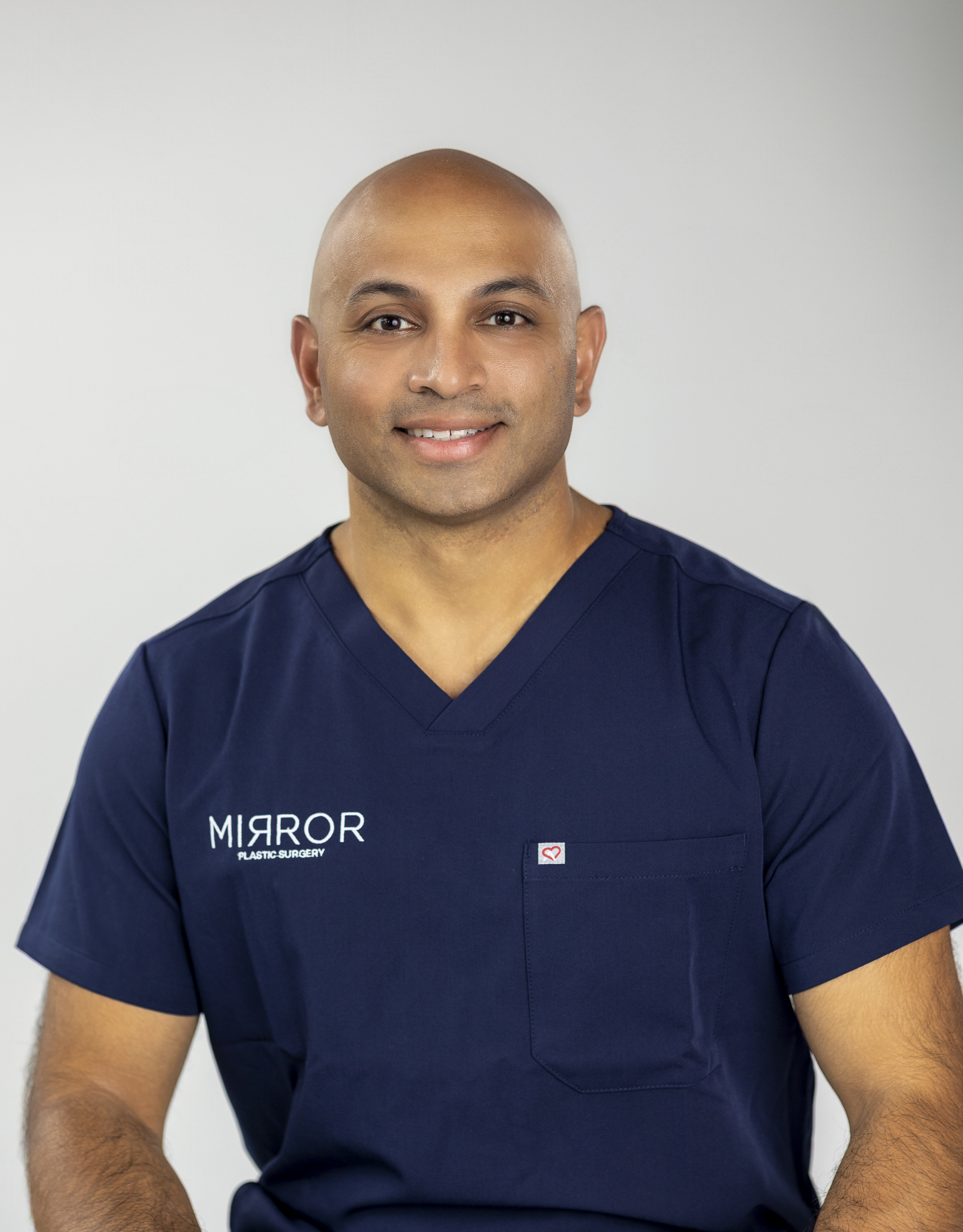
Written by: Dr. Akash Chandawarkar, Board Certified Plastic Surgeon, Mirror Plastic Surgery | Last updated: July 10, 2026
Key Takeaways
- FUT harvests a strip of donor scalp for higher graft counts in one session. It leaves a linear scar that hides under hair longer than 1–2 cm. FUE extracts follicles individually and leaves tiny dot scars that stay nearly invisible even with short styles.
- Both FUT and FUE can deliver permanent, natural-looking results when the surgeon designs the hairline precisely and places grafts at the right angle and density.1 The extraction method itself does not determine final aesthetics.
- FUE recovery usually allows remote work within 2–5 days and in-office return by day 7–10. FUT recovery often requires 5–7 days for home work and 10–14 days after suture removal for in-office return.
- FUT works especially well for patients needing 2,000–4,000+ grafts in one session or those with advanced Norwood Stage 5+ loss. FUE suits patients who prefer very short hairstyles or want minimal visible scarring.
- Schedule a personalized consultation at Mirror Plastic Surgery to decide whether FUT, FUE, or a hybrid approach best fits your anatomy, hairstyle goals, and recovery timeline.
FUT vs FUE: How Each Technique Affects Natural Results
The implantation process is identical between FUT and FUE. Peer-reviewed research including the Josephitis and Shapiro (2018) study in Hair Transplant Forum International found no meaningful difference in final hair growth, feel, or fullness when either technique is performed correctly. The factor that separates a natural-looking result from a detectable one is not the extraction method. It is the surgeon’s judgment in hairline design, graft angle, and density distribution.
The anatomical key to naturalness is preservation of the complete follicular unit. This includes sebaceous oil glands, nerves, and shared blood supply during dissection. This preservation maintains natural growth angle, texture, and density patterns after transplantation. Single-hair follicular units are placed along the frontal hairline for fine directional control. Two- and three-hair units are placed in the mid-scalp and crown to maximize coverage and density.
Graft survival rates between the two techniques are generally comparable when performed correctly.1 These rates depend heavily on careful graft handling. A 2021 study found that intact follicular unit grafts achieved higher survival rates than grafts with slight bulb injury or that were fractured or severed, which shows that surgeon skill, not the technique label, is the dominant variable. This is why the surgeon’s anatomical training and technical precision matter more than the extraction method itself.
Dr. Akash, named in America’s Best Plastic Surgeons 2025 by Newsweek for 2 years in a row, brings Johns Hopkins residency training, Harvard Medical School honors, and an aesthetic surgery fellowship at the Manhattan Eye, Ear and Throat Hospital (MEETH) to every hair restoration case. That depth of anatomical training directly guides graft handling, hairline architecture, and long-term donor planning.
Schedule your personalized technique assessment with Dr. Akash to determine which approach best matches your anatomy and aesthetic goals.
FUT vs FUE Scarring and Hairstyle Options
While both techniques deliver comparable aesthetic results, they differ significantly in their scarring patterns. FUT creates a single linear donor scar. The FUT donor scar is typically 1–3 mm wide and can be concealed under hair on the back of the head. Trichophytic closure allows hair to grow through the scar line and further reduces visibility. For patients who wear their hair at medium or longer lengths, the scar is functionally invisible in daily life.
FUE still creates scars, although they are very small. Each punch extraction leaves a small wound that heals with fibrosis and can occasionally appear as visible hypopigmented macules, or “pinpoint white dots,” particularly in patients with darker skin phototypes or short hairstyles. Larger punches greater than 1 mm and high-density extractions increase the risk of noticeable hypopigmented donor-site scarring by causing greater dermal disruption and reduced melanocyte repopulation.
The practical distinction comes down to scar geometry rather than scar presence. FUT concentrates scarring into one manageable line. FUE distributes it across hundreds of micro-sites. An experienced surgeon minimizes FUT scar width and FUE dot-scar visibility through proper technique and wound closure. Hairstyle preference, especially whether you plan to wear hair shorter than 1–2 cm, becomes the most decisive factor in scar planning.
FUE Recovery Timeline for Returning to Work
FUE recovery follows a predictable arc that most Tampa-area professionals can plan around with confidence.
Day-by-Day FUE Recovery Timeline
- Day 0–1: The scalp shows small red dots at extraction and recipient sites with mild swelling, redness, and tightness. Tiny scabs form around each graft within the first 24 hours. Sleeping with the head elevated is recommended.
- Days 2–3: Frontal and periorbital edema peaks at days 2–3 and resolves spontaneously by days 5–7. Remote or home-based work is feasible for most patients.
- Days 3–5: Most patients experience only mild discomfort. Many return to remote or home-based work within 2–5 days.
- Days 7–10: By day 7, most redness and swelling have faded, scabs loosen and fall off naturally with gentle washing, the donor area is largely healed, and grafts are secure. In-office return to work is generally appropriate at this point.
- Day 10: Grafts are firmly anchored by day 10, allowing normal shampooing, gentle brushing, and standard hair care to resume.
- Day 14: Most patients look presentable enough for normal social and professional activities. Transplanted hairs may still be visible as short stubble before entering the shock-loss phase.
- Weeks 3–4: Recipient-site effluvium (shock loss) occurs between 2–8 weeks postoperatively. This shedding is expected and temporary.
- Month 3 onward: Spontaneous regrowth typically begins around 3 months, with final hair growth generally assessed at approximately 12 months.
FUT Recovery Timeline and Activity Restrictions
FUT recovery follows a parallel but slightly longer arc driven by the linear incision and suture management.
- Days 0–2: Light bandaging covers the donor area. Minor soreness and swelling peak around day 2–3. Head elevation is required during sleep.
- Days 3–5: FUT produces moderate discomfort for 3–5 days due to the linear incision and sutures. Desk work from home is possible for many patients.
- Days 7–10: Scabs form and redness lingers. Many patients limit exercise and heavy exertion to avoid worsening swelling.
- Days 10–14: FUT involves suture removal at approximately 10–14 days, which provides immediate relief of residual tension discomfort. Most patients return to in-office work around this milestone.
- Weeks 2–3: FUT recovery requires 2–3 weeks of restricted physical activity. Strenuous exercise and heavy lifting remain off-limits.
- Month 1: Transplanted FUT grafts shed within the first month, with visible new growth beginning around month four and progressive improvement continuing through months 6–12. Final thickness and length are reached by 18 months.
When FUT Provides Higher Density While Staying Natural
Session size is where FUT holds a measurable structural advantage. FUT procedures typically harvest 2,000–4,000 follicular unit grafts in a single 4–8 hour session, enabling maximum coverage for patients with moderate to advanced pattern baldness. FUE sessions are constrained by the rate of individual punch extraction and cumulative donor-site trauma.
For patients at Norwood Stage 5 or above who need large single-session graft counts, FUT’s strip harvest preserves the highest-density central safe donor zone in one procedure. For patients with advanced hair loss requiring 3,000–6,000 grafts, a hybrid approach, with FUT first to maximize yield from the safe donor zone followed by FUE in later sessions for additional grafts and scar camouflage, is often optimal.
Naturalness remains intact when FUT is chosen within a sound surgical plan. Because the implantation technique is identical in both procedures, hairline aesthetics depend entirely on the surgeon’s design judgment, not on how the grafts were harvested.
When FUT Is Preferable to FUE
Several anatomical and lifestyle factors favor FUT as the primary technique.
- Norwood Stage 5 or above requiring 2,000 or more grafts in a single session, where maximizing yield from a limited donor area is critical.
- Patients comfortable wearing hair at 1–2 cm or longer, where the linear scar remains concealed.
- Afro-textured or curly hair, where FUE extraction carries elevated transection risk because the strip is removed and dissected under microscopes, allowing technicians to follow each follicle’s natural curve.
- Patients with low FOX test scores of 4–5, indicating higher transection risk with FUE punch extraction.
- Patients planning multiple future sessions, since FUE can follow FUT in subsequent sessions, but FUT cannot follow FUE because extensive FUE harvesting disrupts donor-area laxity and tissue integrity needed for strip excision.
Decision Framework for FUT, FUE, and Hybrid Approaches
| Factor | FUT | FUE | Hybrid FUT + FUE |
|---|---|---|---|
| Naturalness factors | Identical implantation technique. Naturalness is determined by surgeon design judgment, not extraction method. | Identical implantation technique. Naturalness is determined by surgeon design judgment, not extraction method. | Combines advantages of both. Scar camouflage is possible in later FUE sessions. |
| Scar visibility by hairstyle | Single linear scar 0.5–1.0 cm wide. Concealed at hair lengths of 1–2 cm or longer. | Hundreds of dot scars. Nearly invisible even with buzz cuts, though hypopigmented macules are possible in darker skin types. | Linear scar present. Later FUE sessions can camouflage it with grafts placed along the scar line. |
| Recovery days to desk work | Approximately 5–7 days for home-based work. In-office return at 10–14 days after suture removal. | Remote work within 2–5 days. In-office return generally at 7–10 days. | Follows the FUT timeline for the initial session. |
| Session size limits | 2,000–4,000 follicular unit grafts per session. | 2,000–5,000+ grafts per session depending on donor density. Constrained by punch extraction rate and cumulative donor trauma. | 3,000–6,000+ grafts achievable across staged sessions for Norwood Stage 5+ patients. |
Key Questions to Ask During Your Consultation
A thorough pre-operative evaluation is the single most important step in achieving a predictable outcome. Mirror Plastic Surgery dedicates up to an hour per consultation, which contrasts with high-volume practices that may see five to ten surgical patients per day. The following checklist reflects the questions that separate an anatomy-first evaluation from a generic sales conversation.
- What is my FOX test score, and what does it indicate about my FUE candidacy?
- What is my current Norwood stage, and is my hair loss still progressing?
- How many total grafts do I realistically need across my lifetime, and which technique preserves the most future donor availability?
- What punch diameter will be used if FUE is selected, and how does that affect my scar risk given my skin phototype?
- Will trichophytic closure be used if FUT is selected to allow hair to grow through the scar line?
- How will single-hair units be distributed along my hairline versus multi-hair units in the mid-scalp and crown?
- What is the surgeon’s personal transection rate for FUE, and how is graft ischemic time managed during the procedure?
- If I need a second session in the future, which technique sequence preserves my options?
Bring this checklist to your consultation at Mirror Plastic Surgery’s St. Petersburg location to ensure you cover every critical decision point.
Conclusion: Matching Technique to Your Anatomy and Goals
FUT and FUE function as complementary tools whose value depends entirely on the anatomical context in which they are applied. The extraction method does not determine how natural the result looks. Surgical judgment in hairline design, angle, and density distribution does. Scar geometry, session size, recovery duration, and long-term donor management are the variables that differentiate the two techniques in practice.
For Tampa-area patients at Norwood Stage 3–6, the most important decision is not FUT versus FUE. The key choice is selecting a surgeon whose anatomical training, case volume discipline, and commitment to individualized planning guide that decision correctly. Dr. Akash performs hair restoration within the same safety-first, anatomy-driven framework that governs every procedure at Mirror Plastic Surgery.
Start with a comprehensive evaluation at Mirror Plastic Surgery in St. Petersburg, where Dr. Akash will assess your donor anatomy, Norwood stage, and recovery timeline to recommend the approach that best fits your hairstyle goals.
Frequently Asked Questions
Can I wear a buzz cut after a hair transplant, and does the technique affect that?
Hairstyle preference is one of the most important factors in technique selection. FUE leaves only small dot scars less than 1 mm in diameter distributed across the donor area, which makes it the preferred option for patients who intend to wear their hair very short or shaved. FUT leaves a single linear scar at the back of the scalp that becomes visible when hair is cut shorter than approximately 1–2 cm. If wearing a buzz cut or grade-2 shave is part of your long-term hairstyle plan, FUE is generally the more appropriate technique. If you prefer medium to longer hair lengths, FUT’s linear scar is effectively concealed and its higher single-session graft yield may be advantageous. Dr. Akash evaluates each patient’s hairstyle goals alongside donor anatomy before recommending a technique.
How long does it take to see final results after a hair transplant?
Both FUT and FUE follow a similar growth timeline. Transplanted hairs shed within the first month in a process called shock loss, which is expected and temporary.1 Early new growth typically begins around months 3–4.1 More complete density becomes visible between months 6–12, and the crown area can take 18–20 months to reach its final appearance.1 Graft survival rates under elite surgical conditions range from 90–95% for FUE and 85–95% for FUT, though these figures depend heavily on how grafts are handled during the procedure, including ischemic time outside the body and the precision of follicular unit dissection.1 Patients at Mirror Plastic Surgery receive detailed post-operative guidance to protect grafts during the critical first two weeks, which directly influences long-term outcomes.
What is the FOX test, and why does it matter before choosing FUE?
The FOX test is a pre-operative assessment that evaluates how safely individual follicular units can be extracted from a patient’s donor area using the FUE punch technique. Surgeons score patients on a scale based on the risk of follicular transection, which is accidental cutting of the hair follicle during extraction and directly reduces graft survival. A FOX score of 1–2 indicates ideal FUE candidacy, meaning the follicles can be extracted with minimal transection risk. A score of 4–5 suggests that FUT is the safer technique because the strip method allows technicians to dissect grafts under stereo-microscopes, following each follicle’s natural angle and curve. Patients with curly or Afro-textured hair often score higher on the FOX test because subsurface follicle curvature increases transection risk with blind punch extraction. Dr. Akash performs this evaluation as part of the comprehensive pre-operative assessment at Mirror Plastic Surgery.
Is it possible to have both FUT and FUE over a lifetime of hair restoration?
Many patients benefit from both FUT and FUE over time. For patients with advanced hair loss at Norwood Stage 5 or above, a staged hybrid approach is often the most effective long-term strategy. The sequencing rule is asymmetric. FUE can follow FUT in subsequent sessions, but FUT cannot follow FUE. Extensive FUE harvesting disrupts the scalp laxity and tissue integrity required for strip excision, which permanently eliminates FUT as a future option. Starting with FUT maximizes single-session graft yield from the central safe donor zone. Later FUE sessions can harvest additional grafts from peripheral areas while also placing grafts along the linear scar to camouflage it. This sequencing approach preserves the widest range of future options and is one reason long-term donor management planning, not just the immediate procedure, is central to every consultation at Mirror Plastic Surgery.
What makes Mirror Plastic Surgery’s approach to hair restoration different from high-volume clinics?
Mirror Plastic Surgery limits itself to one to two surgeries per day so that Dr. Akash and the clinical team maintain focused attention on each patient before, during, and after the procedure. This schedule contrasts sharply with high-volume practices that may perform five to ten surgeries daily. Hair restoration outcomes are highly sensitive to graft handling time. Grafts left outside the body for extended periods show significantly reduced survival rates, which makes a low-volume, high-attention surgical environment directly relevant to results. Dr. Akash’s training at Johns Hopkins, Harvard Medical School, and MEETH provides the anatomical foundation for individualized hairline design, donor management planning, and technique selection. Consultations at Mirror Plastic Surgery run up to an hour and cover Norwood staging, FOX test evaluation, hairstyle goals, and lifetime donor planning rather than defaulting to a one-size-fits-all technique recommendation.
1 Results may vary from person to person. Editorial content, before and after images, and patient testimonials do not constitute a guarantee of specific results.