
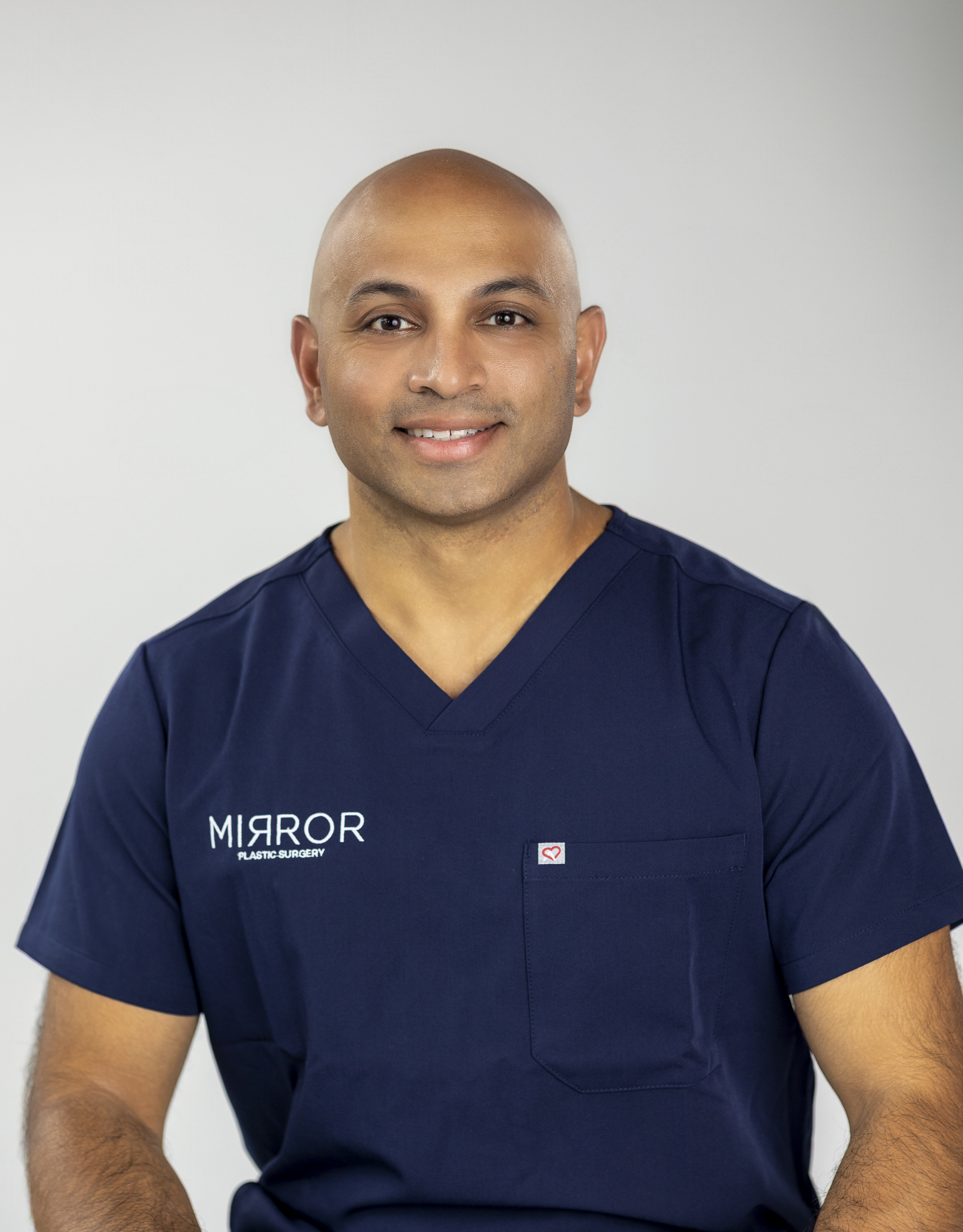
Written by: Dr. Akash Chandawarkar, Board Certified Plastic Surgeon, Mirror Plastic Surgery | Last updated: July 4, 2026
Key Takeaways
- FDA-approved breast implants undergo rigorous clinical trials, manufacturing oversight, and post-market surveillance that non-approved devices do not provide.
- Surgeon credentials such as ABPS board certification, FDA testimony experience, and advisory roles with approved manufacturers directly influence implant safety and outcomes.
- Patients should verify that their surgeon uses only FDA-approved devices from manufacturers with current U.S. approval and personally reviews the FDA Patient Decision Checklist.
- Key red flags include vague implant sourcing, high surgical volume, reluctance to review FDA checklists, and lack of participation in the National Breast Implant Registry.
- Schedule a consultation with Dr. Akash at Mirror Plastic Surgery to review FDA-approved implant options tailored to your anatomy and goals.
Why FDA-Approved Implants Matter for Long-Term Safety
FDA approval for breast implants represents a structured safety process, not a simple label. Manufacturers must submit clinical trial data, manufacturing quality evidence, and post-market surveillance commitments before a device reaches U.S. patients. Once approved, manufacturers must include a boxed warning and a Patient Decision Checklist in all labeling materials, and they must conduct ongoing post-approval studies. That regulatory infrastructure creates a documented safety record that non-approved devices cannot match.
The consequences of bypassing this system are measurable. The FDA has received reports of breast implant-associated anaplastic large cell lymphoma (BIA-ALCL), with most cases linked to a specific textured implant line that was recalled in 2019. That recall, and the data trail that supported it, existed because FDA-approved devices operate within a surveillance framework. Patients who receive implants outside that framework lose that level of protection.
Expert Context: How Dr. Akash’s Training Supports Implant Safety
Implant safety depends on both the device and the surgeon guiding each decision. The surgeon who interprets clinical data, selects the appropriate implant for a patient’s anatomy, and performs the procedure determines whether FDA approval translates into a safe outcome. Dr. Akash brings a credential set that directly supports this responsibility. He completed his medical degree through the Harvard-MIT Division of Health Sciences and Technology, his seven-year plastic and reconstructive surgery residency at Johns Hopkins University, and an aesthetic surgery fellowship at the Manhattan Eye, Ear and Throat Hospital (MEETH).
He also completed the Stanford University Biodesign Innovation Fellowship, which trains physician-innovators to evaluate emerging medical technologies. Critically, Dr. Akash was selected to testify before the U.S. Food and Drug Administration on the topic of breast implant safety. That distinction places him among a small group of surgeons who have formally shaped the regulatory conversation on this subject. This regulatory expertise extends to his advisory board role with Motiva (Establishment Labs), one of the four FDA-approved breast implant manufacturers in the United States, where he evaluates clinical data before it reaches patients.
His recognition in America’s Best Plastic Surgeons 2025 by Newsweek for 2 years in a row reflects the clinical outcomes that result from this evidence-based approach.1 These credentials are not decorative. They reflect direct engagement with the evidence base that patients rely on when choosing an implant and a surgeon.
Schedule your consultation to discuss which FDA-approved implant matches your anatomy and goals.
7-Step Verification Checklist for FDA-Focused Breast Augmentation Surgeons
- Confirm ABPS board certification. The American Board of Plastic Surgery (ABPS) is the only board recognized by the American Board of Medical Specialties for plastic surgery. Verify certification directly through the ABPS public directory. Titles such as “board-certified cosmetic surgeon” do not indicate ABPS certification.
- Verify accredited surgical facilities and board-certified anesthesiologists. Procedures should be performed in an accredited surgical facility, not an unaccredited office suite. A board-certified physician anesthesiologist should manage anesthesia, not a nurse anesthetist working without physician oversight.
- Request written confirmation of FDA-approved implant manufacturers. Ask your surgeon to confirm in writing that they use implants from one of the four FDA-approved manufacturers described in the section below. Request documentation of which manufacturer’s devices they use and why they selected that manufacturer for your case.
- Confirm the surgeon personally reviews the FDA Patient Decision Checklist with you. FDA regulations require that the implanting physician, not a staff member, review the Patient Decision Checklist with every patient before surgery, and both the patient and surgeon must sign it. A surgeon who delegates this step or skips it is not in compliance.
- Ask about National Breast Implant Registry (NBIR) participation. The National Breast Implant Registry tracks long-term implant outcomes and supports post-market surveillance. Surgeons who enroll their patients contribute to the safety data that protects future patients and demonstrate a commitment to evidence-based follow-up.
- Confirm the practice limits volume to one or two surgeries per day. High-volume practices performing five to ten surgeries daily distribute surgical attention across many patients simultaneously. A practice capped at one to two cases per day concentrates the entire team’s focus on each individual patient before, during, and after the procedure.
- Expect a 45–60 minute unhurried consultation. A thorough consultation covers anatomy, implant options, facility details, recovery, and long-term monitoring. A consultation that runs under 20 minutes cannot adequately address all of these areas. Time pressure during consultation often reflects time pressure during surgery.
2026 FDA-Approved Breast Implant Options and Updates
Now that you know how to verify your surgeon’s approach, you can review the current FDA-approved implant options. The four FDA-approved breast implant manufacturers in the U.S. as of 2026 are Mentor, Allergan, Sientra (a Tiger Aesthetics brand), and Motiva, all offering highly cohesive breast implant shapes and sizes. Mentor (Johnson & Johnson) and Allergan offer both silicone and saline options. Saline-filled implants have become less popular since silicone implants returned to the market.
Motiva received FDA premarket approval in September 2024, the first new breast implant approval in the U.S. since 2013. Manufactured by Establishment Labs, Motiva implants feature a SmoothSilk nanosurface engineered to reduce inflammatory response and capsular contracture. In the FDA trial of 451 primary augmentation patients, three-year follow-up data showed positive safety outcomes.1 Motiva’s current FDA approval covers breast augmentation only, not reconstruction, and a 10-year post-approval study of approximately 2,400 women is ongoing.
In December 2024, Mentor’s MemoryGel Enhance silicone implant received FDA approval for its largest size yet, tailored for breast reconstruction. Six new larger implant volumes 930 cc, 1030 cc, 1135 cc, 1240 cc, 1340 cc, and 1445 cc were recently FDA-approved for breast reconstruction. Smooth implants are valued for their safer profile, long-term safety data, and compatibility with various surgical techniques.
Red Flags That Signal Higher-Risk Breast Augmentation Practices
Specific practice patterns tend to cluster in higher-risk environments and deserve close attention. A surgeon who cannot name the specific FDA-approved manufacturer supplying their implants, or who stays vague about implant sourcing, cannot guarantee that FDA-approved devices are being used. Pressure to combine multiple procedures in a single session represents another warning sign. Combining too many procedures simultaneously increases complication rates, and a safety-first practice advises against this approach.
Reluctance to review the FDA Patient Decision Checklist, or delegation of that review to non-physician staff, indicates non-compliance with FDA labeling requirements. High-volume scheduling, such as five to ten surgeries per day, leaves little time for individualized pre-operative assessment, intraoperative precision, and post-operative monitoring. A surgeon who cannot confirm participation in the National Breast Implant Registry is also not contributing to the long-term safety data that protects patients, which signals a limited commitment to broader patient safety.
Printable Reader Checklist: 7 Steps to Verify Your Surgeon
- ☐ ABPS board certification confirmed via the official ABPS directory
- ☐ Procedures performed in an accredited facility with a board-certified physician anesthesiologist
- ☐ Written confirmation that only FDA-approved implants from the four manufacturers described above are used
- ☐ Surgeon personally reviews and co-signs the FDA Patient Decision Checklist with you
- ☐ Practice participates in the National Breast Implant Registry
- ☐ Practice limits volume to one to two surgeries per day
- ☐ Consultation is 45–60 minutes with no time pressure
Bring this checklist to your consultation, Mirror Plastic Surgery meets every criterion above.
Common Misunderstandings About Board Certification and FDA Approval
The phrase “board-certified cosmetic surgeon” appears frequently in advertising but does not indicate certification by the American Board of Plastic Surgery. Cosmetic surgery boards exist outside the American Board of Medical Specialties framework and have different training requirements. ABPS certification requires completion of an accredited plastic surgery residency, written and oral examinations, and ongoing maintenance of certification. Patients should verify ABPS status directly rather than relying on marketing language.
A similar misconception applies to implants. Not every breast implant sold or used in the United States carries FDA approval. Implants obtained through gray-market channels, used outside their approved indications, or sourced from manufacturers without U.S. approval do not carry the same regulatory protections. Confirming that a surgeon uses devices from one of the four FDA-approved manufacturers, and can document it, remains a non-negotiable verification step.
How Mirror Plastic Surgery Connects Implant Choice to Safety and Results
Implant selection at Mirror Plastic Surgery begins with safety and extends to function and aesthetics. The implant must match a patient’s existing anatomy, tissue characteristics, chest wall dimensions, and aesthetic goals. At Mirror Plastic Surgery, implant selection fits within a broader philosophy: safety first, function second, aesthetics third. That sequence ensures anatomical precision and long-term monitoring are built into the process, not added later.
Dr. Akash performs one to two surgeries per day, conducts consultations of up to an hour, and operates in accredited surgical facilities with board-certified physician anesthesiologists. His advisory board role with Motiva and his FDA testimony experience mean he evaluates implant data with the same rigor applied to peer-reviewed literature. For Tampa Bay patients who prioritize evidence over convenience, that combination of credentials, volume discipline, and regulatory engagement defines the standard of care.
Frequently Asked Questions
How do I verify that a surgeon is truly board-certified by the American Board of Plastic Surgery?
Visit the ABPS public directory at abplasticsurgery.org and search the surgeon’s name directly. ABPS certification requires completion of an accredited plastic and reconstructive surgery residency, passage of written and oral board examinations, and ongoing recertification. Do not rely on a surgeon’s website or marketing materials alone. Confirm the certification through the ABPS database itself.
What is the FDA Patient Decision Checklist and what should I expect during the review?
The FDA Patient Decision Checklist is a mandatory document that implant manufacturers must include in all breast implant labeling. It covers contraindications, candidate considerations, surgical risks, BIA-ALCL risk, breast implant illness, and alternatives to implants. The implanting surgeon, not a coordinator or nurse, must review the checklist with you personally before surgery. Both you and the surgeon sign the document as part of informed consent. If a practice skips this step or has staff handle it, that represents a compliance concern worth raising directly.
What is the National Breast Implant Registry and why does it matter for my safety?
The National Breast Implant Registry (NBIR) is a surveillance database that tracks breast implant outcomes over time. When your surgeon enrolls your implant data, it contributes to the long-term safety research that identifies complications, informs future FDA decisions, and helps researchers understand revision rates across different implant types. Registry participation reflects a surgeon’s commitment to evidence-based follow-up beyond the operating room.
What are the most important questions to ask about implant revision or replacement?
Ask your surgeon about their revision rate, what circumstances typically require revision, and how they handle complications such as capsular contracture or implant malposition. Confirm that the practice offers breast revision surgery and has experience correcting issues from prior augmentations. Understanding the long-term maintenance expectations for any implant, including the FDA’s position that implants are not lifetime devices, should be part of every pre-operative conversation.
Does a lower-volume practice actually produce better outcomes for breast augmentation?
Volume discipline affects the quality of attention available to each patient at every stage of care. A practice performing one to two surgeries per day can dedicate the full team’s focus to pre-operative planning, intraoperative precision, and post-operative monitoring for each individual. Practices performing five to ten surgeries daily distribute that attention across many patients simultaneously. While outcomes depend on multiple factors, the time and focus available to each patient remains a meaningful variable in surgical safety and result quality.1
Conclusion
Finding a breast augmentation surgeon focused on FDA-approved implants requires a structured verification process. Patients should confirm ABPS board certification, accredited facility use, documented implant sourcing from one of the four FDA-approved manufacturers, personal review of the FDA Patient Decision Checklist, National Breast Implant Registry participation, volume discipline, and consultation depth. Each step in that process offers a data point about how a practice operates and how it will treat you.
Mirror Plastic Surgery and Dr. Akash meet every criterion on that checklist. Dr. Akash’s Harvard-MIT education, Johns Hopkins residency, MEETH fellowship, Stanford Biodesign training, FDA testimony, and Newsweek recognition reflect a career built on evidence, precision, and patient safety. His concierge model, with one to two surgeries per day, hour-long consultations, accredited facilities, and board-certified anesthesiologists, translates those credentials into the experience you receive.
1 Results may vary from person to person. Editorial content, before and after images, and patient testimonials do not constitute a guarantee of specific results.