

Written by: Dr. Akash Chandawarkar, Board Certified Plastic Surgeon, Mirror Plastic Surgery | Last updated: July 22, 2026
Key Takeaways for Facial Fat Transfer
- Facial fat transfer uses your own harvested and purified fat to restore lost facial volume in areas such as the cheeks, temples, and tear troughs.
- The procedure follows three key steps: gentle harvesting, careful purification, and layered micro-injection. Each step affects how much fat survives long-term and how natural the result looks.
- Most patients retain 50–70% of transferred volume after the initial three-to-six-month resorption period, with results that can last five years or longer once the graft establishes its own blood supply.1
- Compared with hyaluronic-acid or biostimulatory fillers, autologous fat integrates naturally, can improve skin quality through stem-cell activity, and reduces the need for frequent repeat treatments.
- Schedule your personalized assessment with Dr. Akash at Mirror Plastic Surgery to determine whether facial fat grafting aligns with your aesthetic goals.
Step-by-Step Overview of Facial Fat Grafting
Facial fat grafting follows three main steps, and each step influences fat survival and how natural the final result appears.
- Harvesting. The surgeon removes fat from a donor site, most commonly the abdomen, flanks, or inner thighs, using gentle manual syringe aspiration or low-pressure liposuction through small incisions. Blunt cannulas and low-trauma technique help preserve adipocyte viability. The abdomen and inner thigh are preferred donor sites because they contain a higher concentration of adipose-derived stem cells that may support graft survival.
- Purification. The harvested aspirate is processed to separate viable fat cells from oil, blood, and tumescent fluid. Low-speed centrifugation is the most widely used method. Closed sterile filtration systems such as the PureGraft platform remove more than 97% of contaminants while concentrating viable adipocytes. The resulting microfat or nanofat fraction is then loaded into small syringes for precise delivery.
- Injection. The surgeon places fat in small parcels, either tiny droplets or linear threads, using fine blunt cannulas through micro-entry points. A layered technique deposits fat across multiple tissue planes, from deep structural layers to more superficial ones. This approach maximizes cell-to-tissue contact and the surface area available for neovascularization. Surgeons typically overcorrect by approximately 20% to account for expected early resorption. High-risk anatomical zones, including the glabella, periorbital region, nasal root, and nasolabial folds, require particular precision because of their proximity to terminal branches of the ophthalmic artery and anastomoses between the external and internal carotid systems.
Facial Fat Transfer Recovery Timeline
Once the procedure is complete, recovery follows a predictable pattern, though individual variation is common. The following milestones reflect the typical course.
- Days 1–3: Swelling and bruising peak at the injection sites and the donor area. Cool compresses applied four to six times daily for the first 24 hours help manage edema. Sleeping with the head elevated further reduces facial swelling.
- Days 4–7: Bruising and swelling begin to subside. Most patients look like themselves again by the end of week one, though fullness remains above the final result because of residual edema.
- Weeks 2–4: Approximately 80% of swelling resolves by weeks two to four, and most patients feel comfortable resuming social activities. Light desk work is typically possible around days seven to ten.
- Weeks 6–8: Noticeable enhancement becomes visible as residual swelling clears. Gentle exercise is generally permitted from week two. Strenuous activity and heavy lifting remain restricted for four to six weeks.
- Months 3–6: Final volume stabilizes as non-viable fat is fully resorbed and surviving adipocytes establish a permanent blood supply. Surgeons usually perform formal outcome assessments at this stage.
Donor-site recovery, including soreness and bruising at the abdomen or thighs, typically resolves within one to two weeks, with compression garments worn for three to five days. While the donor site heals relatively quickly, the facial injection sites require more prolonged protection, so patients must avoid massaging, rubbing, or placing tension on these areas for a minimum of four weeks to protect the developing blood supply.
How Long Facial Fat Transfer Results Typically Last
Clinical evidence shows that autologous fat grafting for facial rejuvenation produces variable volume retention ranging from 30% to 80%, depending on technique, recipient site, and measurement method. In practical terms, most patients can expect approximately 50–70% of transferred fat to survive the first few months, with volume stabilizing around the three-month mark.1
Several variables influence retention.
- Technique: Modern fat transfer techniques using gentle microfat harvesting, thoughtful purification, and layered low-pressure placement often achieve a 60–80% take rate, compared with 40–50% with older, more traumatic methods.1
- Recipient site: Higher retention, often exceeding 70%, occurs in the cheeks and temples. Lower retention of approximately 40–60% is seen in the lips and tear trough because of motion and thin tissue.1
- Patient health and lifestyle: Lifestyle factors such as smoking, rapid weight loss, or poor nutrition can reduce fat graft survival by 20–30%. Weight stability remains essential because transferred fat retains the genetic characteristics of the donor site and responds to significant caloric changes.
- Advanced techniques: Some reviews have found that cell-assisted lipotransfer using stromal vascular fraction or adipose-derived stem cells can produce higher fat survival rates and patient satisfaction than conventional lipotransfer, with similar complication rates and fewer secondary operations required.
Fat that successfully integrates becomes living tissue with its own blood supply and ages naturally alongside the face, with results in favorable candidates sometimes lasting five years or more.1 Ongoing facial aging and weight fluctuation may prompt later volume refreshment, but patients usually do not need repeat procedures on the same schedule as synthetic fillers.
Risks and Possible Complications of Facial Fat Transfer
Most adverse events following facial fat transfer are transient and manageable. Common side effects include edema, bruising, and minor clumping. Serious complications such as facial nerve injuries or infections remain rare. Overall complication rates for autologous facial fat transfer are low, including hematoma or ecchymosis and fat necrosis, with no hypersensitivity reactions or granuloma formation.
Rare but serious risks include vascular occlusion from intravascular injection. Documented complications include ocular ischemia, retinal artery occlusion, cerebral infarction, and skin necrosis. The glabella, temporal region, and nasolabial fold are recognized anatomic danger zones because of their proximity to terminal branches of the ophthalmic artery and anastomoses between the external and internal carotid systems.
Complication rates correlate directly with injector experience. Evidence confirms that anatomy knowledge and injector experience are the primary prevention factors for vascular occlusion in facial fat grafting. Other documented risks include contour irregularity, asymmetry, fat cysts, donor-site irregularity, and the possibility of requiring a touch-up procedure because of variable resorption.
Comparing Facial Fat Transfer and Dermal Fillers
The table below compares autologous fat transfer with hyaluronic acid (HA) fillers and biostimulatory fillers across four clinically relevant dimensions. All figures are cited inline.
| Dimension | Autologous Fat Transfer | Hyaluronic Acid Fillers | Biostimulatory Fillers (e.g., Sculptra, Radiesse) |
|---|---|---|---|
| Longevity | Durable results once integrated (see longevity discussion above) | Most products last 6–18 months depending on product, depth, and patient metabolism | Sculptra yields results lasting 2–3 years, and Radiesse provides immediate volume plus ongoing collagen stimulation |
| Maintenance | Typically a one-time surgical procedure, with touch-up possible if resorption occurs | Repeat treatments every 6–8 months are typical for patients receiving filler in multiple areas, often totaling 10–15 sessions over 5 years | Multiple sessions are required to build collagen, and periodic maintenance remains realistic over time |
| Natural Integration | Integrated autologous fat moves naturally with facial expressions and has mechanical properties identical to native facial fat | Highly biocompatible and can produce natural-looking results when placed carefully, though palpability or unnatural movement is possible in thin-skinned areas | Results develop gradually, so observers typically notice that the patient looks well-rested rather than identifying a specific treatment |
| Skin-Quality Effects | Stromal vascular fraction of mesenchymal stem cells, pericytes, and growth factors can improve skin quality, texture, and luminosity | Adds passive volume and degrades over time without improving the biological quality of surrounding tissue | Stimulates gradual collagen production, and Radiesse also provides immediate volume while building collagen over time |
Each modality involves trade-offs. HA fillers offer immediate, adjustable, and reversible correction with minimal downtime, making them appropriate for isolated or precise areas. MRI studies have found that hyaluronic acid filler can persist in multiple midface fat compartments for at least 2 years (and up to 27 months) after injection, exceeding manufacturer claims of 3–12 months, and long-term accumulation can produce overfill distortion in some patients. Fat transfer requires surgical downtime but offers integrated, biologically active volume that does not require ongoing product-based replacement for many patients. Biostimulatory injectables occupy a middle ground, stimulating the body’s own collagen without surgery, though results develop gradually and multiple sessions are typically required.
Facial Fat Transfer Results and Follow-Up
Realistic expectations support long-term satisfaction. Retrospective studies of patients undergoing facial fat grafting with an individualized, anatomy-based approach show increases in mean patient-reported satisfaction, with patients achieving significant aesthetic improvement and no major complications. Some patients still require secondary procedures because of partial volume absorption.
The early postoperative period, typically weeks one through three, involves swelling that may make the face appear overfilled. This phase is temporary. Final contour is not assessable until three to six months after the procedure. Some degree of asymmetry during healing is normal and does not necessarily reflect the final outcome. Surgeons usually consider revision surgery for persistent asymmetry or volume irregularities only after six months, once the result has fully stabilized.
Fat transfer augments volume but does not tighten skin or lift sagging tissues. Patients with significant tissue descent, including jowling, jawline changes, or neck laxity, may need evaluation for facelift or neck surgery in addition to or instead of fat grafting alone.
How to Choose a Facial Fat Transfer Surgeon
Surgeon selection is one of the most consequential decisions in facial fat transfer. The criteria below reflect evidence-based standards for evaluating provider qualifications.
- Board certification by the American Board of Plastic Surgery (ABPS). ABPS certification requires completion of an accredited plastic surgery residency, passage of written and oral examinations, and ongoing continuing medical education. It also confers privileged hospital access in the event of rare surgical complications.
- Specialized fellowship training in aesthetic facial surgery. A dedicated aesthetic surgery fellowship, such as the highly competitive program at the Manhattan Eye, Ear and Throat Hospital (MEETH), provides advanced, focused training in facial rejuvenation techniques beyond what residency alone covers.
- Demonstrated anatomical expertise. Vascular complication risk in facial fat grafting concentrates in under-experienced hands. Surgeons with deep anatomical knowledge of facial danger zones, including the glabella, periorbital region, nasolabial folds, and temporal region, are better positioned to minimize serious adverse events.
- Peer recognition. Independent recognition such as inclusion in Newsweek’s America’s Best Plastic Surgeons list provides an additional signal of peer-assessed clinical quality.
Dr. Akash at Mirror Plastic Surgery in St. Petersburg, Florida, holds board certification from the American Board of Plastic Surgery and completed his aesthetic surgery fellowship at MEETH/Lenox Hill Hospital. His foundational training includes a Harvard Medical School degree (graduated cum laude with Honors) through the Harvard-MIT Division of Health Sciences and Technology, a seven-year integrated plastic and reconstructive surgery residency at Johns Hopkins University, and a Biodesign Innovation Fellowship at Stanford University. He has been named to Newsweek’s America’s Best Plastic Surgeons list two years in a row, including 2025. Mirror Plastic Surgery limits itself to one to two surgeries per day so each patient receives the full attention of the surgical team before, during, and after their procedure.
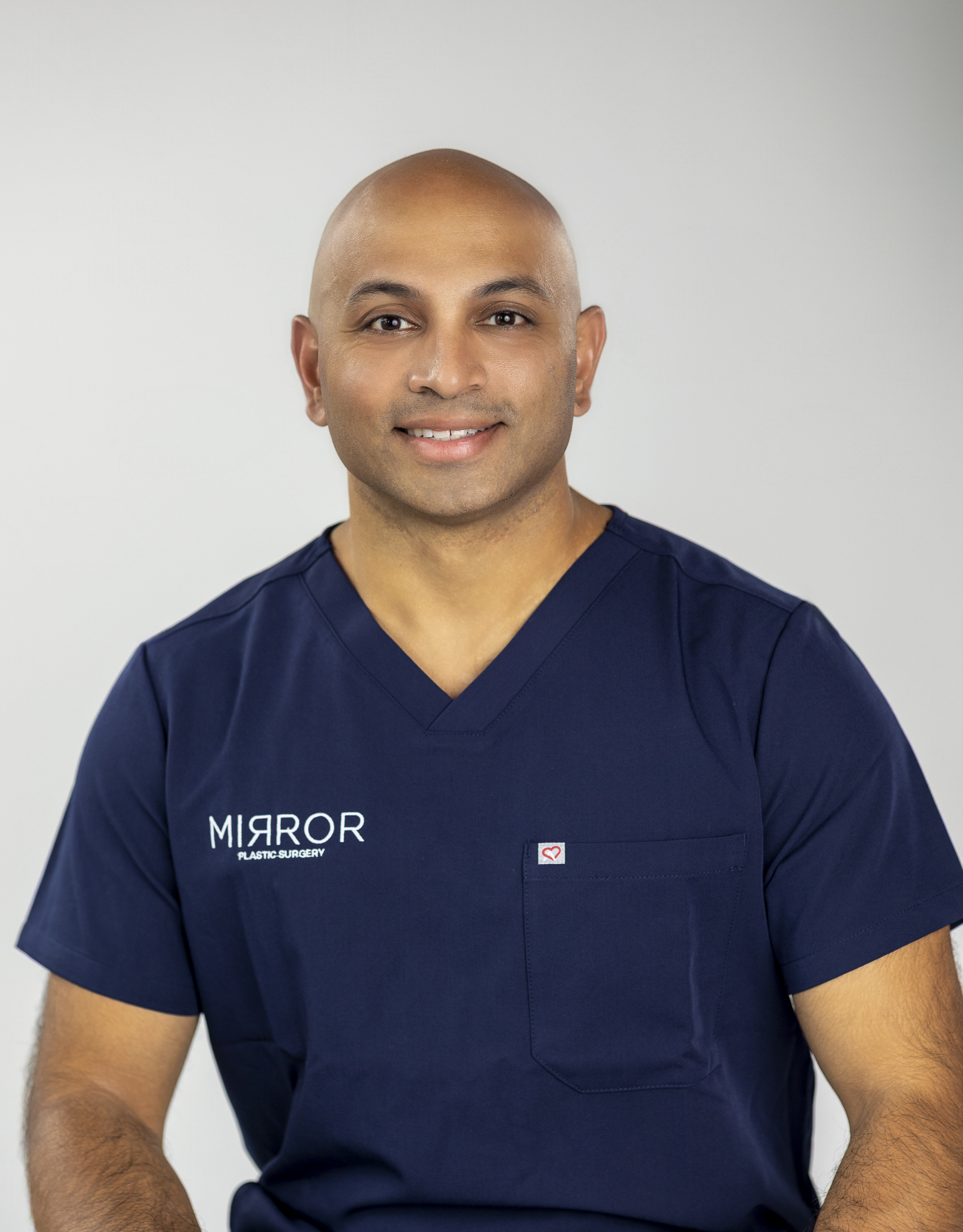
Discuss your candidacy with Dr. Akash to review your facial anatomy, suitability for fat transfer, and how this procedure fits your long-term aesthetic goals.
Frequently Asked Questions
Am I a good candidate for facial fat transfer?
Strong candidates are generally healthy adults in their late 30s through 60s who have noticeable facial volume loss in areas such as the cheeks, temples, or under-eye hollows, sufficient donor fat at the abdomen or thighs, and stable body weight maintained for at least six months. Nicotine use significantly impairs graft survival and must stop well before surgery. Patients whose primary concern is skin laxity or tissue descent rather than volume loss may be better served by a facelift or neck lift, either alone or in combination with fat grafting. An individualized consultation remains the only reliable way to determine candidacy.
How much of the transferred fat will survive?
Fat survival varies based on technique, recipient site, and patient-specific factors. Most patients retain approximately 50–70% of transferred volume long-term after the initial three-to-six-month resorption period.1 Modern techniques using gentle harvesting, low-speed centrifugation, and layered microinjection achieve higher take rates than older methods. The cheeks and temples tend to retain fat more reliably than high-movement areas such as the lips. Surgeons typically overfill by approximately 20% to compensate for expected early resorption. A minority of patients, roughly 15–20%, require a touch-up session after the result has fully stabilized at six months.
How does facial fat transfer compare to dermal fillers for longevity?
Hyaluronic acid fillers typically last 6–18 months and require ongoing maintenance sessions. Fat that successfully integrates after transfer becomes living tissue and does not dissolve on the same schedule as synthetic products, with results in favorable candidates sometimes lasting five years or more.1 However, fat transfer involves surgical downtime, variable absorption, and a longer timeline to final results. Fillers offer immediate, adjustable, and reversible correction with minimal recovery. The right choice depends on the degree of volume loss, the patient’s tolerance for downtime, and long-term goals, which are best evaluated during a thorough consultation.
What are the most serious risks of facial fat transfer, and how are they minimized?
The most serious risk is intravascular injection, which can cause fat embolism leading to skin necrosis or, in rare cases, vision loss or stroke. This risk concentrates in anatomic danger zones including the glabella, periorbital region, nasal root, and nasolabial folds. Surgeons minimize this risk through experience, deep anatomical knowledge, use of blunt cannulas, retrograde injection technique, and, in high-risk zones, ultrasound guidance. Selecting a board-certified plastic surgeon with specialized fellowship training in facial surgery is the single most important factor in reducing serious complication risk. Common transient effects, including bruising, swelling, and minor contour irregularity, resolve in most patients within two to four weeks.
Will the results change if my weight changes?
Yes. Transferred fat retains the genetic characteristics of the donor site and responds to caloric changes like native fat tissue. Significant weight gain can cause the grafted fat to expand. Significant weight loss, including that associated with GLP-1 medications, can cause it to diminish. Maintaining a stable weight after surgery helps preserve consistent volume results. Patients who are still actively losing weight are generally advised to reach a stable weight within a few pounds of their goal before undergoing fat grafting.
Conclusion: Deciding Whether Facial Fat Transfer Is Right for You
Facial fat transfer is a well-established procedure for restoring age-related volume loss using the patient’s own tissue. When a board-certified plastic surgeon with specialized fellowship training and deep anatomical expertise performs the procedure, it can provide durable, naturally integrated volume that ages with the face over time. Outcomes depend on realistic expectations about absorption rates, a recovery timeline measured in months rather than days, and careful patient selection based on individual anatomy, health status, and aesthetic goals.
No two faces are identical, and no published survival rate applies uniformly to every patient. An individualized evaluation that accounts for your specific pattern of volume loss, skin quality, donor-site availability, and long-term objectives forms the foundation of a predictable, satisfying result.
Begin your individualized evaluation with Dr. Akash at Mirror Plastic Surgery in St. Petersburg, Florida, and meet with a Harvard-MIT and Johns Hopkins-trained plastic surgeon recognized among America’s Best Plastic Surgeons by Newsweek two years in a row.
1 Results may vary from person to person. Editorial content, before and after images, and patient testimonials do not constitute a guarantee of specific results.


