
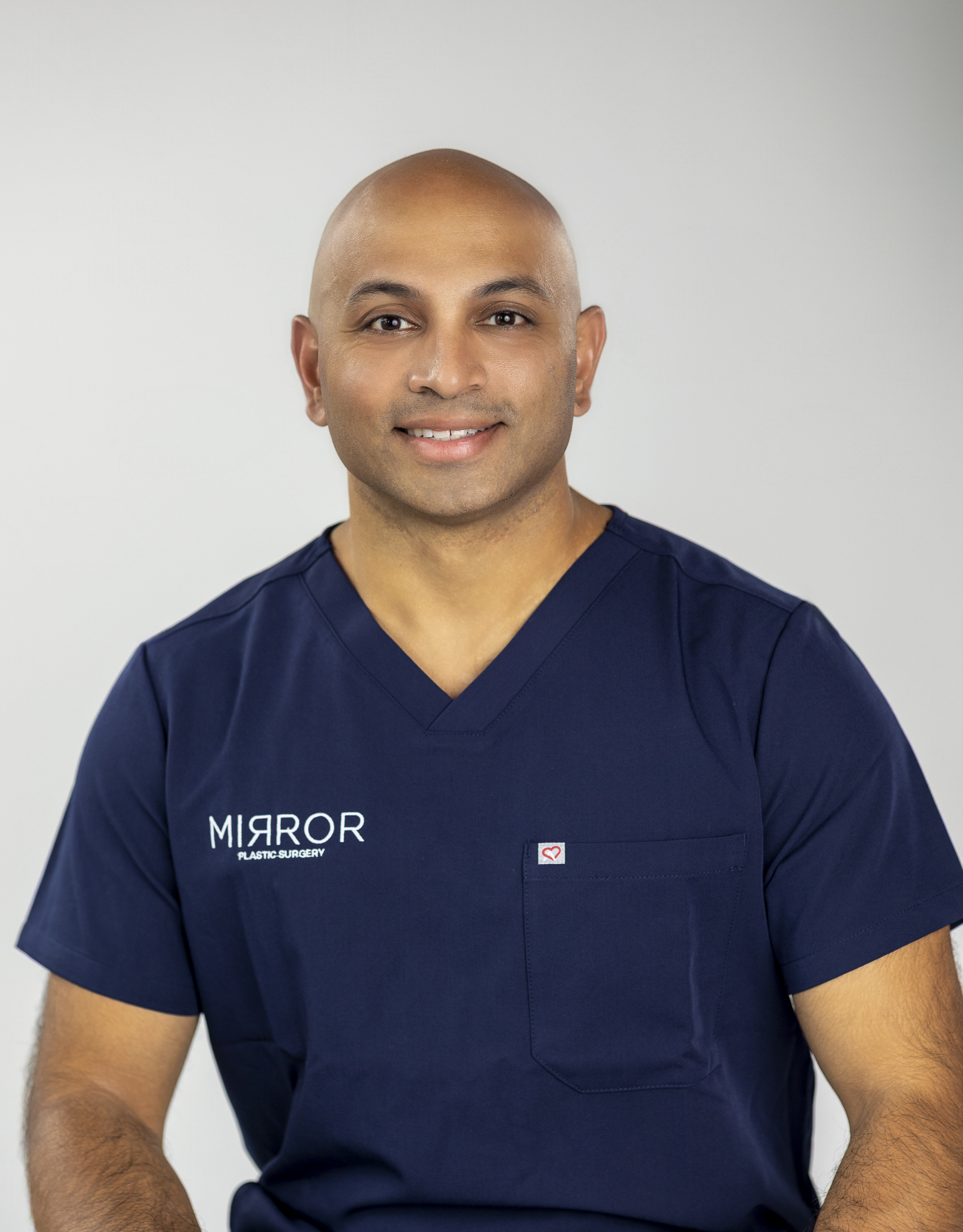
Written by: Dr. Akash Chandawarkar, Board Certified Plastic Surgeon, Mirror Plastic Surgery | Last updated: June 27, 2026
Key Takeaways on Dry Eye Risk
- Dry eye symptoms after lower blepharoplasty are common and usually improve within a few weeks to a few months. Persistent symptoms beyond six months occur in a small minority of patients.1
- Pre-existing dry eye, prior refractive surgery, significant lid laxity, and advanced age create the highest risk for postoperative ocular surface problems.
- Thorough preoperative screening, including Schirmer’s testing, tear osmolarity, and lid-position evaluation, can meaningfully lower both the incidence and severity of dry eye after surgery.
- Technique choice affects risk. A transconjunctival approach with orbicularis preservation and canthopexy when needed offers a safer profile for many higher-risk patients.
- Schedule your personalized ocular-surface assessment to clarify your individual risk and create a tailored surgical plan.
Typical Dry Eye Timeline After Lower Blepharoplasty
The recovery timeline below reflects published onset and resolution data, adjusted for Tampa Bay’s climate. Local factors include high summer humidity, strong indoor air-conditioning throughout the year, and a long spring pollen season that usually peaks from March through May.
Week 1–2 (Onset): Ocular surface irritation, foreign body sensation, and reflex tearing usually peak during the first two weeks. Surgical swelling alters lid position and temporarily reduces blink efficiency. Tampa patients recovering indoors spend long periods in air-conditioning, which speeds tear-film evaporation. Preservative-free artificial tears every one to two hours are standard during this phase.
Week 3–6 (Peak): Residual swelling continues to affect orbicularis tone and lid apposition. Outdoor time during Tampa’s spring pollen season can add allergic irritation on top of surgical dryness. Protective eyewear and regular lubrication remain essential. Any scleral show tends to feel most symptomatic during this period.
Week 7–12 (Resolution for Most Patients): Most transient dry eye cases improve as swelling subsides and normal blink mechanics return. Lid position stabilizes, and tear-film measurements usually move back toward baseline. Patients with pre-existing dry eye or those who had a transcutaneous approach may still notice symptoms at this stage.
Month 3–6 (Extended Recovery): Symptoms that continue beyond three months deserve a formal ophthalmologic evaluation. Schirmer’s testing and tear osmolarity at this point help separate prolonged but improving cases from early persistent disease. Tampa’s outdoor lifestyle, including boating, beach time, and high UV exposure, can prolong irritation if patients skip protective measures.
Beyond Six Months (Persistent Cases): A smaller group of patients continues to report dry eye symptoms after six months. These patients benefit from individualized treatment, which may include punctal plugs, prescription cyclosporine drops, or, in rare situations, surgical revision to correct lid malposition.
Request your personalized timeline assessment based on your ocular surface health and anatomy before scheduling lower blepharoplasty.
Lower Blepharoplasty in Patients With Pre-Existing Dry Eyes
Pre-existing dry eye does not automatically rule out lower blepharoplasty. It does represent the single most important risk factor for worsening ocular surface health after surgery. Safe decision-making relies on an individualized review of disease severity, eyelid anatomy, and planned technique.
A 2025 review by Abumanhal, Morishige, and Kakizaki outlines key risk factors for postoperative dry eye after lower blepharoplasty. The table below summarizes each factor, its clinical threshold, and the related risk implication.
| Risk Factor | Clinical Threshold / Definition | Risk Implication | Source |
|---|---|---|---|
| Pre-existing dry eye disease | Reduced Schirmer’s test or elevated tear osmolarity | Increased risk of worsening ocular surface disease | Abumanhal et al., 2025 |
| Prior LASIK or refractive surgery | Any history of corneal refractive procedure | Corneal nerve disruption from prior surgery compounds tear-film instability, with higher risk of postoperative exacerbation | Abumanhal et al., 2025 |
| Lid laxity (horizontal or lateral canthal) | Positive snap-back test, lateral canthal dehiscence, or reduced orbicularis tone on clinical exam | Higher risk of postoperative ectropion, lower eyelid retraction, and tear-film disruption, with canthopexy often indicated | Abumanhal et al., 2025 |
| Age, sex, and ethnicity | Elderly patients, females, and Asian populations | Greater susceptibility related to age-linked prevalence, hormonal influences, and ethnic differences in tear-film stability and meibomian gland dropout | Abumanhal et al., 2025 |
Patients with mild or moderate dry eye who otherwise qualify for surgery can often proceed when the surgeon selects a technique that limits anatomic disruption and adds canthopexy when laxity is present.
Dry Eyes Six Months After Lower Blepharoplasty
Symptoms that persist beyond six months form a separate category from short-term postoperative irritation. Common anatomical drivers include residual lower lid retraction, incomplete orbicularis recovery, and ongoing lagophthalmos. Each of these problems interferes with blink mechanics and reduces even tear distribution.
The Watery-Eye Paradox: Many patients at this stage describe paradoxical epiphora, or excessive tearing, despite a dry eye diagnosis. Chronic surface irritation can trigger reflex hypersecretion from the lacrimal gland. The eyes look watery, yet the tear film remains unstable. Symptom reports alone cannot separate this pattern from true overproduction, so formal tear-film analysis becomes essential.
What Real Patients Report: Online forums and patient communities frequently mention three concerns at the six-month mark. These include persistent grittiness or burning on waking, sensitivity to wind and air-conditioning, and growing anxiety that symptoms may be permanent. Evidence supports reassurance for most patients, because long-term dry eye after lower blepharoplasty remains uncommon. This group still needs active management rather than simple observation. Ophthalmologic co-management, including punctal occlusion and prescription anti-inflammatory drops, resolves many persistent cases without additional surgery.
Preoperative Screening Checklist for Lower Blepharoplasty
This checklist highlights key elements of a thorough preoperative evaluation for lower blepharoplasty. Patients can use it to prepare for a detailed consultation.
Ocular Surface History: Current symptoms of dryness, burning, grittiness, or foreign body sensation. Frequency of lubricating eye drop use. History of LASIK, PRK, or other refractive procedures. Diagnosed dry eye disease or Sjögren’s syndrome. Contact lens wear history.
Objective Testing Thresholds: Schirmer’s test result, tear osmolarity measurement, tear break-up time, and meibomian gland evaluation.
Lid Position and Anatomy Evaluation: Snap-back test for horizontal lid laxity and distraction test for lateral canthal integrity. Assessment of scleral show at rest and in downgaze. Measurement of proptosis or globe prominence. Orbicularis oculi muscle tone assessment and evaluation for existing lower lid retraction or ectropion.
Systemic and Medication Review: Use of antihistamines, diuretics, antidepressants, and isotretinoin, which can reduce aqueous tear production. Autoimmune conditions that affect lacrimal function and any history of thyroid eye disease.
Complete your preoperative screening with a comprehensive ocular surface and lid-anatomy evaluation before any lower eyelid procedure.
Five Targeted Questions for Your Eyelid Surgeon
These questions help you understand how a surgeon protects eyelid function and ocular health during lower blepharoplasty.
1. How do you preserve the orbicularis oculi muscle during lower blepharoplasty? Orbicularis preservation supports normal blink mechanics and lid apposition. The 2025 Abumanhal et al. review identifies orbicularis-preserving technique as a primary determinant of postoperative dry eye risk. A surgeon who cannot clearly explain their muscle-preservation strategy deserves careful scrutiny.
2. Under what circumstances do you perform canthopexy, and how do you assess for lid laxity preoperatively? Canthopexy becomes necessary when horizontal laxity or lateral canthal dehiscence is present. Skipping canthopexy in lax lids significantly raises the risk of ectropion and retraction.
3. Do you prefer the transconjunctival approach for patients with dry eye risk factors, and why? The transconjunctival approach is preferred over transcutaneous in many high-risk patients because it avoids an external skin incision, reduces orbicularis disruption, and preserves lid support structures.
4. What is your postoperative follow-up schedule, and at what point do you involve an ophthalmologist? Extended follow-up, not a single visit, allows early detection of lid malposition or persistent dry eye. Ophthalmologic co-management should be available for any patient with symptoms that continue beyond six weeks.
5. How do you manage a patient who develops lower lid retraction or ectropion after surgery? A surgeon’s complication-management protocol matters as much as their primary technique. Revision options can include massage, steroid injection, spacer grafts, and canthopexy revision. Clear answers in this area signal accountability and preparation.
Surgeon Profile: Evidence-Based Eyelid Surgery in St. Petersburg
The screening framework and surgical principles described above require specialized training and a practice structure that supports careful evaluation. Dr. Akash completed his medical degree through the Harvard-MIT Division of Health Sciences and Technology, his plastic and reconstructive surgery residency at Johns Hopkins University, and a specialized aesthetic surgery fellowship at the Manhattan Eye, Ear and Throat Hospital (MEETH), one of the few programs in the country with dedicated training in periorbital anatomy and eyelid function.
At Mirror Plastic Surgery in St. Petersburg, the practice limits surgical volume to one or two procedures per day. This schedule supports extended preoperative evaluation, precise intraoperative technique, and close postoperative follow-up for higher-risk eyelid patients. Every eyelid surgery patient receives a comprehensive lid-position and ocular-surface assessment before any plan is finalized, consistent with the approach outlined in this article.
Frequently Asked Questions
What percentage of patients experience dry eyes after lower blepharoplasty?
Transient dry eye symptoms affect a subset of patients, depending on baseline ocular surface health, surgical technique, and follow-up duration. Persistent symptoms beyond six months remain uncommon.1 Patients with pre-existing dry eye disease, prior LASIK, or significant lid laxity face higher risk.
Is the transconjunctival approach safer for patients prone to dry eyes?
Yes. As discussed in the surgical questions section, the transconjunctival approach often offers a safer profile for at-risk patients. Technique selection still needs to be individualized. Some patients require skin excision that calls for a transcutaneous approach, and in those cases orbicularis preservation and canthopexy become especially important.
Can dry eyes after lower blepharoplasty be permanent?
Permanent dry eye after lower blepharoplasty is uncommon but documented.1 It usually reflects uncorrected lower lid retraction, persistent lagophthalmos, or significant orbicularis damage that impairs blink mechanics long term. Many cases that extend beyond six months improve with medical treatment, including punctal plugs, prescription anti-inflammatory drops, or lid hygiene protocols, without surgical revision.1 True permanence appears most often in patients with severe pre-existing ocular surface disease who underwent surgery without adequate screening.
What is the Schirmer’s test, and why does it matter before eyelid surgery?
The Schirmer’s test measures aqueous tear production using a small paper strip placed at the lower lid margin for five minutes. A low result indicates reduced tear production. Patients with reduced production face a higher risk of postoperative ocular surface deterioration and, in purely cosmetic cases, may need to treat the underlying condition before surgery. Tear osmolarity testing, which measures tear concentration, adds complementary information and can reveal tear-film instability.
How does Tampa’s climate affect dry eye recovery after lower blepharoplasty?
Tampa Bay’s climate creates competing pressures during recovery. High outdoor humidity in summer can help protect the ocular surface. Early recovery, however, usually occurs indoors under air-conditioning, which lowers ambient humidity and speeds tear-film evaporation. Tampa’s long spring pollen season also adds an allergic component that can intensify irritation during weeks three through six. Patients should use preservative-free artificial tears frequently indoors, wear wraparound sunglasses outdoors, and discuss antihistamine use with their surgeon, because many antihistamines reduce aqueous tear production.
Conclusion: A Safety-First Plan for Lower Blepharoplasty
Dry eye risk after lower blepharoplasty can be measured, stratified, and reduced through individualized evaluation and thoughtful technique selection. Patients with identifiable risk factors, such as pre-existing ocular surface disease, prior refractive surgery, lid laxity, or advanced age, still qualify for surgery when they work with a surgeon who has the training and infrastructure to screen carefully, choose the right approach, and follow them closely. The current evidence supports a safety-first framework that protects ocular function before pursuing aesthetic goals.
Begin your evaluation at Mirror Plastic Surgery in St. Petersburg with a comprehensive assessment of your ocular surface health, lid anatomy, and candidacy for lower blepharoplasty.
1 Results may vary from person to person. Editorial content, before and after images, and patient testimonials do not constitute a guarantee of specific results.