
Written by: Dr. Akash Chandawarkar, Board Certified Plastic Surgeon, Mirror Plastic Surgery
Key Takeaways
- Hip dips are fixed anatomical depressions caused by pelvic and femoral bone geometry that exercise or standard implants cannot change.
- Autologous fat grafting (BBL) is the most common surgical option, with 60–80% volume retention when performed in the subcutaneous plane only.1
- Gluteal implants carry higher revision and complication rates and do not directly fill the lateral trochanteric hollow unless custom hip implants are used.
- Non-surgical options such as Sculptra, Radiesse, and AlloClae offer modest, temporary improvement for patients lacking sufficient donor fat.
- Schedule a personalized consultation at Mirror Plastic Surgery to choose the safest, evidence-based approach for your anatomy.
Hip Dip Anatomy and Why the Indent Forms
Hip dips, also called trochanteric depressions, violin hips, or hip divots, are inward curves along the lateral hip created by the fixed geometric relationship between the iliac crest and the greater trochanter of the femur. The depth of the indentation depends on three structural variables: pelvic width and flare angle, femoral anteversion (typically 10–20° in adults), and the thickness and tension of the soft tissue that spans the transition zone. That soft tissue includes muscle, fascia, and fat.
The tensor fasciae latae (TFL) and its fascial band sit over the indentation, but no muscle exists within the dip itself. The hollow is an anatomical gap between muscle attachment points rather than a simple lack of muscle that can grow with training. This structure explains why resistance exercise cannot change pelvic width, femoral bone shape, or the spacing between bony landmarks. In some people, added gluteal muscle mass increases the contrast around the hollow and makes the transition more pronounced instead of smoothing it.
Understanding this fixed anatomical reality is essential when evaluating treatment options, because it defines which approaches can realistically improve the contour.
Why Patients Seek Buttock Augmentation for Hip Dips
Most patients seeking hip dip correction fall into two groups. One group has soft-tissue-dominant dips, where the main issue is limited subcutaneous fat over the outer hip. The other group has structurally dominant dips, where the bony anatomy near the greater trochanter drives the contour.
Identifying which category applies is the first clinical task. Soft-tissue-dominant dips usually respond predictably to fat grafting. Structurally dominant dips may improve with soft-tissue techniques but rarely disappear completely.
Realistic expectations keep patients satisfied and safe. Buttock augmentation can soften the lateral contour within the limits set by bone structure, but it cannot change the skeleton. At Mirror Plastic Surgery, every consultation starts with a detailed anatomical assessment so patients understand what is achievable for their frame before any procedure is recommended.
Gluteal Implants and Their Limits for Hip Dips
Gluteal implants are solid or semi-solid silicone devices placed intramuscularly, subfascially, or in a dual-plane configuration. They are designed mainly for patients with limited donor fat who want central buttock projection rather than targeted hip dip correction. Standard round implants add volume behind the buttock but do not directly fill the lateral trochanteric hollow. Custom silastic hip implants are separate devices created specifically for that region.
Longevity data for gluteal implants show that many patients keep them for years without revision, but this apparent durability must be weighed against the complication profile. Published data report notable overall complication and revision rates, so a meaningful portion of patients eventually need additional surgery. The most common complications include capsular contracture, implant displacement, seroma, and infection that can require implant removal. These tradeoffs explain why many patients and surgeons favor fat grafting for hip dip correction when adequate donor fat exists.
Fat Transfer for Hip Dips: What to Expect
Autologous fat grafting is the most common surgical technique for hip dip correction. Surgeons harvest fat with liposuction, process it, and inject it into the trochanteric hollow. Fat placed in the gap creates the visual effect of added soft tissue, although it does not change the underlying bone or fascia.
Technique strongly influences outcome. Effective correction uses multi-plane fat grafting. The surgeon first back-fills the deeper trench to provide support, then layers fat more superficially to sculpt a smooth, convex outer hip line. Superficial-only placement reduces contact between graft and healthy tissue, lowers integration, and often leads to recurrence of the hollow. Studies using advanced fat processing with PRP and adipose-derived stem cell enrichment report favorable volume retention in hip dip areas.
Most BBL patients retain approximately 60–80% of transferred fat after healing.1 This means 20–40% of the grafted volume is reabsorbed, mainly in the first few months.1 Final results usually stabilize between three and six months, once the body has cleared non-viable fat cells.1 Because resorption varies from person to person, two patients receiving similar volumes can end up with different final contours.
Hip Dip Fillers and Non-Fat Injectables
Injectable fillers for hip dips fall into two main categories: hyaluronic acid (HA) and biostimulatory agents such as Sculptra (poly-L-lactic acid) and Radiesse. Providers inject these products into the deep subcutaneous plane using blunt cannulas, and treatment does not require general anesthesia.
Sculptra results for hip dip correction can last more than two years, and annual touch-ups help maintain the collagen framework.1 HA fillers usually last 6–12 months.1 Sculptra treatment for hip dips requires 2–4 sessions spaced 4–6 weeks apart. The product received initial FDA approval for facial volume restoration, so hip dip treatment uses it outside that original indication.
The risk profile of fillers is lower than surgery but not zero. Sculptra risks include mild swelling, bruising, rare nodules, and extremely rare allergic reactions. Proper injection technique and required post-treatment massage reduce nodule risk. More serious events such as filler migration, vascular occlusion, and isolated deaths have been reported with large-volume buttock filler injections. These reports highlight the need for experienced injectors and precise anatomical knowledge. The FDA advises against using dermal fillers for body contouring, reinforcing that this use falls outside approved indications even when products are cleared for facial treatment.
AlloClae, an FDA-registered injectable made from donor-derived adipose tissue, offers a distinct non-surgical option. AlloClae shows a 90% survival rate over one year for volume restoration and acts as a scaffold that supports collagen regrowth and stem cell migration.1 It is especially helpful for lean patients who lack enough donor fat for traditional fat transfer. Dr. Akash serves on the advisory board for Tiger Aesthetics, the company behind AlloClae, and offers this option at Mirror Plastic Surgery for carefully selected patients. While non-surgical options have different risk profiles than surgery, understanding safety across all approaches helps patients make informed choices.
Safety, Revisions, and Common Myths
The most important safety factor in fat grafting is the injection plane. Complication rates for gluteal fat grafting are much higher when surgeons inject into or within the muscle compared with purely subcutaneous injection. The risk of fat embolism is closely linked to intramuscular injection, and cases are not typically seen with subcutaneous-only techniques.
Current best-practice guidelines from the 2018 Multi-Society Gluteal Fat Grafting Task Force (ASPS, ASAPS, ISAPS, ISPRES, IFATS) require grafting only into the subcutaneous plane. They also recommend rigid blunt cannulas at least 4 mm in diameter and injection only while the cannula is moving.
For implants, many people assume they provide a simple permanent solution, but the revision data tell a different story. Systematic reviews report that revision rates for gluteal implants can be significant. For fat grafting, another misconception is that one session always achieves the final desired result. In reality, patients undergoing hip dip fat grafting typically need one session, with optional touch-ups for added volume because fat retention varies. The implant revision data discussed earlier contrasts with the safety profile of carefully performed subcutaneous fat grafting.
Candidacy Checklist for Hip Dip Correction
Candidacy depends on both anatomy and health. Surgeons evaluate the following factors during a comprehensive consultation.
- Fat availability: Patients with body fat percentage 20–30% or BMI 20–30 kg/m² are usually ideal for autologous fat grafting. Those with BMI below 20 often lack enough donor volume.
- Dip classification: Soft-tissue-dominant dips respond predictably to grafting. Structurally dominant dips driven by bone may need custom implants or achieve only partial improvement with fat alone.
- Skin quality and elasticity: The skin must stretch and redrape smoothly over the added fat. Loose or inelastic skin can make results less predictable.
- Weight stability: Candidates should maintain a stable weight for at least six months before surgery, because large swings affect graft survival and long-term contour.
- Smoking status: Active smoking excludes patients from fat grafting, since it compromises blood flow and graft survival.
- Medical history: A thorough preoperative history must include personal or family history of clotting or bleeding disorders and a review of medications that affect bleeding.
- Psychological readiness: BAAPS guidelines call for assessment of goals, expectations, and psychological factors, including screening for body dysmorphic disorder and unrealistic expectations.
- Goal alignment: Patients seeking dramatic silhouette changes rather than contour refinement may not be good candidates for any single technique.
Surgeon Expertise and Practice Approach
Hip dip correction, whether surgical or injectable, requires a surgeon with deep knowledge of lateral hip anatomy, strong fat-processing skills, and familiarity with current multi-society safety guidelines. Board certification by the American Board of Plastic Surgery (ABPS) serves as the baseline credential and reflects completion of accredited plastic surgery training and rigorous exams. Aesthetic fellowship training adds focused experience in body contouring beyond residency.
Dr. Akash at Mirror Plastic Surgery is board-certified by the American Board of Plastic Surgery. He completed plastic and reconstructive surgery training through the Johns Hopkins University integrated residency program, followed by an aesthetic surgery fellowship at the Manhattan Eye, Ear and Throat Hospital (MEETH), one of the most competitive aesthetic fellowships in the country. He also completed the Stanford University Biodesign Innovation Fellowship, which shapes his evaluation of emerging technologies such as AlloClae and ultrasound-guided fat grafting.
Dr. Akash serves on the Next Generation Editorial Board of the Aesthetic Surgery Journal and has testified before the FDA on implant safety. He has been named to Newsweek’s America’s Best Plastic Surgeons list for two consecutive years. Mirror Plastic Surgery performs one to two surgeries per day, a deliberate limit that keeps the full clinical team focused on each patient before, during, and after surgery, in contrast to high-volume centers that perform many more cases daily.
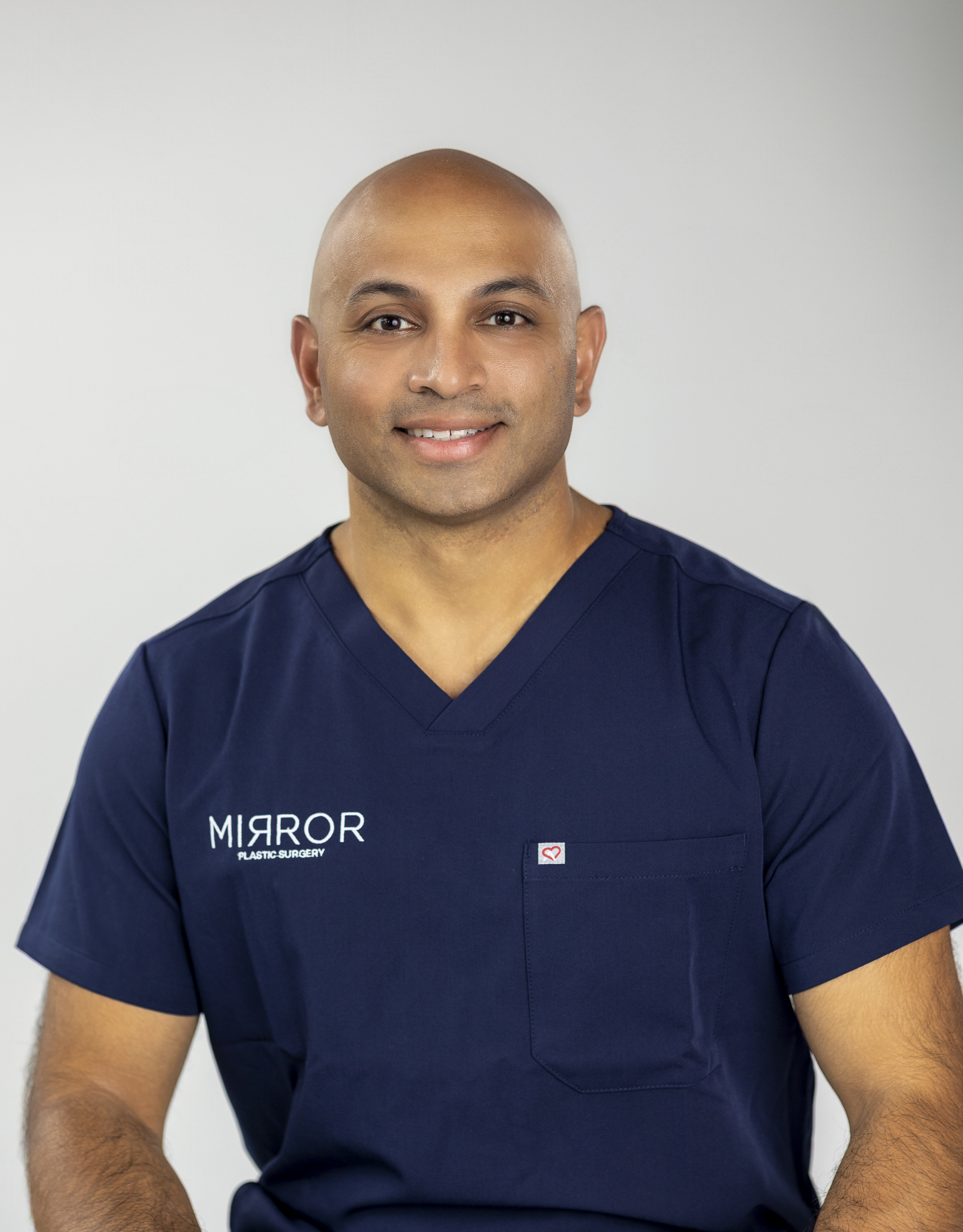
Schedule your individualized assessment with Dr. Akash to receive a detailed anatomical evaluation and a recommendation tailored to your structure and goals.
Comparing Hip Dip Treatment Options
| Procedure | Mechanism | Typical Longevity | Key Considerations |
|---|---|---|---|
| Autologous Fat Grafting (BBL/Hip Dip Fat Transfer) | Liposuction harvest, processing, subcutaneous injection into trochanteric hollow | Typical retention matches broader BBL outcomes (see fat transfer section) | Lower complication rates with subcutaneous-only injection vs intramuscular, requires adequate donor fat, typically 1 session per hip dip fat grafting outcome data |
| Gluteal / Hip Implants | Silicone device placed intramuscularly, subfascially, or dual-plane, with custom silastic implants for lateral hip | Semi-permanent; many patients retain implants for years or longer | Significant overall complication and revision rates, suitable for lean patients lacking donor fat, standard round devices do not directly address the lateral hollow |
| Biostimulatory Filler (Sculptra / Radiesse) | Poly-L-lactic acid or calcium hydroxylapatite injection stimulates collagen production in the deep subcutaneous plane | Over 2 years for Sculptra with annual maintenance1 | No general anesthesia, 2–4 sessions required, use for body contouring falls outside FDA-approved indications, limited volume capacity, nodule risk with improper technique |
| AlloClae (Donor Adipose Filler) | FDA-registered donor-derived adipose tissue injected as a scaffold that supports collagen regrowth and stem cell migration | 90% survival rate at 1 year; observed longevity of several years1 | No donor fat required, minimal downtime, suitable for leaner patients, long-term data remain limited, designed for targeted contouring rather than dramatic change |
The comparison above outlines the technical differences between options, but many patients also want clear answers about recovery, durability, and day-to-day impact.
Frequently Asked Questions
How long is recovery after hip dip fat grafting?
Recovery after hip dip fat grafting is usually less demanding than after a full Brazilian Butt Lift because surgeons use smaller fat volumes. Most patients notice mild swelling and temporary soreness at both the donor and injection sites. Direct pressure on the grafted area should be avoided for two to five weeks, using positioning pillows when sitting or sleeping.
Many patients return to desk work within two to three weeks. High-impact exercise typically resumes around weeks six to eight, once the surgeon clears activity. Final aesthetic results appear at about three months, when swelling has resolved and surviving fat has stabilized.1
Will the results change if I gain or lose weight?
Once transferred fat cells develop a blood supply and survive early healing, they behave like normal fat. They expand with weight gain and shrink with weight loss, just as fat in other areas does. Maintaining a stable weight close to your pre-operative baseline offers the best chance of preserving your new contour.
Large weight changes after surgery can alter the distribution and appearance of the grafted area. For this reason, Mirror Plastic Surgery evaluates weight stability as part of candidacy before recommending any fat-based procedure.
Can hip dip fillers be reversed if I am unhappy with the result?
Hyaluronic acid fillers can be dissolved with hyaluronidase, which makes them the most reversible option. Biostimulatory fillers such as Sculptra are not reversible, because they work by stimulating your own collagen, and that collagen cannot be selectively removed. AlloClae integrates with native tissue over time and is also not reversible once placed.
Autologous fat grafting becomes permanent once the fat establishes a blood supply, although the portion that does not survive is naturally reabsorbed. Knowing how reversible each option is helps patients choose an approach that matches their comfort level, and Dr. Akash reviews this in detail during consultation.
How do I evaluate whether a surgeon is qualified to perform hip dip correction?
Board certification by the American Board of Plastic Surgery is the first credential to confirm. Beyond that, completion of an aesthetic surgery fellowship signals focused training in body contouring. Ask whether the surgeon follows current multi-society safety guidelines for fat grafting, including subcutaneous-only injection and the use of blunt-tipped cannulas.
Inquire about intraoperative ultrasound guidance, which allows real-time confirmation that fat stays in the correct tissue plane. During consultation, note whether the surgeon classifies your hip dips as soft-tissue-dominant or structurally dominant, because that distinction guides which techniques are appropriate for your anatomy.
Is there a non-surgical option if I do not have enough donor fat for grafting?
Patients without enough donor fat for autologous transfer still have non-surgical choices. Biostimulatory fillers such as Sculptra do not require donor fat and can soften shallow dips through collagen stimulation over several sessions. AlloClae, an FDA-registered injectable derived from donor adipose tissue, adds structural volume without using the patient’s own fat and is available at Mirror Plastic Surgery.
Both approaches create more modest changes than surgical fat grafting and work best for soft-tissue-dominant dips in patients seeking subtle refinement rather than major reshaping. An in-person anatomical assessment is necessary to decide which option fits your structure and goals.
Summary: Choosing the Right Hip Dip Treatment for You
Hip dips are a normal anatomical variation driven mainly by pelvic and femoral bone geometry. No procedure removes the underlying skeletal structure, but well-chosen techniques such as fat grafting, implants, biostimulatory fillers, or AlloClae can soften the lateral contour within those limits. The safest and most predictable outcomes come from individualized assessment that classifies dip type, evaluates donor fat, checks skin quality and weight stability, and matches the technique to your anatomy and realistic goals.
Complication and revision rates differ meaningfully between techniques and depend heavily on surgeon training, strict attention to injection plane, facility accreditation, and adherence to current multi-society safety guidelines. These factors are not interchangeable.
Mirror Plastic Surgery’s philosophy of safety first, function second, aesthetics third means every recommendation starts with what is anatomically sound and clinically defensible, not simply what is popular. Dr. Akash, recognized by Newsweek as one of America’s Best Plastic Surgeons, brings Harvard Medical School training, Johns Hopkins residency, and MEETH aesthetic fellowship experience to each assessment, along with the low-volume practice model described earlier.
Book a consultation with Dr. Akash at Mirror Plastic Surgery in St. Petersburg, Florida, to receive a thorough anatomical evaluation and an honest, evidence-based recommendation tailored to your anatomy and goals.
1 Results may vary from person to person. Editorial content, before and after images, and patient testimonials do not constitute a guarantee of specific results.