

Written by: Dr. Akash Chandawarkar, Board Certified Plastic Surgeon, Mirror Plastic Surgery | Last updated: July 8, 2026
Key Takeaways
- A structured, unhurried consultation allows time to evaluate your anatomy, review techniques, and set realistic expectations before surgery.
- Arrive prepared with medical history, measurements, implant longevity data, placement questions, imaging records, and lifestyle details to get the most from your visit.
- Clear understanding of terms such as silicone gel implants, dual-plane technique, submuscular placement, and fat transfer supports more confident decisions.
- Current safety standards favor smooth implants, accredited facilities, and board-certified anesthesiologists, with complication rates tied to implant type and technique.
- Schedule your personalized consultation at Mirror Plastic Surgery to receive guidance tailored to your anatomy and goals.
7-Step Pre-Consultation Preparation Checklist
Arriving prepared keeps your consultation focused on clinical evaluation instead of paperwork. Complete each step before your appointment.
- Gather your complete medical history. Compile a list of current medications, supplements, prior surgeries, and any diagnosed conditions. Include autoimmune or thyroid disorders such as Hashimoto’s thyroiditis, because these details shape candidacy discussions.
- Measure your breast base width at home. Use a soft measuring tape to measure the horizontal width of each breast at its widest point. Tissue-based planning relies on breast base width, nipple-to-fold distance, chest-wall dimensions, and skin-pinch thickness rather than cup-size goals, so a baseline measurement speeds this step.
- Review implant longevity data. Silicone gel implants average 15–20 years and saline implants average 10–15 years, with many patients enjoying results beyond those ranges with proper monitoring and follow-up care.1 This timeline frames realistic expectations about future maintenance and possible revision.
- Prepare questions on placement trade-offs. Read about submuscular, subfascial, and subglandular placement so you can ask focused questions about animation deformity, rippling risk, and recovery duration during the consultation.
- Compile imaging records. Bring any prior breast imaging, including mammograms or ultrasounds. Note that MRI screening may be recommended every 2–3 years starting at 5 to 6 years post-surgery for silicone implants, and your surgeon will need a baseline to advise on future imaging protocols.
- Note lifestyle factors, including future pregnancy plans. Pregnancy after augmentation can change breast volume and skin elasticity, which may affect long-term results. Sharing these plans helps your surgeon factor them into implant selection and placement recommendations.
- List your priorities for safety and proportion. List your top three concerns and your top three aesthetic goals in one place. Ranking them in advance keeps the consultation focused on what matters most to you, because your surgeon can address your highest-priority items first and allocate time accordingly.
Key Breast Augmentation Terms to Know Before Your Visit
Familiarity with the following terms supports a more productive clinical conversation.
- Silicone gel implants: Shells filled with cohesive silicone gel that move and soften more like natural breast tissue than saline implants. Saline implants can feel firmer and ripple more noticeably in patients with thinner soft-tissue coverage.
- Cohesive gel (“gummy bear”): A form-stable silicone gel that holds its shape if the shell is compromised, which reduces migration of gel material.
- Dual-plane technique: A placement method that positions the implant partly beneath the pectoralis muscle and partly beneath the breast gland. This approach provides upper-pole muscle coverage while allowing the lower pole to follow natural breast tissue movement.
- Submuscular placement: Placement beneath the pectoralis major muscle, which offers greater tissue coverage and reduces visible rippling and edge palpability.
- Subfascial placement: Placement beneath the fascia overlying the pectoralis muscle, above the muscle itself. This preserves muscle function while adding a tissue layer over the implant.
- Fat transfer breast augmentation: Autologous fat harvested via liposuction is processed and injected into the breast. Long-term volume retention after autologous fat grafting for breast augmentation is approximately 50–55% on average, per systematic reviews and MRI studies.1
- 3D imaging (e.g., Vectra simulation): Preoperative imaging technology that generates a three-dimensional model of the torso to simulate potential outcomes. Using these tools within a structured size selection process can reduce long-term size-related dissatisfaction.1
Current Safety Standards and Evidence-Based Techniques
Complication rates vary meaningfully by implant type, surface texture, and surgical technique. For context, traditional silicone implants show capsular contracture rates of roughly 10–15% at 10 years, while newer-generation implants such as Motiva report lower rates in shorter-term studies.1 These figures are not directly comparable because the Motiva data reflect a shorter follow-up period, and longer studies naturally accumulate higher cumulative rates.
Regarding implant surface, most U.S. surgeons now favor smooth implants because the FDA reports that breast implant-associated anaplastic large cell lymphoma (BIA-ALCL) occurs more frequently with textured implants. Prophylactic explantation of textured implants is not routinely recommended, though it may be reasonable for risk reduction in select individuals after informed discussion.
Beyond implant selection itself, the surgical environment plays an equally critical role in safety outcomes. Accredited surgical facilities and board-certified physician anesthesiologists are non-negotiable safety standards. Mirror Plastic Surgery performs one to two surgeries per day, which allows the entire clinical team to remain focused on each patient before, during, and after the procedure.
Surgeon Credentials That Signal Advanced Expertise
Board certification by the American Board of Plastic Surgery is the foundational credential for any surgeon performing breast augmentation. An integrated plastic and reconstructive surgery residency, a dedicated aesthetic surgery fellowship, and demonstrated innovation experience further distinguish surgeons who practice at the top of the specialty.
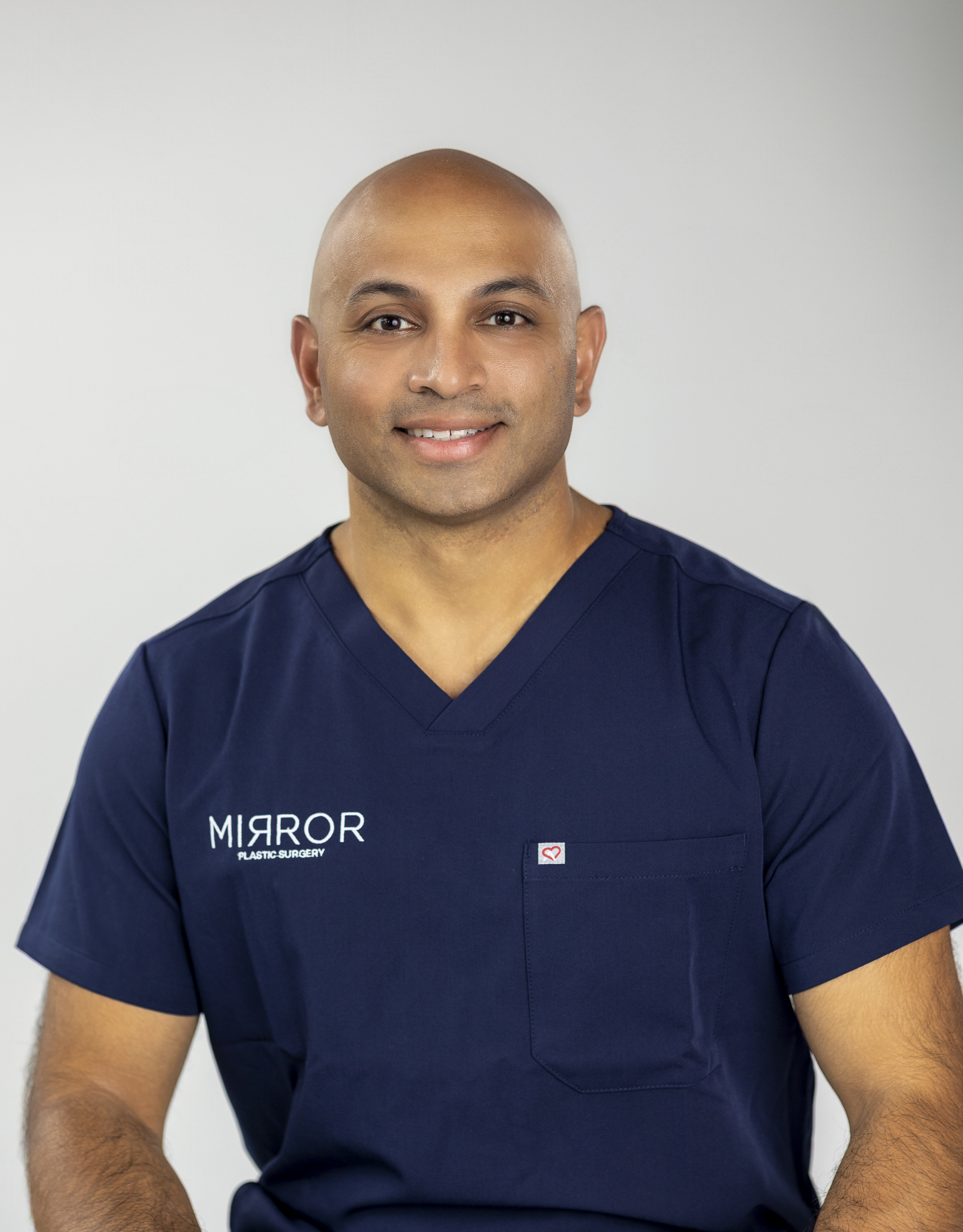
Dr. Akash at Mirror Plastic Surgery completed his medical degree through the Harvard-MIT Division of Health Sciences and Technology, a seven-year integrated plastic and reconstructive surgery residency at Johns Hopkins University, and an aesthetic surgery fellowship at the Manhattan Eye, Ear and Throat Hospital. He also completed the Stanford University Biodesign Innovation Fellowship and serves on the advisory board for Motiva, the implant manufacturer whose safety data appear in this guide. Named to Newsweek’s America’s Best Plastic Surgeons list for two consecutive years, including 2025, Dr. Akash has also testified before the FDA on breast implant safety, reflecting direct engagement with the regulatory science that guides the field.
Major Decision Factors to Review During Consultation
A thorough consultation walks through several key decision points in a structured way.
- Candidacy: General health status, smoking history, BMI, and any autoimmune or connective tissue conditions are evaluated, because these factors influence surgical risks and outcomes.
- Implant versus fat-transfer longevity: Implants have defined replacement timelines, while fat transfer volume stabilizes after initial absorption and does not require device replacement.
- Placement trade-offs: Submuscular and dual-plane placement provide better upper-pole tissue coverage and reduce rippling. Subglandular placement may shorten recovery but increases visible rippling risk in patients with thinner soft-tissue envelopes.
- Future imaging implications: Implants can obscure mammographic tissue, so patients should discuss screening protocols with both their surgeon and their radiologist.
- Pregnancy and breastfeeding: Future pregnancies may alter breast volume and skin laxity, which can affect long-term implant aesthetics.
- Revision risk: Reoperation may be needed for reasons such as asymmetry, capsular contracture, device rupture, or implant malposition. Patients should review their individual risk profile with their surgeon.
Technique Options: Implants, Fat Transfer, and Hybrid Approaches
Three primary technique categories dominate natural breast augmentation. Smaller silicone implants often produce about a 1–2 cup size increase. Fat transfer usually produces about a 0.5–1 cup size increase.1 Hybrid implant-plus-fat-grafting procedures combine both approaches.
Each option carries distinct trade-offs in achievable volume, recovery profile, longevity, and candidacy requirements. Moderate profile implants often create more natural upper-pole slopes than high-profile options, although the optimal choice depends on individual anatomy.1 Implant volume is treated as a result of matching width and projection to anatomy, not a starting target number.
Mirror Plastic Surgery also offers fat transfer using AlloClae technology, which provides volume and fat integration that differ from traditional fat transfer methods. Hybrid approaches layer fat grafting over a smaller implant for patients who want meaningful volume along with a very natural feel.
Addressing Common Breast Augmentation Misconceptions
Misconception: Cup size is a reliable way to select an implant. Cup size varies by bra manufacturer and provides no anatomical data. Surgeons choose implant size and profile based on body measurements such as breast width, soft-tissue thickness, skin envelope, and frame proportion, not bra cup size.
Misconception: Regret rates for breast augmentation are high. Long-term follow-up studies of primary augmentation patients show high levels of satisfaction.1 Size-related dissatisfaction can be reduced through structured size-selection protocols that incorporate sizers and 3D simulation.
Misconception: Autoimmune conditions such as Hashimoto’s thyroiditis automatically disqualify a patient. Medical eligibility is determined on an individual basis. BII symptoms can overlap with symptoms of thyroid disorders, autoimmune conditions, and other systemic conditions, which makes thorough pre-operative medical review essential. Patients with existing autoimmune diagnoses need detailed discussion of their specific condition, current disease activity, and medication status before any surgical plan is finalized.
Frequently Asked Questions
How do I know if I am a good candidate for breast augmentation?
Candidacy is determined through a comprehensive medical evaluation that reviews your overall health, breast anatomy, skin quality, soft-tissue coverage, and personal goals. Factors such as smoking status, BMI, diabetes management, and any autoimmune or thyroid conditions are all assessed. A board-certified plastic surgeon also reviews your plans for future pregnancy and your long-term expectations for the result. There is no universal checklist, because candidacy is individualized to your anatomy and health profile.
What is the difference between submuscular, subfascial, and subglandular placement, and which is safest?
Submuscular placement positions the implant beneath the pectoralis major muscle, which provides additional tissue coverage over the implant’s upper edge and reduces visible rippling, particularly in patients with thinner soft-tissue envelopes. Subfascial placement sits beneath the fascia overlying the muscle, above the muscle itself, preserving muscle function while adding a tissue layer. Subglandular placement positions the implant directly behind the breast gland, above the muscle, which may shorten recovery but increases rippling risk in thinner patients. The safest and most appropriate placement depends on your specific anatomy, tissue thickness, and aesthetic goals, not a single universal recommendation.
How should I prepare for Tampa Bay’s climate during breast augmentation recovery?
Tampa Bay’s heat and humidity affect recovery planning. Patients are typically advised to avoid direct sun exposure to incision sites, limit strenuous outdoor activity during the initial healing phase, and stay well hydrated. Compression garments worn during recovery can feel more uncomfortable in high heat, so timing your surgery around your schedule and seasonal activity level is worth discussing with your surgeon. Air-conditioned rest environments during the first one to two weeks support healing and comfort.
How long do breast implants last, and what monitoring is required?
As noted in the preparation checklist, implants have defined longevity ranges, with many patients maintaining satisfactory results beyond those timelines when monitored appropriately. For silicone implants, the MRI screening protocol discussed earlier, typically every 2–3 years starting at 5–6 years post-surgery, helps assess implant integrity, although specific protocols continue to evolve and should be reviewed with your surgeon. Regular follow-up appointments allow your surgeon to monitor for capsular contracture, implant position changes, or other developments over time.
What credentials should I verify before choosing a breast augmentation surgeon in Tampa?
Verify board certification by the American Board of Plastic Surgery, which requires completion of an accredited integrated plastic surgery residency and passage of written and oral examinations. Beyond certification, look for surgeons who have completed a dedicated aesthetic surgery fellowship, operate in accredited surgical facilities, and work with board-certified physician anesthesiologists. A surgeon’s training institution, publication record, and any regulatory engagement, such as FDA testimony on implant safety, serve as additional indicators of depth of expertise. The quality and length of the consultation itself also matter, because an hour-long, anatomy-focused assessment reflects a commitment to individualized care that high-volume practices rarely match.
The Value of Education and Realistic Expectations
Durable breast augmentation outcomes start with thorough consultations. Patients who arrive with an understanding of anatomy-based implant selection, evidence-based complication data, and clear personal priorities can participate more meaningfully in surgical planning and maintain realistic expectations through recovery and long-term follow-up.
At Mirror Plastic Surgery, the consultation functions as a clinical education session rather than a sales appointment. Every decision is grounded in your anatomy, your health, and your long-term goals. Dr. Akash brings Harvard-MIT, Johns Hopkins, and Manhattan Eye Ear and Throat Hospital training to every patient assessment, along with a safety-first philosophy that does not sacrifice function or proportion for speed.
Begin your personalized consultation at Mirror Plastic Surgery
1 Results may vary from person to person. Editorial content, before and after images, and patient testimonials do not constitute a guarantee of specific results.



