
Written by: Dr. Akash Chandawarkar, Board Certified Plastic Surgeon, Mirror Plastic Surgery | Last updated: July 8, 2026
Key Safety Takeaways for Choosing a Breast Augmentation Surgeon
- Public rankings and volume claims do not reveal a surgeon’s capsular contracture, infection, or revision rates. Patients must request this data directly.
- Board certification by the American Board of Plastic Surgery, verified through the ABMS portal, provides the most objective credential for evaluating a breast augmentation surgeon.
- Accredited surgical facilities and a board-certified physician anesthesiologist for every case are essential safety standards that patients should confirm.
- Low daily surgical volume, evidence-based contamination-reduction techniques, and preference for smooth or specialized-surface implants correlate with lower complication risk.
- Patients in the Tampa Bay and St. Petersburg area can schedule an in-person safety review with Dr. Akash at Mirror Plastic Surgery to verify these criteria in person.
Why Public Rankings Miss Real Complication Risks
Ranking systems reward name recognition, patient volume, and online reviews. None of those inputs correlate directly with complication outcomes. A surgeon who performs ten breast augmentations per day may accumulate thousands of five-star reviews while maintaining complication rates that are never disclosed publicly. The metrics that actually matter, such as capsular contracture incidence, infection rate, revision frequency, and anesthesia adverse events, are not reported to any public consumer database in the United States. Patients must request this data directly and understand how to interpret it.
Five Safety Questions for Any Breast Augmentation Surgeon
These five questions target the complication rates, credentials, facility standards, surgical volume, and implant safety data that public rankings ignore. Each question produces objective, comparable answers across any practice, and acceptable answers align with published clinical benchmarks.
- What is your personal capsular contracture rate at one year and five years? Acceptable answer: a surgeon who tracks and can cite their own data. Refusal to answer is a disqualifying signal.
- Are you board certified by the American Board of Plastic Surgery, and can I verify that independently? Acceptable answer: yes, with a direct reference to the ABPS public verification tool.
- In what accredited facility will my surgery be performed, and who will administer anesthesia? Acceptable answer: a named, accredited facility plus a board-certified physician anesthesiologist. A CRNA without physician oversight does not meet this standard.
- How many breast augmentations do you perform per day, and how is your team’s attention allocated? Acceptable answer: a specific number of daily cases with a clear explanation of whether cases run simultaneously and how the team stays focused on each patient.
- Which implant surfaces do you use, and what is your position on textured implants given current FDA guidance? Acceptable answer: a surgeon who can clearly explain the FDA’s current regulatory position on BIA-ALCL and textured surfaces.
Ready to ask these questions in person? Schedule your consultation with Dr. Akash and bring this checklist to verify each answer.
How to Verify American Board of Plastic Surgery Certification
Board certification by the American Board of Plastic Surgery requires an accredited plastic surgery residency, rigorous written and oral examinations, and ongoing continuing education. This combination makes it the most objective credential available to patients, and verification takes under two minutes.
- Navigate to the American Board of Medical Specialties (ABMS) public verification portal.
- Enter the surgeon’s full legal name and state of licensure.
- Confirm the listed specialty reads “Plastic Surgery,” not “Cosmetic Surgery,” which is not an ABMS-recognized specialty.
- Cross-reference the result against the surgeon’s own website biography.
Beyond serving as a credential checkpoint, board certification also carries a practical safety benefit. Board-certified plastic surgeons maintain hospital privileges, so in the rare event of a serious complication, the surgeon can manage your care in a hospital setting rather than transferring you to an unfamiliar physician.
Checking Facility Accreditation and Anesthesia Credentials
Operating in an accredited surgical facility provides standardized protocols for anesthesia, infection prevention, and emergency management. The three primary accrediting bodies for outpatient surgical facilities in the United States are the American Association for Accreditation of Ambulatory Surgery Facilities (AAAASF), the Accreditation Association for Ambulatory Health Care (AAAHC), and The Joint Commission. Each organization maintains a public directory where patients can confirm a facility’s current accreditation status.
Anesthesia credentials require a separate verification step. Confirm that the anesthesia provider holds an M.D. or D.O. with board certification in anesthesiology. Ask the practice directly whether a physician anesthesiologist will be present for the entirety of your procedure.
How to Request and Interpret Complication Data
Patients evaluating breast augmentation surgeons should directly ask for the surgeon’s personal complication rates for breast augmentation as a key objective data point. When requesting this data, ask for rates expressed as a percentage of total cases performed, segmented by complication type and time horizon at one year and five years.
Surgeons should also disclose their specific experience managing complications such as capsular contracture, rupture, or infection when patients inquire. A surgeon who cannot describe their complication management protocol in concrete terms has not systematized it.
The FDA requires that the implanting surgeon personally review the patient decision checklist covering complications and long-term risks with every patient before breast augmentation. This responsibility cannot be delegated. If a staff member, rather than the surgeon, walks you through implant risks, that pattern signals a compliance and safety concern.
Daily Surgical Volume, Team Focus, and Complication Risk
Surgeon training and experience correlate with complication rates, surgical technique quality, and the ability to manage complications when they arise. Volume alone does not equal high-quality experience. A surgeon performing eight procedures per day across two or three simultaneous operating rooms divides team attention, extends total anesthesia time for later cases, and compresses the decision-making window for each patient.
Given these attention-dependent factors, the relevant comparison when evaluating surgeons is not total career cases but cases per day and the team structure supporting each one. Practices that limit daily surgical volume to one or two cases can dedicate the full attention of the surgeon, anesthesiologist, and nursing team to a single patient at a time. That structural difference affects sterile field management, intraoperative monitoring, and the surgeon’s physical and cognitive state during each procedure.
Implant Surface Safety and Current FDA Guidance
Macro-textured breast implants have a documented scientific link to Breast Implant-Associated Anaplastic Large Cell Lymphoma (BIA-ALCL), a rare but real non-Hodgkin lymphoma. BIA-ALCL occurs in the scar tissue and fluid near the implant and is almost exclusively associated with textured implants. It is not breast cancer. Smooth breast implants have no association with BIA-ALCL.
Post-market surveillance, global recalls of certain textured models, and independent studies confirm that smooth implants carry lower risk than macro-textured implants. The FDA states that patients should be aware of the risks associated with breast implants, including BIA-ALCL, which is primarily linked to textured surfaces.
One relevant development in implant surface technology involves Motiva breast implants. These implants feature a surface designed to reduce inflammation without the risks of traditional texturing. Motiva’s surface does not carry the BIA-ALCL association that macro-textured surfaces do.
Evidence-Based Techniques That Cut Contamination and Contracture Risk
Capsular contracture, the hardening of scar tissue around an implant, is the most common long-term complication of breast augmentation. Bacterial biofilm on the implant surface is a primary driver of the inflammatory cascade that produces it. Several intraoperative protocols have demonstrated measurable reductions in contamination risk.
- No-touch implant handling technique: The implant is inserted through a funnel device without direct contact, which reduces surface contamination.
- Pocket irrigation with triple-antibiotic solution: Irrigating the implant pocket with a combination antibiotic solution before implant placement reduces bacterial load at the surgical site.
- Nipple shields: Covering the nipple-areola complex during surgery reduces contamination from ductal bacteria.
- Subfascial or dual-plane pocket placement: Proper anatomical pocket selection based on individual tissue characteristics reduces implant-tissue friction and inflammatory response.
- Minimizing operative time: Shorter exposure time for the implant pocket correlates with lower contamination risk.
Collectively, these protocols share a common requirement. They demand focused surgical attention and unhurried execution, which conflicts with high-volume, multi-room scheduling models.
Dr. Akash’s FDA Testimony and Concierge Surgical Model
Dr. Akash was selected to testify before the U.S. Food and Drug Administration on breast implant safety. That role places him among a small group of plastic surgeons whose clinical expertise has been sought at the regulatory level and reflects direct engagement with the evidence that guides implant safety in the United States.
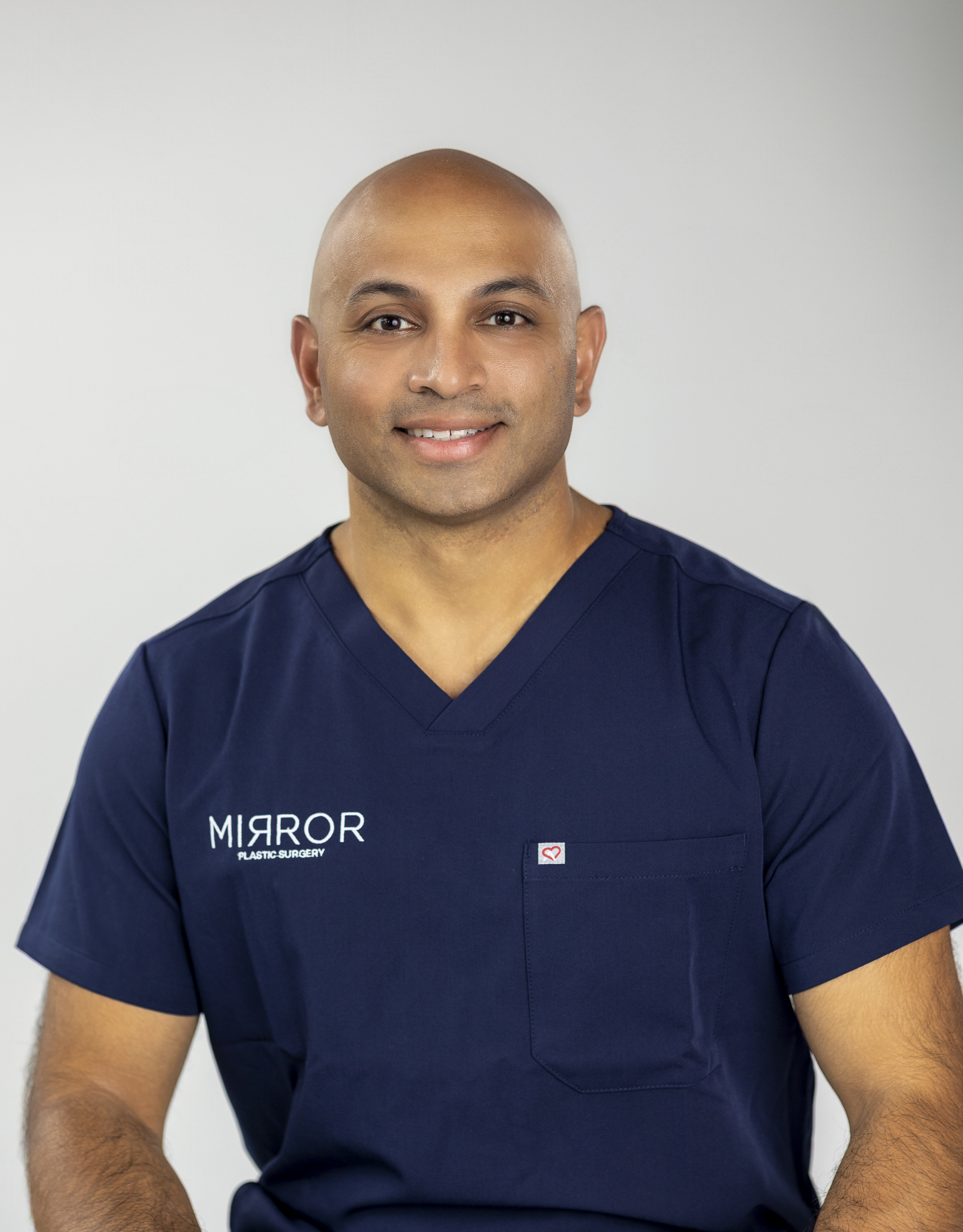
At Mirror Plastic Surgery, Dr. Akash performs one to two surgeries per day. That limit is structural, not incidental. It means the surgical team’s full attention before, during, and after the procedure is allocated to a single patient. The practice operates in an accredited surgical facility with a board-certified physician anesthesiologist for every case. Pre-operative assessment includes advanced in-office ultrasound for precise anatomical evaluation. Dr. Akash also serves on the advisory board for Motiva, the manufacturer of the implant with specialized surface technology described above, which gives him direct access to the latest clinical and engineering data on implant surface safety.
Dr. Akash has been named to Newsweek’s America’s Best Plastic Surgeons list for two consecutive years, based on peer nominations and patient outcomes rather than marketing spend.
Review your anatomy, implant options, and Mirror’s contamination-reduction protocols in a consultation with Dr. Akash.
Common Misconceptions About Volume and Implant Texture
Misconception: Higher volume always means more experience and better outcomes. Volume and outcomes are not the same variable. A surgeon who has performed 5,000 procedures across simultaneous operating rooms has necessarily distributed attention across those cases, which means the quality of attention per case decreases as total volume increases. That inverse relationship explains why the relevant metric is focused, undivided surgical attention per case, not career totals.
Misconception: Textured implants are safer because they stay in place better. The positional stability argument for textured implants predates the BIA-ALCL data. Current evidence does not support accepting a lymphoma risk in exchange for rotational stability. Modern smooth implants and precise pocket dissection achieve reliable positioning without macro-texturing.
Misconception: Certain newer implant surfaces carry the same BIA-ALCL risk as macro-textured implants. The BIA-ALCL association documented in the literature is specific to macro-textured surfaces. Newer specialized surfaces, such as those on Motiva implants, do not fall into the same risk category.
Practical Checklist Before You Schedule a Consultation
- Verify ABPS board certification at the ABMS public portal.
- Confirm the surgical facility’s accreditation status through AAAASF, AAAHC, or The Joint Commission’s public directories.
- Ask the practice whether a board-certified physician anesthesiologist will be present for your entire procedure.
- Request the surgeon’s personal capsular contracture and revision rates, expressed as a percentage of total breast augmentation cases.
- Ask how many surgeries the surgeon performs per day and whether cases ever run simultaneously.
- Ask which implant surfaces the surgeon uses and their rationale given current FDA guidance on BIA-ALCL.
- Confirm that the surgeon, not a staff member, will personally review the FDA-required patient decision checklist with you.
Frequently Asked Questions About Breast Augmentation Safety
What is breast implant illness, and how real is the risk?
Breast implant illness (BII) refers to a cluster of systemic symptoms, including joint pain, chronic fatigue, cognitive difficulties, rashes, and sleep disturbance, that some patients develop after breast implant surgery. The symptoms can appear immediately after surgery or years later, and they have been reported with both silicone and saline implants, intact or ruptured. Some patients who report BII symptoms experience improvement after implant removal.1 A 2025 retrospective cohort study using the TriNetX Global Collaborative Network found that women with implant-based reconstruction had a higher risk of developing BII-compatible symptoms compared to those who underwent autologous flap reconstruction.1 There are currently no standardized diagnostic criteria or official treatment guidelines for BII. The FDA began requiring breast implant manufacturers to include systemic symptom warnings on packaging in 2021. At Mirror Plastic Surgery, Dr. Akash discusses BII risk transparently during consultation as part of the FDA-required patient decision checklist review.
What revision rate should I expect, and how do I evaluate a surgeon’s revision history?
Revision rates vary by implant type, surgical technique, patient anatomy, and follow-up duration. The most meaningful figure is a surgeon’s personal revision rate for primary breast augmentation at five and ten years, not industry averages. Ask any surgeon you are evaluating to provide this number as a percentage of their own cases. A surgeon who tracks outcomes systematically will have this data available. A surgeon who cannot produce it has not been monitoring their own results. At Mirror Plastic Surgery, outcome tracking is part of the standard of care, and Dr. Akash discusses realistic revision expectations during the initial consultation based on your specific anatomy and implant selection.
How long do breast implants last, and when should they be replaced?
Breast implants are not lifetime devices. The FDA recommends that patients with silicone gel implants undergo ultrasound or MRI screening five to six years after implantation and every two to three years thereafter to detect silent rupture. Saline implants deflate visibly when ruptured, which makes detection straightforward. Many patients go ten to twenty years without requiring replacement, while others need revision sooner due to capsular contracture, implant malposition, or changes in body composition.1 The decision to replace implants should be based on clinical findings and patient symptoms, not a fixed calendar schedule. Dr. Akash uses in-office ultrasound as part of pre-operative and follow-up assessment to monitor implant integrity and surrounding tissue.
What recovery should I realistically expect after breast augmentation?
Most patients return to light daily activity within five to seven days.1 Strenuous exercise and heavy lifting are typically restricted for four to six weeks.1 Swelling and implant position continue to evolve for three to six months as the tissue settles.1 Pain levels vary by pocket placement, and submuscular placement generally involves more initial discomfort than subglandular or subfascial approaches.1 At Mirror Plastic Surgery, recovery planning is individualized based on your anatomy, implant selection, and pocket placement. Dr. Akash provides specific post-operative protocols and is directly accessible to patients during recovery, consistent with the practice’s concierge model.
Mirror Plastic Surgery: How the Practice Meets These Safety Standards
Every criterion in this framework describes the standard of care at Mirror Plastic Surgery. These criteria include board certification, an accredited facility, a physician anesthesiologist, personal complication data, low daily case volume, smooth implants or those with specialized surfaces designed to reduce inflammation, and evidence-based contamination reduction protocols.
Dr. Akash holds board certification from the American Board of Plastic Surgery. He completed his medical degree at Harvard Medical School with Honors through the Harvard-MIT Health Sciences and Technology program, his plastic surgery residency at Johns Hopkins University, and an aesthetic surgery fellowship at the Manhattan Eye, Ear and Throat Hospital (MEETH). He completed the Stanford University Biodesign Innovation Fellowship and serves on the advisory board for Motiva, among other leading medical technology companies. His FDA testimony on implant safety, detailed earlier, reflects direct regulatory engagement. His Newsweek recognition reflects the peer-nominated standard described earlier.
The practice maintains the low-volume model described earlier. The facility and anesthesia standards meet the criteria outlined earlier. Pre-operative evaluation includes in-office ultrasound. Dr. Akash personally reviews the FDA-required patient decision checklist with every breast augmentation patient. Implant selection at Mirror Plastic Surgery reflects current evidence on surface safety, including the use of Motiva implants with specialized surface technology.
Patients in the Tampa Bay and St. Petersburg area seeking a breast augmentation surgeon whose protocols satisfy every objective safety criterion have a clear next step.
Schedule your safety-focused consultation at Mirror Plastic Surgery, located at 780 4th Ave S, St. Petersburg, FL 33701. Call or text 727-361-6515, or email hello@mirrorplasticsurgery.com.
1 Results may vary from person to person. Editorial content, before and after images, and patient testimonials do not constitute a guarantee of specific results.