
Written by: Dr. Akash Chandawarkar, Board Certified Plastic Surgeon, Mirror Plastic Surgery | Last updated: July 6, 2026
Key Takeaways for Natural Results
- Natural-looking breast augmentation starts with precise anatomical measurements like chest width and tissue thickness, not cup-size goals.
- Five key measurements guide implant selection: base width, soft-tissue thickness, nipple-to-fold distance, chest-wall curvature, and skin elasticity.
- Modern cohesive silicone implants in a dual-plane position, with fat grafting when needed, create breasts that look and feel real.1
- Implant choices are customized for different body types, including petite, athletic, broad, and post-pregnancy frames, to keep proportions balanced.
- Schedule a personalized consultation at Mirror Plastic Surgery for an anatomy-first evaluation and a natural breast augmentation plan.
Five Core Measurements That Shape Your Result
Tissue-based planning relies on five anatomical data points collected before any implant catalog is opened.
- Breast base width. Base diameter is the single most important measurement for determining implant shape and size. An implant wider than the natural breast footprint pushes toward the armpit, crowds the chest, and disrupts spacing.
- Soft-tissue thickness. Women with athletic builds and lower body fat have less tissue to conceal implants, which can make edges visible or easy to feel with above-muscle placement. Thicker tissue provides natural camouflage and allows more flexibility in implant choice.
- Nipple-to-inframammary-fold distance. This distance, combined with breast base width and skin elasticity, determines which implant width and projection will fill the lower pole. The goal is to add volume without overstretching the fold or creating a double bubble.
- Chest-wall width and curvature. A narrow rib cage limits usable base widths because an implant wider than the chest wall tends to migrate laterally. In contrast, a rounded or barrel-shaped chest already provides forward dimension, which reduces the projection needed to achieve balance because the chest itself contributes volume. When pre-existing asymmetries such as pectus excavatum are present, these width and curvature factors may require different profiles per side to compensate for uneven starting anatomy.
- Skin elasticity. Loose or stretched tissue after pregnancy or significant weight loss may require internal mesh support to maintain implant position and prevent bottoming out. Firm, elastic skin tolerates a wider range of implant dimensions and supports the implant more reliably over time.
Schedule your detailed anatomy assessment with Dr. Akash and have all five measurements evaluated during a dedicated, hour-long visit at Mirror Plastic Surgery in St. Petersburg.
How Implants Can Look and Feel Like Natural Breast Tissue
Modern cohesive silicone gel implants closely mimic the density and movement of natural breast tissue when profile selection follows your anatomy. Moderate-profile silicone implants are the most commonly selected profile in augmentation mammoplasty because their broader base distributes volume gradually across the chest wall. This creates a gentle slope instead of a pronounced forward projection.1
Placement technique reinforces that outcome. In dual-plane positioning, the lower portion of the pectoral muscle is released so the implant sits in a more natural position and the lower pole fills out softly.1 The upper muscle then provides coverage that blends the chest-to-breast transition. This approach is especially helpful for patients with thinner tissues where implant edges might otherwise be visible.
Some patients want added volume without a full implant, or need softening around an existing device. Fat grafting using AlloClae offers a complementary option in these situations. AlloClae is a structured adipose technology that provides volume and fat integration with greater long-term stability than traditional fat transfer alone. Dr. Akash serves on the advisory board for Tiger Aesthetics, the company behind AlloClae, which gives Mirror Plastic Surgery direct access to its latest clinical protocols.
A study of 330 tissue-preserving inframammary fold augmentations reported a 0.9% complication rate at a mean 18-month follow-up, with zero instances of capsular contracture, rupture, or malposition.1 Surgeons attributed these outcomes to limiting implant width to match the circummammary ligament diameter and preserving suspensory structures.
Implant Choices for Different Body Types
The five measurements above translate into specific implant decisions for four common body frames. The table below shows how base width and profile recommendations shift across body types. Narrower frames usually need narrower bases with moderate-to-higher projection, while broader frames can accommodate wider bases with lower projection to maintain natural proportions.
| Body Type | Base Width Guidance | Recommended Profile | Preferred Placement |
|---|---|---|---|
| Petite / narrow chest | Narrow base to stay within natural footprint | Moderate to moderate-plus | Submuscular or dual-plane |
| Athletic / low body fat | Matched precisely to breast base width | Moderate | Dual-plane for muscle coverage |
| Broad / wider chest | Broader base to fill chest wall evenly | Low to moderate | Dual-plane or prepectoral |
| Post-pregnancy / weight loss | Conservative to avoid overstressing stretched tissue | Moderate | Dual-plane, mesh support if indicated |
Athletic patients face a specific concern called animation deformity, where a submuscular implant shifts visibly during pectoral contraction. For athletic patients with strong muscle development, subfascial or supramuscular placement may be recommended to avoid muscle distortion during movement while preserving a natural appearance. Dr. Akash evaluates each athletic patient’s muscle mass, body fat, and activity level before recommending a plane.
Post-pregnancy and post-weight-loss patients often present with reduced skin elasticity and altered fold anatomy. Patients with loose or very thin tissue may require internal mesh support to reinforce the breast fold and prevent bottoming out. A concurrent mastopexy may also be indicated when ptosis is present. Mirror Plastic Surgery’s safety-first philosophy means that this combination is planned conservatively to avoid compounding complication risk.
What Is a Ballerina Implant?
Beyond the clinical considerations for different body types, many petite or narrow-chested patients encounter the term “ballerina implant” while researching options. The term “ballerina implant” is not a manufacturer designation. It describes a clinical philosophy of selecting a narrow-base, moderate-projection implant for petite or narrow-chested patients to maintain proportions consistent with a lean, refined silhouette.
An implant that appears modest on a taller or broader woman can look overpowering on a petite frame, especially if it is too wide for a narrow chest. The ballerina approach prioritizes staying within the natural breast footprint and choosing a volume that enhances without announcing itself.
A narrow-chested patient may benefit from higher projection to achieve fullness without exceeding natural width. That projection is still calibrated to the frame and never selected purely for dramatic effect. The result is a breast that moves naturally, has no visible lateral edge, and reads as the patient’s own anatomy.1
The Value of an In-Depth, Anatomy-First Consultation
All of the measurement-driven decisions described above, from the five anatomical data points to body-type-specific implant selection, depend on a consultation process that values precision over speed. Anatomy-based planning requires time. Mirror Plastic Surgery dedicates up to a full hour to each initial consultation, with a top-to-bottom assessment that covers all five measurements, chest-wall symmetry, skin quality, lifestyle factors, and long-term goals.
The practice performs one to two surgeries per day. This deliberate limit keeps the entire clinical team focused on each patient before, during, and after the procedure. High-volume practices may perform five to ten surgeries daily, which can shorten planning and recovery oversight.
Dr. Akash earned his medical degree from Harvard Medical School with Honors through the Harvard-MIT Health Sciences and Technology program. He completed a seven-year integrated plastic and reconstructive surgery residency at Johns Hopkins University and holds an aesthetic surgery fellowship from the Manhattan Eye, Ear and Throat Hospital (MEETH), one of the most competitive aesthetic training programs in the country. He has been recognized on Newsweek’s America’s Best Plastic Surgeons list for two consecutive years, including 2025, and serves as a Next Generation Editor for the Aesthetic Surgery Journal. He was also selected to testify before the U.S. FDA on breast implant safety, which reflects the depth of his evidence-based approach.
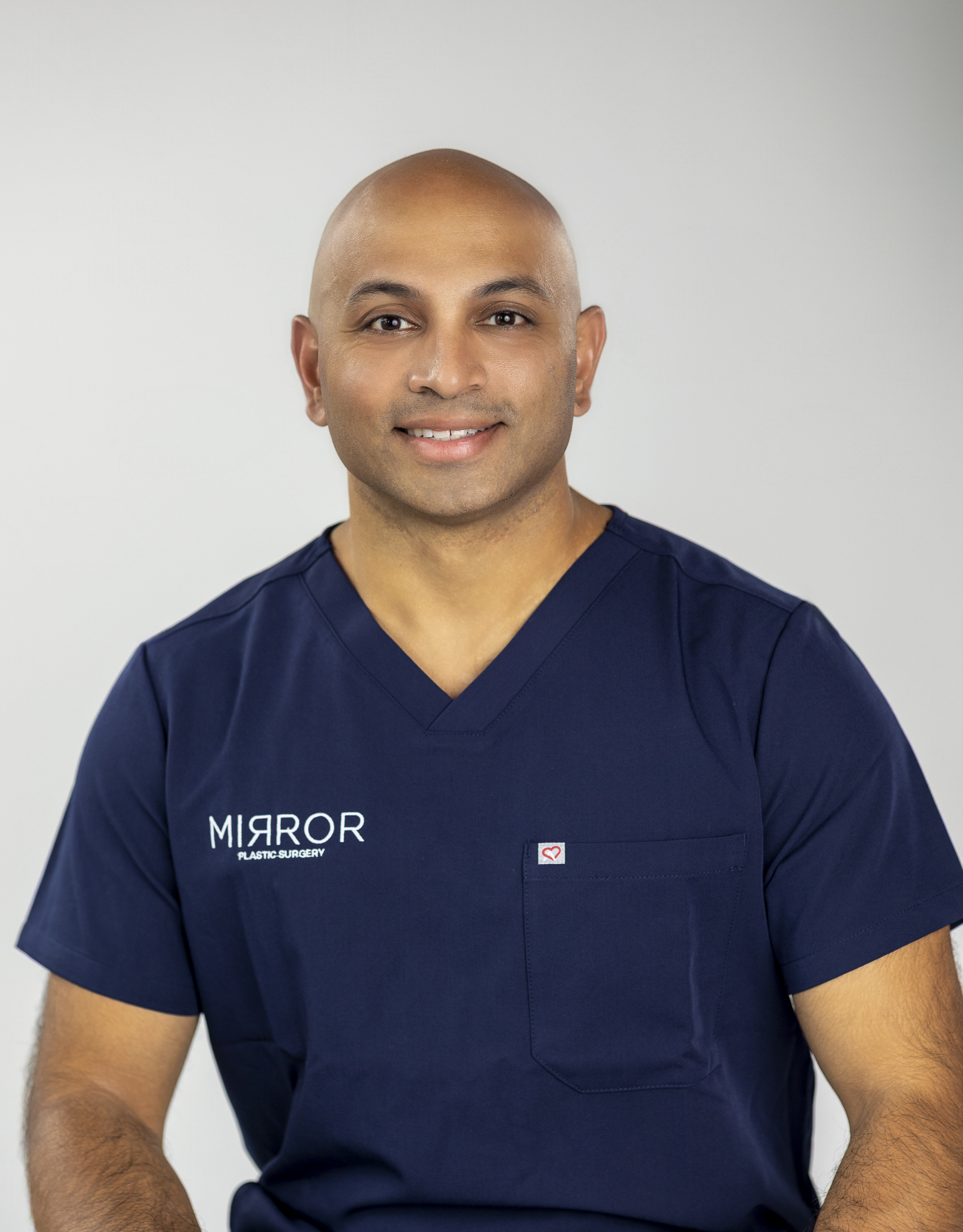
Mirror Plastic Surgery’s guiding hierarchy of safety first, function second, and aesthetics third means implant selection is never driven by volume targets or catalog defaults. Every recommendation is grounded in the patient’s measured anatomy and documented in a personalized surgical plan.
Schedule your hour-long anatomy assessment at Mirror Plastic Surgery’s St. Petersburg location to begin your personalized breast augmentation plan.
Frequently Asked Questions
How do surgeons determine the right implant size without using cup size as a guide?
Board-certified plastic surgeons measure breast base width, chest wall width, soft-tissue thickness, nipple-to-fold distance, and skin elasticity to select an implant whose base diameter fits within the natural breast footprint. Volume in cubic centimeters flows from those measurements, not from a target cup size. Cup size is not a reliable surgical metric because sizing varies widely between bra brands and styles, which makes it an inconsistent basis for a permanent anatomical decision.
What is dual-plane breast augmentation and why does it produce more natural results?
Dual-plane placement positions the upper portion of the implant beneath the pectoral muscle while the lower portion sits under the breast gland. Releasing the lower muscle attachment allows the implant to settle into a more anatomically natural position and softens the lower-pole contour. The upper-chest muscle coverage then blends the chest-to-breast transition.
This technique works especially well for patients with thinner tissues, mild ptosis, or athletic builds where above-muscle placement would leave implant edges visible.
Can fat grafting be combined with implants for a more natural look?
Fat grafting or structured adipose technologies like AlloClae can be used alongside implants to soften visible edges, improve upper-pole contour, or add subtle volume in areas where the implant alone does not blend seamlessly. This combination is most common in revision cases or in patients with very thin tissue coverage.
At Mirror Plastic Surgery, Dr. Akash evaluates whether adjunctive fat grafting is anatomically indicated during the initial consultation rather than recommending it as a default add-on.
What causes animation deformity and how is it avoided in athletic patients?
Animation deformity occurs when a submuscular implant shifts or distorts visibly during pectoral muscle contraction. This concern is most pronounced in athletic women with well-developed chest muscles and low body fat. Animation deformity can be minimized or eliminated by placing the implant in a subfascial, supramuscular, or dual-plane position that reduces direct muscle contact with the implant.
The appropriate plane depends on the patient’s tissue thickness, muscle mass, and activity level, all of which Dr. Akash assesses during the anatomy-first consultation.
How does Mirror Plastic Surgery’s consultation process differ from a standard breast augmentation consultation?
Mirror Plastic Surgery allocates up to one hour per initial consultation and limits daily surgical volume to one or two procedures so that no patient’s planning feels rushed. Dr. Akash conducts a comprehensive anatomical assessment covering all five key measurements, reviews chest-wall symmetry and soft-tissue quality, and discusses the safety-function-aesthetics hierarchy.
He then builds a personalized surgical plan before any implant selection is made. This level of individualized attention forms the foundation of the practice’s concierge medicine model and reduces the risk of size-related dissatisfaction or revision surgery.
Conclusion
Natural-looking breast augmentation functions as an anatomical exercise. Chest width, tissue thickness, nipple-to-fold distance, chest-wall curvature, and skin elasticity collectively determine which implant base, profile, and placement plane will integrate with a patient’s frame instead of overwhelming it. Moderate-profile silicone implants in a dual-plane position remain the evidence-based default for many body types, with adjustments for petite, athletic, broad, and post-pregnancy frames based on measured anatomy. Fat grafting and structured adipose options provide additional tools for edge softening and subtle volume refinement.
For Tampa-area women seeking proportionate, long-term results, the quality of the pre-operative assessment carries as much weight as the surgery itself. Mirror Plastic Surgery’s hour-long, anatomy-first consultations and Dr. Akash’s Harvard-MIT, Johns Hopkins, and MEETH credentials provide the clinical foundation for outcomes that look and feel entirely natural.1
Start your personalized augmentation plan at Mirror Plastic Surgery, 780 4th Ave S, St. Petersburg, FL 33701, or call 727-361-6515.
1 Results may vary from person to person. Editorial content, before and after images, and patient testimonials do not constitute a guarantee of specific results.