
Written by: Dr. Akash Chandawarkar, Board Certified Plastic Surgeon, Mirror Plastic Surgery | Last updated: June 24, 2026
Key Takeaways
-
The Brazilian butt lift is a high-risk procedure, so patients must closely review a surgeon’s training, safety record, and technique.
-
Patients in Tampa should confirm ABPS board certification, hospital privileges, and compliance with Florida’s 2026 BBL safety mandates, including ultrasound guidance and accredited facilities.
-
Choosing a practice that limits daily surgical volume to one or two cases supports focused attention and safer outcomes.
-
Advanced options such as ultrasound-guided grafting and structural approaches like AlloClae can improve fat retention and long-term results compared to traditional methods.1
-
Schedule an in-depth consultation with the team at Mirror Plastic Surgery to review your goals and confirm that every safety standard is met here.
Why BBL Safety in Florida Requires a Step-by-Step Surgeon Review
The BBL carries higher risk because the gluteal blood vessels sit close to the fat-grafting plane. Fat injected into or beneath the gluteal muscle can enter the venous system and trigger a life-threatening fat embolism.
This risk profile led Florida’s Legislature to enact BBL safety mandates via bills HB 1471 (2023) and HB 1561 (2024) that govern licensed practices in the state. Those mandates require real-time ultrasound guidance during fat injection. Patients should use these rules as the first filter when evaluating any surgeon, then move through the additional steps below.
Step 1: Confirm ABPS Board Certification and Local Hospital Privileges
In Florida, any licensed physician can legally market cosmetic surgery services. The title “board-certified” carries real weight only when it refers to certification by the American Board of Plastic Surgery (ABPS), the only board recognized by the American Board of Medical Specialties for plastic surgery.
ABPS certification requires completion of an accredited plastic surgery residency, passage of written and oral examinations, and ongoing maintenance of certification through continuing education and peer review.
Verification uses a two-part process because each step confirms something different about a surgeon’s qualifications. First, confirm ABPS certification directly through the ABMS Certification Matters database to validate formal training and examination credentials.
Second, confirm active hospital privileges with a Florida-accredited hospital, which involves an independent review of the surgeon’s training, outcomes, and malpractice history over time. Hospital privileges also create a safety net if a rare complication requires inpatient care.
Dr. Akash at Mirror Plastic Surgery holds ABPS board certification and active hospital privileges, and has been named to Newsweek’s America’s Best Plastic Surgeons list for two consecutive years. His training includes Harvard Medical School, a seven-year integrated plastic surgery residency at Johns Hopkins, and an aesthetic surgery fellowship at the Manhattan Eye, Ear and Throat Hospital.
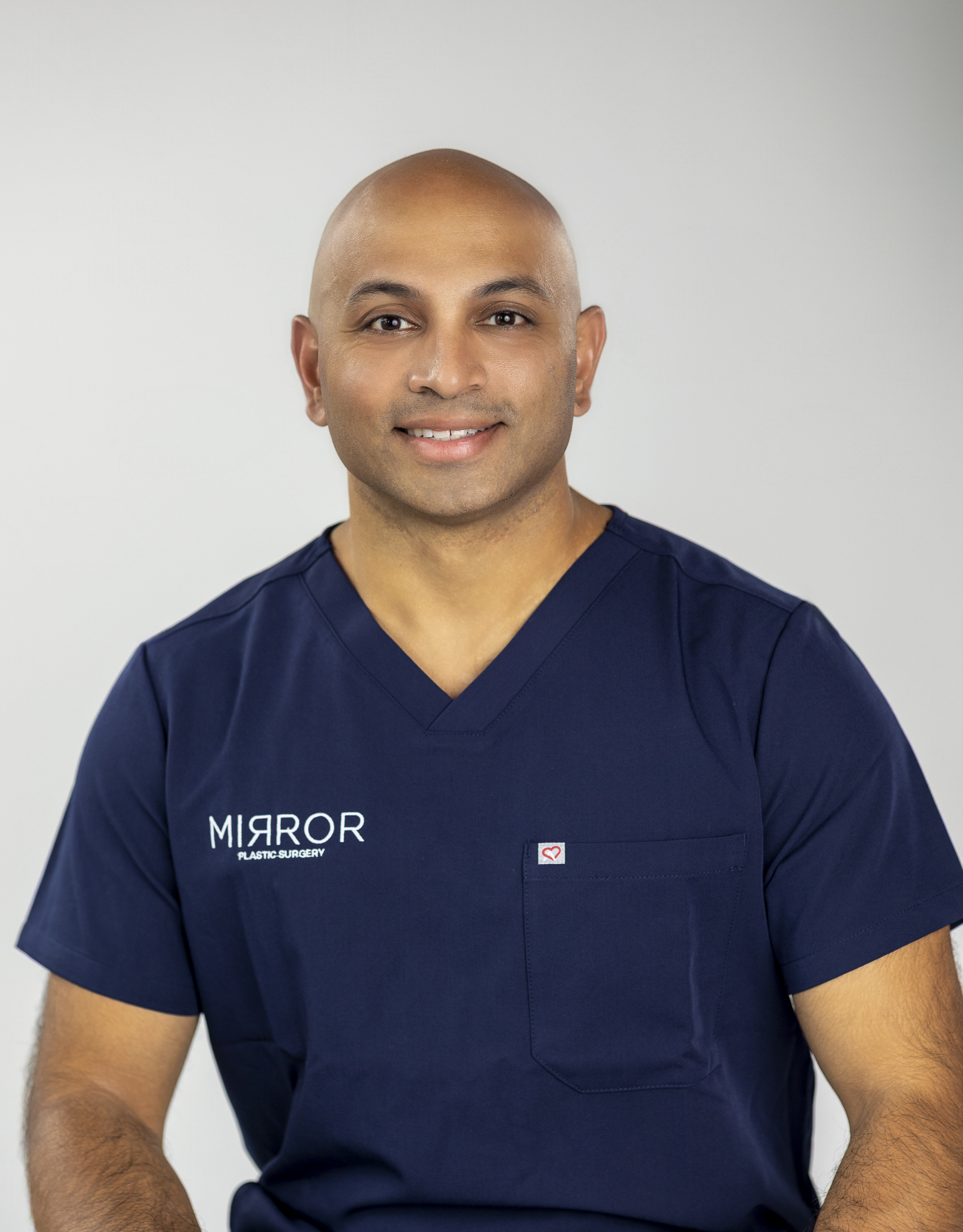
Book a consultation with Dr. Akash to review these credentials in person and discuss your candidacy for BBL surgery in Tampa.
Step 2: Check Compliance with Florida’s 2026 BBL Safety Rules
Florida’s regulatory framework for BBL procedures now sets three core requirements that work together to reduce risk.
First, fat must be injected exclusively in the subcutaneous plane, never submuscular, to eliminate the primary mechanism of fatal fat embolism.
Second, real-time ultrasound guidance must be used during fat injection to confirm needle position and prevent inadvertent intramuscular or intravascular placement.
Third, procedures must occur in a facility accredited by a recognized accrediting body such as the Accreditation Association for Ambulatory Health Care (AAAHC) or the American Association for Accreditation of Ambulatory Surgery Facilities (AAAASF), which supports these technical safeguards with standardized protocols.
When you evaluate a practice, ask directly whether the surgeon uses intraoperative ultrasound for every BBL case, and request the facility’s accreditation certificate. A surgeon who cannot clearly confirm both points is not meeting the current Florida standard.
Step 3: Review Daily Surgical Volume and Confirm Facility Accreditation
Florida’s daily case limits for BBL exist because surgical fatigue, reduced team focus, and compressed scheduling each increase the chance of complications. A practice performing five to ten surgeries per day divides anesthesia, nursing, and surgical attention across multiple simultaneous cases.
A practice limited to one to two cases per day concentrates the entire team’s resources on a single patient from pre-operative preparation through recovery.
Mirror Plastic Surgery performs one to two surgeries per day by design. This clinical policy ensures Dr. Akash’s full attention, the anesthesiologist’s focused monitoring, and the nursing team’s complete availability for every patient. Patients should also confirm facility accreditation independently. Ask for the accrediting body’s name and certificate number, then verify it directly on the accrediting organization’s website.
Step 4: Compare Traditional Fat Transfer with Ultrasound-Guided and AlloClae Structural Techniques
Traditional BBL fat transfer involves harvesting fat via liposuction, processing it by centrifugation or filtration, and reinjecting it into the subcutaneous gluteal tissue. Results depend heavily on fat survival rates, which vary with patient metabolism, post-operative positioning, and injection technique.
Volume loss of 30–50% in the months after surgery is common with traditional fat grafting, so revision procedures occur with some frequency.1
Ultrasound-guided BBL adds real-time imaging to the injection phase. The surgeon can see needle depth and confirm subcutaneous placement throughout the procedure. This approach reduces the risk of intramuscular injection and improves the precision of fat distribution for a more anatomically consistent result.1
AlloClae, a structural fat-grafting matrix on whose advisory board Dr. Akash serves through Tiger Aesthetics, represents a further advancement. AlloClae provides a scaffold that supports fat integration and can offer more durable volume retention than traditional fat transfer alone.1 Patients who want long-term gluteal augmentation with a lower likelihood of revision should discuss this option directly during consultation.1
Step 5: Plan for a Full Hour Focused on Your Anatomy
A brief fifteen to twenty minute BBL consultation cannot cover what this procedure requires. A thorough consultation should include a full anatomical assessment of the gluteal region, flanks, and donor sites.
It should also review the patient’s medical history and body composition, explain the specific technique recommended and why it fits the patient’s anatomy, outline realistic outcomes and fat survival expectations, and address revision considerations and facility accreditation, including compliance with Florida’s 2026 mandates.
Mirror Plastic Surgery’s consultations run up to one hour. Dr. Akash uses this time to explain the anatomy of the area being treated, review the evidence behind the recommended approach, and confirm that the patient’s goals align with what is safely achievable. This educational model reflects the practice’s core philosophy: safety first, function second, aesthetics third.
Book a consultation with Dr. Akash and experience a BBL evaluation built around your anatomy rather than a high-volume schedule.
Florida BBL Safety Checklist
|
Criterion |
Florida 2026 Requirement |
What to Ask the Practice |
Mirror Plastic Surgery |
|---|---|---|---|
|
Board Certification |
ABPS certification required for plastic surgery designation |
“Can I verify your ABPS certificate number?” |
ABPS board-certified |
|
Ultrasound Guidance |
Real-time ultrasound required during fat injection |
“Do you use intraoperative ultrasound on every BBL case?” |
Yes, ultrasound used for intraoperative guidance |
|
Daily Case Limits |
Regulatory daily volume limits in effect |
“How many BBL surgeries do you perform per day?” |
Limited number of surgeries per day, by clinical policy |
|
Facility Accreditation |
AAAHC or AAAASF accreditation required |
“What is your facility’s accrediting body and certificate number?” |
Accredited surgical facility, certificate available on request |
|
Hospital Privileges |
Not mandated but strongly indicative of independent credentialing |
“Do you hold active hospital privileges in Florida?” |
Yes, active hospital privileges held |
Key Questions to Bring to Your BBL Consultation
The questions below give you a practical checklist for evaluating any BBL surgeon in Tampa or elsewhere in Florida.
-
Are you certified by the American Board of Plastic Surgery, and can I verify that certification?
-
Do you hold active hospital privileges at a Florida-accredited hospital?
-
Do you use real-time ultrasound guidance during fat injection on every case?
-
How many BBL procedures do you perform per day, and what is your policy on daily case limits?
-
In which accredited facility will my procedure be performed, and can I see the accreditation certificate?
-
What technique do you recommend for my anatomy and why: traditional fat transfer, ultrasound-guided grafting, or a structural approach like AlloClae?
-
What is a realistic expectation for fat survival and long-term volume retention in my case?
-
What is your revision rate, and under what circumstances would a revision be recommended?
Conclusion: Use a Structured Checklist to Protect Your BBL Results
Selecting a board-certified Brazilian butt lift surgeon in Tampa, Florida directly affects your safety during surgery and the longevity of your results.1 Patients should confirm ABPS certification and hospital privileges, verify compliance with Florida’s 2026 BBL safety mandates, review daily surgical volume and facility accreditation, understand the proposed technique and its evidence base, and insist on a consultation long enough to address their anatomy in detail.
Mirror Plastic Surgery’s concierge model, with one to two cases per day, ultrasound guidance, ABPS certification, an accredited facility, and hour-long anatomical consultations with the Johns Hopkins-trained surgeon recognized earlier, is structured to meet every item on that checklist.
Book a consultation with Dr. Akash at Mirror Plastic Surgery in St. Petersburg, Florida, and begin your BBL evaluation with a surgeon whose credentials, regulatory compliance, and clinical philosophy center your safety.
Frequently Asked Questions
What does “board-certified plastic surgeon” mean in Florida, and why does it matter for BBL?
In Florida, any licensed physician can legally perform cosmetic surgery, including BBL procedures. The designation “board-certified plastic surgeon” is meaningful only when it refers to certification by the American Board of Plastic Surgery, the sole ABMS-recognized board for this specialty.
ABPS certification requires completion of an accredited plastic and reconstructive surgery residency program, passage of comprehensive written and oral examinations, and ongoing maintenance through peer review and continuing medical education.
For BBL, this matters because the procedure involves complex vascular anatomy where improper technique can cause life-threatening fat embolism. A surgeon without ABPS certification has not completed the standardized training and independent examination that the certification represents.
Patients evaluating any BBL surgeon in Tampa should confirm ABPS certification directly through the ABMS Certification Matters database before scheduling a consultation.
What are Florida’s current safety requirements for BBL surgery in 2026?
Florida’s regulatory framework for BBL procedures, developed between 2023 and 2026, establishes three core mandates detailed in Step 2. These include subcutaneous-only fat injection to prevent embolism, mandatory real-time ultrasound guidance to confirm needle placement, and accredited facility requirements.
Daily case volume limits are also in effect. Patients should ask about each requirement and request documentation, including the facility’s accreditation certificate and confirmation that intraoperative ultrasound is used on every case.
How does limiting BBL surgeries to one or two per day improve patient safety?
Surgical safety depends on team focus, preparation time, and the avoidance of fatigue-related errors. A practice performing five to ten surgeries per day divides anesthesia monitoring, nursing attention, and surgical concentration across multiple cases, often with tight scheduling between procedures.
A practice limited to one to two cases per day keeps the surgeon, anesthesiologist, and nursing team fully dedicated to a single patient from pre-operative preparation through recovery room discharge.
For BBL, where the margin between subcutaneous and intramuscular injection is measured in millimeters, this level of focused attention directly supports safer technique. Mirror Plastic Surgery’s one-to-two-surgeries-per-day policy reflects a deliberate commitment to safety before aesthetics.
What is the difference between traditional BBL fat transfer and an AlloClae structural approach?
Traditional BBL fat transfer involves harvesting fat via liposuction, processing it, and reinjecting it into the subcutaneous gluteal tissue. A known limitation of this approach is variable fat survival, because a meaningful percentage of transferred fat is reabsorbed by the body in the months after surgery. This reabsorption can reduce volume and change the final shape, so revision procedures are not uncommon.
AlloClae is a structural fat-grafting matrix that provides a scaffold to support fat integration, which can improve retention and offer more durable long-term volume compared with conventional grafting alone.1 It differs from biostimulatory fillers, which do not provide the same structural support for gluteal augmentation.
Dr. Akash serves on the advisory board for Tiger Aesthetics, the company behind AlloClae, and can discuss whether this approach fits a patient’s anatomy and goals during a full anatomical consultation.
What should I expect during a BBL consultation at Mirror Plastic Surgery?
A BBL consultation at Mirror Plastic Surgery runs up to one hour and centers on a comprehensive anatomical assessment rather than a quick review of photos and pricing. Dr. Akash evaluates the gluteal region, flanks, and potential donor sites, reviews the patient’s medical history and body composition, and explains the specific technique he recommends along with the anatomical reasoning.
The consultation also covers realistic outcomes, expected fat survival, and revision considerations, as well as Florida’s 2026 safety mandates and how the practice meets each one. Patients leave with a clear understanding of what is safely achievable for their anatomy. Mirror Plastic Surgery provides personalized pricing based on each patient’s anatomy and the scope of the recommended procedure.
1 Results may vary from person to person. Editorial content, before and after images, and patient testimonials do not constitute a guarantee of specific results.