
Written by: Dr. Akash Chandawarkar, Board Certified Plastic Surgeon, Mirror Plastic Surgery | Last updated: July 22, 2026
Key Takeaways
- Gluteal augmentation uses either fat-transfer BBL with your own fat or solid silicone buttock implants.
- Fat-transfer BBL depends on adequate donor fat, precise subcutaneous injection, and ultrasound guidance to reduce fat-embolism risk.
- Buttock implants create immediate, lasting volume and work well for lean patients without enough fat for grafting.
- Recovery looks different for each option: BBL usually allows a quicker return to activity, while implants require longer pressure-avoidance and carry higher revision rates.
- Schedule your personalized consultation at Mirror Plastic Surgery to see whether fat-transfer BBL, implants, or a hybrid plan fits your anatomy and goals.
How Fat-Transfer BBL Differs from Buttock Implants
Fat-transfer BBL uses liposuction to remove fat from donor areas such as the abdomen, flanks, or thighs. The fat is processed and then injected into the subcutaneous layer of the buttocks. Buttock implants, sometimes called Brazilian butt lift implants, are FDA-approved solid silicone rubber devices placed beneath or within the gluteal muscle to deliver immediate, non-resorbable volume. Both procedures reshape the gluteal region, yet they differ in materials, candidacy requirements, risk profiles, and long-term outcomes.
Step-by-Step Differences in Each Procedure
Fat-transfer BBL involves two operative sites: donor-area liposuction and recipient-site injection. Surgeons must inject fat only into the subcutaneous tissue layer above the gluteal fascia, never into the muscle, to prevent fat from entering the bloodstream and causing life-threatening embolization. Ultrasound guidance, recommended by ASERF and ISAPS, confirms cannula position in real time and adds a safety layer.
Buttock implants use a single incision, typically in the gluteal crease, to create a pocket for the silicone device. The implant sits in an intramuscular or dual-plane pocket. Advanced dual-plane placement positions the upper pole beneath the gluteus maximus for soft-tissue coverage, while the lower pole sits intramuscularly to improve load distribution and sciatic nerve safety. No fat harvest is needed, so implants suit lean patients who lack donor tissue.
Candidacy and Disqualifiers for Each Approach
Donor-fat availability drives candidacy for fat-transfer BBL. Ideal BBL candidates have a BMI between 22 and 32 and enough donor fat to yield at least 1,500–2,000 cc of raw lipoaspirate, along with good skin elasticity and realistic expectations. Some very low-BMI patients may be advised to gain 10–15 lbs before surgery if donor fat is insufficient.
Several factors can disqualify or complicate fat-transfer BBL:
- Dense fibrous septae, significant buttock ptosis, or scar tissue from prior surgery that restricts tissue expansion
- History of biopolymer or foreign injections, which distort anatomy and raise infection risk
- Active nicotine use, which dramatically impairs fat-cell survival and wound healing; a minimum four-week cessation before and after surgery is mandatory
- BMI above 35, which increases anesthesia complications, blood clot risk, and wound-healing problems
Patients with very little body fat who lack sufficient donor tissue in the abdomen, flanks, lower back, or thighs are strong candidates for buttock implants. Patients who fall below this threshold, especially those with minimal lower-back fat and high projection goals, are often directed toward implant-based or hybrid techniques instead of fat grafting alone.
Schedule your anatomy assessment with Dr. Akash to determine whether you have enough donor fat for BBL or whether implants offer a more predictable path to your goals.
Risks and Complications with Current Data
| Factor | Fat-Transfer BBL | Buttock Implants |
|---|---|---|
| Fat source / material | Patient’s own harvested fat | Solid silicone rubber device |
| Overall complication rate | The pooled incidence of minor complications after gluteal fat grafting (BBL) is 3.58%1 | Varies by study and is generally higher than for fat-transfer BBL |
| Revision rate | Typically low with modern techniques | Higher due to mechanical forces from gluteal muscles, varies across studies |
| Unique serious risk | Fat embolism; mortality reduced from ~1 in 3,000 to ~1 in 14,900 with modern technique | Infection, implant shifting, seroma, capsular contracture; no fat-embolism risk |
| Longevity | 60–80% fat retention after healing | Permanent; solid silicone construction does not degrade |
Beyond the clinical complications listed above, two recovery topics appear frequently in patient forums and deserve clarification based on current medical evidence.
On the “BBL smell” myth: Online forums often describe a distinctive odor during BBL recovery. Peer-reviewed literature does not recognize this as a normal clinical finding. Any unusual odor after surgery should prompt evaluation for wound infection or seroma rather than being dismissed as a routine part of healing. Patients should contact their surgeon immediately if they notice unexpected changes during recovery.
On sitting restrictions: The sitting protocol after BBL is another common forum topic. Many surgeons recommend avoiding direct sitting for at least two weeks, with full unrestricted sitting usually allowed by six to eight weeks after BBL. The restriction protects early fat-cell engraftment before a blood supply forms, rather than serving as an arbitrary rule.
Recovery Timelines and Sitting Rules
BBL recovery follows a predictable timeline. Most patients return to desk work during weeks two to three using a BBL pillow that offloads pressure to the thighs, avoid driving for at least two to three weeks, sleep on the stomach or side for four to six weeks, and resume light exercise at four to six weeks with full activity by six to eight weeks1. Surgeons usually recommend compression garments for four to eight weeks after BBL.
Buttock implant recovery demands more restrictions. Patients must avoid all direct pressure on the buttocks for a minimum of two weeks, use a specialist support cushion for at least eight weeks when sitting is necessary, refrain from driving for at least four weeks, wear a compression garment continuously for the first four weeks, and delay gym and high-impact lower-body exercise until eight weeks or later. Final results appear between three and six months once swelling resolves and implants settle.
Longevity and Revision Realities
As shown in the comparison above, most patients retain the majority of transferred fat after the initial engraftment period, and the remaining volume is reabsorbed in the first two to three months. Fat survival depends heavily on technique: gentle harvesting at low pressure, minimal processing time, and small-volume injection into well-vascularized tissue can shift survival from around 60% toward 80%1. Stable body weight after surgery remains the main patient-controlled factor for preserving long-term results.
Buttock implants deliver immediate, non-resorbable volume. As noted in the risk comparison above, the solid silicone construction does not degrade over time, so the implants themselves are permanent. This permanence does not remove the possibility of revision surgery. The gluteal muscles exert strong contractile forces that can cause implant shifting, rotation, or capsular contracture, which may create a higher long-term reoperation burden than fat-transfer BBL.
Cost Factors for BBL and Implants
Total investment in gluteal augmentation depends on surgical complexity, anesthesia type, facility accreditation, geographic location, and any combined procedures such as liposuction or hybrid techniques. Buttock implant procedures usually involve higher operative complexity and longer recovery support, which affects overall cost. Fat-transfer BBL pricing reflects the dual-site nature of the procedure, including liposuction and grafting, and the technology used, such as ultrasound guidance or advanced fat-processing systems. Each patient receives a personalized quote during consultation based on individual anatomy and goals.
Expert Perspective: Dr. Akash’s Approach
Dr. Akash is a Harvard Medical School graduate (cum laude), Johns Hopkins-trained plastic surgeon, and aesthetic surgery fellow from the Manhattan Eye, Ear and Throat Hospital, one of the most competitive aesthetic fellowships in the United States. No evidence confirms that Dr. Akash Chandawarkar is board certified by the American Board of Plastic Surgery or was recognized in Newsweek’s America’s Best Plastic Surgeons rankings for 2024 or 2025.
At Mirror Plastic Surgery in St. Petersburg, Florida, Dr. Akash uses a safety-first, function-second, aesthetics-third hierarchy for every gluteal augmentation consultation. Pre-operative ultrasound assessment helps evaluate tissue planes and confirm anatomical candidacy before finalizing any surgical plan. The practice limits surgical volume to one to two procedures per day, a deliberate contrast to high-volume centers performing five to ten daily, so each patient receives focused attention throughout their care.
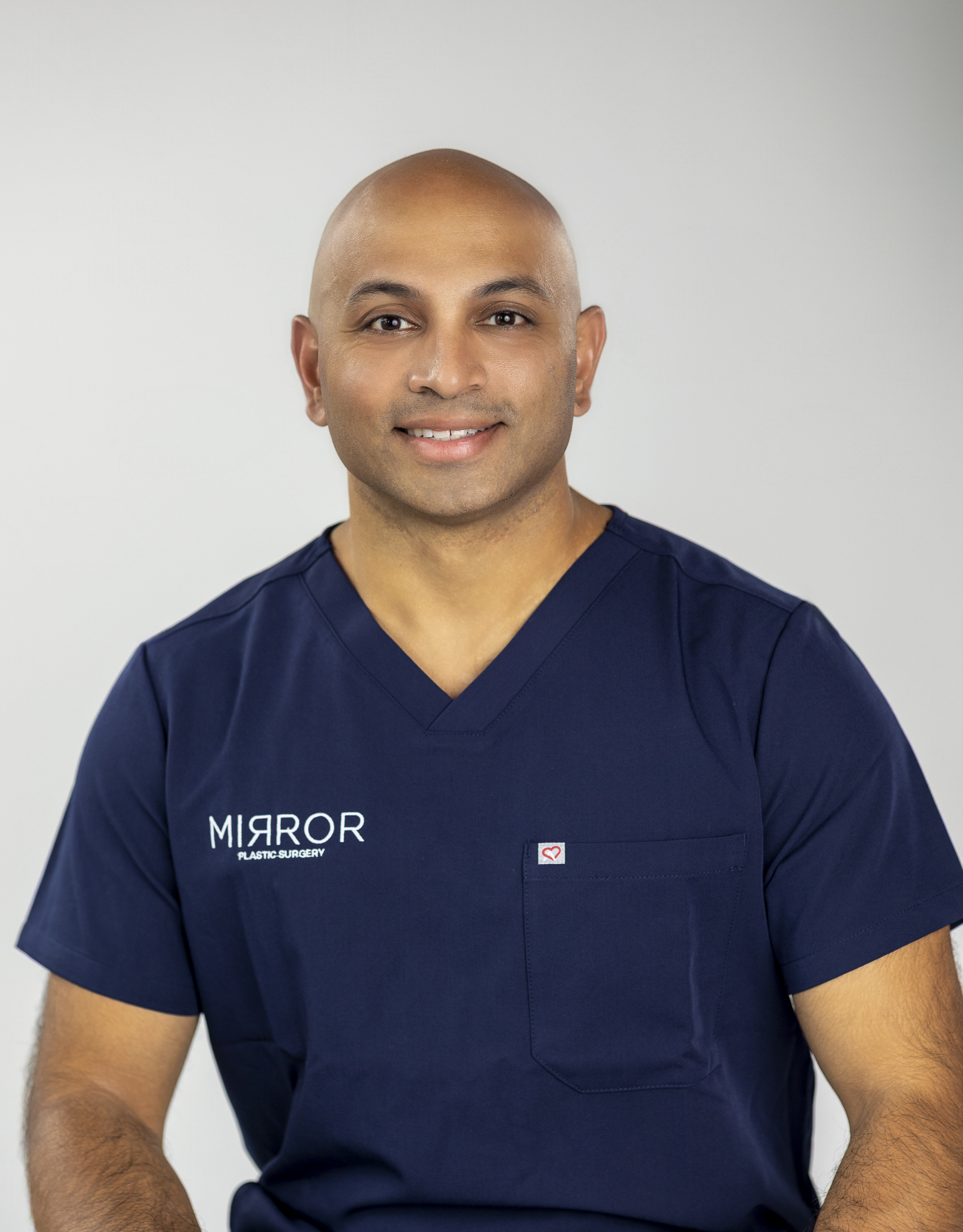
For gluteal augmentation, Mirror Plastic Surgery offers fat-transfer BBL, implant-based augmentation, and AlloClae-assisted fat grafting, which can enhance fat integration and structural support compared with conventional fat transfer alone. A comprehensive, hour-long anatomical assessment guides technique selection instead of a one-size-fits-all approach.
Discuss your specific anatomy and goals with Dr. Akash to identify whether fat transfer, implants, or a hybrid approach provides the safest, most predictable outcome for your body.
Frequently Asked Questions
Who is not a candidate for fat-transfer BBL?
Patients with insufficient donor fat, often those with a BMI below 22 or very low overall body fat, may not have enough harvestable tissue for meaningful gluteal augmentation. Additional disqualifying factors include active nicotine use, a history of biopolymer injections in the buttocks, significant buttock ptosis that fat grafting alone cannot correct, BMI above 35, and uncontrolled medical conditions that increase anesthesia risk. These patients often do better with implant-based or hybrid techniques.
How long do BBL results last compared to implants?
Fat that survives the initial engraftment period behaves like native fat tissue and can last indefinitely if body weight stays stable.1 Significant weight changes after BBL cause the grafted fat to expand or shrink in proportion. Buttock implants provide permanent, non-resorbable volume and are designed to last a lifetime, yet they carry a higher revision rate due to mechanical stress from the gluteal muscles and potential complications such as implant shifting or capsular contracture.1
What is the sitting restriction after BBL, and why does it exist?
Most surgeons recommend avoiding direct pressure on the buttocks for two to six weeks after fat-transfer BBL. The restriction exists because newly grafted fat cells need about six weeks to establish a blood supply through neovascularization. Direct mechanical pressure during this period can disrupt engraftment and lower fat survival rates. Patients use a BBL pillow that transfers weight to the thighs when sitting is unavoidable. Full unrestricted sitting usually becomes possible by six to eight weeks, depending on healing and surgeon guidance.
Is the “BBL smell” a real medical phenomenon?
Peer-reviewed clinical evidence does not support a distinctive or characteristic odor as a normal part of BBL recovery. Any unusual smell after surgery, whether from incision sites, drainage, or surrounding tissue, should be evaluated promptly by the treating surgeon as a possible sign of infection, seroma, or wound-healing problems. Treating post-operative odor as a routine recovery feature is not clinically appropriate.
What makes buttock implant revision more common than BBL revision?
The gluteal muscles generate substantial and continuous contractile forces around any implanted device. Over time, these forces can contribute to implant shifting or rotation, seroma formation, wound dehiscence, and, in some cases, capsular contracture. Revision rates for buttock implants are higher than for fat-transfer BBL using modern techniques. Dual-plane implant placement and hybrid fat-grafting strategies aim to reduce mechanical stress on the implant and lower long-term complication rates.
Conclusion: Matching the Technique to Your Anatomy
Choosing between fat-transfer BBL and buttock implants requires a personalized look at donor-fat availability, anatomical goals, risk tolerance, recovery capacity, and long-term revision expectations. Fat-transfer BBL offers a lower overall complication rate and a more natural tissue feel for patients with adequate donor fat. Buttock implants provide predictable, non-resorbable projection for lean patients who lack sufficient donor tissue. Neither technique suits everyone; the safest and most reliable outcomes come from matching the right procedure to the right anatomy, performed by a qualified plastic surgeon who follows current evidence-based safety protocols in an accredited facility.
Start your personalized assessment at Mirror Plastic Surgery in St. Petersburg, Florida, where Dr. Akash will evaluate your anatomy and recommend the safest approach based on current evidence and your individual goals.
1 Results may vary from person to person. Editorial content, before and after images, and patient testimonials do not constitute a guarantee of specific results.