Written by: Dr. Akash Chandawarkar, Board Certified Plastic Surgeon, Mirror Plastic Surgery | Last updated: July 14, 2026
Key Takeaways
- Brachioplasty removes excess upper-arm skin and fat for a slimmer contour and leaves a permanent inner-arm scar that matures over 12–18 months.1
- Scars follow clear stages, starting red and raised, then turning pink or purple, and finally fading to a thin, pale line with consistent care.
- Recovery follows a predictable schedule: most patients return to desk work in 1–2 weeks, resume light cardio at 3–4 weeks, and see final contour by 4–6 months.1
- Ideal candidates maintain stable weight, have a BMI under 30, do not smoke, and accept visible scarring as the trade-off for improved arm shape and comfort.
- Schedule your personalized consultation at Mirror Plastic Surgery to review your goals and receive a tailored treatment plan from Dr. Akash.
How Brachioplasty Scars Change at 1 Month, 6 Months, and 1 Year
Brachioplasty scars follow a predictable biological sequence across three overlapping phases, evolving from a red, raised line to a thin, pale mark. Knowing what to expect at each stage helps you recognize normal healing and avoid mistaking it for a complication.
Inflammatory phase (weeks 1–4): The wound is red, swollen, firm, and tender as the body deposits collagen to close the incision. This early appearance is expected and does not indicate poor healing.
Proliferative phase / 1-month mark (months 1–3): The scar typically thickens and darkens to pink or purple in lighter skin tones, and often feels itchier as inflammation subsides and nerve endings regenerate. Patients with Fitzpatrick skin types IV–VI may notice more pronounced hyperpigmentation during this window.
Active remodeling / 6-month mark (months 3–6): Some scars temporarily darken or thicken before beginning to soften, which is the phase patients most commonly mistake for abnormal scarring. Disorganized collagen is gradually replaced by a more orderly pattern, and redness starts to fade.
Maturation / 12-month mark (months 6–18): Brachioplasty scars transition from purple-red to pink during months 7–12, then fade to a faint white or silver line. A mature 12-month scar is typically flat, pale pink to silver-white, and optimally 2–4 mm wide when healing proceeds without complications. Minor improvements may continue through 18–24 months.
Consistent silicone sheeting and careful sun protection are the two most evidence-supported ways to improve scar appearance throughout this timeline.
Brachioplasty Recovery Timeline and Activity Milestones
Recovery milestones are consistent across published clinical guidance and allow patients to set realistic expectations for each phase. The following outline reflects the consensus from multiple surgical sources and shows when most people feel ready to work, exercise, and resume daily routines.
First Week After Surgery (Days 1–7)
- Days 1–3: Pain is moderate, rated 4–6 out of 10, and feels tight and aching along the inner arms. Prescription medication usually controls discomfort well. Swelling and bruising peak within the first 72 hours. Arms should rest elevated on pillows to reduce edema.
- Days 4–7: Pain improves noticeably by day four as the acute tissue response settles. Ice packs and gentle repositioning support comfort alongside medication. Drains, when placed, are typically removed within 3–7 days.
Weeks 2–6: Returning to Work and Exercise
- Week 2: Most patients transition to over-the-counter acetaminophen or ibuprofen within 5–7 days. Sutures are addressed at 7–14 days. Desk work is generally possible once narcotics are no longer required.
- Weeks 3–4: Patients must avoid lifting anything over 5 pounds for the first 4 weeks. Compression garments are worn full-time day and night for the first four weeks, then during the day for an additional two weeks.
- Weeks 5–6: Light lower-body cardio usually resumes during this period. Upper-body weight training begins at 6–8 weeks with surgeon clearance, starting at 5–10 pounds of resistance.
Months 3–18: Long-Term Healing and Scar Maturation
- Months 3–6: Residual subtle swelling can persist for 3–6 months and is most noticeable at the end of the day. Nerve sensation continues to recover throughout this window.
- Months 6–18: Scar maturation progresses and then completes. Some degree of numbness or tingling affects most patients, and sensation typically returns within 6–12 months, though small areas of reduced sensitivity may persist permanently.
Get your personalized recovery timeline. Dr. Akash will map out when you can safely return to work, exercise, and daily activities based on your anatomy and lifestyle.
Immediate Results Versus Final Brachioplasty Outcome
Patients notice slimmer arm contours as soon as surgery is complete, although swelling, bruising, and compression garments initially hide the final shape. Final results are visible once swelling has fully subsided at 4–6 months.1
At 4–6 weeks, the arm contour is substantially improved but still softened by residual edema. Scars are at their most visible during this window, appearing red, raised, and firm. Over the following months, swelling continues to resolve and scars mature through the remodeling phases described earlier, so the transformation becomes more apparent. At 12–18 months, contour is fully settled, scars have faded to a pale line, and the arm profile is stable. Results are considered lifelong provided weight remains stable.1
Mini Arm Lift Results Versus Traditional Brachioplasty
The timeline and scar appearance described above apply to traditional brachioplasty, and not every patient needs the full procedure. The mini and traditional operations address different degrees of skin laxity and create different scar patterns, so choosing the right option depends on your anatomy.
Mini brachioplasty uses a crescent or fish-shaped incision placed entirely within the armpit fold, leaving no scar on the visible arm. It suits patients with mild to moderate skin laxity limited to the upper arm near the armpit who want subtle refinement. Liposuction may be added when excess fat contributes to arm fullness.
Traditional brachioplasty uses an incision running from just above the elbow along the inner arm to the armpit, allowing removal of a large elliptical segment of skin and fat. It is indicated for patients with moderate to significant sagging that extends from the armpit toward the elbow, the classic “bat wing” often seen after major weight loss.
An extended brachioplasty variant begins above the elbow, traverses the inner arm and armpit, and continues onto the lateral chest wall to treat patients who have lost more than 100 pounds. Dr. Akash determines which approach is anatomically appropriate during a comprehensive consultation and does not default to a single technique for all patients.
Is Brachioplasty Worth It? Who Usually Benefits Most
Brachioplasty offers benefits beyond aesthetics, including reduced skin irritation, easier hygiene in the underarm fold, and greater comfort in fitted clothing. The main trade-off is a visible scar along the inner arm.
Ideal candidates meet the following criteria:
- Stable weight for at least 6 months, within 10–15 pounds of goal weight, which helps prevent recurrent sagging or suture stress from future fluctuations.
- BMI below 30 for optimal safety and results, with candidacy still assessed individually.
- Significant upper-arm skin laxity, with loose, hanging skin that will not retract with exercise or non-surgical treatments.
- Non-smoker or willing to avoid all nicotine products for 4–6 weeks before and after surgery, since nicotine impairs circulation and incision healing.
- Good general health without uncontrolled conditions such as diabetes or cardiovascular disease that interfere with wound healing.
- Realistic expectations about permanent scarring, recognizing that the scar is an expected trade-off rather than a complication.
- Patients who achieved weight loss with GLP-1 receptor agonists need a full 6-month period of weight stability so skin, tissues, and nutritional status can stabilize before surgery.
There is no specific age requirement. The decision is based on physical findings, skin quality, health status, and personal circumstances rather than age alone.
How Painful Is an Arm Lift Procedure? What to Expect
Once you know you are a good candidate, pain and comfort during recovery usually become the next concern. Patients typically describe post-operative sensation as deep tightness and soreness rather than sharp pain. Pain is most commonly rated 4–6 out of 10 during the first 3–5 days, usually well controlled with prescription medication, then transitioning to over-the-counter analgesics by days 5–7.
Patients who have undergone both brachioplasty and abdominoplasty often describe arm-lift pain as less intense than tummy-tuck recovery, with brachioplasty typically requiring prescription pain medication for 3–5 days compared with 5–10 days for abdominoplasty. Non-pharmacological strategies such as ice packs, arm elevation, and gentle repositioning work alongside medication and help improve comfort throughout recovery.
Discuss your pain management plan with Dr. Akash and learn exactly what to expect at each stage of your recovery.
Why Surgeon Credentials Shape Your Brachioplasty Results
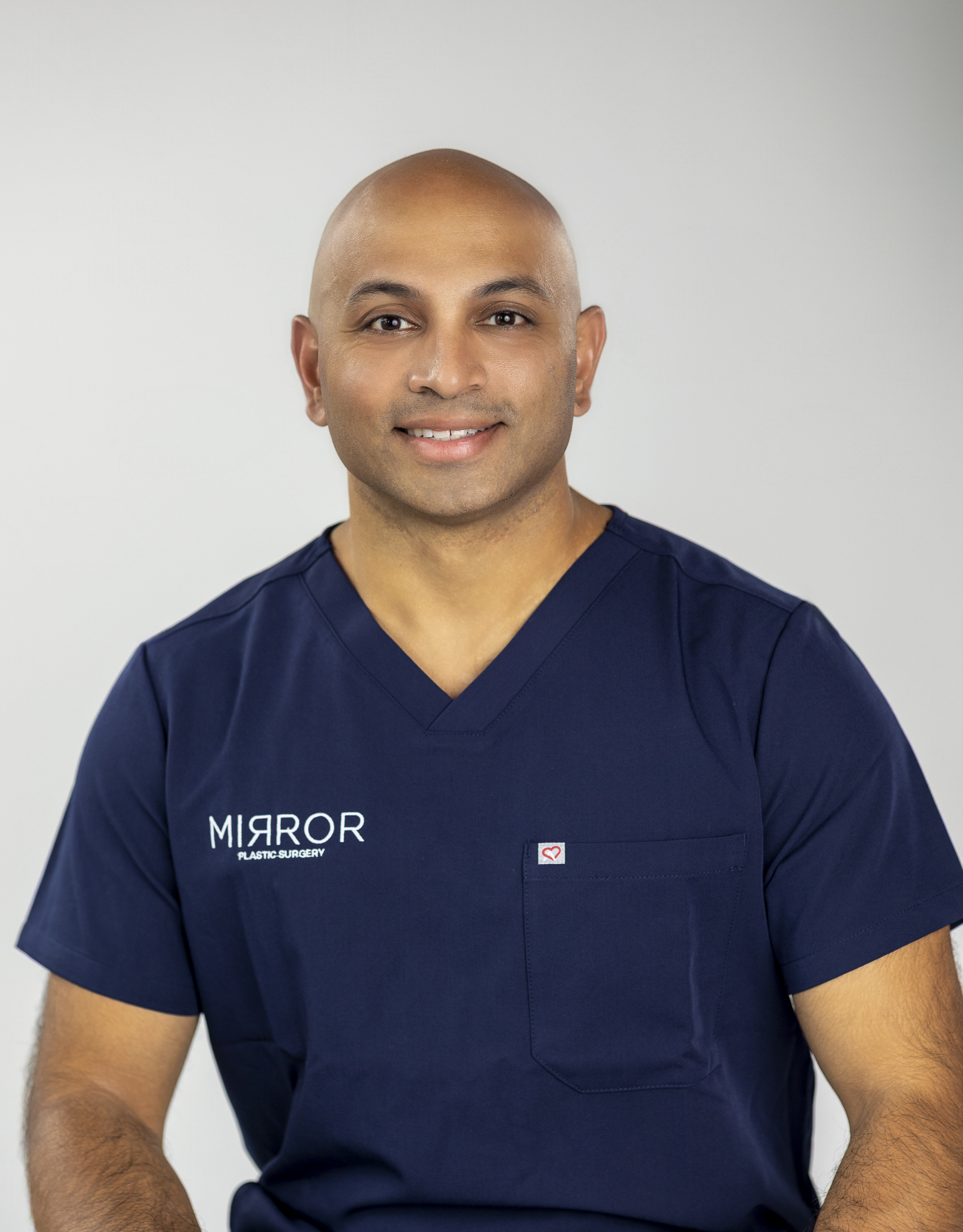
Brachioplasty outcomes, including contour quality, scar placement, and complication rates, closely track with surgical training and anatomical expertise. At Mirror Plastic Surgery, every brachioplasty is performed by Dr. Akash, a Harvard Medical School graduate (cum laude) who completed the Harvard-MIT Division of Health Sciences and Technology program and a seven-year integrated plastic and reconstructive surgery residency at Johns Hopkins University. His residency included rotations at the Johns Hopkins Hospital, the R Adams Cowley Shock Trauma Center, and the Curtis National Hand Center for microsurgical training.
After residency, Dr. Akash completed an aesthetic surgery fellowship at the Manhattan Eye, Ear and Throat Hospital (MEETH), one of the most competitive programs in the country for advanced body contouring, facial rejuvenation, and breast surgery. He also completed the Stanford University Biodesign Innovation Fellowship, which trained him to integrate emerging surgical technologies into clinical practice. Dr. Akash is board certified by the American Board of Plastic Surgery and has been named in America’s Best Plastic Surgeons 2025 by Newsweek for two consecutive years.
Mirror Plastic Surgery performs one to two surgeries per day, a deliberate limit that keeps the entire clinical team focused on each patient before, during, and after the procedure. This concierge model contrasts with high-volume practices that may perform five to ten surgeries daily.
Schedule your consultation at Mirror Plastic Surgery and experience the difference that elite training and a concierge approach make in your brachioplasty outcome.
Frequently Asked Questions
What is a realistic brachioplasty scar after 1 year?
At the 12-month mark, the scar described in the timeline above is considered fully mature. Beyond the flat, pale appearance noted earlier, you can expect the scar to feel soft to the touch and remain flush with surrounding skin. Patients with darker skin tones may retain more visible pigmentation at this stage, although improvement often continues through 18–24 months. Consistent use of silicone sheeting and sun protection from the second week onward supports the final appearance. The scar usually runs along the inner arm and is not visible when the arms rest at the sides of the body.
How long is brachioplasty recovery, and when can I return to work?
Return-to-work timing follows the recovery milestones outlined above, with 1–2 weeks typical for desk jobs and 10–14 days for physically demanding roles. The key factor is being off prescription pain medication and able to keep your arms close to your body without strain. Lifting remains limited early on, and activity gradually increases as your surgeon clears each stage. Full scar maturation takes 12–18 months, although the arm contour is largely settled by months 4–6.
Is a mini arm lift a good option, and who qualifies?
A mini arm lift works well for patients with mild skin laxity confined to the area near the armpit who are close to their goal weight and want subtle refinement. The incision sits within the armpit fold and leaves no scar on the visible arm surface. It cannot correct skin laxity in the lower half of the arm near the elbow. Patients with moderate to severe hanging skin, the classic “bat wing” appearance, need a traditional brachioplasty with a longer inner-arm incision to achieve meaningful correction. The correct procedure is chosen after a thorough anatomical assessment rather than by preference alone.
What age is appropriate for brachioplasty?
There is no specific age requirement for brachioplasty. As noted in the candidacy section above, the procedure is performed across a wide age range, from adults in their 30s after significant weight loss to patients in their 60s with age-related skin laxity. Your individual anatomy, health status, and goals matter more than your birth year. A comprehensive evaluation at Mirror Plastic Surgery reviews these factors instead of applying an age-based cutoff.
What are the most important factors for choosing a brachioplasty surgeon in Tampa?
Board certification by the American Board of Plastic Surgery is the baseline credential to verify. Beyond certification, important factors include fellowship training in aesthetic body contouring, hospital privileges that provide a safety net in the rare event of a complication, and a documented philosophy that prioritizes safety and function before aesthetics. The consultation should allow enough time to discuss anatomy, scar expectations, and recovery in detail. A surgeon who performs a limited number of procedures per day, rather than operating at high volume, can dedicate the attention and precision that brachioplasty requires. Dr. Akash’s Harvard-MIT, Johns Hopkins, and MEETH training, combined with Mirror Plastic Surgery’s concierge model, reflects these standards.
1 Results may vary from person to person. Editorial content, before and after images, and patient testimonials do not constitute a guarantee of specific results.