
Written by: Dr. Akash Chandawarkar, Board Certified Plastic Surgeon, Mirror Plastic Surgery | Last updated: July 12, 2026
Key Takeaways for Tampa Tummy Tuck Patients
- Board certification from the American Board of Plastic Surgery (ABPS) is the only plastic surgery credential recognized by the ABMS and reflects rigorous training and ethical standards.
- Credential verification, facility accreditation, and a surgeon’s commitment to full muscle repair work together to support safe, lasting abdominoplasty results.1
- Full abdominoplasty with complete rectus fascia repair restores core strength and corrects diastasis recti more effectively than mini tummy tucks, which leave upper abdominal separation unaddressed.1
- Tampa’s heat and humidity make strict compression-garment use essential during the four-to-six-week recovery period to reduce seroma risk and support healing.
- Schedule your personalized assessment with Dr. Akash at Mirror Plastic Surgery to confirm your candidacy for a safe, functional tummy tuck.
Why Board Certification Matters for Your Tummy Tuck
ABPS certification requires completion of an accredited residency, three to five years of advanced training depending on the specialty, and passage of a written examination (with some boards also requiring an oral exam) covering the full scope of plastic surgery procedures. This training pathway matters because the ABPS is a member board of the ABMS, which hospitals and credentialing bodies recognize as the standard for physician certification. ABPS-certified surgeons operate only in accredited medical facilities, adhere to strict ethical standards, and complete continuing medical education requirements to maintain certification.
The term “cosmetic surgeon” has no ABMS-recognized meaning. Physicians board-certified in other specialties, such as dermatology or oral surgery, may legally use the title without specific training in plastic, reconstructive, or cosmetic surgery. A 2023 University of Florida outpatient safety study found that serious complications often occur outside major centers, which makes formal training and facility oversight even more relevant.
The following checklist supports methodical credential verification before any abdominoplasty consultation:
- Verify active ABPS certification at the ABMS Certification Matters database, which is refreshed daily and recognized by The Joint Commission as primary source verification.
- Confirm the surgeon holds active hospital privileges at an accredited facility, so an independent credentialing body has reviewed their qualifications.
- Verify the surgical facility is accredited by AAAHC, JCAHO, or an equivalent body.
- Confirm a board-certified physician anesthesiologist, not a CRNA alone, will manage anesthesia.
- Review the surgeon’s residency and fellowship training specifically in plastic and reconstructive surgery.
Verify Dr. Akash’s credentials in person during a consultation and receive a thorough anatomical assessment before any surgical decision is made.
Medical and Lifestyle Factors That Can Disqualify a Tummy Tuck
Several medical and lifestyle factors significantly elevate surgical risk or preclude candidacy for abdominoplasty. Active smokers face impaired wound healing because nicotine reduces blood flow. Patients who avoid nicotine before and after abdominoplasty tend to heal more predictably.1 Most surgeons require complete cessation for a minimum of four to six weeks before and after surgery.
Additional factors that may disqualify or delay candidacy include:
- Uncontrolled autoimmune or connective tissue disorders that impair healing
- Active or recent cancer treatment
- Uncontrolled diabetes or cardiovascular disease
- Morbid obesity with a BMI above the surgeon’s established threshold
- Plans for future pregnancy, which can reverse muscle repair and skin tightening
- Recent significant weight fluctuation
- Blood clotting disorders or anticoagulant therapy that cannot be safely managed
Beyond these medical factors, Tampa-area patients should also consider a practical element of candidacy: proximity to the surgical practice matters during recovery. Follow-up access in the weeks after surgery is a safety variable, not a convenience preference. Choosing a local, low-volume practice with direct surgeon availability reduces the risk that complications go unaddressed.
How a Tummy Tuck Addresses Diastasis Recti
Full abdominoplasty with muscle repair directly addresses diastasis recti, the separation of the rectus abdominis muscles that commonly results from pregnancy or significant weight changes. The procedure restores the abdominal wall from the chest to the pubic area by suturing the separated muscle fascia back to the midline. This repair re-establishes core integrity that no amount of exercise can replicate once the fascia has separated.1
This functional restoration has measurable quality-of-life benefits.1 A 2025 randomized clinical trial in normal-weight postpartum women with symptomatic rectus diastasis measured low back disability and health-related quality of life at one-year follow-up, finding significant improvements in both metrics after abdominoplasty with muscle repair compared to conservative management.1
Mini tummy tucks, which address only the tissue below the navel, leave upper abdominal muscle separation unrepaired. Patients who undergo a limited approach often retain functional weakness and visible upper abdominal pooching that a full procedure would have corrected. At Mirror Plastic Surgery, the emphasis on function before aesthetics means that incomplete muscle repair is not considered an acceptable outcome.
Full Abdominoplasty vs Mini Tummy Tuck for Core Repair
Understanding the difference between these two approaches is essential to making an informed decision about diastasis recti repair. Full abdominoplasty repositions the navel, removes excess skin above and below it, and repairs the entire length of the rectus muscle fascia. As noted earlier, a mini tummy tuck addresses only the lower abdominal skin panel and does not reposition the navel or address the upper muscle separation that affects most postpartum patients.
The anatomical differences produce distinct functional outcomes. Patients with diastasis recti extending above the navel, which includes the majority of postpartum patients, will not achieve complete core restoration with a mini approach. Full abdominoplasty procedures addressing skin and muscle above and below the navel typically require a slightly longer recovery than mini tummy tucks focused below the navel,1 but the functional and aesthetic completeness of the result justifies that difference for appropriate candidates.
Mirror Plastic Surgery avoids mini tummy tucks that address only the lower abdomen, because partial approaches can leave upper abdominal pooching and unresolved muscle weakness. True functional restoration requires full abdominal wall repair.
Tummy Tuck Recovery in Tampa’s Climate
Tampa’s heat and humidity act as relevant clinical variables during abdominoplasty recovery. Compression garments are worn for four to six weeks post-operatively, and Florida’s summer temperatures make garment use uncomfortable, yet compliance remains non-negotiable for effective healing and seroma prevention. A systematic review and meta-analysis reported high global seroma rates following abdominoplasty, which makes compression adherence a primary prevention strategy.
A general week-by-week recovery framework for full abdominoplasty follows:
- Week 1: Swelling, tightness, and bruising are expected, patients walk slightly bent at the waist, drains are commonly in place, and compression garments are worn continuously. Short walks three times daily support circulation.
- Weeks 2–3: Swelling improves but may fluctuate with activity or heat, many patients return to desk work between 10 and 14 days, and standing becomes more upright.
- Weeks 4–5: Bruising is largely resolved, abdominal contour becomes more apparent, and daily routines feel easier while incisions may appear pink or firm during scar maturation.
- Week 6 and beyond: Light cardio and controlled core exercise may resume if cleared by the surgeon, and scar maturation continues for many months.
Warning signs requiring immediate contact with the surgical team include increasing pain, fever, sudden or one-sided swelling, increasing redness or warmth, calf pain, chest pain, or shortness of breath.
Key Factors When Choosing a Tampa Board Certified Tummy Tuck Specialist
Credential verification is the starting point, not the endpoint. Additional evaluation criteria include:
- Residency and fellowship specificity: Plastic surgery residency at a major academic medical center provides breadth, and an aesthetic surgery fellowship adds focused refinement in body contouring techniques.
- Facility accreditation: Surgery performed in an accredited outpatient surgical center or hospital benefits from independent safety oversight.
- Surgical volume per day: High-volume practices performing five to ten surgeries daily distribute team attention across many patients simultaneously. Low-volume practices performing one to two procedures per day concentrate resources on each individual case.
- Muscle repair philosophy: Ask explicitly whether the surgeon repairs the full length of the rectus fascia or limits repair to the lower abdomen.
- Consultation depth: A thorough pre-operative consultation should include anatomical assessment, discussion of realistic outcomes, and honest communication about candidacy, not a brief sales interaction.
- Long-term follow-up structure: Recovery from full abdominoplasty extends over months, and a practice with structured follow-up protocols reduces the risk of undetected complications.
Common Misunderstandings About Board Certification and Tummy Tuck
Several persistent misconceptions affect how patients evaluate providers and procedures.
Misconception: Any surgeon offering “cosmetic surgery” is board certified in plastic surgery. The title “cosmetic surgeon” carries no ABMS recognition. Unlike ABPS-certified surgeons, providers certified by the American Board of Cosmetic Surgery or similar non-ABMS boards typically have fewer years of surgical training and are not subject to the same facility and ethical requirements.
Misconception: Insurance covers tummy tuck when diastasis recti is present. Abdominoplasty with or without tightening of the underlying muscles and repair of diastasis recti is considered cosmetic and not medically necessary by major insurers. Patients should not select a surgeon based on insurance acceptance as a proxy for quality.
Misconception: A rushed consultation is normal. A 2021 peer-reviewed study in Plastic and Reconstructive Surgery – Global Open found that patients ranked experience as the most important factor when choosing an aesthetic provider yet many did not accurately understand differences in training and board certification between plastic surgeons and other providers. A consultation that does not include anatomical assessment and honest candidacy discussion is a red flag, not an efficiency.
Questions to Ask and Red Flags to Watch For
Questions to ask at your consultation:
- Are you certified by the American Board of Plastic Surgery, and can I verify this through the ABMS database?
- Where will surgery be performed, and is that facility accredited?
- Will a board-certified physician anesthesiologist manage my anesthesia?
- Do you repair the full length of the rectus fascia, or only below the navel?
- How many surgeries do you perform per day, and who manages my care if you are unavailable post-operatively?
- What is your protocol if a complication arises after discharge?
Red flags to avoid:
- Inability or reluctance to provide ABPS certification verification
- Surgery offered in a non-accredited facility
- Consultation lasting fewer than 20 minutes with no anatomical discussion
- Pressure to book immediately or accept a package without individualized assessment
- No structured post-operative follow-up plan
- Surgeon unavailable for post-operative questions or emergencies
Meet Dr. Akash: Concierge Board Certified Tummy Tuck Care in Tampa Bay
Dr. Akash completed his medical degree through the Harvard-MIT Division of Health Sciences and Technology, graduating from Harvard Medical School with Honors. He then completed a seven-year integrated plastic and reconstructive surgery residency at Johns Hopkins University. He subsequently completed an aesthetic surgery fellowship at the Manhattan Eye, Ear and Throat Hospital (MEETH) and a biodesign innovation fellowship at Stanford University.
Dr. Akash holds active board certification from the American Board of Plastic Surgery and has been named to Newsweek’s America’s Best Plastic Surgeons list for two consecutive years. At Mirror Plastic Surgery, he performs one to two surgeries per day, a deliberate limit that ensures each patient receives the full attention of the surgical team before, during, and after their procedure.
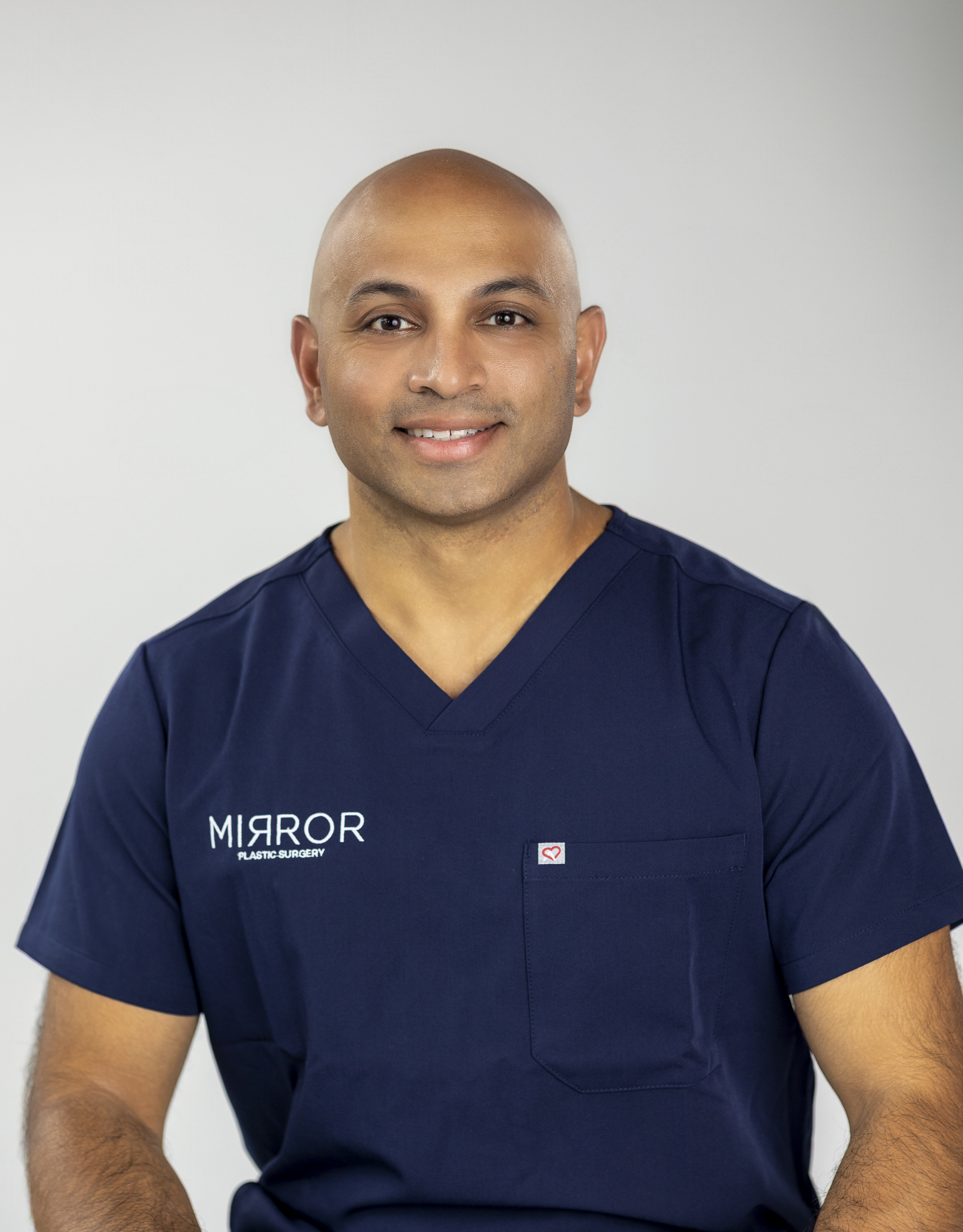
Begin your abdominoplasty journey with a comprehensive consultation at Mirror Plastic Surgery’s St. Petersburg location to receive a detailed anatomical assessment and individualized plan.
How Tummy Tuck Fits Into Long-Term Well-Being
Abdominoplasty functions as more than an isolated cosmetic event. Full abdominal wall restoration with muscle repair addresses functional deficits, including core weakness and associated low back strain, that affect quality of life beyond appearance. Patients who undergo abdominoplasty as part of a mommy makeover, combining breast and abdominal procedures, benefit from coordinated surgical planning that accounts for total operative time and recovery load.
Mirror Plastic Surgery’s approach of limiting combined procedures to those that do not exponentially increase complication risk reflects the evidence that high complication rates are particularly associated with abdominoplasty combined with other procedures. Long-term maintenance after abdominoplasty includes weight stability, core strengthening once cleared by the surgeon, and avoidance of future pregnancies that would reverse muscle repair. Patients who approach abdominoplasty as one component of a sustained commitment to physical health achieve the most durable outcomes.
Frequently Asked Questions
How do I verify that a surgeon is truly board certified in plastic surgery?
Visit the ABMS Certification Matters database at certificationmatters.org and search the surgeon’s name. This database is updated daily from all 24 ABMS member boards and is recognized by The Joint Commission as primary source verification. Confirm that the certification listed is from the American Board of Plastic Surgery specifically, not the American Board of Cosmetic Surgery or another non-ABMS body. You can also ask the surgeon’s office directly for their ABPS certificate number and cross-reference it.
Am I a good candidate for a full tummy tuck versus a mini tummy tuck?
Most patients seeking abdominoplasty after pregnancy or significant weight loss have skin laxity and muscle separation that extends above the navel, which makes a full abdominoplasty the appropriate procedure. As discussed earlier, a mini approach is limited to the lower abdomen and cannot address the navel repositioning or upper muscle repair that most post-pregnancy patients require. Candidacy is determined by a thorough anatomical assessment during consultation. Relevant factors include the extent of diastasis recti, the location and amount of excess skin, overall health, BMI, and whether future pregnancies are planned. Patients who smoke, have uncontrolled chronic conditions, or plan future pregnancies may need to address those factors before proceeding.
What is the recovery timeline for a tummy tuck in Tampa, and how does the climate affect it?
Most patients resume light desk work within 10 to 14 days and return to full activity by six weeks, with scar maturation and residual swelling continuing for several months. Tampa’s heat and humidity make compression garment use more physically demanding but no less important, because compression is a primary strategy for preventing seroma, one of the most common post-operative complications. Patients should plan to limit outdoor activity during peak heat hours in the early recovery weeks, stay well hydrated, and attend all scheduled follow-up appointments. Warning signs including fever, increasing pain, one-sided swelling, or calf pain require immediate contact with the surgical team.
Does a tummy tuck fix diastasis recti permanently?
Full abdominoplasty with muscle repair restores the rectus abdominis fascia to the midline and, when performed correctly across the full length of the abdominal wall, provides durable correction of diastasis recti.1 The repair is permanent in the sense that the sutured fascia heals in its corrected position, but future pregnancies or significant weight gain can re-separate the muscles.1 Patients who complete their families before surgery and maintain stable weight afterward achieve the most lasting functional and aesthetic results. A mini tummy tuck does not address diastasis recti above the navel and is not an appropriate procedure for patients whose muscle separation extends into the upper abdomen.
Why does surgical volume per day matter when choosing a tummy tuck surgeon?
A surgeon performing five to ten procedures daily distributes their team’s attention, energy, and focus across many patients simultaneously. A surgeon limiting their schedule to one to two procedures per day can dedicate full pre-operative preparation, intraoperative precision, and post-operative oversight to each individual case. For a procedure like full abdominoplasty, which involves muscle repair, skin resection, navel repositioning, and often concurrent liposuction, that concentrated attention directly affects both safety and outcome quality. At Mirror Plastic Surgery, the one-to-two-surgery-per-day model reflects a deliberate clinical decision, not a scheduling limitation.
Conclusion: Taking the Next Step Toward a Safe Tummy Tuck
Choosing a board certified tummy tuck specialist in Tampa requires active credential verification through the ABMS database, confirmation of facility accreditation, and honest evaluation of a surgeon’s anatomical philosophy and surgical volume. Full abdominoplasty with complete muscle repair delivers functional restoration that a mini approach cannot replicate. Recovery in Florida’s climate demands compression compliance, close follow-up access, and a surgical team available to respond to complications promptly.
Mirror Plastic Surgery and Dr. Akash offer Tampa-area patients a concierge model built on ABPS certification, Harvard-MIT and Johns Hopkins training, a one-to-two-surgery-per-day commitment, and a safety-first philosophy that prioritizes function before aesthetics. Book your consultation with Dr. Akash at Mirror Plastic Surgery, located at 780 4th Ave S, St. Petersburg, FL 33701, to begin a thorough, evidence-based evaluation of your abdominoplasty candidacy.
1 Results may vary from person to person. Editorial content, before and after images, and patient testimonials do not constitute a guarantee of specific results.