
Written by: Dr. Akash Chandawarkar, Board Certified Plastic Surgeon, Mirror Plastic Surgery | Last updated: June 29, 2026
Key Takeaways
-
Surgeon credentials and training drive safe breast implant outcomes more than implant brand or specific technique choices.
-
Patients should verify ABPS board certification, hospital privileges, and facility accreditation through official independent sources before surgery.
-
Transparent complication data, reasonable surgical volume, and consultations of at least 60 minutes signal a safety-focused practice.
-
Following a safety-first hierarchy and avoiding high-volume or multi-procedure shortcuts lowers revision rates and long-term risks.1
-
Schedule your personalized consultation at Mirror Plastic Surgery for an anatomy-first assessment from a surgeon who meets every standard on this checklist.
Why Board Certification Directly Affects Your Safety
Checklist Question 1: Is the surgeon certified specifically by the American Board of Plastic Surgery?
The American Board of Plastic Surgery (ABPS) is the sole ABMS-recognized certifying board for plastic surgery in the United States. It requires completion of an accredited plastic surgery training program and passing comprehensive written and oral examinations. Certification in related specialties such as general surgery, otolaryngology, or obstetrics does not qualify a physician to perform breast augmentation under ABPS standards. The minimum acceptable standard is current, active ABPS certification. A clear red flag is any surgeon who claims to be “board certified” without naming the ABPS or who cites a non-ABMS board.
Simple Steps to Confirm ABPS Certification
Checklist Question 2: Have you verified certification through official lookup tools?
Verification takes under two minutes. The ABPS public verification tool at abplasticsurgery.org/public and the ABMS Certification Matters portal at certificationmatters.org both display current certification status specifically in plastic surgery. The ABMS maintains board-certification records on more than one million physicians, refreshed daily from all 24 member boards, and these records are recognized by The Joint Commission, NCQA, and URAC as primary source verification. After confirming ABPS status, review the surgeon’s license and disciplinary history through the Federation of State Medical Boards at DocInfo.org. Any lapsed certification, active disciplinary action, or license restriction in any state where the surgeon has practiced is a disqualifying sign.
Complication Rates That Reveal Real-World Performance
Checklist Question 3: Can the surgeon provide specific data on revision rates, capsular contracture incidence, and bacterial contamination protocols?
Ask directly: “What is your personal capsular contracture rate, and what technique modifications do you use to reduce it?” A qualified surgeon should reference the 14-point no-touch technique or an equivalent evidence-based protocol, antibiotic irrigation, and meticulous pocket dissection. These contamination-reduction steps directly affect capsular contracture rates, yet technique alone is not enough. The implant itself must match your anatomy.
Ask whether the practice is supplier-neutral, meaning the surgeon recommends the implant best suited to your tissue characteristics rather than one tied to a volume incentive or manufacturer relationship. This matters because both smooth and textured surface options remain available in 2026, and the right choice depends on your individual anatomical assessment. Vague answers, deflection, or claims of a zero-complication rate are disqualifying responses.
Hospital Privileges as an Independent Safety Check
Checklist Question 4: Does the surgeon hold active hospital privileges for breast surgery?
Hospital privileges require an independent credentialing review by a hospital’s medical staff committee. This process validates training, licensure, malpractice history, and clinical competence. A surgeon with active privileges at an accredited hospital has passed a vetting process separate from their own marketing claims.
To verify, contact the hospital’s medical staff office and ask whether the named surgeon holds current privileges for breast and reconstructive procedures. The red flag is a surgeon who operates only in an office-based setting with no hospital affiliation. That setup removes the safety net of peer-reviewed credentialing and limits seamless transfer options if a rare intraoperative complication occurs.
Accredited Facilities and Physician Anesthesia
Checklist Question 5: Is the surgical facility accredited, and who administers anesthesia?
The American Society of Plastic Surgeons states that surgery should be performed in accredited, state-licensed, or Medicare-certified facilities. Recognized accrediting bodies include the American Association for Accreditation of Ambulatory Surgery Facilities (AAAASF), the Accreditation Association for Ambulatory Health Care (AAAHC), and The Joint Commission. These organizations evaluate equipment, staffing, emergency protocols, and infection control.
The anesthesia provider carries equal weight. A board-certified physician anesthesiologist, not a nurse anesthetist working without physician supervision, represents the appropriate standard for elective breast surgery. Disqualifying signs include an inability to name the facility’s accrediting body and reliance on sedation administered by non-physician personnel without anesthesiologist oversight.
Surgical Volume and Daily Case Load
Checklist Question 6: What is the surgeon’s annual breast augmentation volume, and how many cases does the practice schedule per day?
Volume matters in two directions. A surgeon performing very few breast cases per year may lack the pattern recognition needed to manage anatomical variability and complications. A practice scheduling five to ten surgeries per day introduces a different risk: compressed preparation time, fatigued surgical teams, and reduced capacity for individualized intraoperative decision-making.
These risks are structural. They relate to the surgeon’s cognitive capacity and decision quality, not just staffing levels. Mirror Plastic Surgery limits its schedule to one to two surgeries per day. This structure ensures that the full attention of Dr. Akash and the entire clinical team focuses on a single patient through every phase of care. This low-volume model functions as a built-in safety feature rather than a marketing preference.
Consultation Red Flags and Overloaded Surgery Plans
Checklist Questions 7 and 8: Does the consultation last at least 60 minutes, and does the surgeon discourage combining too many procedures at once?
A consultation shorter than 30 minutes cannot cover a thorough anatomical assessment, implant options, revision policy, and an honest risk discussion. Fifteen-minute consultations signal that the practice prioritizes throughput over individualized care. Additional red flags include pressure to combine multiple major procedures in a single session without a clear anatomical rationale. Combining procedures increases complication risk in a nonlinear way.
Other warning signs include vague or evasive answers to direct questions about revision rates, no written documentation of the proposed surgical plan, and an inability to explain the specific implant selection rationale for your anatomy. A surgeon who cannot explain why a particular implant size, profile, and placement plane fits your chest wall measurements has not completed the assessment that safe augmentation requires.
Beyond the Checklist: Why Training Pedigree Adds Confidence
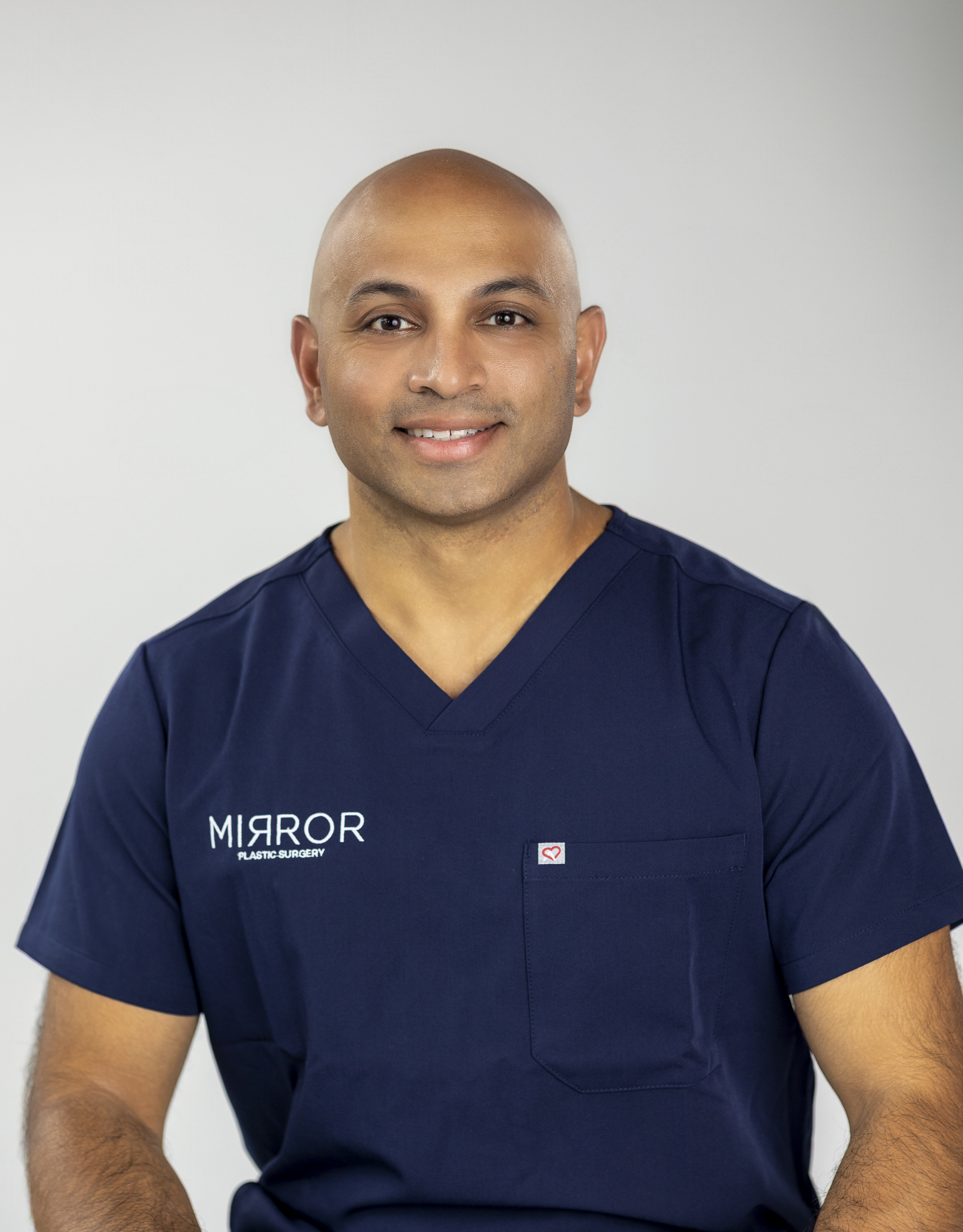
Credentials beyond ABPS certification help distinguish surgeons who simply meet the baseline from those who exceed it. Dr. Akash completed his medical degree through the Harvard-MIT Division of Health Sciences and Technology, a program that integrates rigorous scientific research with clinical medicine, and he graduated from Harvard Medical School with Honors. His surgical skills developed during a seven-year integrated plastic and reconstructive surgery residency at Johns Hopkins University, including rotations at the Johns Hopkins Hospital, the R Adams Cowley Shock Trauma Center, and the Curtis National Hand Center.
He then completed an aesthetic surgery fellowship at the Manhattan Eye, Ear and Throat Hospital (MEETH), one of the most competitive aesthetic training programs in the country. Dr. Akash was also selected to testify before the U.S. Food and Drug Administration on breast implant safety, a distinction that reflects peer-recognized expertise in this specific procedure category.
How the Safety-Function-Aesthetics Hierarchy Ties the Checklist Together
The eight questions above all support one core principle: a surgeon should place safety ahead of aesthetics. Mirror Plastic Surgery operates on an explicit priority sequence that makes this principle concrete: safety first, function second, aesthetics third. In breast augmentation, this means that implant selection, pocket placement, and incision planning follow the requirements of your anatomical integrity and long-term tissue health.
Patients who choose surgeons aligned with the safety-function-aesthetics sequence experience lower revision rates because the initial surgical plan anticipates how the breast will age, respond to gravity, and interact with the implant over a decade or longer.1
Schedule your safety-first consultation to receive a comprehensive anatomical assessment grounded in this framework.
Frequently Asked Questions
How do I verify that a plastic surgeon is truly ABPS board certified?
As covered in Checklist Question 2, use the ABPS and ABMS verification portals to confirm active certification in plastic surgery specifically, then cross-reference with the surgeon’s license history through DocInfo.org. The key is relying on official, independent sources rather than a practice’s website or marketing materials, which are not independently verified.
What facility accreditation should I require for breast implant surgery?
As outlined in Checklist Question 5, look for AAAASF, AAAHC, or Joint Commission accreditation. Accreditation matters because it functions as an ongoing review process, not a one-time credential. Facilities must maintain standards and pass periodic inspections to keep accreditation current, so an accredited facility today has recently demonstrated compliance with safety protocols.
Does it matter whether a physician anesthesiologist or a nurse anesthetist administers anesthesia?
For elective breast augmentation, a board-certified physician anesthesiologist represents the highest safety standard. Physician anesthesiologists complete four years of medical school followed by a four-year anesthesiology residency, which prepares them to manage cardiovascular and respiratory complications intraoperatively. Certified Registered Nurse Anesthetists (CRNAs) are qualified practitioners, yet when you can choose your care team, the physician anesthesiologist standard provides the greatest margin of safety. Ask directly who will administer anesthesia and what their credentials are before scheduling surgery.
How many breast augmentation revisions should I expect over a lifetime?
Implants are not lifetime devices. Most patients can expect at least one revision procedure over a 10-to-20-year period for implant exchange, capsular contracture management, or changes in personal preference. The quality of the initial surgical plan strongly influences the revision rate. Surgeons who perform detailed preoperative anatomical assessments, select implants that match the patient’s tissue characteristics, and use evidence-based contamination-reduction protocols consistently achieve lower revision rates than high-volume practices where planning time is compressed.1 Ask any prospective surgeon for their personal revision rate and the specific protocols they use to minimize it.
Conclusion
The 8-question checklist above, covering ABPS verification, certification lookup, complication rate transparency, hospital privileges, facility accreditation, surgical volume, consultation length, and procedure-combining policy, gives patients a structured way to evaluate any surgeon before a breast augmentation consultation. Each question has a minimum acceptable answer and a clear red flag. Applying this checklist systematically removes the most common sources of preventable harm in elective breast surgery.
Mirror Plastic Surgery’s approach, from Dr. Akash’s training at Harvard-MIT, Johns Hopkins, and MEETH to the practice’s one-to-two-surgeries-per-day limit, is built to meet every standard on this checklist by default. Credential verification, complication transparency, and individualized consultation time are integrated into every patient’s experience rather than treated as optional extras. Request your hour-long consultation at Mirror Plastic Surgery in St. Petersburg, Florida, and receive the anatomy-first assessment that safe breast augmentation requires.
1 Results may vary from person to person. Editorial content, before and after images, and patient testimonials do not constitute a guarantee of specific results.