
Written by: Dr. Akash Chandawarkar, Board Certified Plastic Surgeon, Mirror Plastic Surgery | Last updated: July 8, 2026
Key Takeaways for Choosing Your Surgeon
- Verifying American Board of Plastic Surgery (ABPS) certification through official databases is the essential first step to confirm a surgeon’s plastic surgery training and credentials.
- Checking Florida medical licensure, disciplinary history, and facility accreditation confirms the surgeon operates in safe, properly regulated environments.
- Procedure-specific experience in breast augmentation, including case volume and before-and-after results, directly influences surgical outcomes and complication rates.1
- A thorough consultation that includes anatomical education and detailed risk discussions supports better-informed decisions and higher patient satisfaction.
- Patients seeking safe, personalized breast augmentation in Florida can schedule a consultation at Mirror Plastic Surgery with Dr. Akash to begin their verification process.
How Elite Training Shapes Breast Augmentation Outcomes
Elite surgical training improves breast augmentation outcomes by sharpening anatomical precision, deepening understanding of implant safety, and refining aesthetic judgment. This type of background supports safer operations, more predictable results, and lower revision rates over time.1
Dr. Akash is the lead surgeon at Mirror Plastic Surgery in St. Petersburg, Florida. His academic path began at MIT with studies in neuroscience and nuclear engineering, which built a strong foundation in anatomy, physiology, and problem-solving. He then completed the Harvard-MIT Division of Health Sciences and Technology M.D. program, graduating cum laude with Honors.
He trained in a seven-year integrated plastic and reconstructive surgery residency at Johns Hopkins University, one of the most rigorous programs worldwide. He then completed an aesthetic surgery fellowship at Manhattan Eye, Ear and Throat Hospital (MEETH), which represents the highest level of specialization in cosmetic surgery, followed by the Stanford University Biodesign Innovation Fellowship.
Dr. Akash has been named in America’s Best Plastic Surgeons 2025 by Newsweek for two consecutive years and has testified before the U.S. Food and Drug Administration on breast implant safety. This depth of training supports Mirror Plastic Surgery’s safety-function-aesthetics framework and its concierge model that limits the schedule to one to two surgeries per day.
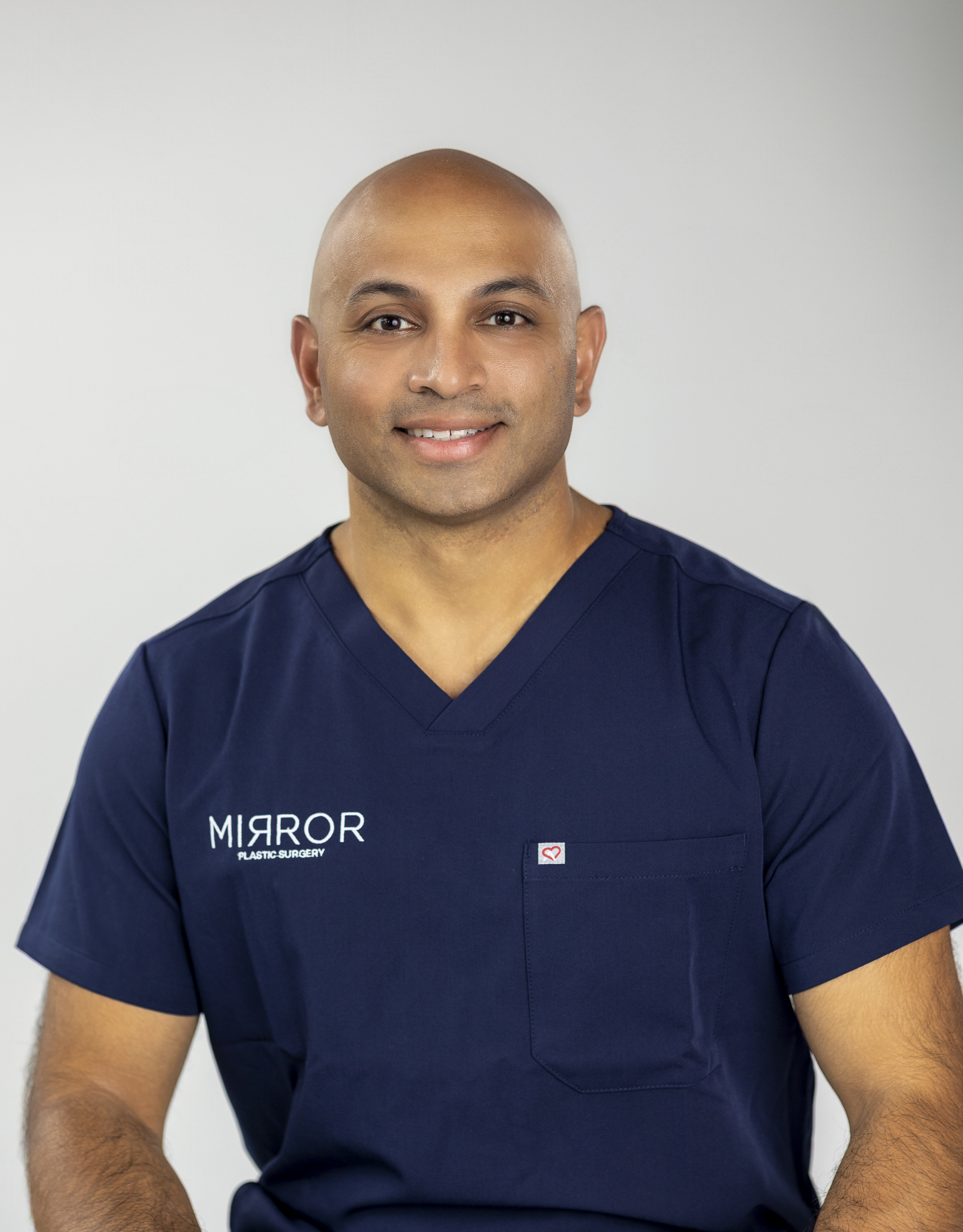
Book a consultation with Dr. Akash to discuss your breast augmentation goals with a Harvard-MIT and Johns Hopkins-trained surgeon.
Step 1: Confirm True Board Certification in Plastic Surgery
The American Board of Plastic Surgery (ABPS) is the only ABMS-recognized board for plastic and reconstructive surgery. ABPS certification requires graduation from a recognized medical school, three to five years of advanced training in an ACGME- or AOA-approved residency (depending on the specialty), and passing a computer-based written examination, with some boards also requiring an oral exam. The American Board of Medical Specialties (ABMS) maintains board-certification records on more than 997,000 physicians (per 2020 data), with the database updated daily and current totals now exceeding one million. These records are recognized by The Joint Commission, NCQA, and URAC as primary source verification.
Verification takes about two minutes. Enter the surgeon’s full name into the ABPS public verification tool and cross-check the result at ABMS Certification Matters. A valid result shows current, active certification specifically in plastic surgery.
Any board not listed among the 24 ABMS member boards does not carry verified training and examination standards regardless of its name. A surgeon who does not appear in either database represents a significant red flag that the credential may not be legitimate.
Step 2: Check Florida Medical Licensure and Disciplinary History
A valid ABPS certification must pair with an active, clean state license. FSMB’s DocInfo.org provides a national lookup for physician license status and board actions across all U.S. states. The Florida Department of Health’s MQA Consumer Services portal lists active licenses in good standing along with any disciplinary actions, suspensions, malpractice settlements, or complaints.
A clean record across both sources sets the baseline for safety. It does not distinguish an excellent surgeon from an average one, but it rules out clear risk.
Step 3: Confirm Accredited Facilities and Hospital Privileges
Hospital privileges and accredited facilities signal that independent committees have reviewed a surgeon’s training and outcomes. Board-certified plastic surgeons typically hold surgical privileges at accredited hospitals, where a peer credentialing committee evaluates their qualifications and results. Absence of any hospital affiliation warrants further inquiry.
For outpatient procedures, confirm that the surgical facility holds accreditation from a recognized body such as AAAHC, JCAHO, or AAAASF. At Mirror Plastic Surgery, Dr. Akash operates only in accredited surgical facilities and works with board-certified physician anesthesiologists, with hospital privileges available in the rare event of a complication.
Step 4: Focus on Breast-Augmentation-Specific Experience
Breast-augmentation-specific volume matters more than general surgical experience. Higher procedural volume in breast augmentation specifically enables refined technique and more effective anticipation of complications.1
Ask the surgeon how many breast augmentations they have performed. Request before-and-after photos of patients with anatomy similar to yours. Ask what specific technique will be used for your case and why it fits your anatomy and goals.
Clear, detailed answers indicate familiarity and confidence. Vague or evasive responses to technique questions are a red flag.
Step 5: Evaluate Consultation Depth and Education
A high-quality consultation feels unhurried and educational. It covers your anatomy, skin quality, implant options, incision placement, pocket location, and a detailed informed consent discussion of risks specific to your health history. Detailed informed consent discussions covering risks are associated with higher patient satisfaction and fewer post-operative concerns.1
Mirror Plastic Surgery dedicates up to one hour per initial consultation. This visit includes an anatomical education component that explains why a specific approach is recommended for each patient’s structure and goals.
Florida ABPS and Safety Verification Table
| Verification Source | What to Look For | Red Flag | URL |
|---|---|---|---|
| ABPS Public Verification | Active certification specifically in plastic surgery | No listing, expired status, or certification in an unrelated specialty | abplasticsurgery.org/public |
| ABMS Certification Matters | Current, active ABMS-recognized certification | Board not listed among the 24 ABMS member boards | certificationmatters.org |
| FSMB DocInfo.org | Active license, no disciplinary actions or board sanctions | Suspensions, malpractice settlements, or unresolved complaints | docinfo.org |
| Florida Dept. of Health MQA | Active Florida license in good standing | Disciplinary history, license restrictions, or lapsed status | mqa.doh.state.fl.us |
How Practice Volume Affects Your Care
Practice volume shapes how much attention each patient receives. Practices performing five to ten surgeries daily divide their team’s focus across many patients, which compresses pre-operative assessment, intraoperative precision, and post-operative follow-up.
Mirror Plastic Surgery limits its schedule to one to two surgeries per day. This structure keeps the entire clinical team focused on a single patient before, during, and after the procedure.
High-volume models often compress patient interaction time, and that compression shows up in several ways. Consultations under 20 minutes cannot support thorough anatomical education, which leaves patients unsure why a specific technique is recommended. This time pressure can turn into same-day decision pressure as the practice works to maintain throughput.
Reluctance to show the surgeon’s own before-and-after photos suggests limited procedure-specific experience. Lack of a clear plan for managing complications signals that the practice prioritizes volume over long-term relationships. The safety-function-aesthetics framework at Mirror Plastic Surgery reverses this pattern: safety remains non-negotiable, function is restored before aesthetics are refined, and aesthetic outcomes follow from anatomical integrity.
Cosmetic Surgeon Titles, Pricing, and Real Value
The term “cosmetic surgeon” carries no standardized credential requirement in the United States. Any licensed physician can legally perform cosmetic procedures and market themselves as a cosmetic surgeon without completing a plastic surgery residency or passing ABPS examinations.
This distinction matters because only ABMS-recognized boards confirm standardized training and examination requirements. Certification from non-ABMS boards does not guarantee equivalent standards, regardless of how the credential is named or marketed.
Price also functions as an unreliable proxy for quality. A lower fee may reflect reduced overhead from an unaccredited facility, a less experienced surgeon, or a higher-volume model that compresses per-patient time. A higher fee does not automatically indicate superior outcomes.
The meaningful variables are verified credentials, facility accreditation, procedure-specific volume, and consultation depth, not the invoice total. Each Mirror Plastic Surgery patient receives a personalized quote during consultation based on individual anatomy and treatment planning.
Quick Checklist Before You Schedule Surgery
Before scheduling a breast augmentation procedure in Florida, confirm each of the following:
- Surgeon’s name appears in the ABPS public database with active certification in plastic surgery.
- Certification is cross-checked at ABMS Certification Matters.
- Active Florida license with no disciplinary history is confirmed via FSMB DocInfo.org and the Florida MQA portal.
- Surgical facility holds accreditation from AAAHC, JCAHO, or AAAASF.
- Surgeon holds hospital privileges at an accredited hospital.
- Consultation includes anatomical education, technique rationale, and a detailed risk discussion specific to your health history.
- Surgeon provides before-and-after photos of patients with anatomy similar to yours.
- No pressure is placed on you to commit on the day of consultation.
How Surgeon Choice Reduces Revision Risk
Surgeon selection is the single most consequential variable in reducing revision risk because the factors that lead to revision are set during the primary procedure. Revision breast augmentation is more complex, more costly, and carries higher complication rates than primary augmentation, so prevention through proper initial technique offers the most effective strategy.1
The factors most strongly associated with revision, including capsular contracture, implant malposition, animation deformity, and asymmetry, are directly influenced by surgical technique, implant selection relative to anatomy, and pocket placement decisions made during the first operation. A surgeon with deep breast-specific training, strong procedure-specific volume, and a safety-first framework is positioned to minimize these risks from the outset.1
Dr. Akash sits on the advisory board for Motiva, a leading breast implant technology company, and has testified before the FDA on breast implant safety. This level of engagement with the evidence base directly informs primary surgical planning at Mirror Plastic Surgery.
Book a consultation with Dr. Akash to receive a personalized anatomical assessment and long-term surgical plan.
Frequently Asked Questions
Can you get breast implants with Hashimoto’s?
Hashimoto’s thyroiditis is an autoimmune condition that affects the thyroid gland. Most patients with well-controlled Hashimoto’s are candidates for breast augmentation, but the condition requires careful pre-operative evaluation. Thyroid function must be stable before surgery because hypothyroidism can affect wound healing, anesthesia metabolism, and recovery.
A thorough consultation with a qualified plastic surgeon, coordinated with the patient’s endocrinologist or primary care physician, helps assess surgical risk and establish a safe plan. Mirror Plastic Surgery’s pre-operative evaluation process includes a comprehensive health assessment to identify and address conditions like Hashimoto’s before any procedure is scheduled.
What autoimmune diseases are associated with breast implants?
Breast Implant Illness (BII) is a term patients use to describe a constellation of systemic symptoms, including fatigue, joint pain, cognitive difficulties, and hair loss, that some individuals attribute to their breast implants. The scientific literature on BII continues to evolve, and a causal relationship has not been definitively established.
The FDA has identified a confirmed association between textured breast implants and a rare lymphoma called Breast Implant-Associated Anaplastic Large Cell Lymphoma (BIA-ALCL). Patients with pre-existing autoimmune conditions should discuss their history in detail during consultation. Dr. Akash has testified before the FDA on breast implant safety and approaches implant selection with an evidence-based framework that accounts for each patient’s health profile.
What are typical revision rates for breast augmentation?
Revision rates for breast augmentation vary based on implant type, surgical technique, patient anatomy, and surgeon experience.1 Published data from implant manufacturers submitted to the FDA show that a meaningful percentage of patients undergo at least one revision procedure within ten years of their primary augmentation. Common reasons include capsular contracture, implant malposition, size change, and rupture.
Surgeon-specific factors, including pocket placement, implant selection relative to the patient’s tissue characteristics, and technique precision, are among the most modifiable variables affecting long-term outcomes. Choosing a surgeon with deep breast-specific training and a safety-first approach remains the most direct way to reduce primary revision risk.1
What is the expected recovery after breast augmentation in Florida?
Recovery timelines depend on implant placement, implant size, and individual healing. Most patients return to light daily activity within three to five days and resume non-strenuous work within one to two weeks. Strenuous exercise and heavy lifting are usually restricted for four to six weeks.1
Swelling and implant position continue to evolve for three to six months as tissues settle.1 Florida’s warm climate does not significantly change recovery, but patients should avoid prolonged sun exposure to incision sites during healing. Mirror Plastic Surgery provides detailed, individualized post-operative protocols and maintains close follow-up contact throughout recovery as part of its concierge care model.
Conclusion: Putting the Five Verification Steps into Action
Selecting a breast augmentation surgeon in Florida follows a five-step verification process. Confirm ABPS certification through official databases, verify state licensure and disciplinary history, confirm facility accreditation and hospital privileges, review procedure-specific volume and before-and-after results, and evaluate consultation depth and anatomical education. Each step has a specific data source and a clear set of red flags.
Completing all five steps before committing to a surgeon offers a reliable way to reduce revision risk and support a safe, long-term outcome.1 Mirror Plastic Surgery and Dr. Akash bring together elite academic training from Harvard-MIT, Johns Hopkins, and MEETH, a concierge model limited to one to two surgeries per day, and a safety-function-aesthetics framework that prioritizes anatomical integrity over volume.
Dr. Akash, recognized by Newsweek as one of America’s Best Plastic Surgeons for two consecutive years, brings FDA-level engagement with breast implant safety to every primary consultation. Book a consultation with Dr. Akash and begin your verification process with a surgeon whose credentials, facility standards, and consultation depth align with every benchmark outlined in this guide.
1 Results may vary from person to person. Editorial content, before and after images, and patient testimonials do not constitute a guarantee of specific results.