

Written by: Dr. Akash Chandawarkar, Board Certified Plastic Surgeon, Mirror Plastic Surgery | Last updated: June 29, 2026
Key Blepharoplasty Cost Insights for Tampa Patients
- Blepharoplasty is eyelid surgery that removes or repositions excess skin, muscle, and fat to restore a rested, alert appearance.1 Upper, lower, and combined procedures each carry distinct cost and recovery considerations.
- In 2026, blepharoplasty pricing in Tampa varies based on surgeon credentials, facility accreditation, anesthesia type, and procedure complexity. Combined upper and lower procedures often provide more efficient per-procedure costs than staging them separately.
- Upper blepharoplasty may qualify for insurance coverage in Florida when excess skin obstructs the visual field. Qualification requires documented visual-field testing, photographic evidence, and prior authorization. Lower blepharoplasty is almost always considered cosmetic.
- Financing options such as CareCredit, Cherry, and Alphaeon Credit are widely accepted in Tampa. Each platform has different credit requirements, promotional periods, and APR structures that patients should compare before applying.
- Patients seeking blepharoplasty in Tampa can schedule a consultation at Mirror Plastic Surgery to receive a personalized cost estimate and financing guidance tailored to their anatomy and goals.
Blepharoplasty Price Ranges in Tampa for 2026
Blepharoplasty pricing in the Tampa metropolitan area reflects several combined variables. Surgeon credentials and fellowship specialization, facility accreditation level, anesthesia type (local with sedation versus general), anatomical complexity, and insurance coverage all influence the final investment.
Upper blepharoplasty performed solely for cosmetic reasons typically represents the lowest investment tier. Lower blepharoplasty usually costs more because it requires more precise fat repositioning and carries a higher technical burden. Combined upper and lower procedures involve a single anesthesia event and shared facility time, which can make the per-procedure cost more efficient than staging them separately, even though the total investment is higher.
Understanding the complete cost picture requires looking beyond the surgeon’s fee alone. Additional line items that appear on final invoices include the surgical facility fee, board-certified physician anesthesiologist fee, pre-operative laboratory work, post-operative medications, and any specialized diagnostic testing such as visual-field assessment. Every patient at Mirror Plastic Surgery receives a personalized, itemized quote following a thorough anatomical evaluation. No two quotes are identical because no two anatomies are identical.
Insurance Qualification Steps for Upper Eyelid Surgery in Florida
Upper blepharoplasty may qualify as a medically necessary procedure when excess upper-lid skin clearly obstructs the superior visual field. Florida insurers and Medicare Local Coverage Determinations generally require objective documentation before approving benefits. The following numbered checklist reflects the standard qualification pathway.
- Ophthalmology or optometry referral: Obtain a referral from a licensed eye-care provider who documents symptomatic ptosis or dermatochalasis affecting daily activities.
- Baseline visual-field test: Complete a formal Humphrey or Goldmann perimetry examination with lids in their natural, untaped position to establish the degree of superior-field obstruction.
- Taped visual-field test: Repeat the perimetry examination with upper-lid skin manually elevated and taped to simulate post-surgical correction. A clinically significant improvement (commonly ≥12 degrees or ≥30% field improvement, per payer policy) supports medical necessity.
- Margin-reflex distance measurement: A physician documents the distance from the corneal light reflex to the upper-lid margin. Values below 2 mm often satisfy ptosis criteria.
- Photographic documentation: Standardized frontal and lateral photographs demonstrating lid position and skin overhang are submitted with the prior-authorization request.
- Functional symptom documentation: Written records of symptoms, such as brow fatigue, headaches from compensatory brow elevation, and difficulty reading or driving, strengthen the medical-necessity argument.
- Prior-authorization submission: The surgeon’s office submits all documentation to the insurer before scheduling. Approval timelines vary by carrier and plan type.
Lower blepharoplasty is almost universally classified as cosmetic and is rarely covered. Patients pursuing combined procedures should confirm with their insurer whether the upper-lid portion can be billed under a medical benefit while the lower-lid portion remains self-pay.
Financing Platforms Commonly Used for Blepharoplasty in Tampa
Three third-party financing platforms are widely accepted at Tampa-area plastic surgery practices: CareCredit, Cherry, and Alphaeon Credit. Each platform operates differently in terms of credit-score thresholds, promotional period structures, and deferred-interest mechanics.
CareCredit offers promotional no-interest periods, typically 6, 12, 18, or 24 months, for qualified applicants. Standard APR applies retroactively to the original balance if the promotional balance is not paid in full by the end of the period. Approval generally requires a credit score in the mid-600s or higher, though terms vary.
Cherry uses a soft-pull pre-qualification process and is designed to approve a broader credit spectrum, including applicants with scores in the 550–600 range, by offering shorter-term installment plans at higher APRs. Monthly payments are fixed and predictable.
Alphaeon Credit is a healthcare-specific card with revolving credit and promotional financing tiers similar to CareCredit. It is issued through a bank and reports to credit bureaus, which can affect credit utilization scores.
Regardless of which platform you choose, request a Good Faith Estimate before applying for financing. This ensures that the financed amount reflects the complete all-in cost, including surgeon fee, facility, anesthesia, and ancillary charges, rather than the surgeon fee alone.
Blepharoplasty Cost and Payment Scenarios at a Glance
The table below illustrates general investment tiers and sample financing scenarios for educational purposes. All figures are ranges reflecting national and regional market data. Individual quotes at Mirror Plastic Surgery are determined after in-person anatomical assessment and will differ based on case complexity.
| Procedure Type | Typical Total Investment Range | Illustrative Financing Term | Illustrative Monthly Payment Range |
|---|---|---|---|
| Upper Blepharoplasty (cosmetic) | $3,000 – $5,500 | 12–24 months | $125 – $460 / month |
| Lower Blepharoplasty (cosmetic) | $3,646–$4,638 | 12–36 months | $125 – $625 / month |
| Combined Upper + Lower (cosmetic) | Varies, often $6,000–$10,000 | 24–60 months | $108 – $500 / month |
| Upper Blepharoplasty (insurance-covered portion) | Copay / deductible only after approval | N/A or residual cosmetic balance | Varies by plan |
Monthly payment estimates above assume zero-interest promotional periods where available. Actual payments under standard APR financing will be higher. Use these figures for budgeting orientation only, not as a quoted price from Mirror Plastic Surgery.
Revision Risk and Long-Term Blepharoplasty Costs
Blepharoplasty revision ranks among the more technically demanding secondary procedures in facial surgery. The American Society of Plastic Surgeons identifies over-resection of upper-lid skin (lagophthalmos), lower-lid retraction, and asymmetry as the most common drivers of reoperation. Revision surgery typically costs more than the primary procedure because it involves scar tissue management, possible grafting, and longer operative time.
Several factors strongly influence revision risk. Inadequate pre-operative anatomical assessment, failure to evaluate levator function before upper-lid surgery, aggressive fat removal in the lower lid without addressing the orbital septum, and high operative volume that limits per-patient attention all increase the chance of problems. A surgeon performing one to two procedures per day, rather than five to ten, maintains the focused attention that reduces technical error rates.1
Lifetime cost calculations should therefore include the primary procedure, any financing interest, and the probability-weighted cost of revision. Time off work for a second recovery and the psychological burden of corrective surgery also matter. Investing in a thorough pre-operative evaluation and a credentialed specialist meaningfully reduces this probability.1
Key Surgeon Credentials for Eyelid Surgery in Tampa
Board certification by the American Board of Plastic Surgery is the minimum credential standard for blepharoplasty. Fellowship training specifically in aesthetic facial surgery, particularly at a program recognized for oculoplastic and periorbital expertise, distinguishes surgeons who operate on eyelids daily from those who perform the procedure occasionally.
Dr. Akash at Mirror Plastic Surgery holds an aesthetic surgery fellowship from the Manhattan Eye, Ear and Throat Hospital (MEETH), one of the most competitive and eyelid-focused training environments in the United States. His foundational medical degree was earned through the Harvard-MIT Health Sciences and Technology program, and his surgical residency was completed at Johns Hopkins University, consistently ranked among the world’s premier plastic surgery training programs. He has been named to Newsweek’s America’s Best Plastic Surgeons list two years in a row, including 2025.
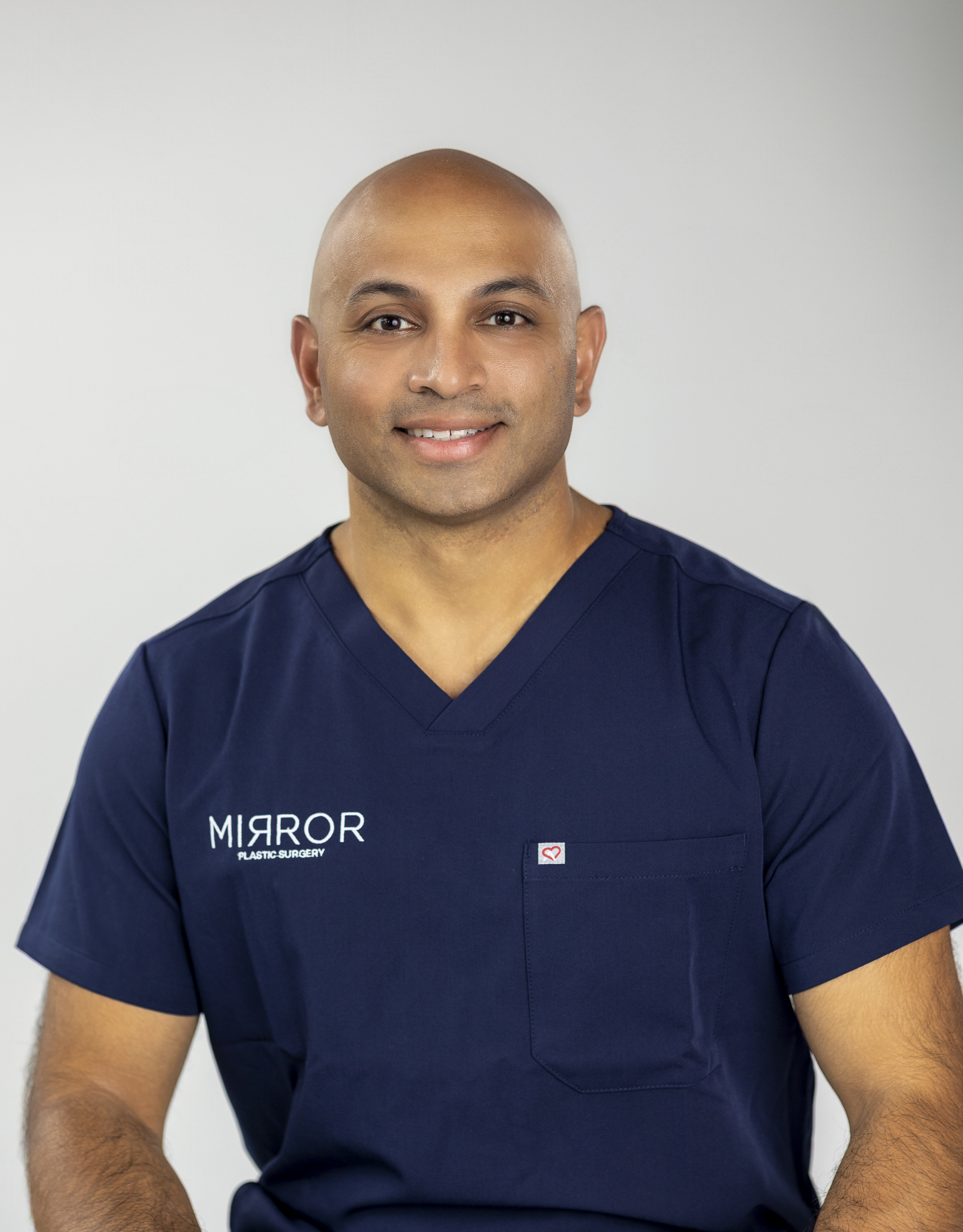
Mirror Plastic Surgery’s concierge model reinforces these credentials through its structure. Consultations run up to one hour, allowing complete anatomical assessment of lid position, levator function, orbital fat distribution, and brow position before any surgical plan is proposed. The practice limits operative days to one to two procedures, so the entire clinical team can focus on each patient before, during, and after surgery. The guiding hierarchy of safety first, function second, and aesthetics third ensures that no cosmetic goal is pursued at the expense of ocular health or lid mechanics.
Book a consultation with Dr. Akash and experience a credential-backed, hour-long evaluation that prioritizes your safety and long-term outcomes.
Blepharoplasty Cost and Financing FAQ
Does blepharoplasty qualify for insurance coverage in Florida?
Upper blepharoplasty may qualify for insurance coverage when excess upper-eyelid skin causes a measurable obstruction of the superior visual field. Qualification requires formal visual-field testing performed both with and without the lids taped, photographic documentation, and a prior-authorization submission from the surgeon’s office. Lower blepharoplasty is almost always classified as cosmetic and is not covered. Patients should contact their insurer directly to confirm their specific plan’s medical-necessity criteria before scheduling any testing.
What credit score do I need to finance blepharoplasty?
Credit requirements vary by financing platform. CareCredit generally approves applicants with scores of 600 and above, though approval for promotional no-interest terms depends on the applicant’s full credit profile. Alphaeon Credit has its own distinct criteria. Cherry is designed to serve a broader credit range, including applicants in the 550–600 range, though at higher APRs and shorter terms. Pre-qualification through a soft credit pull, available on each platform’s website, allows patients to check eligibility without affecting their credit score.
How long is recovery from blepharoplasty, and does it affect total cost?
Most patients return to desk work within seven to ten days and resume full activity within three to four weeks. Recovery length affects total cost indirectly through lost income during downtime and the cost of post-operative medications, arnica supplements, and cold compresses. Combining upper and lower blepharoplasty in a single operative session, when anatomically appropriate, creates one recovery period rather than two and can reduce total indirect costs compared to staging the procedures separately.
What is the regret rate for blepharoplasty?
Blepharoplasty consistently ranks among the highest patient-satisfaction procedures in aesthetic surgery.1 Regret most often occurs after over-correction, particularly excessive skin removal that produces a hollow or surprised appearance, rather than after under-correction. Thorough pre-operative simulation, conservative tissue management, and a surgeon experienced in periorbital anatomy are the primary safeguards against outcomes that patients later wish to revise.
Can blepharoplasty be combined with other procedures to reduce total cost?
Combining blepharoplasty with a brow lift, facelift, or non-surgical treatments such as laser resurfacing under a single anesthesia event can reduce the per-procedure facility and anesthesia fees. Combining too many procedures simultaneously, however, increases physiological stress and complication risk. Mirror Plastic Surgery evaluates combination requests on a case-by-case basis and recommends only combinations that are anatomically appropriate and safe, never for the purpose of maximizing procedure volume.
Why Careful Surgeon Selection Matters for Tampa Blepharoplasty
High-volume surgical practices that perform five to ten procedures per day operate under different constraints than a concierge practice limited to one to two cases. Time pressure affects pre-operative assessment depth, intraoperative decision-making, and post-operative availability. These factors influence safety outcomes and the likelihood of revision.
Tampa patients researching blepharoplasty cost and financing benefit from complete information. Realistic price ranges, clear insurance qualification criteria, transparent financing mechanics, and an understanding of how surgeon selection affects lifetime cost all support better decisions. A lower upfront quote that later requires a revision procedure rarely represents the most economical choice.
This concierge approach, which combines thorough pre-operative evaluation with the safety-function-aesthetics hierarchy described earlier, is designed to produce outcomes that do not require correction.1 Dr. Akash’s Harvard-MIT, Johns Hopkins, and MEETH credentials, combined with his Newsweek recognition, provide an objective basis for evaluating the quality of care available in the Tampa Bay area.
Book a consultation with Dr. Akash at Mirror Plastic Surgery’s St. Petersburg location and receive a thorough, personalized blepharoplasty evaluation, including a complete cost and financing breakdown specific to your anatomy and goals.
1 Results may vary from person to person. Editorial content, before and after images, and patient testimonials do not constitute a guarantee of specific results.


