

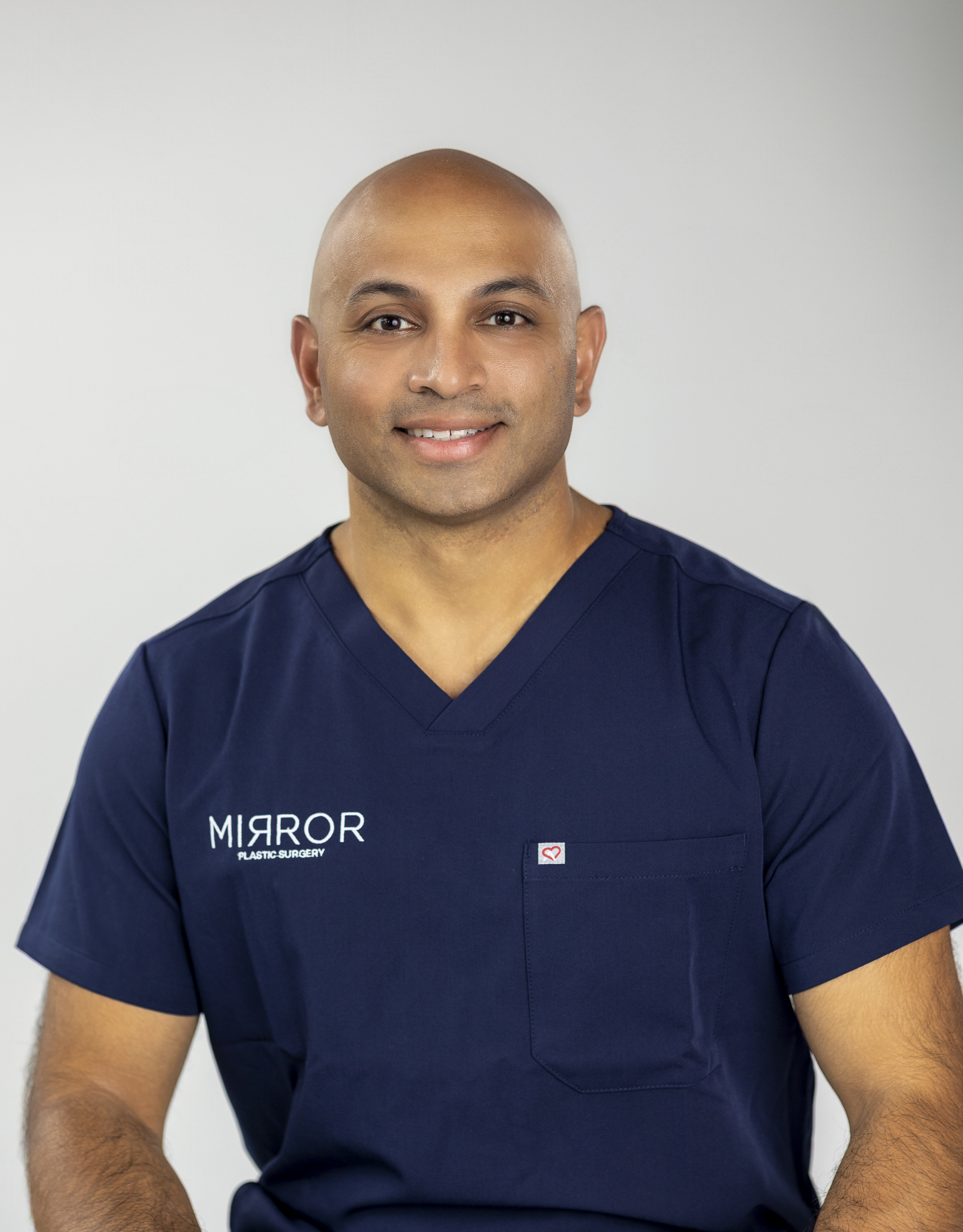
Written by: Dr. Akash Chandawarkar, Board Certified Plastic Surgeon, Mirror Plastic Surgery | Last updated: June 26, 2026
Key Takeaways
- Blepharoplasty is a high-stakes procedure that affects both appearance and eyelid function, including vision and eye closure.
- Elite credentials, such as ABPS board certification and focused periorbital fellowship training, lower surgical risk and improve outcomes.1
- Patients should confirm Florida medical licensure, facility accreditation, and standardized before-and-after photography before choosing a surgeon.
- High daily surgical volume and rushed consultations signal a practice model that may limit individualized care and follow-up.
- Schedule a consultation with Dr. Akash at Mirror Plastic Surgery for a detailed, anatomy-focused blepharoplasty evaluation.
Why Careful Blepharoplasty Evaluation Protects Your Eyes
The eyelid is one of the most anatomically complex regions of the face. The upper lid alone includes the orbicularis oculi muscle, the levator aponeurosis, Müller’s muscle, the orbital septum, and the tarsal plate, with each layer interacting closely. Disrupting these relationships without precise anatomical knowledge can cause lagophthalmos, ptosis, or hollowing that accelerates aging instead of reversing it. Revision blepharoplasty is more demanding than primary surgery, so the first choice of surgeon often has the greatest impact on your long-term result.1
Training pathways strongly influence safety and outcomes.1 Oculoplastic surgeons complete ophthalmology residency followed by a two-year fellowship focused exclusively on periorbital anatomy. Board-certified plastic surgeons who complete dedicated aesthetic fellowships at high-volume facial surgery centers develop comparable periorbital expertise through a different but rigorous route. General cosmetic providers without either pathway carry a meaningfully higher risk profile for eyelid surgery.
Expert Context: How Dr. Akash’s Training Supports Eyelid Results
Understanding what elite training looks like in practice helps clarify these distinctions. Dr. Akash completed his medical degree through the Harvard-MIT Division of Health Sciences and Technology. He then finished a seven-year integrated plastic and reconstructive surgery residency at Johns Hopkins University, widely regarded as one of the world’s premier training programs. After residency, he completed an aesthetic surgery fellowship at the Manhattan Eye, Ear and Throat Hospital (MEETH), one of the most competitive periorbital and facial surgery training environments in the country. He has been named in America’s Best Plastic Surgeons by Newsweek for two consecutive years, including 2025. This combination of foundational science, reconstructive depth, and focused aesthetic fellowship training shapes his approach to blepharoplasty at Mirror Plastic Surgery in St. Petersburg.
Schedule your evaluation with Dr. Akash to review your eyelid anatomy and candidacy for blepharoplasty.
Step 1: Confirming Board Certification and Hospital Privileges
Board certification by the American Board of Plastic Surgery (ABPS) is the foundational credential for plastic surgeons who perform blepharoplasty. ABPS certification requires completion of an accredited plastic surgery residency, successful written and oral examinations, and ongoing maintenance of certification.
Start by searching the surgeon’s name directly on the ABPS verification portal. After you locate the profile, confirm that the certification is active rather than lapsed or inactive. Pay close attention to the specific board name, because the phrase “board certified” without a named ABMS-recognized board can signal a non-equivalent credential. Finally, confirm hospital privileges at an accredited facility, which require independent credentialing review and provide an extra safety layer beyond board certification alone.
| Green Flag | Red Flag |
|---|---|
| Active ABPS certification confirmed on official database | Certification listed only on practice website with no verifiable link |
| Hospital privileges at an accredited facility | Vague language such as “board eligible” or unnamed certifying board |
Step 2: Reading Before-and-After Photos Like a Specialist
A surgeon’s photo gallery functions as a portfolio of judgment as well as technical skill. You gain the most value when you use clear criteria instead of relying on a quick impression.
- Look for consistent lighting, angles, and timeframes across cases, because inconsistency can hide the true result.
- Assess lid crease symmetry, scleral show, and brow position in post-operative images, not just skin smoothness.
- Confirm that photos show a range of ages, skin types, and anatomical patterns that resemble your own features.
- Ask whether the photos are of the surgeon’s own patients or borrowed from stock or manufacturer libraries.
| Green Flag | Red Flag |
|---|---|
| Standardized photography with multiple angles and 6–12 month follow-up images | Only frontal close-ups with no lateral or oblique views |
| Natural lid contour with preserved orbital fat volume where appropriate | Hollow, skeletonized upper orbits suggesting over-resection |
Step 3: Verifying Florida DOH License and History
Florida law requires every practicing physician to hold an active state license. The Florida Department of Health Practitioner Profile provides the official public record for licensure status, disciplinary history, and malpractice actions.
Search by name and specialty on the Florida DOH MQA portal, then review the full profile for disciplinary orders, license restrictions, or pending complaints. Confirm that the license is active and not on probationary status. Cross-reference the license number listed on the practice website with the DOH record to ensure consistency.
| Green Flag | Red Flag |
|---|---|
| Active, unrestricted Florida medical license with clean disciplinary record | Any history of license suspension, restriction, or unresolved complaints |
| License number publicly displayed and verifiable | Refusal to provide license number or DOH profile link |
Step 4: Checking Surgical Facility Accreditation and Anesthesia
The operating environment directly affects safety, not just comfort. Accredited facilities meet strict standards for equipment, staffing, and emergency readiness that independent organizations review regularly.
Verify accreditation through the AAAASF or Joint Commission databases. Confirm that a board-certified physician anesthesiologist, not only a nurse anesthetist, manages anesthesia for surgical cases. Ask whether the surgeon holds active hospital privileges for emergency transfer if a complication occurs.
| Green Flag | Red Flag |
|---|---|
| AAAASF- or Joint Commission-accredited surgical suite | Unaccredited office procedure room with no disclosed safety protocols |
| Board-certified physician anesthesiologist on record | Anesthesia provider credentials not disclosed upon request |
Step 5: Using Consultation Questions to Gauge Volume and Support
Daily surgical volume and revision policy reveal how a practice balances patient care with throughput. Thoughtful answers usually indicate a patient-centered model, while vague or rushed responses can signal the opposite.
Ask how many blepharoplasty procedures the surgeon performs per day and per year, then listen for a range that allows focused attention rather than assembly-line scheduling. Clarify the practice’s policy if a patient feels dissatisfied with the result, and request that this policy be provided in writing. Confirm that the surgeon personally performs every key step of the procedure instead of delegating critical portions. Review the follow-up schedule and identify who manages post-operative concerns after hours, because access during recovery strongly affects peace of mind.
| Green Flag | Red Flag |
|---|---|
| One to two surgeries per day with dedicated pre- and post-operative attention | Five or more surgeries scheduled daily with limited follow-up access |
| Clear, written revision policy discussed proactively | Revision policy absent or disclosed only after direct questioning |
Experience a full-hour, anatomy-focused consultation with Dr. Akash and see how this approach feels in practice.
Step 6: Recognizing Red Flags in High-Volume or Discount Clinics
High-volume aesthetic practices often operate under business pressures that can reduce individualized assessment and follow-up. These pressures tend to show up in several predictable ways.
Consultations that last fewer than 20 minutes and skip brow position, lid laxity, or dry eye history suggest a rushed evaluation. Strong pressure to book surgery at the first visit, without a cooling-off period, reflects a sales focus rather than a partnership. Standardized treatment plans that ignore your specific orbital anatomy indicate a template approach. Lack of pre-operative diagnostic testing, such as visual field studies or Schirmer’s testing for dry eye, further compounds risk when functional concerns exist.
| Green Flag | Red Flag |
|---|---|
| Comprehensive anatomical assessment with documented findings before any surgical recommendation | Surgical recommendation made without functional evaluation of the eyelid |
| Surgeon available for post-operative questions directly | Post-operative care managed exclusively by non-physician staff |
Step 7: Comparing Oculoplastic and Plastic Surgery Training Paths
The two main training pathways for blepharoplasty each offer a structured route to periorbital expertise. Your goal is to verify depth of eyelid-specific training within whichever path your surgeon followed.
- Oculoplastic surgeons complete ophthalmology residency plus a two-year ASOPRS-accredited fellowship with exclusive periorbital focus.
- Board-certified plastic surgeons with aesthetic fellowships at dedicated facial surgery centers, such as MEETH, receive intensive periorbital training within a broader facial anatomy context.
- Ask where and under whom the surgeon trained for eyelid surgery, not just the name of the residency program.
- Confirm that the surgeon performs both upper and lower blepharoplasty, because lower lid surgery carries higher functional risk and requires greater precision.
| Green Flag | Red Flag |
|---|---|
| Named fellowship program with documented periorbital surgery training | Eyelid surgery listed as a service with no fellowship or subspecialty training disclosed |
| Surgeon can explain the anatomy of the orbital septum and levator aponeurosis in plain language | Surgeon cannot articulate functional risks specific to the patient’s anatomy |
Common Misunderstandings About Credentials and Volume
Board certification in plastic surgery and board certification in cosmetic surgery do not represent the same standard. The American Board of Cosmetic Surgery is not recognized by the American Board of Medical Specialties, which governs legitimate specialty boards in the United States. Patients should confirm ABMS-recognized certification specifically when evaluating surgeons.
Limiting surgical volume to one or two cases per day reflects a safety and quality standard, not a lack of demand or experience. A surgeon who performs five to ten eyelid procedures daily cannot provide the same depth of pre-operative assessment, intraoperative focus, or post-operative availability as a surgeon who limits daily volume. At Mirror Plastic Surgery, this limit functions as a core operational principle that supports a concierge level of care.
Printable Reader Checklist
Seven-Step Blepharoplasty Provider Checklist
- Verify active ABPS certification on the official ABPS database.
- Evaluate before-and-after photos for standardized photography, symmetry, and natural contour.
- Confirm active, unrestricted Florida medical license on the Florida DOH Practitioner Profile.
- Verify AAAASF or Joint Commission facility accreditation and physician anesthesiologist use.
- Ask about daily surgical volume, revision policy, and post-operative access.
- Identify red flags such as rushed consultations, no functional evaluation, and pressure to book immediately.
- Confirm fellowship-level periorbital training and the surgeon’s ability to explain eyelid anatomy.
Three Consultation Questions to Ask Every Provider:
- Where specifically did you train for eyelid surgery, and how many blepharoplasties have you performed?
- What is your protocol if I develop dry eye or lid retraction after surgery?
- Will you personally perform every step of my procedure?
How Eyelid Surgery Fits Facial Balance
Blepharoplasty affects and reflects the entire upper and midface, not just the eyelids. Brow position directly influences upper lid fullness, because a descended brow can mimic excess upper lid skin. Operating on the lid without addressing brow descent often produces incomplete or short-lived results. Midface descent also affects lower lid support, and lower blepharoplasty without midface evaluation increases the risk of ectropion. A thorough provider evaluates the full periorbital frame, including candidacy for brow lift, midface lift, or fat grafting, before recommending eyelid surgery alone.
Frequently Asked Questions
What is the typical recovery timeline for blepharoplasty?
Most patients experience visible bruising and swelling for seven to fourteen days after upper or lower blepharoplasty.1 Sutures are usually removed within five to seven days. Residual swelling can last six to twelve weeks, and final results, including scar maturation, are generally assessed after several months. Individual recovery varies with age, skin quality, and whether upper lids, lower lids, or both were treated.
At what age is blepharoplasty most appropriate?
No single age defines ideal timing. Upper blepharoplasty becomes appropriate when excess skin causes visual obstruction or significant cosmetic concern, which may occur in the late thirties for some patients and in the sixties for others. Lower blepharoplasty usually responds to fat prolapse or skin laxity rather than age alone. A detailed anatomical evaluation offers a more accurate guide than any age threshold.
How likely is revision surgery after blepharoplasty?
Revision likelihood closely relates to the precision of the initial procedure. Over-resection of upper lid skin or fat is the most common driver of revision and can create a hollowed or lagophthalmic result that is difficult to correct. Under-resection is usually easier to address. Choosing a surgeon with focused periorbital training, low daily case volume, and thorough pre-operative evaluation significantly reduces revision risk.1 Patients should ask each prospective surgeon to share their revision rate directly.
Does blepharoplasty affect vision?
Upper blepharoplasty can improve peripheral vision when significant dermatochalasis, or excess upper lid skin, blocks the superior visual field.1 In those situations, the procedure may qualify as functional rather than purely cosmetic. Lower blepharoplasty usually does not change visual acuity but can affect tear film stability if the lower lid position changes. Pre-operative dry eye assessment forms an important part of planning for any blepharoplasty candidate.
What distinguishes a concierge blepharoplasty practice from a high-volume clinic?
A concierge practice limits daily surgical volume, provides extended consultation time for anatomical assessment, and keeps the operating surgeon personally available throughout recovery. High-volume clinics may offer shorter wait times or lower prices but often cannot match the depth of pre-operative evaluation or post-operative access. For eyelid surgery, where functional implications are significant, the quality of individualized attention strongly influences both safety and outcome.
Conclusion
Evaluating a blepharoplasty provider in Tampa involves seven clear steps. These include ABPS board certification, detailed review of before-and-after photos, Florida DOH license confirmation, accredited facility verification, direct questions about surgical volume and revision policy, recognition of high-volume red flags, and confirmation of fellowship-level periorbital training. Each step addresses a specific risk category, including credentialing, technical skill, legal compliance, safety infrastructure, care philosophy, throughput pressure, and anatomical specialization.
Dr. Akash’s training at Harvard-MIT, Johns Hopkins, and MEETH, combined with Mirror Plastic Surgery’s one-to-two surgery daily limit and concierge evaluation model, is structured to meet every criterion on this checklist. This national recognition in America’s Best Plastic Surgeons by Newsweek reflects a standard of care that Tampa Bay patients can verify, not just read about.
Bring this checklist to your consultation at Mirror Plastic Surgery and apply each step to your own blepharoplasty planning.
1 Results may vary from person to person. Editorial content, before and after images, and patient testimonials do not constitute a guarantee of specific results.



